




Laura Collett and London 52 over Badminton’s broken bridge, which returns this year. Photo by Nico Morgan Media.





The famous wartime journalist Hal Borland once wrote that “no winter lasts forever; no spring skips its turn.”
Well, sorry Hal, but we’re still smarting over here from those two Badminton-less springs during the pandemic, and course designer Eric Winter seems to be holding on strong to the role he took on in 2017, so while this could have been a really lovely lead-in to a whopping great big course preview, we’re afraid we’re going to have to take the reins ourselves here. Thanks for playing, and apologies.
Eric’s winter, as it were, has been a very busy one: setting fences down, picking them back up again, moving them all around like PlayMobil pieces on a big green carpet. For his efforts, and those of his course building team, we’ve been graced with a big and beefy course that shakes up some long-held ways of designing at this venue.
Every course must be its own unique entity, somehow asking previously unasked questions while making use of largely the same terrain and many of the same fences. Nobody gets a pass for having jumped a similar track in the same direction on another occasion – but despite all that, there are still years that are redolent of previous courses. This year, you could certainly argue that the Badminton track has notes of 2024 about it: it’s similarly very ditchy, with a real intensity to the section of the course that runs along that famous Vicarage ditch line.
But where 2024 used twistiness as a trump card in some of its combinations, this year’s track feels like it uses much more straightforward – though not easy – lines in many places.
That’s not a case of the course designer wanting an easy year, though, and any competitor who heads out of the start box feeling complacent about it all will quickly be found out. Eric has made the interesting call to turn many formerly three-part combinations into two-parters, which offers up a new way to slow horses and riders down, putting them into a near-constant cycle of set-up and approach.
That, he reckons, should make the clock one of the great storytellers of the week.
“We’ve actually got the most combinations we’ve ever had on course – there’s fourteen out there,” he says. Notable two-parters now include the Equidry Huntsman’s Close, which comes early on course this year; the MARS Lake, which will ride as one bigger complex but is actually numbered as two AB combinations; and the INEOS Sunken Road. On the other side of the coin, the ordinarily double-handed Spillers Sustainability Bay is now a behemoth of a three-parter, with more happening in that little pond than we’ve ever seen.
But we’ll get into fence-by-fence analysis soon enough: for now, let’s take a look at the bigger picture.
One of the most important factors in any competition is the going, and this year, Badminton’s ground has benefited from a major change to its off-season management: it’s gone sheepless.
“[Event Director] Jane [Tuckwell] gave the estate a lecture at the beginning of the year and told them that this was a premier sporting site that did farming, not a farming site that runs a premier sporting event,” says Eric. “And since then, they’ve taken a lot of stock off it, and you can really tell, can’t you? It’s made the world of difference, especially out on the Vicarage ditchline.”
The lack of little cloven hooves after a very wet winter may well have made the world of difference, because once the clouds cleared and the sun came out, the track was ready to go considerably earlier than it has been in most of Eric’s previous prep periods here.
“I don’t know why, but the whole track seemed really dry, so we put everything out at the end of February,” he says. “We could drive anywhere on the track and it didn’t make any difference to it. We’ve had a much clearer run-through than normal, in part because we took the stock off it, I think.”
A change in the estate’s staffing also meant that Eric’s own timelines for designing the course were shifted.
“We’ve got a new guy on the estate, Dan, who’s in charge of looking after everything – spraying nettles, mowing, everything else – and he wanted to start mowing the track in July of last year,” he explains. “So it meant I had to come up with the track, and to come up with the track, you need to decide which fences you’re going to use… it’s all lived in my head for a long time. Normally I don’t need to have that idea in place until November, which means I’d start formulating it around August time. But actually, it’s meant we’ve been super ahead all the way through.”
As always, the course has switched directions from last year – and although Eric admits that this way around used to underwhelm him, he’s made enough incremental changes over the years, particularly to the Vicarage ditch field, that he now relishes this route.
“I used to prefer the other way, but now, actually, I don’t mind,” he says. “I think we’ve got it much more level in the up- and downhills, and in how hard they have to work. It used to be that the other direction was considered much harder, because they pull up towards the end and there’s the rough, undulating bit at the start which just shifts them off their rhythm.”
“But now,” he continues, “I think it’s quite good this way. The Vicarage ditch valley area used to be used longways, and I like to use it crossways, and that means we use those little bits of terrain and undulation to create something almost more like Burghley terrain, rather than keeping them on very flat ground the whole way through. It always shifts them off their rhythm.”
And so, after a very long engagement, Eric’s 2026 Badminton course is ready to say its vows. Let’s take a look at what this week’s competitors will encounter out there.
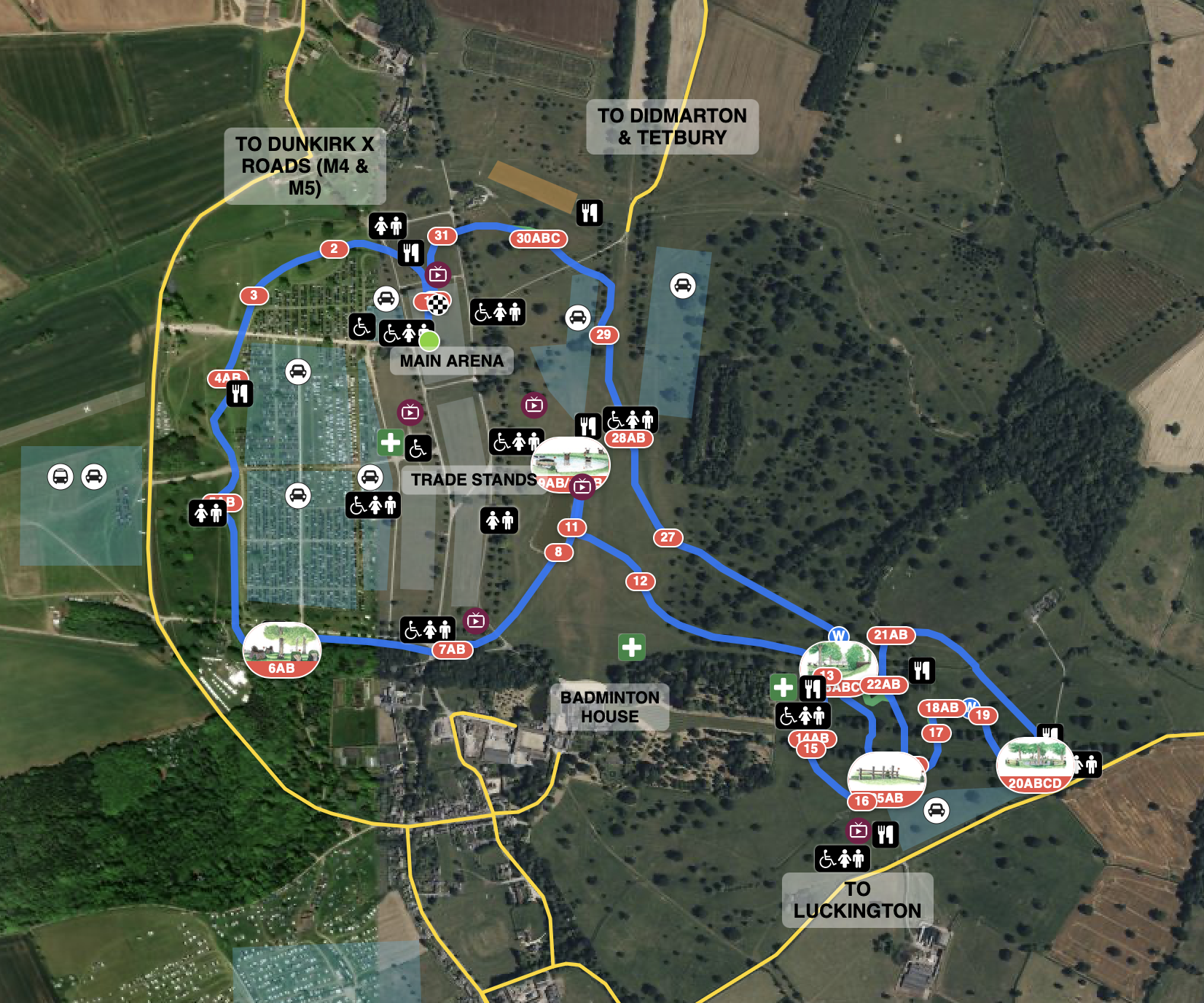
The 2026 Badminton course, via CrossCountryApp.
FENCES: 32
EFFORTS: 45
DISTANCE: TBC
OPTIMUM TIME: TBC
The first three fences are mainstays: the Spillers Starter in the main arena, the Haywain at fence two, and the brush fence on a little knoll at three all simply service to get horses moving and into the air, rather than asking any questions. That little knoll at three is a handy amuse-bouche of terrain, which reminds both horses and their riders that they can, and will, be shifted off their rhythm around the course, and must be prepared to adjust their balance.
The first combination appears at fence 4AB, the HorseQuest Quarry, which is “in over the wall and out over the wall, as they intended when they built the quarry,” says Eric. This is very straightforward, though with a variable stride number because of the dip in the going, and with a long route alternative for the B element that really oughtn’t to be used but will be helpful in the rare case of a tricky landing from the first fence.
While this is really just in situ to serve as a warm-up combination, Eric has made sure to give his riders their fair share of responsibility, as befits the level: rather than putting a bend into the approach to set the horses up, he’s laid a straight approach from fence 3 to fence 4A, so riders will have to adjust the balance themselves.
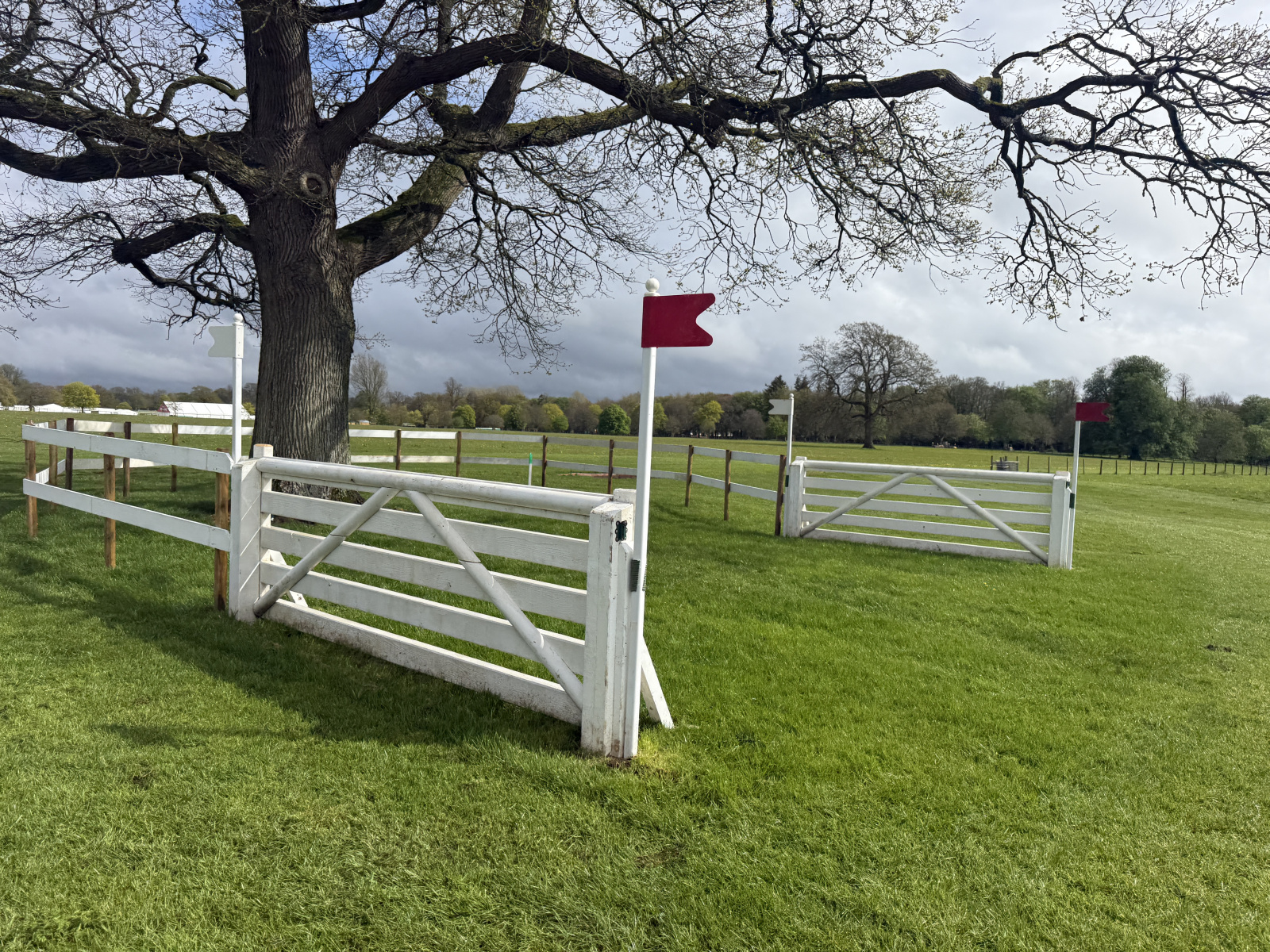
The Ebony Horse Club Gates at 5AB.
At fence 5AB, the Ebony Horse Club Gates, we’re back on flat ground but with the added pressure of making two clean, calculated efforts, because these upright fences are both MIM-clipped for safety. There’s one stride between them, but no funny business, and Eric doesn’t anticipate issues here; its primary purpose after the quarry, which serves to remind keen horses that there’s sometimes another fence coming up after the first, is to ensure that rideability and adjustment is firmly in place ahead of the tougher questions coming up.
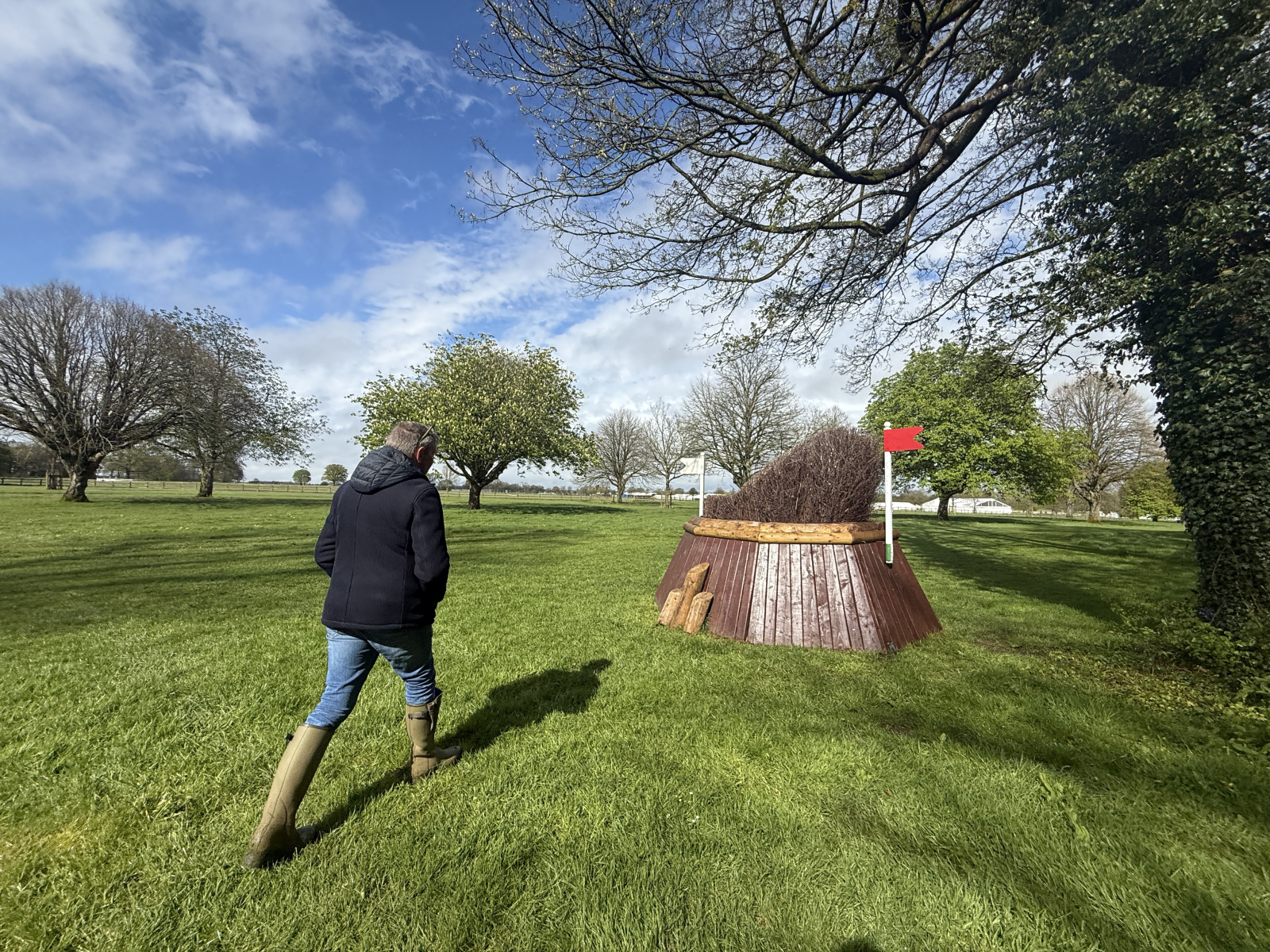
Eric Winter walks the line at Huntsman’s, which has been laid with sizeable brush boxes this year.
The most significant early question on course when we run in this direction is always the EquiDry Huntsman’s Close at fence 6AB. Gone are the open corners and timber oxers of recent years, and the twisting, tough routes under the dappled light of the trees. This year, instead, they’ll run into the close under a new ranch-style gateway – “my little nod to Yellowstone,” grins Eric – and then, on the far side of the close, they’ll meet two brush boxes. They can decide whether to go inside or around a tree; Eric reckons most will go around it, though the course will be wheeled on the more direct inside route, so those with an eye on the time will need to keep this in mind.
“This year, I really wanted to put just two jumping efforts in here, because I wanted to focus on time. Because I’ve split up so many combinations, we’ve ended up with a few more than normal. That means the course will just pull the competitors back a bit, a bit more regularly. I think it’ll put them down on the clock and I think it’ll put them under more pressure.”
This is the first time on course, Eric says, “where riders will need to be on it. The first two combinations really just sort of set you up to get you going.”
Here, he continues, “there’s a bit of ground that just shifts them a bit and lets them know that they’re not at Thoresby or Burnham Market or somewhere intrinsically flat-ish.”
Though at first glance this is a friendlier Huntsman’s, it mustn’t be underestimated: a good ride through will require pace, and the jumpable face of these fairly enormous brush boxes is actually quite small. There are a couple of open doors here, and riders will need to make sure they set their horses up to pick the right one.
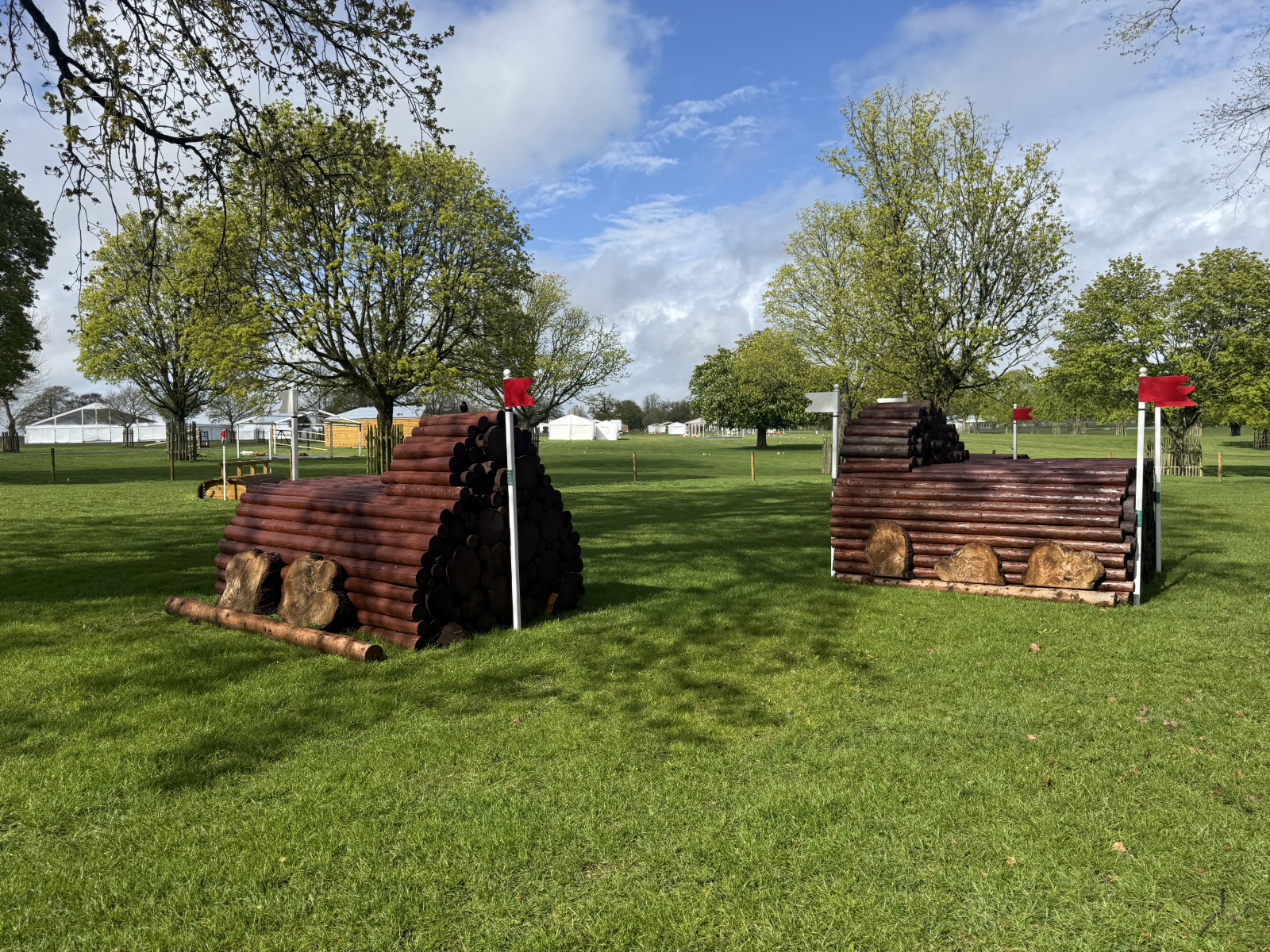
The ClipMyHorse cord piles at 7AB.
The largest fences on course come up at fence 7AB, the ClipMyHorse Cord Piles, which have a new home en route to the front of Badminton House.
“This is the only 2m jumpable width on course,” says Eric, who’s put them on a bit of a slope and camber this year, which is, he says, “quite fun.”
Once our competitors reach the lawn of the house, they’ll swing left to meet the Badminton Lake for the first time, popping a brand new fence as they do so. Fence 8, the Beaufort Owl Hole, was built from the remnants of a fallen tree on the estate, and now presents a beautiful – but plenty intimidating – picture in the water. Though we saw it when it was in its birthday suit, it’ll be fully brushed for the big day.

The Beaufort Owl Hole at 8.
Then, there’s a leg-stretch along the length of the lake before meeting the biggest crowds, and one of the biggest questions, of the day at fences 9AB and 10AB, the MARS Lake.
The first fence is a slightly offset brush-topped fish with a 2m drop, to a skinny arrowhead in the water on four strides – then, they’ll go on to two further skinny fences. One is on the top of the bank, quite close to the scrum of the crowd, and the second is in the water. The one on the bank, says Eric, will be the most important: if riders don’t set their line up early enough, and try to save a second or two with a tighter turn, they’ll encourage their horses to run out.
This complex, he continues, will be a time-sapper – and it’ll be a while before that time can be made back up.
“You have to accept the fact that you’ll come out of here probably 20 seconds down on the clock.”
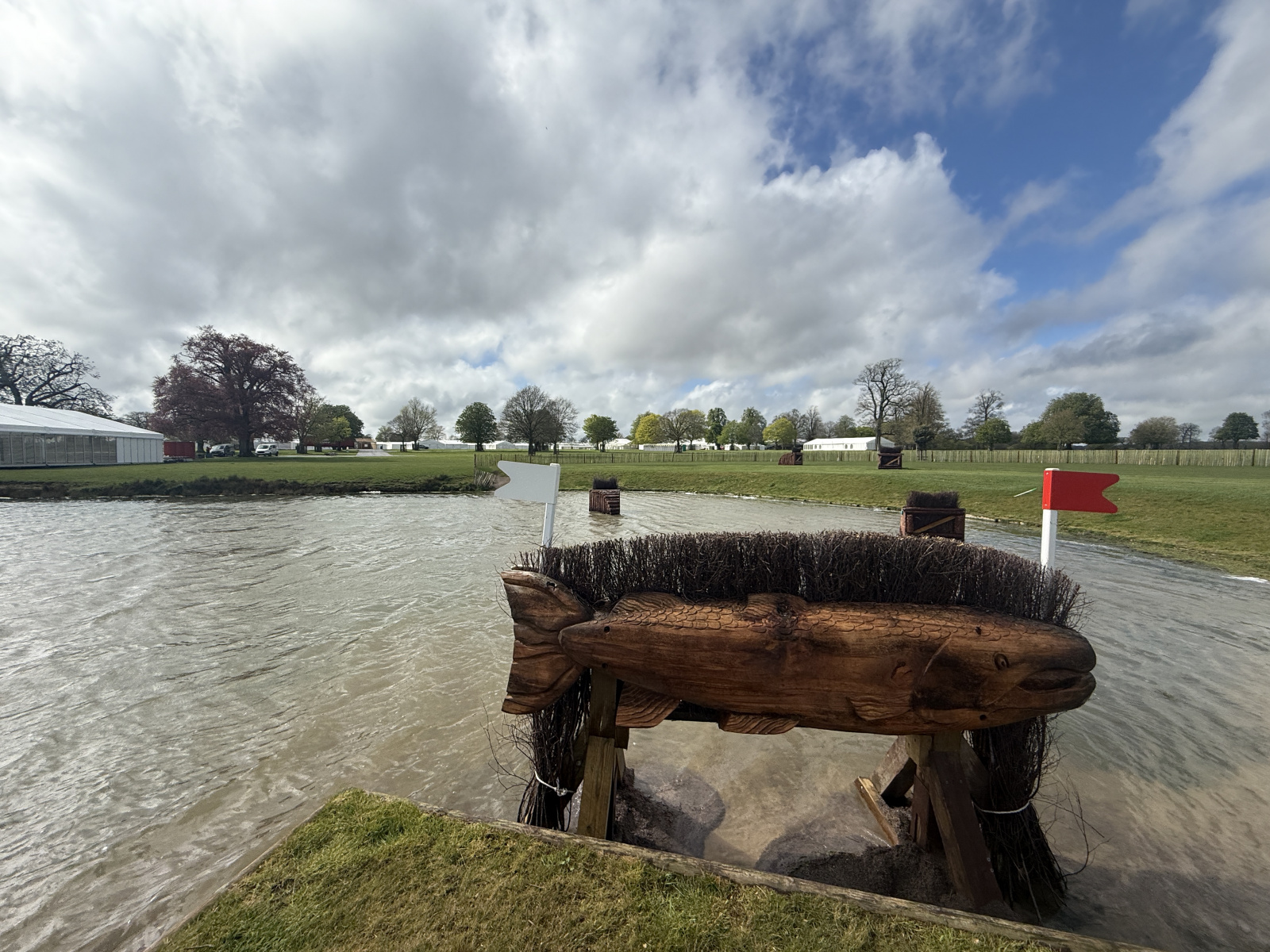
The MARS Lake at 9AB/10AB.
After the complexity of the Lake, there’s the familiar face of the water-topped table at fence 11, the World Horse Welfare Table, which was famously inspired by a water feature in a restaurant in Oxford, where Eric took wife Lizzel out for dinner while in the middle of designing the 2019 course.
But, he laments, “my tolerance of boredom is very small. I’d like to change it up, but I haven’t thought of anything that works better there.”
At fence 12, the Project Pony Puzzle, we encounter a wide, open oxer with white, slightly offset rails – a common motif around early-season courses this year.
Fence 13 sees the return of the British Eventing Broken Bridge, which was debuted in 2022 as a way to transition into the back half of the course. It’s a straightforward fence in its own right, but it has a knock-on effect on the combination that follows, because it’s a proper run-and-jump fence and horses will land galloping, so if the adjustment back to a controllable canter takes a bit of time, that’ll eat away at the clock.
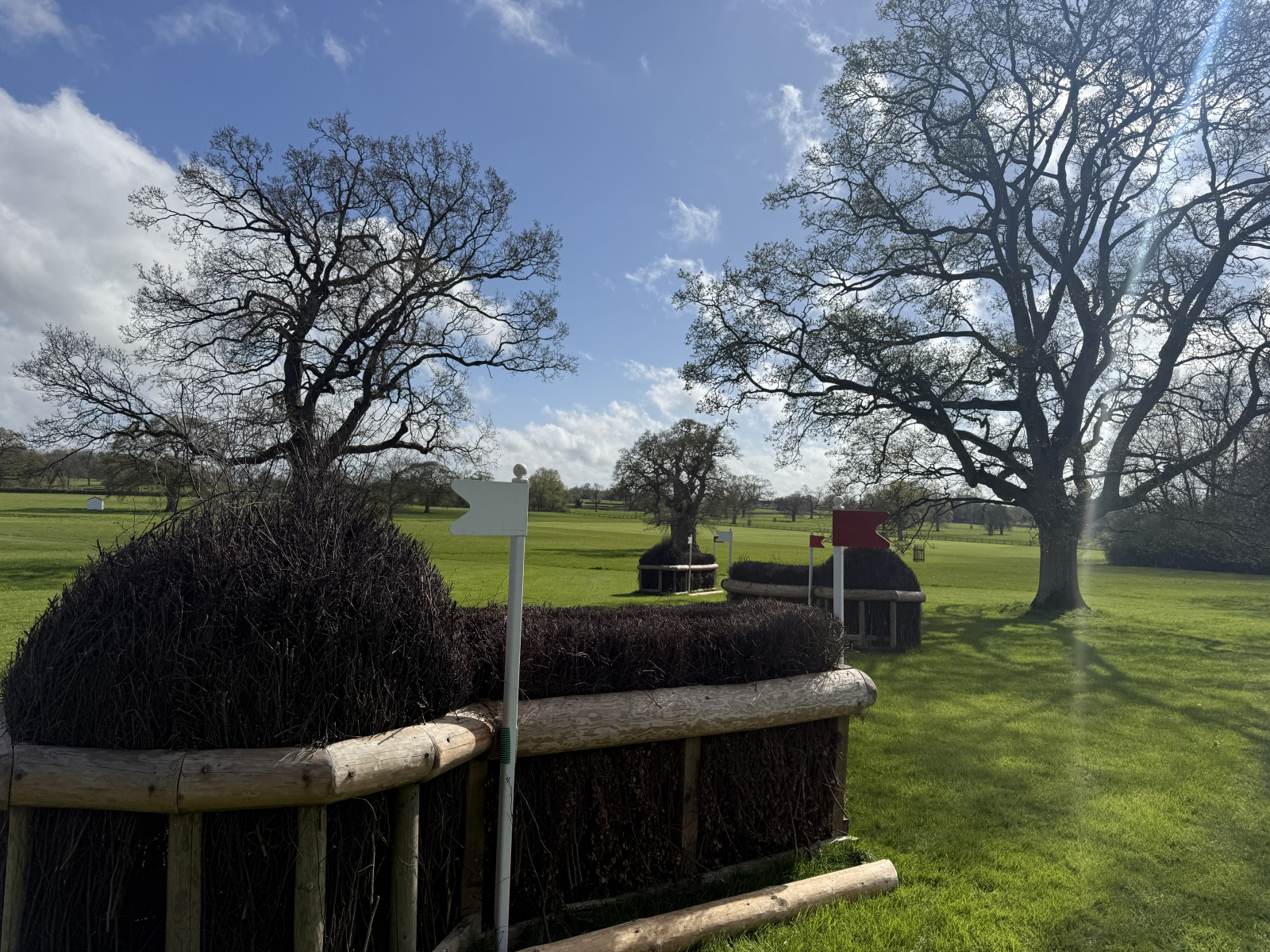
The KBIS Slalom at 14AB/15 is one of this year’s significant challenges.
Fences 14AB and 15 comprise the KBIS Slalom, which looks set to be an influential combination, even if the numbering technically allows for a circle before the final element.
The line on the approach here is interesting: the roping will be reasonably tight, and so riders won’t get eyes on their line until quite close to the fence, because there are low-hanging tree branches obscuring it on the approach.
“I think this is quite decent and will have a real influence on the time, because of how much you have to set up to jump it,” says Eric.
The angle you get to 14B is the most important of the three angled brushes.
“You can jump the second and then go around the tree to come back to the third, but the three together is quite tasty,” says Eric. “It would be easy to get to the 14B and jump it quite straight, but then you’re a bit stuffed [and you’ve opened the door for a right-handed run-out]. There’ll be a few that land here and think, ‘I’ve got no chance of getting to 15.”
Playing it safe here also robs you of the chance to set up for a very intense section of the course to come. A good ride here will engender confidence through the major accuracy questions that are coming up swiftly.
The first use of the Vicarage ditch line comes at fence 16, the Vicarage Oxer.
“We have iconic fences, and we have iconic areas, but to be able to pick up and drop fences so that people don’t know what they’re going to get when they get there, or how their horse is going to feel at eight minutes, is the greatest advantage of how we deal with the ground here,” says Eric. “At Burghley, they’re stuck on that track – you can’t really move the Cottesmore Leap. But Jane said to me, she’d looked at where we’d been over the last few years down here, and it really was everywhere through this valley. This, to me, is the one piece of ground where we can hit into those hills and start to use them a bit. It makes it much more like a cross-country course and also more spectator-friendly – you’ve got loads of places where you can sit and watch quite a few jumps.”
With this ditchline, he continues, he has the choice of being “technical – or just brave.” The Vicarage Vee, perhaps Badminton’s most famous fence, and present in this year’s course, is an example of the former, while the Vicarage Oxer, a yawning timber frame spanning the expanse of the ditch, is the latter, and will embolden horses and riders as they enter the hole-in-the-ground segment of this year’s track.
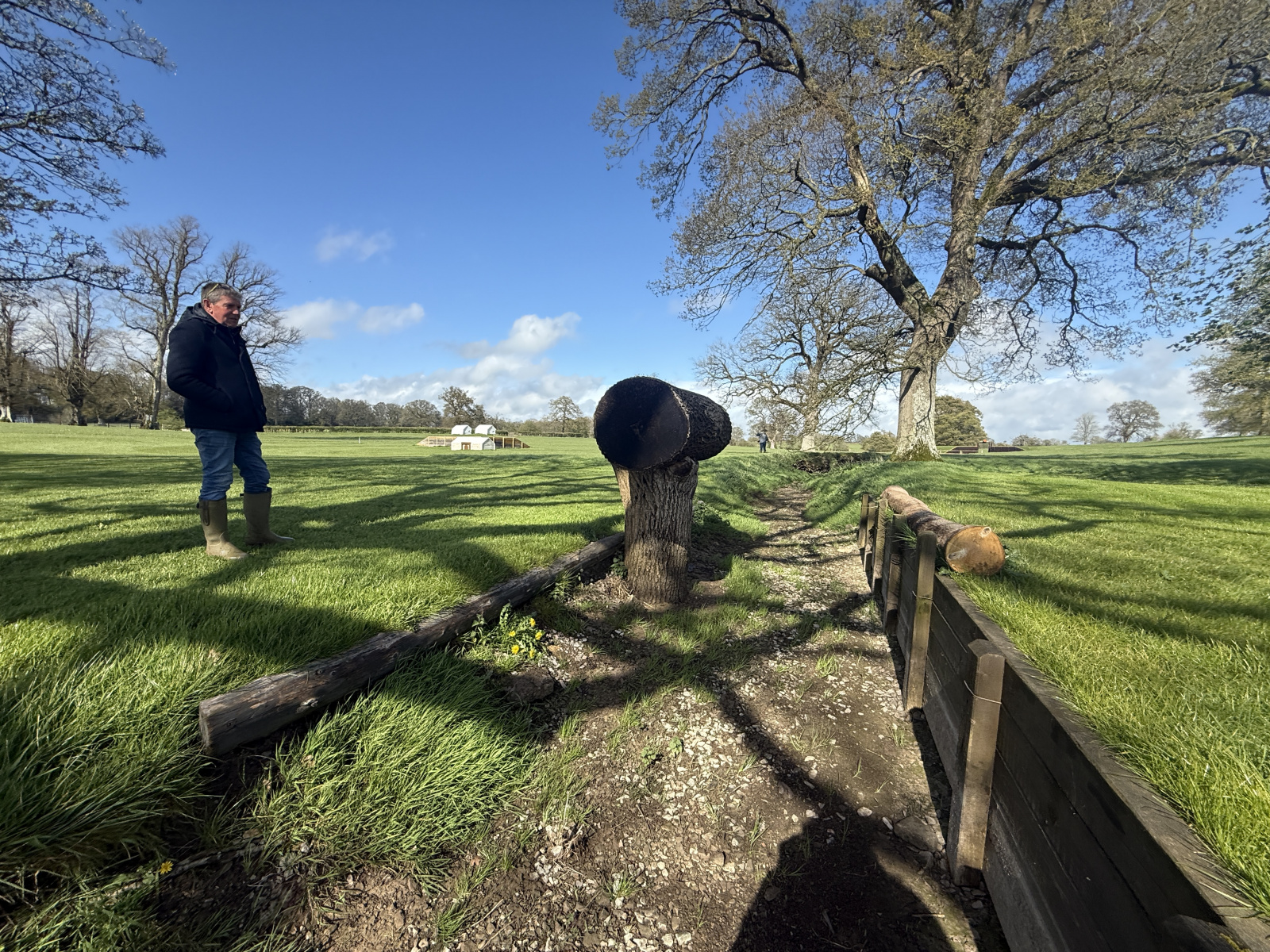
The funny little T-Bar at 17 shouldn’t be underestimated, but also shouldn’t cause issues for combinations who are equipped for the level.
Fence 17, the Joules T-Bar Log, also uses the ditch line, but this time with a much narrower fence. The ditch here looks twice as wide as the fence is high, but at this stage of the course, if riders can’t find the right line to get over this, it’s probably a sign that it would be best to come back another day, having done a bit more homework.
At fence 18, the LeMieux Village, it all gets a bit Hot Fuzz. There’s a church with a spire, two houses, a little garden – and by the time we see it again this week, there’s no telling how much time Eric will have put into the details.
“I did it years ago for an unaffiliated event, and we spent ages making this village with a butcher, a church, a bakery with lots of little carved loaves of bread,” laughs Eric. “It all cost a bomb and the event only ended up running for a year!”
This time, though, he has a chance to reproduce the idea – sans loaves of bread, for now at least – at the top level. The houses atop the mound are deformable, to encourage softer riding than Eric says he saw previously over this piece of terrain.
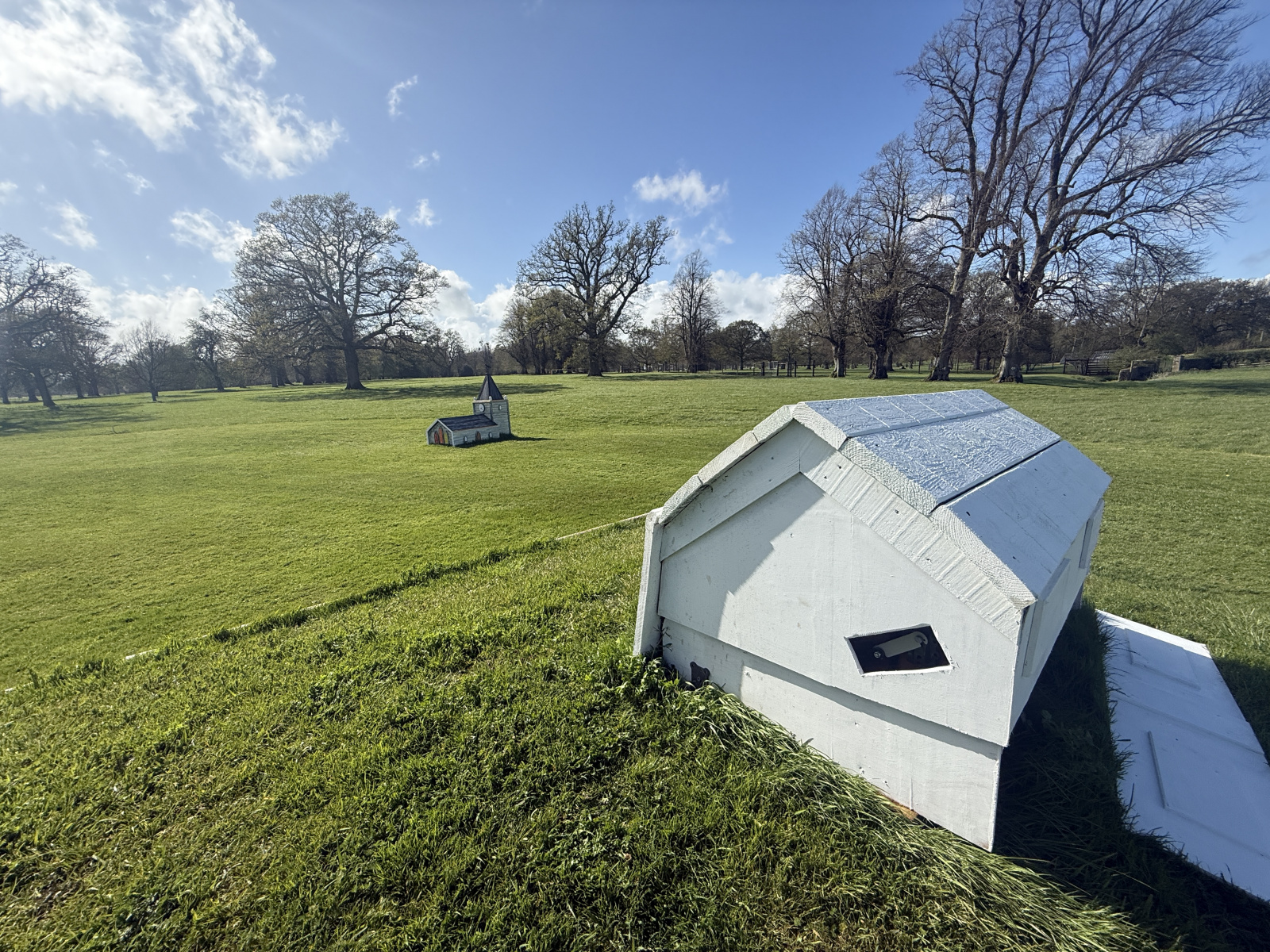
Undecorated and unfinished, but a look at the model village-style complex at 18, with its collapsible element.
Visually, it’s a bit of a fun departure from the rustic timber that Eric prefers for his Badminton courses – but, he says, there’s a line that he’s keen not to cross.
“I think this will look quite smart, but it’s really a balance between something like this and turning the course into a theme park. I had a stand-off about the eggboxes here, which a lot of people said they really liked. But the problem is, if you give a sponsor a custom fence, how do you then stop another from ringing up and saying ‘we want our fence to be washing line full of clothes,’ and before you know it, your whole course is a theme park. To me, Badminton is about these rustic bits of timber, and if we design what we want to design and then allow branding on the fences, that’s much better. It’s the reason I did away with the solar panels, too – I want to design the questions I want to ask, not the aesthetics.”
Fence 19, the Antech Trakehner, is “basically a stopping fence – it’s just a nice fence to restart them over.”
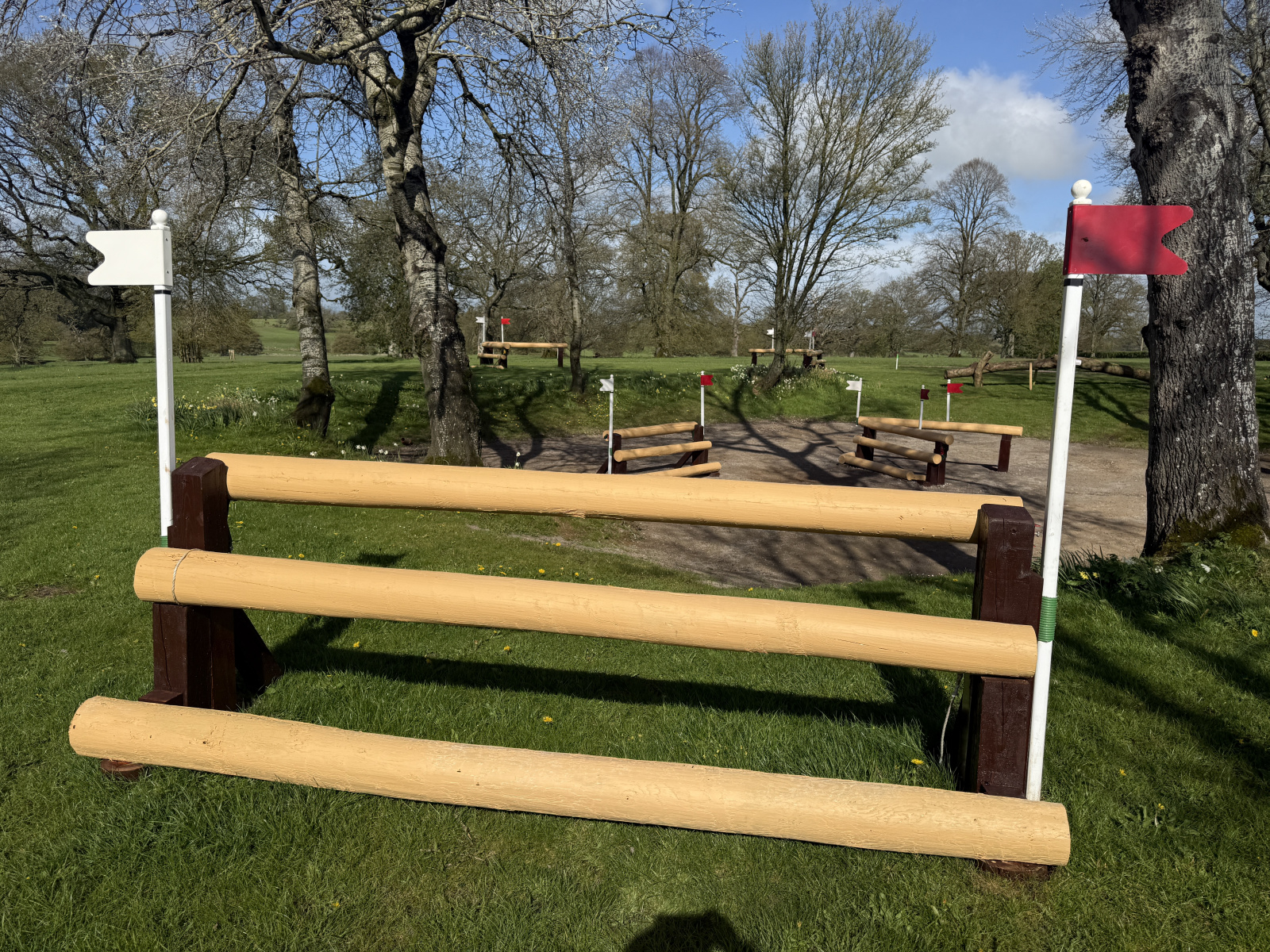
Sustainability Bay is at its busiest this year.
Up at fence 20ABCD, Spillers Sustainability Bay, there’s suddenly an awful lot to do.
Sometimes, Eric says, the germination of a course can come from a singular idea – even if that initial brainwave doesn’t make it into the final product. That’s certainly the case with this year’s course, which began with a new concept for Sustainability Bay that featured a turn to a corner in the water.
But, he says, “when we went to put it out I thought, ‘no – that’s not going to work.’ We got it in there and it looked absolutely vast. The water wasn’t big enough to allow three or four strides to find a line to it.”
Those bright ideas that don’t quite fit aren’t dispensed with entirely – instead, he files them away for use elsewhere, on another spot in the course or at another venue entirely, wherever the right piece of ground and design challenge might present itself.
When I suggest an alternative Badminton some year – an accumulator format, perhaps, in which Eric sets a course featuring all of his wildest whims, no matter how unjumpable, he wryly replies, “that’s what we did in my first year, no?”
“It’s interesting,” he continues, “walking with Andy [Heffernan, who is assistant designing here for the first time]. I can see me in my first year in him. Everything is bigger, stronger, wider – and I’m like ‘woah, woah!’ The easiest thing in designing five-stars is to go too big.”
Though the original corner concept didn’t work out, it hasn’t been totally abandoned. This year’s interpretation of the pond is the busiest it’s been in a very long time, if ever: six fences in total, with two route options; upright rail to left-handed corner to right-handed corner or rail to rail to corner. The times are fairly close on either route but each will suit a specific horse.
“It’s got the guts of what I wanted to do,” says Eric. “I wanted to make it a bit of an either/or rather than a fast route and a slow route, though the left-hand route is probably very slightly more direct. They just look for different skills: the rails will suit quite a neat jumper and the corners will suit a bold, precise one.”
After this, there’s roughly 50 seconds of galloping, which is a welcome chance to catch up on some time – but we’re also two-thirds of the way into the course now, and so riders can’t go hellbent for leather at the expense of their horse’s energy levels. They’ll need to ride this sympathetically so it refills the lungs and gives them a second wind.
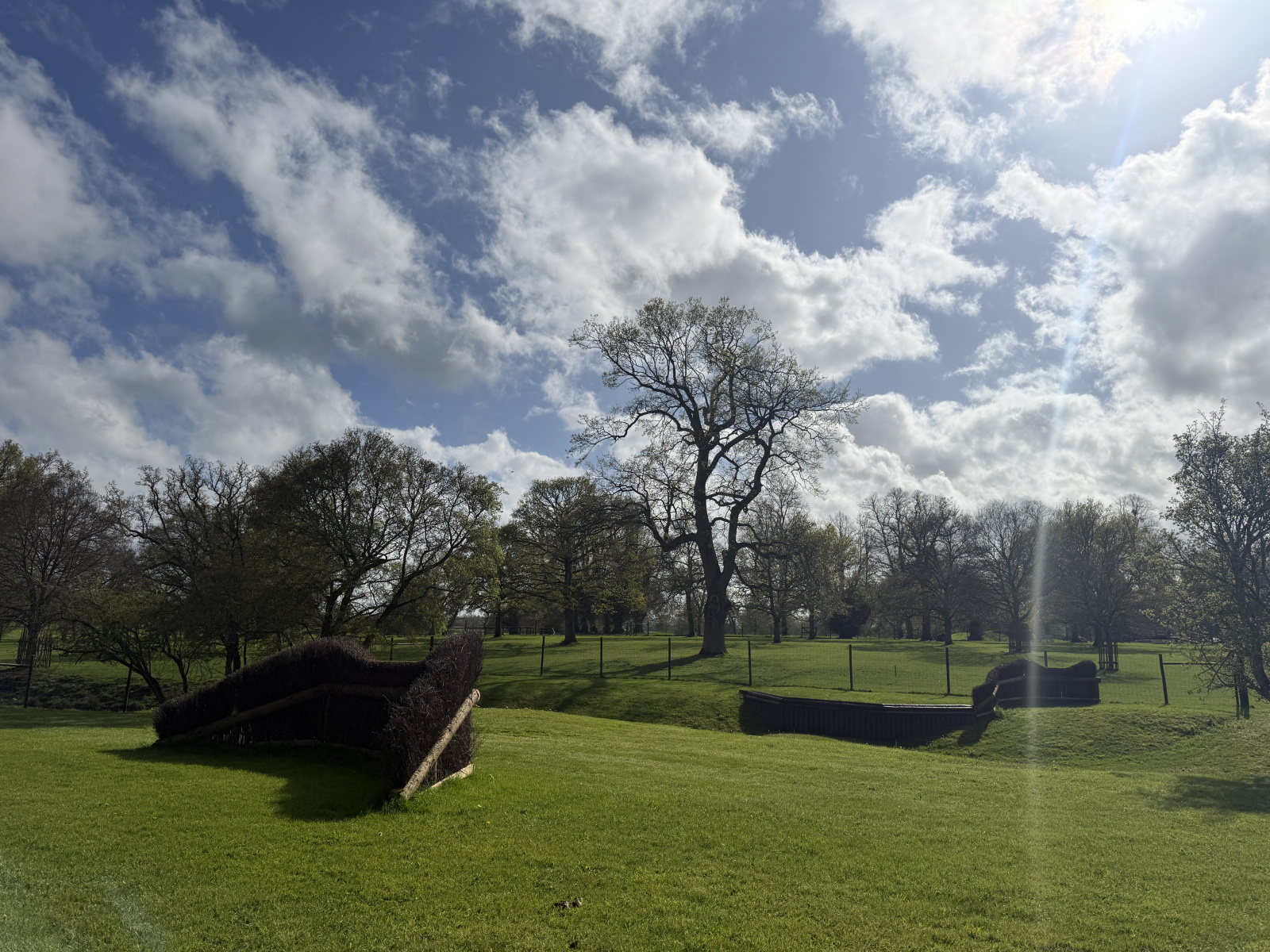
The INEOS Sunken Road at 21AB.
Then, they’ll come to the INEOS Sunken Road at fence 21AB. We’ve previously seen this complex built with rails, and it’s generally been an influential question; this year, it’s made up of brush fences instead, and perhaps a touch more visually inviting.
“I did think about making both of them true bullfinches, but then I thought, ‘it would be good to have a showjumping competition on Sunday, wouldn’t it?’,” laughs Eric.
Now, he says, the question should be more of a speed ramp than a true test of skills.
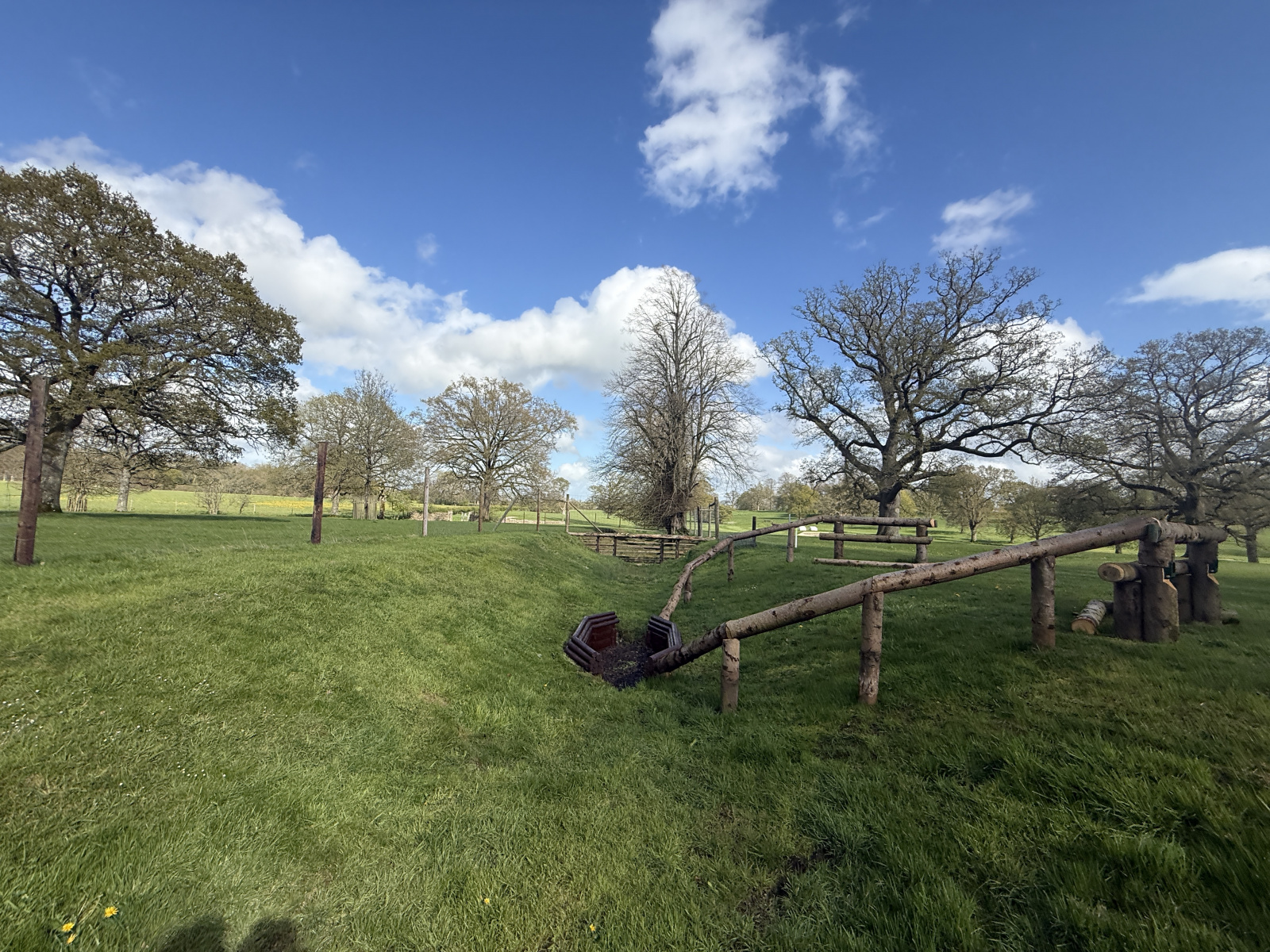
A side-on look at Mike Weaver’s Farm Yard at 22AB, with its unique terrain question.
At fence 22AB, Mike Weaver’s Farm Yard, there’s a small ditch in the hollow up to choice of left or right angled rail. The left route is very slightly quicker but features a sharper incline; the right has a slight camber that softens the approach. The rails themselves are quite little but the ground is tricksy here and there will be runouts, particularly as the ditch can be a touch unpredictable and horses can balloon or skip over it. There’s an alternative to the rails if someone has issues, as it’s nearly impossible to approach them in isolation.
This is a good spot to leave your dad for the afternoon, by the way, if that’s a concern you have.
“Mike Weaver’s the guy who owns the hay cart,” explains Eric, who’s decorating this complex with a playpen full of vintage farmyard equipment supplied by the neighbour of the estate. “I got chatting to him and said, ‘you know something, I could really do with a threshing machine for this little corral,’ and he said, ‘oh, I’ve got a threshing machine. But I haven’t got a tractor that goes with the threshing machine, because the threshing machine’s from 1949 and the tractor’s from 1962…’”
“But then he says, ‘actually, I’ve got a mate who’s got a 1962, and then he brought loads of stuff, hay trucks and machines and all sorts. So now we have this little area where we have a really fun and inexpensive way of dressing it up.”
Next, there’s a yawning corner over a ditch at fence 23/24, which is just one jumping effort if they pop that or, if they want to make it a little bit easier, they can jump the ditch at 23 and a different corner at 24, with a circle in between. Then they’ll skip on over to the Holland Cooper Vicarage Vee at fence 25AB – one of the sport’s most famous, and frightening, fences, with its tiny margin for error and its exacting angled trajectory.
“It’s incredible that something that was designed fifty years ago still asks all the questions you’d want to ask for the sport,” says Eric.
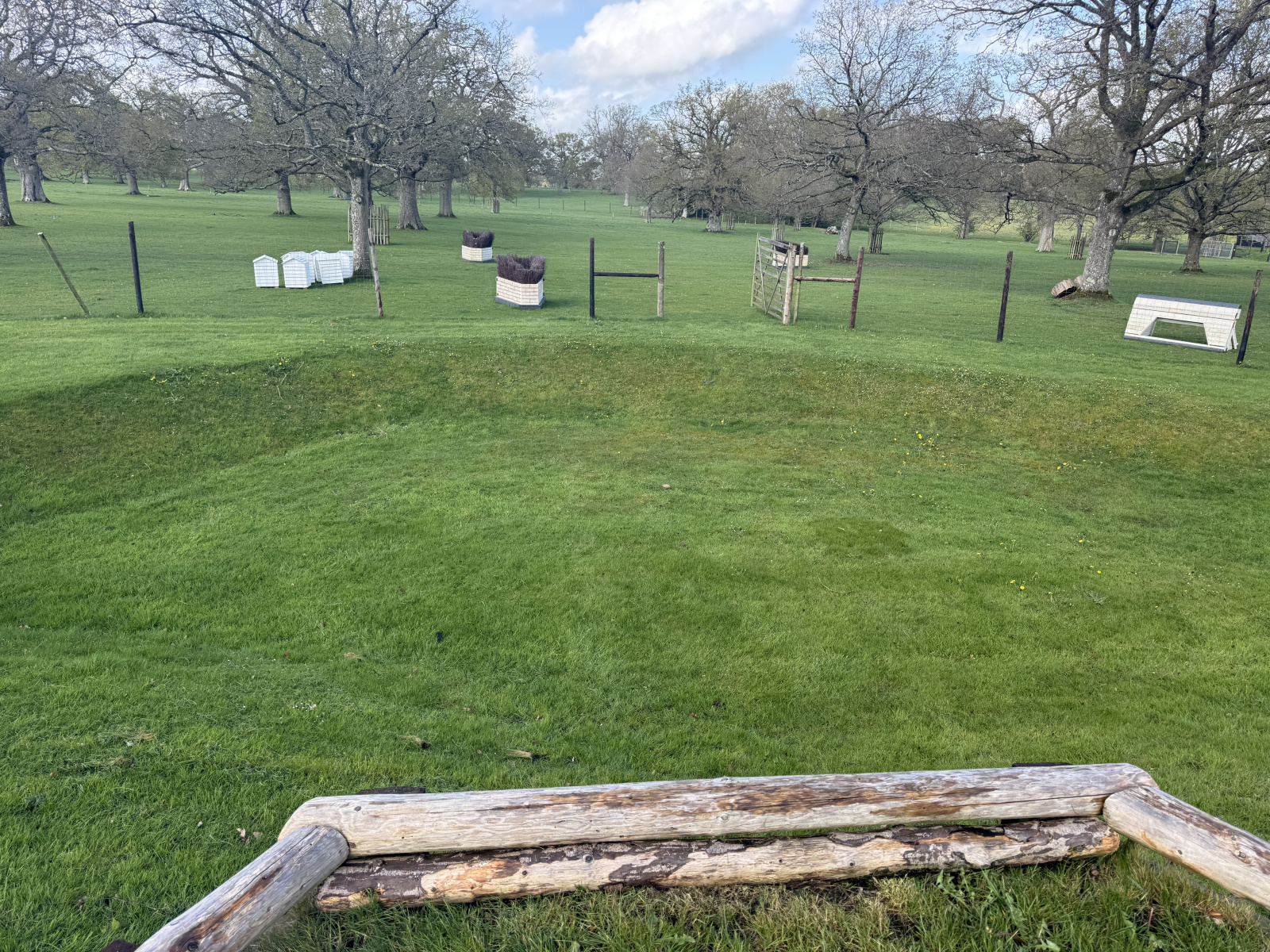
Spitting off the edge of the world: the Mayston Equestrian Hollow at 26ABC.
Last year, the Mayston Equestrian Hollow at fence 26ABC caused a number of problems as horses skimmed past the skinny fences on the lip of the quarry, and this year, Eric has moved them back a bit.
“This is probably slightly more simple than in previous years, but I think it did tend to come up big through here,” he says. “This time, I’ve given them a bit more time and made it straighter. It’s a funny distance across here, and if you’re on the lip, it’s a very open five or a very short six. Last year, a lot of them landed [here] and ended up on nothing.”
Now, it’s six strides from the drop to the first brush-topped skinny, and three more to the second of the skinnies.
Then, there’s another long gallop before meeting the Spillers Stables single fence at fence 27, which will get them back up in the air.
Back in the main field, competitors will navigate the colossal, half-owlhole-style corners at fence 28AB, the Rathbones Curve, which are set on an open six strides this time. This, Eric thinks, will be easier than last year, when they featured early on in the course and had a trickier line, causing plenty of problems.
“It’s slightly more open this time. Last year I made them hug the string and turn off it to find the line, and this time it’s much more offered up to them.”
Fence 29, the Countryside Parallel, is a silver birch oxer that offers a tantalising glimpse of the red and white roof of the grandstands – that enduring symbol of the finish at Badminton.
Next, there’s the final combination of the day: fence 30ABC is the Savills Keepers Rails. They can jump this as two fences – a double of timber oxers – or three, a timber oxer to two slightly less imposing uprights. They’re all MIM-clipped, so require careful jumping, and it’s unlikely we’ll see many riders give their horses an extra jumping effort at this late stage.
Then, it’s fence 31, the Keepers Lodge, a stalwart of a brush-topped rolltop, before they head back into the main arena to pop fence 32, the MARS M, everyone’s favourite fence unless you make a silly mistake: you win or you become good television, laughs Eric, who confesses to secretly loving the drama of reality TV.
So what’s the verdict?
Well, as Eric tells us, sometimes the final product ends up surprising you – and in the case of this year’s course, it’s ended up being a much bigger, bolder track than he necessarily envisaged when he set out to design it.
“Last year, when I was walking around on the Monday, I thought the course had come up a big lighter than I’d thought, but actually it still finished up around a 50% clear rate,” he says. “This year feels like it’s come up slightly bigger than I’d thought it would.”
Big fences, beautiful going, and a chance for a bit of history to be made, if Ros Canter and Lordships Graffalo have anything to say about it – it’s a competition that has all the ingredients for a vintage-feeling Badminton. There’s an awful lot to be done en route to winning it, and the vibe at Badminton HQ is wholly positive, despite some baseless concerns winging their way around social media about the slightly smaller field of entries this year.
“I knew we wouldn’t have the strongest field, because it’s a World Championships year. The year after an Olympics is always a very strong field, because you get the 15 and 16 year olds who did the Olympics and Badminton is a bucket list item their riders want to tick off with a horse who’s probably not going to go to the next Olympics,” explains Eric. “A lot of good horses come out of the woodwork, proper World Championships and Olympic horses. This year, a lot of people will be saving their horses. The UK is slightly different in that a lot of people have reserve horses, but the Europeans will mostly save their best horses for the Worlds.”
“One of my ambitions when I took over here,” he continues, “was to get rid of the waitlist. I wanted it to be the pinnacle and to stay there, whereas with the waitlist, it was a bit up and down. You’d get people bringing nine-year-olds that hadn’t done a 5*, but had gone well at Blenheim. I wanted to get to the point where people wanted to bring a horse here and so they really made a plan and worked towards it, rather than coming just because they’d qualified.”
The waitlist, he tells us with a laugh, hasn’t always been quite the narrative device it has become in recent years.
“When Hugh [Thomas] was still designing and I was TD, we had one year with a massive waitlist. Jane kept ringing people up to offer them a spot – ‘so and so has pulled out, and you’re next on the waitlist’ – and everyone kept saying, ‘oh, I actually only really entered as a joke, I’m not coming!’ Six times, this happened, and it wasn’t until the seventh rider she called that she found someone who actually wanted to come! That was back when we didn’t charge entry fees. We started charging them after that!”
“Vin Jones [breeder of Treworra, entered this year with Katie Magee, incidentally] was the best one. Three times he came here, did his dressage test, didn’t run cross-country, and just hung out and went to the parties for the rest of the event. He kept it thoroughly safe!”
A winning strategy if ever we’ve heard one. For everyone else, there’s wheeling to be done and a lot of lines out there to walk and rewalk. Bring it on.
MARS Badminton CCI5*: [Website] [Tickets] [Live Stream] [Entries] [Schedule] [CrossCountry App XC Maps] [EN’s Coverage]