–
The second half of the session at the well-attended and well-received MSEDA General Meeting was a general Question and Answer Session with guest speaker Boyd Martin and it was no holds barred. Boyd didn’t blanch at anything and replied to each question frankly and thoughtfully. Apart from a few of the longer, and very amusing stories that don’t translate well onto the page I haven’t left a lot out because I found most of it fascinating. I’m actually glad I got to sift through all my notes and type it all up as I got to appreciate it all over again and digest it a bit more slowly and I hope you’ll do the same. Bon Appetit…!
–
When Neville was a little bit off in England and you thought originally it was his foot or his ankle, who finally diagnosed it, how long did it take, and how are you treating it now?
“Neville’s lameness in England was about half a degree, minute, it was something that most of us couldn’t see in a trot up; if you were a real expert perhaps you could see it. Initially he’d had sore heels and Phillip had looked at him and helped him. There were twelve horses in England at the camp, and just to let you know, in the team situation that we were in, once your horse isn’t perfect you’re out. It’s not a very comfortable place, you’re in a situation where you haven’t yet been selected for the team, you’ve got your friends there but you’re hoping that you’re going to get ahead of them, so once your horse was not 100% you’re out of the way basically. They pull you in and they say thank you very much but we’re not worrying about this horse any more, and then to get access to the team vets while they’re trying to work on everyone else’s horses is very difficult. Once we got home, we took him to the New Bolton clinic and did a bone scan on the horse, and he had a part of arthritis in his neck. Whenever you think a horse is lame you’re blocking it’s foot, ankle, tendon, suspensory, pulling your hair out…..! Anyway, they gave him some medication called Depomedrol but it’s a steroid which will eventually wear off. I also have a chiropractor for him and a horse massage specialist that does stretching in that part of the neck – there’s nothing that horse doesn’t get; yesterday he got an acupuncturist, today a massage, it’s costing me a bloody fortune!”

–
Can you comment on the High Performance Spring Training Lists, and the fact that Otis and Neville aren’t on those lists?
“I couldn’t care less! Funnily enough in the beginning of 2012 I had a horse called Remington who wasn’t on the A List, B List, C List or any list and I laughed to myself because he was in the truck at Greenwich Park on the Wednesday, the day of the trot up, as the reserve horse for America. I can understand why they left Otis off the list because he’s coming back off his injury now and he’s probably not going to make Rolex this year, although we may do Luhmuhlen or Pau. Neville – it doesn’t bother me but you wonder why; they ask you not to run the horse so I saved him for most of last year, and then he was sore in England right before the Olympics and they scratched him off the list! For a young rider who’s seeking recognition I think it might be more upsetting not to be included but I’m not really that bothered. At the end of the day it should be about results, that’s the key with making a team. I don’t care who the the coach or the selectors are, it’s the performance that gets you on a team and if you turn in an outstanding performance and your horse is sound you’re going to make the team. Put in performance and results that they can’t say no to.”
–
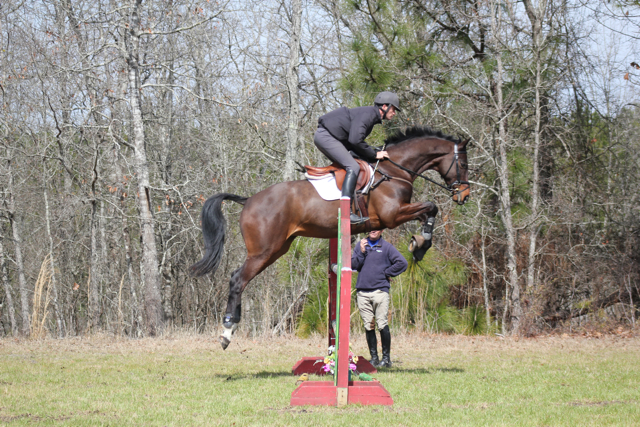
What are kind of bit did you use cross country on Otis in London; in the picture it looked like you had neck strap or did you have two reins?
“This horse Otis is a very good jumper but he jumps very big behind, very hard behind and he almost lands on his head a little bit. He’s quite a strong horse and that bit is a cherry roller gag. I don’t really like big bits but the problem I’ve got is if you just have the gag part it’s good to slow them up but you lose your turning ability. I hate riding with two reins but it’s the only way I could figure it out. The second rein is on the snaffle for turning, and when he starts to get a little bit strong and rude, you can pull the bottom rein, but to be quite honest you’re just pulling back on both reins! It’s basically a bridle I’d be using as a last resort, you’d try every other piece of equipment you have before you try that.”
–
What are you looking for for yourself in an upper level horse?
“I’ll probably buy a lot more young horses, a lot more three-, and four-, and five-year-olds, and then if the time is right and the situation is right, like with Otis, I’d try and jump in and grab a two star horse. Buying a made-up horse at that level doesn’t work that often. Usually if a horse is a two star horse at that level for sale it’s no good, or it’s unsound. How many of you in here, if you had an unbelievable two star horse, it wouldn’t matter how much people offered you it wouldn’t be for sale? The number one thing stopping a horse from being a four star horse is the ability to gallop flat out for eleven or twelve minutes. I would be very, very nervous about buying a horse with less than 70% thoroughbred; there are exceptions to the rule where you see horses that are half and half or even more, like Remington was pretty much all warmblood but he came up a little bit short in the speed and endurance side of things. That would be my number one thing – if you buy something with too much warmblood you don’t realize that the horse might not be good enough until six years later, and that is a painful thing to go through because you’ve put in thousands of hours of training and you’ve dragged him all over the countryside and you’ve produced him, and you’re at a CCI*** and someone taps you on the shoulder to say he can’t make it, it’s too far. Obviously your horse has got to have a natural jump, and the dressage is important. What’s most important about the dressage is that he does have a little bit of quality but that he’s trainable – trainability is more important than ability. We often get dragged towards the really flashy, fancy horse that’s a bit nuts but you’re much better off going after a quieter more trainable horse, and that’s something that’s hard to evaluate when you’re trying them. The biggest thing, I think, when you’re trying out a horse is it’s got to be love at first sight. If you’re riding it around and trying to convince yourself that it’s the right one then it’s not the right one. Every horse that’s worked out well for me I knew it within two minutes, and every horse that didn’t work out was one of those ones that other people were convincing me it was a good horse.”
–
When you’re looking for an upper level prospect what height limitations do you put on a horse?
“There’s exceptions to every rule. One of the greatest horses of all time was Charisma who was 15.2. I rode one horse around a 4* called Extreme who was 15.1 and he could jump like a kangaroo, that’s why he was called Skippy. Then you’ll get horses at the other end of the spectrum; if you look at the silver medalist from Hong Kong I think McKinlaigh was about 18hh. Look at Theodore O’Connor who was literally a pony, so if Ioved everything about a horse but it was a bit small or a bit tall and every other box was ticked I would probably go with it. Ideally, if you go through the laws of probability and went through all the Olympic Games and worked out statistics then you’d probably want a horse between 16hh and 17hh, probably 70% TB, probably a gelding, probably black…! At the end of the day though you’ve got to go with your gut; if you think it’s the right horse and it looks a bit funny – still buy it because they’re the ones that work out. If you go too much to just what everyone else is doing it’s hard to do something exceptional because you’re always thinking inside the box, and then you’re just pretty much the same as everyone else.”
–

When you’re talking about the horse being 70% Thoroughbred, do you look at the pedigree, and are you looking for horses that are more sport horse oriented thoroughbreds?
“I always think you’re better off looking at the horse. If the horse looks like an athlete and can gallop I think that’s more important than the percentages on the bit of paper, and you’ll see that as well with racehorse people when they buy yearlings; the really good guys that get the successful horses, the talented people that can look at the way a horse moves and how it’s put together, it’s length of neck and shoulder, etc etc, versus the ones who just look at a piece of paper and tell you who it’s by, the latter ones are those who tend to come up a bit short. You’re better off evaluating the horse as it is, looking at the horse and seeing if it fulfills your requirements, if it moves and jumps well, if it has a good nature, and then look at its breeding. If it’s by a stallion that breeds a heap of crazy, mad horses then the chances are it’s going to have that element, or it breeds uncareful jumpers you’ve got to try not get too emotional and take that into account. Sometimes I’d buy a horse with less than 70% thoroughbred if it looked like an athlete, and I’ve made the mistake of buying horses with more than 70% thoroughbred that aren’t athletes. I’ve probably bought 150 horses in my life and seventy of them have been disasters! That’s life – you’ve just got to take a deep breath, don’t even go through your cheque book and work out how much you’ve spent on shoes, entry fees and vet bills, and get out of them. As soon as you’re not in love with it, sell it and don’t even worry about getting your money back, don’t even worry about breaking even, just be done with it; move it on and try again.”
– (more…)