



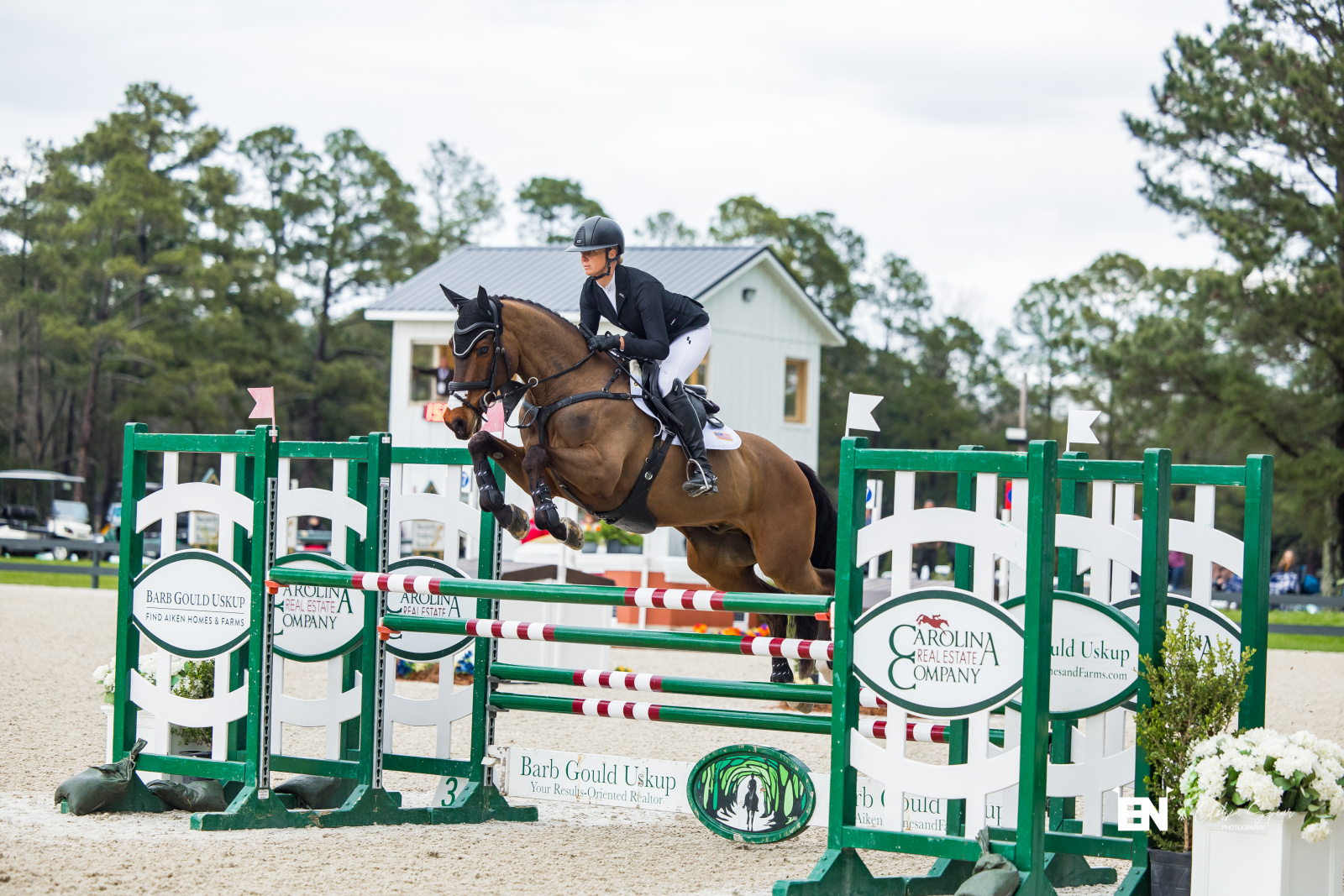
Caroline Pamukcu and HSH Connor. Photo by Chelsea Spear Photography.
The first day of the $100,000 LiftMaster Grand-Prix Eventing Showcase at Bruce’s Field, presented by Taylor, Harris Insurance Services, always feels something like a sprint and an ultra-marathon all in one. Sure, there are plenty of events that run two phases (or even three!) on one day, but when you add in the pomp and circumstance of this event — the buzzy spectator crowds and a pack-tight schedule of both competition and accompanying events — you’ve got a uniquely charged atmosphere on your hands.
Our competitors certainly gave us plenty to enjoy today as they completed both dressage and show jumping before we wrap things up in a whirlwind of cross country on Saturday. Heading into the finale, it’ll be Caroline Pamukcu, making her first visit to the Showcase with three rides this weekend, in the driver’s seat to take home the win. HSH Connor, who is owned by Luann McElduff and Sherrie Martin, is the best of the three, holding onto his dressage lead and score of 28.3 after two phases. Elisa Wallace — another rider making her Showcase debut — also enjoyed a stellar day with Rosemarie Spillane and Donna Biggs’ Lissavorra Quality, sitting second on their dressage score of 29.7. Phillip Dutton rounds out the top three with Annie Jones, Neill Sites, Ann Lapides and Caroline Moran’s Denim, adding 1.2 time penalties but nevertheless keeping their position with a score of 30.3.

Caroline Pamukcu and HSH Connor. Photo by Chelsea Spear Photography.
The day didn’t start without its drama: more than one rider made an error while riding FEI CCI4*-S Test C, including poor Ryan Wood, who had learned the wrong test by mistake and needed some assistance from the judges (Christian Steiner from Austria at C and Sara Miller Leary from the U.S. at E) to right his path. Props to him though, he was able to navigate his own and Linda Ledray’s Check Point to a complete test so that their weekend could continue.
The dressage scores themselves also saw their fair share of highs and lows, though no one touched last year’s winning test from eventual winners Will Coleman and Chin Tonic HS (19.7). Riders like Emily Hamel and Corvett (placed fifth after show jumping) posted a personal best score (32.9 in this case), while others like anticipated frontrunners Monica Spencer and Artist scored an uncharacteristic 35.1 despite some lovely work within the test — a missed change was the primary undoing here. Certainly not a cause for concern; there are plenty of those impressive 20s-and-below we’ve become accustomed to from this pair in the future, and as we know here at the Showcase it’s certainly a competition where the leaderboard can change at any time.
And while the top four mostly did a bit of a shuffle beyond Caroline and HSH Connor in first, indeed the shake-up did come over Michel Vaillancourt’s show jumping track Friday afternoon.
Here’s an interview with Caroline after her clear round with Connor:

Sydney Elliott and QC Diamantaire. Photo by Chelsea Spear Photography.
While I’ll be spending much more time on the horses and riders themselves in tomorrow’s wrap-up, I thought it would be interesting to take just a bit of a different angle for tonight’s (exceptionally late, like I think this might be a record. For context, EN serves as the press and media team on site here for the Showcase, which means our work for the event generally comes first. We’re operating with a four-woman team this weekend, but I’m the sole person writing, so I appreciate your patience while I attempt to form words at 11 p.m.! I am not confident they are coherent!) report.
I sat down with Michel himself for a debrief on the course, and I always find his insights to be useful. And with the challenge that is Showcase show jumping (going back to 2021, the course carries an average 32% double clear rate and typically elicits a fair number of dropped rails), it’s always interesting to dive into the brain behind the operation.
To be clear: the riders here know what they’re in for. This may not be an “official” event in that it’s not a traditional USEF/USEA event and it’s not an FEI event. But there’s still more prize money than another non-CCI5* event on the line, and the competition is set at 4* standards for the most part (the cross country is set at the Advanced level).
‘You Have to Think’

Elisa Wallace and Lissavorra Quality. Photo by Chelsea Spear Photography.
“I love the course,” Peter Wylde, perhaps the busiest man on the ground today running back and forth from warm-up to ring with his plethora of students, said. An Olympic team gold medalist in his own right, he’d certainly be one whose opinion carries weight. “It’s challenging, it’s big. I think the time allowed is just right. You have to think about it, but [the time] didn’t need to be any tighter, because there’s not that many clear rounds.”
“I think you have to be efficient to make the time,” Peter continued. “You have to think. I could be wrong about the height, but it seems as high as I’ve seen it here. It’s hard to say that it was a hole lower [last year], but still, it seems substantial. But this is as close we’re going to get to practice to go before going to Kentucky and we need to jump a big track to set the sights and raise the horse’s sights. So I like the course, plus, this ring is a perfect size. The footing is perfect. Michel Vaillancourt is a beautiful course designer. It’s subtle, but it’s not mean. There’s nothing ugly about it. It’s just good.”
Michel may come from a pure show jumping background himself — he won an individual silver medal at the 1976 Olympics in his home country of Canada — but he loves designing courses for the eventers. For him, the investment is somewhat personal — he, like Peter, has become a fan of the sport, has dedicated time to learning the nuance of it and watching the evolution of the sport from its former days to its modern era.
“I have the most admiration for those guys and girls, because the three disciplines are so different from one to another. They manage to keep it together for all three disciplines and it’s quite remarkable. I really admire what these guys do. That’s why I like designing show jumping for them, because I appreciate the effort that they put into their sport.”
And that’s also why he knows he can’t go too soft on them. There was a time, he recalls, when the eventers nearly seemed to think of the jumping, as its traditional position in three-day event, last. One pole, two, sometimes even three may not have had the impact that they would today, both with the changes in how the sport is scored as well as, importantly, the quality of both horses and the training and riding of them through the decades.

Phillip Dutton and Denim. Photo by Chelsea Spear Photography.
“If you look at it, the old event horse used to jump really flat with a very weak back end, because they didn’t care — they could brush the jump,” Michel said. “As long as they slither over the jump, they were fine. So they’d look at the Thoroughbreds that were fast and that were handy a little bit, but their technique may have been mediocre, and then the stadium was a big problem for them. But you look at the type of horses that you see in this day and age…I mean, even Kentucky is the same thing. You look at these riders go around and, hell, if they were showing at a normal hunter jumper show, you would not realize that this is is actually an eventer. So it becomes a real three-discipline competition. It’s not just about the cross country anymore.”
Six clear rounds — about par with the last year or two — were counted today, and one additional clear with time from Phillip Dutton and Denim. There are always varying factors to the challenge of this course: it’s early season (many of these horses haven’t had many “real” runs yet), the spectators are packed to the rail on every side, and the atmosphere is electric. It’s a lot for many a horse, and that’s not an insubstantial amount of influence.
“No, I wasn’t surprised,” Phillip said when asked about the number of rails flying this afternoon. “It walked pretty big, actually, so I think that the numbers come out about right. I thought it was a lot bigger than it was last year. There was a couple of lines there that your horse had to really be on the line to get it right. But the faults were spread evenly throughout the out the course, so I think it was fair.”
What Makes a Course ‘Good’?

Emily Hamel and Corvett. Photo by Chelsea Spear Photography.
The other key ingredient to Michel’s course is the delicacy of some of the rails he uses on some jumps. Show jumping rails come in multiple weights (as do jump cups, in terms of shape) and materials, and Michel intentionally uses lighter rails on some of his fences to add an additional degree of technicality.
“I need to challenge these guys a little, even if it’s the beginning of the year,” Michel explained. “But [that beginning of the year idea] to me is more about the cross country, not the show jumping. From my standpoint, I built a course that was not a real scope test, but more of a rider’s course and a little bit delicate. If I were designing a Grand Prix, I might have put two oxers in the triple combination, but I opted for a vertical-vertical-oxer and I kept it a bit technical. It was very delicate, so that’s why we had maybe a few extra rails than I really wanted to see there. It was going downhill towards the in-gate, and I knew that the challenge was that.”
For Michel, the result of his course — what makes it a success in his book — isn’t necessarily, or only, the number of clear rounds or poles on the ground. It’s about the mental effect on both horse and rider. Was there education? Did the horse come out better, or more educated, than they went in? Were there few “ugly” jumps or distances? Those, he says, are almost more impactful in his assessments.
“For the most part, I would think that most riders came out of the ring thinking ‘my horse learned something today. I learned something today.'” he said. “It was a very positive experience, because there nobody swam through jumps, nothing scary, everybody kind of started and finished on a good note. I’m not afraid to to go strong, you know. I felt that the course was demanding, challenging, but not unfair. And that’s pretty much what the results showed. I’m happy with the whole thing, and I hope that the riders were happy as well.”
We’ll have much more for you (maybe, ideally, at a more reasonable hour) tomorrow as we wrap things up with cross country, which kicks off at 12:30 p.m. in reverse order of standing. Nine pairs have withdrawn (seven of which were withdrawn after show jumping, mostly pre-planned), leaving us with a field of 19 to see on Jay Hambly’s debut track. You can view the full course on CrossCountry App here, and we’ll drop the video preview below. More links, including to the ClipMyHorse.TV live stream, can be found at the bottom of this post.
I’d like to end this recap with a note of love to Allison Springer and the family and friends of Nancy Winter, who passed away suddenly on Thursday night. Allison left the competition today, withdrawing Vandyke, and the event held a moment of silence in Nancy’s honor during what would have been Allison’s ride time. Nancy Winter was an icon of the sport, supporting riders like Allison and the greater community through her dedication, production of quality horses (Connemaras were her favorite, and why Allison rides many Connemara crosses), and philanthropy. She will leave a large and lasting void in our hearts, and we are sending her friends and family our love and greatest sympathies.
$100,000 LiftMaster Grand Prix Eventing Showcase at Bruce’s Field (SC): [Website] [Tickets] [Entries/Ride Times] [Scoring] [Volunteer] [Ride for Charity Team Vote] [Live Stream] [CrossCountry App XC Course] [EN’s Coverage]
EN’s reporting is supported this weekend by Deirdre Vaillancourt Real Estate, your source for all things Aiken. Learn more about Deirdre and how she can help you embrace the Aiken lifestyle here.