



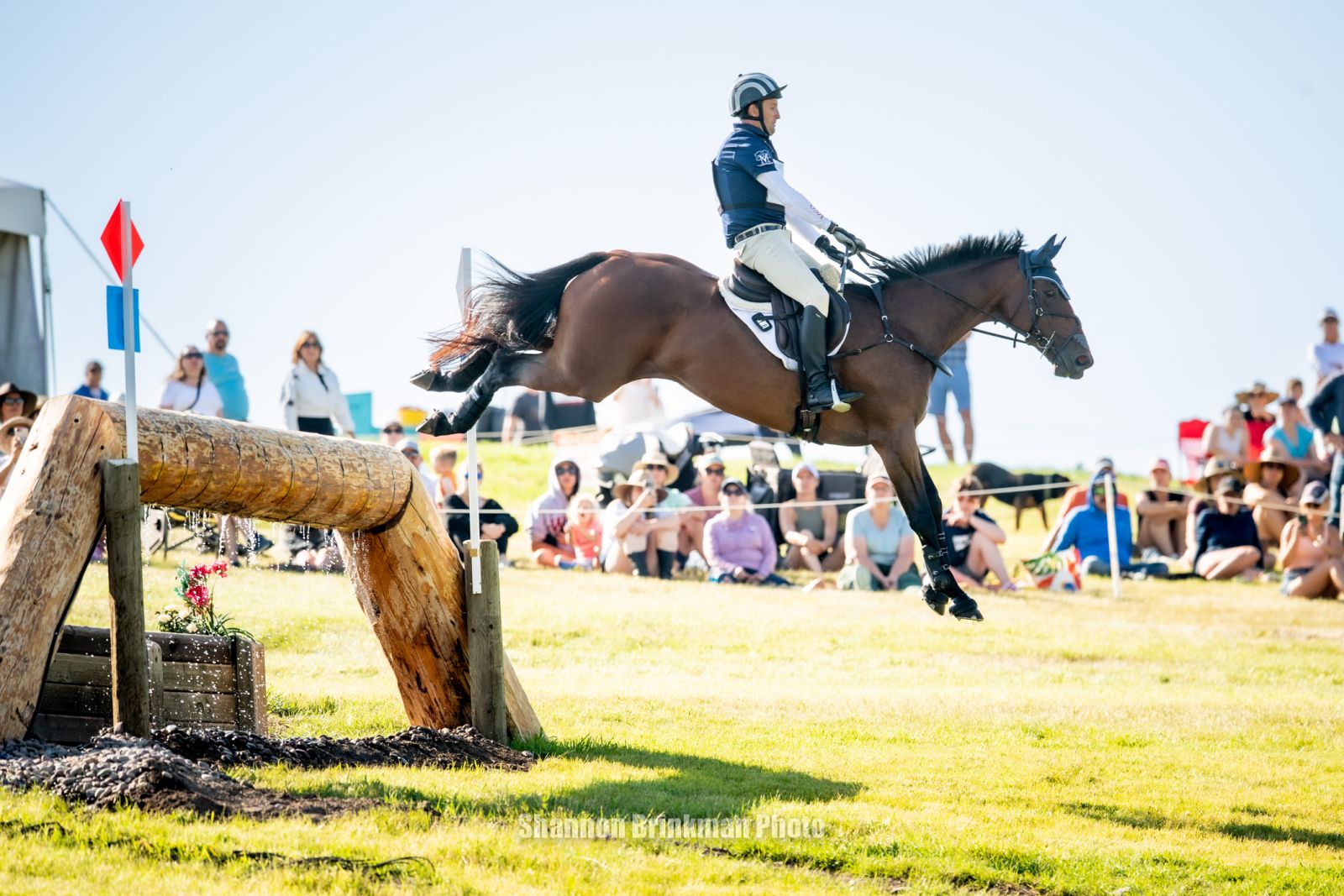
Andrew McConnon and Wakita 54. Photo by Shannon Brinkman.
Earlier this week, the FEI released the full documentation outlining the decision of a three-member Tribunal Panel regarding Case 2025/HA01 involving 5* rider Andrew McConnon and allegations of horse abuse. The decision, which resulted in a 20-month suspension that was retroactively applied to the start of McConnon’s provisional suspension on January 8, 2025, follows a two-day hearing held virtually on June 16 and 17. The Panel consisted of Ms. Harveen Thauli (Chair), Mr. Brian Ward, and Mr. Agustin Fattal Jaef. Jamie Cambreleng Contreras was also present for the Panel to serve as clerk. The CVs and roster of current FEI Tribunal members is available publicly and can be found here. McConnon’s suspension is due to end on September 8, 2026.
There is a lot of information (120 pages, to be exact) to dig through here, so we’ll do our best to lay things out below. While we’re bringing you as much detail as we can, we do encourage you to take the time to read through the documents, which can be viewed here.
As with the piece Eventing Nation published in September of 2024 detailing the case to date, we’ll be leaving any personal opinion and views out of this rundown of the documents. We’ll conclude this piece with some analysis, which will contain some of our interpretation of the results. This story will be followed by some opinion pieces written by various members of the team at EN, which will be published in the coming days.
How We Got Here
June 2024: USEF was informed of the allegations of horse abuse, but it was determined that the Federation did not have jurisdiction under the interpretation of GR838. The rule has since been modified to allow for reports of abuse that happens on private property, versus its original version which allowed for reports only at USEF-sanctioned shows. The case was handed off to the FEI.
September 2024: While McConnon competed at Defender Burghley with Wakita 54, videos were posted to social media depicting abuse to multiple horses. Eventing Nation followed this with a report on the timeline to date, including confirmation that an investigation had begun.
January 2025: McConnon was informed that disciplinary proceedings had begun for possible violations of Articles 142 and 164.11 (b), (g) and (i) within FEI General Rules. McConnon was provisionally suspended from January 8, according to the rules. On January 20, he acknowledged receipt of this notification letter and denied the allegations.
February 2025: The FEI Tribunal Chair appointed a Panel to decide the case, with no objection from either party. Documents were provided on either side as submissions for the hearing.
March 2025: A case management conference (CMC) was held on March 26 to discuss the procedures and other matters pertaining to the upcoming hearing.
June 2025: The hearing took place on June 16-17 via video conference. Present in addition to the FEI Panel were Andrew McConnon, accompanied by two legal counsels in Howard Jacobs and Roland Wiley, as well as three members of the FEI Legal Counsel (Ana Kričej, Katarzyna Jozwik and Anna Thorstenson).
Statements from a total of 8 witnesses for the FEI and 12 witnesses for the Respondent (McConnon) were submitted, and several of these witnesses were also cross-examined during the hearing. Additionally, 5 videos and 12 photographs were submitted by the FEI.
What Were the Allegations and Charges?
The FEI’s case consisted of the following allegations:
- 41.1 excessive beating of horses
- 41.2 excessive whipping
- 41.3 excessive use of spurs
- 41.4 excessive jabbing of the horses’ mouths with the bit and excessive use of hand aid
- 41.5 intentionally leaving horses without adequate food and drink
- 41.6 riding horses despite the horses being lame and/or injured
- 41.7 overworking horses
- 41.8 using abusive training methods
- 41.9 employing hyperflexion (rollkur) on horses
- 41.10 tying the horses’ heads down for a prolonged period of time
- 41.11 trapping and tying horses into static positions
- 41.12 chasing horses by foot
- 41.13 preventing horses from breathing
- 41.14 causing damage and inflicting injuries on the horse
Importantly, as it pertains to the ultimate outcome of the case, the Panel notes that “various versions of the GRs [General Regulations] are applicable given the alleged violations occurred from 2017 to 2024,” which is the FEI’s own framing of the time span of the alleged violations, based on collected testimonies from witnesses. FEI Witness 2 is the clearest source for the multi-year narrative, as they worked for McConnon from August 2019 to October 2023 and alleged that between 25 and 30 horses were subjected to his abuse “over an extended period.” Other instances identified include a report from FEI Witness 3, who alleged that in January 2021, at a show at the World Equestrian Center (WEC) in Ocala, Florida, which she describes as a National Snaffle Bit Association (NSBA) show, she saw McConnon display abusive behaviors, which was seen by a steward and halted. The Witness attempted to file a report via USEF but the incident did not fall under their jurisdiction at the time. Given the span of time and grievances alleged, the FEI initially sought a lifetime ban.
Who Were the Witnesses?
The statements and/or testimony of a total of 8 FEI Witnesses and 12 Respondent Witnesses were used in this decision. While the Witnesses were not named, their backgrounds and association with McConnon was outlined.
For the FEI, the witnesses included three individuals who had worked for McConnon between the periods of 2019 and 2024, a neighbor, a rider who kept horses at a neighboring farm and one who kept her horses with McConnon before moving to a nearby facility but who also spent some time living on McConnon’s property, a rider who ran a Thoroughbred retirement nonprofit who kept at least two horses in McConnon’s program at one point, and a veterinarian who treated the horse of another witness’ daughter.
For McConnon, witnesses included a rider who has represented the U.S. on Championship teams, two veterinarians, a rider and part-time employee who was in McConnon’s program in early 2024, long-time clients and students, McConnon’s landlord/neighbor, a Licensed Eventing Official, a Senior US Pony Club official, a Licensed Specialist Clinical Social Worker who has worked with McConnon since February of this year, and other associates and colleagues.
The Evidence and Testimony
As mentioned previously, multiple pieces of evidence were provided to the FEI, as follows:
There were 5 videos in total, all filmed by the same former employee (FEI Witness 1) — four from February 2024 and one from March 2024. Here’s exactly how the Tribunal treated each one, along with the weight assigned to each in terms of its relevance and acceptability for proof of allegations. The notes shown in the bullet points are pulled from the documentation:
- Video 1 (14 Feb 2024, Horse A)
- Shows McConnon slapping Horse A on the top of the neck seven times.
- Tribunal: this constitutes horse abuse.
- Weight: High probative value; high weight.
- Video 2 (14 Feb 2024, Horse C)
- Shows two “neck slaps” after jumping; no whip visible, no injuries or visible distress, 2 seconds long, no sound.
- Tribunal: description in the FEI’s claim (“hitting the horse’s head/face with a whip”) was not accurate; clip is inconclusive.
- Weight: No probative value; no weight in deciding horse abuse.
- Video 3 (20 Mar 2024, Horse A)
- Taken from behind, at a distance. Shows McConnon pulling more than necessary on the right rein to keep the horse bent, then jabbing the horse’s mouth three times by pulling the rein across the neck.
- Tribunal: this constitutes horse abuse.
- Weight: Moderate to high probative value (because of camera angle/distance); high weight overall.
- Video 4 (14 Feb 2024, Horse C)
- Shows Horse C being walked and bent left/right after jumping; no striking or jerking, no visible distress.
- Tribunal accepted McConnon’s explanation (cooling down / shoulder mobility) as plausible; clip is inconclusive.
- Weight: No probative value; no weight.
- Video 5 (14 Feb 2024, Horse A)
- Shows Horse A being walked and bent to the right; no striking or jerking, no visible resistance, very brief.
- Tribunal: looks corrective and calm, not punitive; again inconclusive.
- Weight: No probative value; no weight.
12 photographs were also submitted, as follows. The FEI’s own summary (used in the decision) describes them as:
- 20 Feb – Horse A – Whip marks
- 20 Feb – Horse A – Whip marks
- 20 Feb – Horse A – Whip marks
- 20 Feb – Horse A – Tied down
- 20 Mar – Horse A – Blood on stirrups
- 20 Feb – Horse A – Tied down
- 21 Feb – Horse A – Whip marks
- 21 Feb – Horse A – Whip marks
- 15 Feb – Horse B – Blood on bit
- 14 Feb – Horse C – Wounds on mouth
- 14 Feb – Horse C – Overworked horse
- 14 Jun – Horse A – Whip marks
The Panel reviewed these videos and photos submitted by the FEI, but ultimately only relied on a small fraction of that material. Two videos, both involving the same horse in February and March 2024, were given high weight: one showing McConnon slapping the horse on the neck seven times, and another showing him jabbing the horse in the mouth three times with the rein across the neck. The other three videos were found to be inconclusive and assigned no probative value for abuse.
Of the 12 photos — almost all taken within a single week in February 2024 — the Tribunal Panel found that only two images (showing whip marks on the horse’s shoulder and haunches) had moderate to high probative value, largely because McConnon acknowledged he had used the whip more than appropriate on that occasion; the remaining photos were given little or no weight and were not treated as proof of a broader, long-term pattern.
The Panel also heard testimony, spending large amounts of time verifying timelines from the witness statements as they pertain to the case. Some excerpts from the FEI Witness testimony include:
- FEI Witness 2 (working student, 2019–2023)
- On withholding food as punishment: “[The Respondent] withholds food from horses after a bad ride, both grain and hay. Anywhere from one feeding to a few days.”
- On how hard she says he whipped: “Sometimes so bad that patches of skin are missing and most of the times until they are covered in lash marks. When [he] whips them it’s almost always hard enough to leave large welts. On a few occasions bleed.”
- FEI Witness 3 (boarder/parent, 2019)
- On hitting heads and making horses fall: “[The Respondent] hits horses repeatedly in the head during rides with an open hand…” and “[The Respondent] rides well-behaved 5-year-olds and yank their head so violently that they fall down because they are unable to keep their balance.”
- FEI Witness 7 (working student around 2014)
- Referring to “beating and abusing” horses: “His go-to would be to gallop them violently after missing a distance or other mistakes, beating them with a crop or whip.”
For McConnon’s witnesses, the focus was primarily character reference and confirmation. A few excerpts from this testimony include:
- Respondent Witness 1 (U.S. team rider, knows him ~20 years)
- On how he’s seen McConnon ride and compete: “[…] in the 20 years I have known [the Respondent] I never witnessed him treat horses in that way. I have witnessed him riding and competing in a very kind and competent way.”
- On remorse after the videos surfaced: He said the Respondent was “ashamed, embarrassed, and completely honest in his statement of regret.”
- On how he views McConnon’s place in the sport: “[The Respondent] is an asset to the horse community and a significant ban would only add fuel to an already volatile cancel culture mentality.”
- Respondent Witness 4 (long-time client/coach)
- On his coaching style with her daughter: “[The Respondent] would give my daughter excellent, proactive advice on how to help [her horse] and not make the situation worse.”
- Respondent Witness 5 (long-time trainer/mentor/colleague)
- On his integrity and approach to horses: “[The Respondent] is a person of exceptional integrity. He’s inherently kind and gentle, and he’s a loyal and dedicated member of the Equestrian World.”
- On the videos used in the case: “I would consider that bad decision making, but I don’t know how I could call that abuse with less than a minute of tape.”
- Respondent Witness 12 (social worker)
- On his engagement with mental health treatment: “Over our six sessions together, I have been impressed by [the Respondent’s] dedication to his mental health and his commitment to working through these challenges.”
In assessing the evidence, the Tribunal applied the FEI’s “comfortable satisfaction” standard, but it was notably stricter with the FEI’s witnesses than with the defense. It expressly gave only minimal weight to the two main former employees and no weight at all to several other FEI witnesses except where their accounts could be independently corroborated.
The Panel repeatedly described McConnon’s own testimony and a number of his supporting witnesses as credible, assigning them moderate to high, and in some cases full, weight. Within the framework that the FEI carries the burden of proof, this meant that inconsistencies or gaps in the complainants’ timelines often led to their evidence being discounted, while long-term professional, client, and landlord witnesses on the Respondent’s side were more readily accepted as reliable background. The consistent vein of the Respondent witness testimony was character testimony and confirmation that abusive or aggressive behavior was not witnessed on their part.
McConnon himself was also given the opportunity to respond the allegations, from which we’ll include some excerpts below:
- On not just being sorry he was caught: “This isn’t a case of I’m sorry I got caught. I’m genuinely sorry for my actions.”
- On apologizing and taking accountability: “I’d like to start by apologizing. I’ve personally taken accountability with FEI Witness 1, each of my owners, clients, and sponsors, but I haven’t had the opportunity to apologize to you. In the beginning of last year, I acted out of character with my values as a horseman.”
- On personal circumstances bleeding into his work: “Those are just some of the things that were going on personally and inappropriately I let my personal life go over into my work life and that never should have happened.”
Here is how the Panel weighted each witness:
FEI witnesses – summary of weight assigned
- FEI Witness 1: minimal weight and primarily to the circumstances leading up to her discussion with the Respondent on 20 March 2024
- FEI Witness 2: minimal weight and only to those aspects supported by independent or contemporaneous evidence, such as the length of her employment with the Respondent
- FEI Witness 3: no weight
- FEI Witness 4: moderate weight
- FEI Witness 5: not applicable (this witness declined to attend the hearing and their statement was therefore not admitted into the final decision)
- FEI Witness 6: no weight
- FEI Witness 7: no weight
- FEI Witness 8: no weight
Respondent and his witnesses – summary of weight assigned
- Respondent: high to full weight
- Respondent Witness 1: high weight
- Respondent Witness 2: moderate to high weight
- Respondent Witness 3: full weight
- Respondent Witness 4: high to full weight
- Respondent Witness 5: high weight
- Respondent Witness 6: moderate to high weight
- Respondent Witness 7: moderate to high weight
How This Case Was Decided
Because the FEI is headquartered in Switzerland, this case was ultimately decided under Swiss law and the FEI’s own rules, not U.S. law. In simple terms that means the FEI, as the prosecuting body, had to prove its allegations with enough detail and solid evidence before the Tribunal could rule that abuse had occurred. If the FEI couldn’t meet that bar on a particular claim, the Tribunal was required to dismiss it, even if it raised concerns. This will come into greater play as we get further into the documents.
On top of that, FEI abuse cases are judged using a standard that comes from international sports law, often called “comfortable satisfaction.” You can think of it as sitting between two concepts U.S. readers might know:
- Higher than the usual U.S. civil standard of “more likely than not”
- Lower than the criminal standard of “beyond a reasonable doubt”
It’s also a bit of a sliding scale. The more serious the allegation and the heavier the potential penalty (for example, a lifetime ban or effectively ending someone’s career), the stronger and more consistent the evidence needs to be before the Tribunal feels “comfortably satisfied” that it really happened.
In this case, that meant the FEI had to put forward clear, specific, and well-supported facts: detailed timelines, footage, documents, and witness accounts that lined up with each other. Only once the Tribunal was convinced on a particular point did the burden shift to Andrew McConnon to explain or challenge that evidence. Where the evidence was vague, inconsistent, or not backed up by photos, videos, or records, the Tribunal said it could not reach comfortable satisfaction – and those broader allegations were not upheld, even though some narrower incidents were.
The Panel ultimately found McConnon guilty of abuse of horse, bringing the FEI and equestrian sport into disrepute, and breaching the FEI Code of Conduct on the Welfare of the Horse, based on a limited number of training incidents in early 2024. It did not uphold the majority of the broader allegations originally brought by the FEI, including the initial range of time it alleged from 2017 forward. This decision meant that although the FEI requested to have McConnon banned for life for the abuse of horses, and for bringing the Federation’s reputation into disrepute, the Tribunal ultimately deemed “that the Respondent’s offenses for Abuse of Horse falls within the “mid-range” category of the table provided at Article 164.13 of the GRs. This table provides for a Suspension ranging “between three months and two years” and awarded him a 20-month suspension, backdated to the start of his provisional suspension in January of this year.
The Panel also reviewed a string of previous FEI horse-abuse decisions to get a sense of the sanction “range,” but ultimately said none of them were truly comparable to McConnon’s case. Those included FEI v. Zbibi, where a rider designed tendon boots with hidden pins that caused pain when the horse hit a rail (four-year suspension), FEI v. Da Silva, in which an oversized rider was filmed violently yanking and whipping a pony (three-year suspension), and FEI v. Kocher, where an electric shock device was used on horses in training and competition over about six years (ten-year suspension, upheld on appeal). They also cited several endurance cases (Al Hosani, Al Khatri, Al Ghailani, Al Marzouqi) involving aggressive kicking, rein-slapping and, in one instance, a horse collapsing and being declared lame, which led to suspensions ranging from eight to 30 months. In each example, the Panel explicitly notes that the case is “not comparable to the Respondent’s matter,” and concludes that McConnon’s situation doesn’t fit neatly beside any of these precedents.
The Panel also wrote: “There was no evidence to suggest that the pain or discomfort was long-lasting or resulted in any enduring harm. For example, Horse A is now living in California and had just won a competition at the time of the hearing.” This refers to the horse formerly known as D’Luxe Steele, now named Jump To Day D and ridden by Tamie Smith, who won the CCI3*-L at Galway Downs at the end of October. They also wrote: “The Panel considers his personal circumstances to be a mitigating factor,” referring to a cancer diagnosis for McConnon’s father and other personal difficulties he referenced in his testimony and response.
“The Panel acknowledges that the Respondent has expressed genuine remorse for his actions” also appears in the closing text of the documentation. This, coupled with the fact that the verified offenses were not found to span multiple years, are reasonings for the 20-month suspension.
McConnon has confirmed to EN that he does not intend to appeal the Panel’s decision. It remains unknown whether or not he will return to the sport in September of 2026, when the suspension is lifted. He has yet to make any public or on-record statements, outside of what was transcribed from his testimony.
Where This Leaves Us
Here, we’ll depart a little from straight fact-sharing to offer up our analysis of the events that have transpired. The following section does contain some of this writer’s opinions, as well as those of the EN team, and should be read as such.
Initially as I began this piece, I had planned to include excerpts from a post made by Tamie Smith on Wednesday of last week detailing the trauma she had seen from the horses that were sent to her care after leaving McConnon’s facility. In this post, she detailed the physical manifestation of abuse that these horses displayed and continue to display to this day. Tamie’s post has since been edited and, to be frank, its credibility is now undermined as multiple public posts have been shared in recent days alleging abuse of staff and horses on Tamie’s part. This is a developing story and is one that EN is monitoring closely for further updates.
A few of our takeaways:
- To indicate that horses carried no long-lasting effects of trauma is, frankly, scientifically untrue. A horse that wins a competition can do so in many ways. It is not EN’s belief that a win or other competitive success is synonymous with health and good care.
- EN has confirmed that several involved parties, including owners and current riders of some of McConnon’s top horses, were not contacted by the FEI in the investigation, nor were they brought as witnesses or asked to provide a statement/testimony. One former owner contacted the FEI when the investigation was announced, offering up evidence that could help establish a pattern of abusive behavior dating back 15 years. The FEI declined to investigate her materials further, as confirmed in emails obtained by EN, but did inquire after her interest in being a witness. She was not included in the investigation beyond this.
- There’s an important reminder contained within these documents: if a case is to succeed, it must contain firm documentation. This is tricky. To be honest, reading this and watching the testimony of the FEI Witnesses get picked apart felt… a little too familiar. Burden of proof, yes, but who suffers the most in these instances? The horses, and the people who want to stick up for them. And to me, the prioritization of the horses does not come across in the way this hearing proceeded, and the low weight assigned to the FEI Witnesses bears a striking difference to the severity of the allegations.
- The “strength” of the witnesses on McConnon’s side was notably different: he was assisted by two lawyers who have worked on similar cases in the past. He had at least two well-known and highly-placed individuals called as Witnesses, including a current 5* rider and a Licensed Official. I, personally, do not feel confident that this case will make other individuals of less “stature” (i.e. a groom or working student) feel empowered to utilize the same system.
In just a few days of interviews, research, and writing, I’ve learned more about the backstory of this case than I did within the decision documents. According to the individuals I spoke with, none of the information I was given was requested by the FEI in the form of a witness statement, evidence, etc. I’ve confirmed with two owners of horses that were depicted in the photos and videos used in the case that the FEI did not reach out to them for their statements or experiences before, during, or after this investigation and hearing. Two individuals from the FEI Witness side of the case have informed me that their testimony transcription was inaccurate in multiple places.
“Do people deserve second chances? Sure,” said Vanesa Crumpley upon discussion with me, who owned a horse for McConnon previously and reached out to the FEI during the investigation to offer up her background information based on her experience. “I don’t think that ten seconds on a video necessarily should define someone’s entire existence. It’s the patterns that are much more important, and when people are willing to come forward and discuss those patterns, it’s important.”
“If this is the way that the FEI is handling investigating these cases, it’s hard to really put your trust in them that they’re really going out there and they want to find the abusers and find them really accountable,” said another owner of a horse that had been with Andrew for a period of time, whose name is withheld at request. “I’m more like, they should do a better job for the future horses, and we should be able to put our trust in them. It shouldn’t feel like such an uphill battle.”
I also want to reiterate a point I made in my original story about this case, and that is that this extends far beyond Andrew McConnon. As a human, I hope that Andrew can find his way to a place of health and safety, and that he does truly feel remorse for what he did. I hope that more horses do not suffer at his, or anyone else’s, hands. I hope that he can find happiness, and that he can find forgiveness – but only if the patterns and actions show real change. And only he knows the answer to that. I can’t speak for everyone when I say these things, but that is where I stand. This extends beyond him, to our greater world at large, and this sport we’ve all given our lives to in some way, shape, or form. What do we do if we no longer have it? What do we do if it eats itself from the inside?
So, it’s important that this conversation does not die down, that the dust does not settle. For my part, I find myself feeling somewhat at a crossroads. Eventing Nation has been built off the “hype” of many riders, including some who now come under fire from substantial allegations of abuse themselves. My career has been built off of this, and off of trust that the people who show themselves to me are who they say they are. And now, more than ever, I feel that trust has been sorely eroded. I can only imagine how some of the individuals who have bravely come forward feel, and I can only imagine how the horses — incapable of speaking for themselves in our language — feel. I do not, personally, condone the vicious attacks of named individuals on social media, but I also know that in more cases than not, victims only feel safe speaking out when the stone has begun to roll.
I also know that there ARE good people, good horsemen and horsewomen, in our world, and I want them to be known. I want them to speak out. The silence from the high performance level in cases like this is deafening, and it’s telling.
And until that silence is broken, our horses, our sport, our livelihood — but mostly, our horses — will continue to suffer.
I’ll leave you here to draw your own conclusions, and again, our team will have some opinion pieces to share in the coming days. We’re also working on a piece that will help shed light on the reporting process, as the path to making a report (and what happens after) is murky in many ways.
Full documentation of this case can be found here.
While my name is on this article’s byline, the entire Eventing Nation team contributed to the research, review, and editing of this article.