




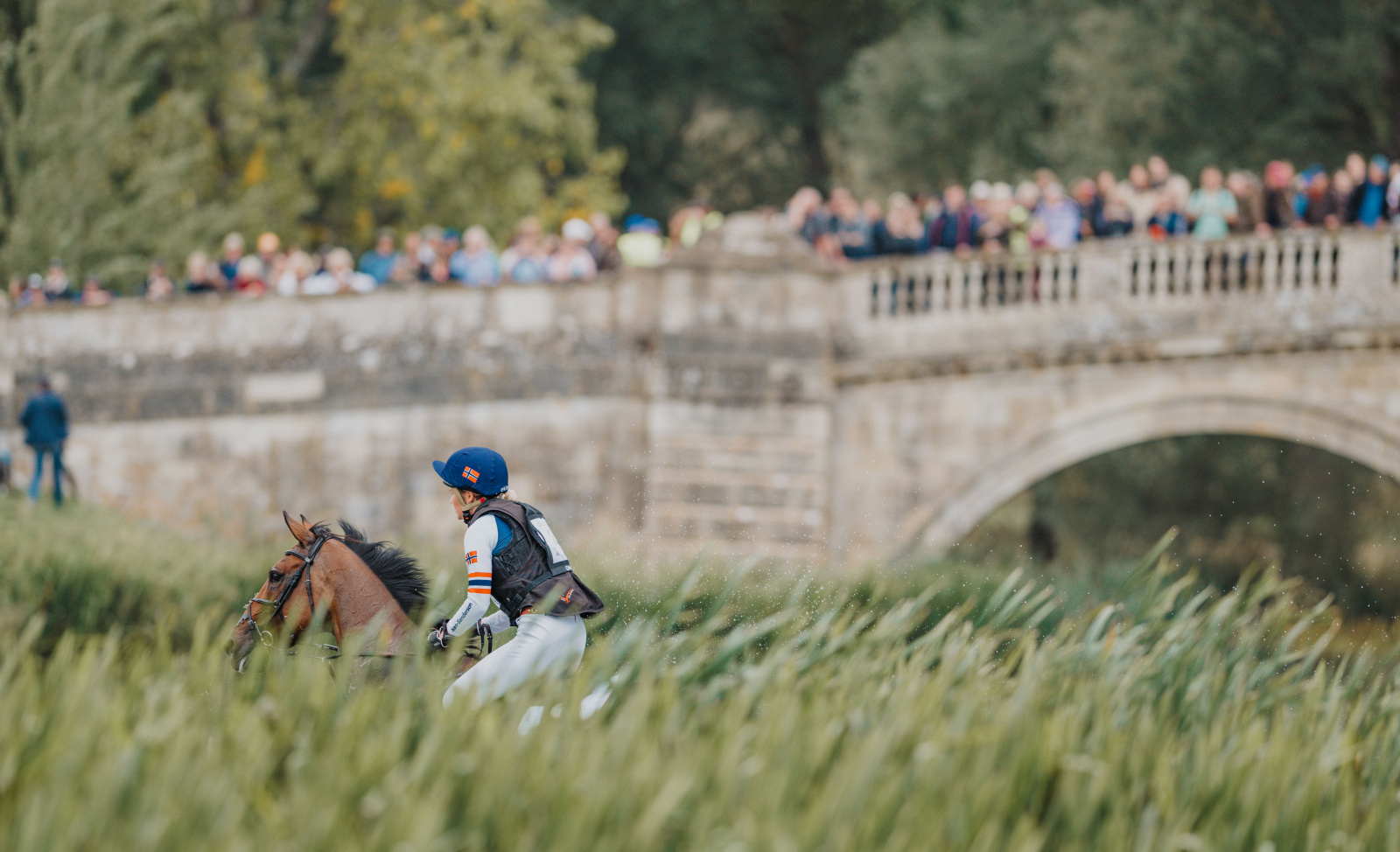
Norway’s Yasmin Olsson-Payne and Cos Me Will cross Blenheim’s long water. Photo by Tilly Berendt.
You’ll forgive us, I hope, for the time it’s taken to get this report written up: we were busy checking to see if Mercury’s in retrograde, or a full moon is coming, or if we’d maybe had a weird batch of media centre coffee and had hallucinated through a full day of sport here at the FEI European Eventing Championships at Blenheim. Now we’ve been signed off by the inspecting vet and deemed fit to continue, we can confirm: no fever dreams here, just a truly, truly bonkers rewriting of the narrative of the week.
Host nation Great Britain could hardly have come into this week on better form: they’ve been gold medallists at the last two Europeans, winners at last year’s Paris Olympics, relentlessly consistent and almost preternaturally competitive on the world stage. The country has the highest medal tally of any nation throughout the history of the European Championships, with just about double the number won by their nearest competitors, the Germans – and this week, on home soil, at a venue this extraordinarily strong line-up knows like the back of their hands, they were fairly expected to walk it. After the close of the dressage phase, they sat pretty in the top spot, though with the merest of margins ahead of – you guessed it! – Germany, and today, the feeling around the packed grounds was that the experienced foursome would widen the gap between themselves and the largely next-generation German contingent.
And hey, look, they did widen the gap – just not in the direction anyone expected. As cross-country day dissolves into the night before showjumping, Great Britain is no longer a part of the team competition at all.
It began early. The day’s pathfinders, Switzerland’s Nadja Minder and Toblerone, overcame a couple of early scrappy efforts to cruise home clear and with 12.8 time penalties, but almost immediately, the plot thickened like day-old custard. Italy’s Giovanni Ugolotti and Duke of Champions, the most experienced pair of their country’s line-up, picked up a flag penalty and a MIM penalty, and those riders watching could immediately see just how tricky the forward distances and technical lines would be. There was a yawning gap for them to process that – Belgium’s Senne Vervaecke had withdrawn before the start of the day’s competition, turning the five-minute interval into a long ten-minute one – and then all eyes were on British team pathfinder Yasmin Ingham (9th on 29) who, they knew, would deliver the sort of round they could glean valuable, confidence-building intel from.
Intel, yes. Confidence-building? Well.
The first two-thirds of Yas’s round were bold, confident, and as competent and efficient as she and Rehy DJ always are, and it looked set to be a galvanising starting point for the home nation. But then, at the top end of the course, it suddenly unravelled: as they jumped through the tough line at 22AB, an open oxer to a right-handed corner on a bending, left-handed turn, ‘Piglet’ caught a hind leg on the corner, ejecting Yas out of the side door. She was quickly back up on her feet and Piglet, who hadn’t fallen, was no worse for wear, but just like that, the Brits didn’t have the benefit of a discard score anymore. Like Austria, who came to this event with just three riders, and Belgium and Sweden, who’d each lost a rider to withdrawals, every step, every stride, and every ride was going to have to count.
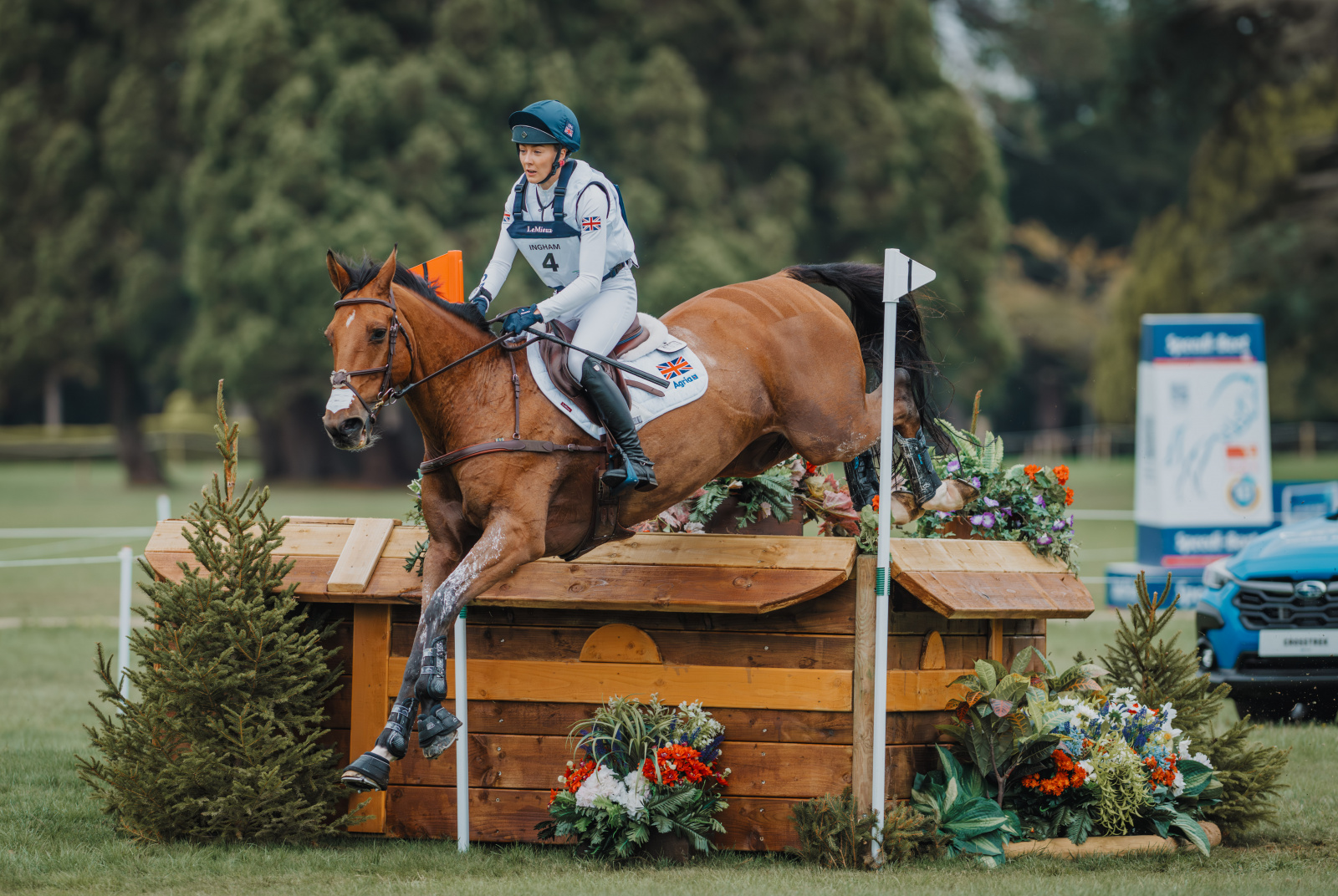
British pathfinders Yasmin Ingham and Rehy DJ. Photo by Tilly Berendt.
At the end of the day, it would be just Austria – the underdog nation of this week’s nine-strong team lineup – that would stay in the hunt.
Run-out after run-out after run-out plagued riders throughout Captain Mark Phillips’s up-to-standard, testing track, with many running into trouble early at the first combination on course. That was fence 6ABC, a dimensionally diminutive pair of skinny triple-bars with a little pond between them, but crucially, the first element was set on top of a short, sharp mound, and because there had been nothing earlier on in the track to force riders to finetune their horses’ adjustability, many found that their mounts came up the mound and then ground to a halt, startled to find a speedbump suddenly in front of them. Nine pairs faulted here; one of them, France’s Astier Nicolas and Alertamalib’or, lost their chance at an overnight bronze medal position as the result of it.
The skinny brush fence that dropped into the first long water crossing, too, took plenty of strong competitors out of the game: four competitors faulted here, and Sweden bid adieu to the team competition when their final rider, Frida Anderson, opted to retire the inexperienced Stonehavens Baby Blue at this fence.
Then, the top water complex at 20ABC, a log drop and a brush corner that’ll no doubt be deported overnight: just moments after Yas’s shock fall the next British rider, individual competitor Caroline Harris and her Pau winner D.Day, picked up 20 penalties at the second element. Two fences later she, too, would fall at exactly the same spot her compatriot did. And then! And then. Britain was up to bat again, and this time with another team rider: 12th-placed Piggy March and the little stallion Halo, who has previously won here at Blenheim, were having a super round, nipping around the track as though on rails. But after a big jump into the water at 20ABC, Halo made a game attempt at taking off early for the corner and, a split second later, realised the gap was too long. He attempted to chip in an extra stride, but it was too late: he scrambled along the front of the fence, and in cleverly staying on his feet, deposited his rider into the pond.
We were barely 90 minutes into a four-and-a-half hour day of cross-country, and Britain was out.
But wait! There’s more!
Poor Bubby Upton was, like her fellow countrymen, having a peach of a ride with the ten-year-old Bramham winner Its Cooley Time when she, too, ran into trouble: again, a rider fall, though this time at fence 19, an angled brush just after the first long lake crossing. Though the team was already out of contention, and though Bubby had, like Caroline, been riding as an individual, it was another harsh blow to morale: four Brits had started, and four Brits had fallen off. Just two remained, and though Laura Collett and London 52 and Tom McEwen and JL Dublin are two of the strongest combinations in the field, they’re also both horses that would leave the start box with something of a question mark over their heads where hilly, stamina-testing tracks are concerned.
In the meantime, while all this was happening, smaller nations were demonstrating the fruits of their labours – the quiet building blocks of progress that don’t always get noticed in the shadows of the major player nations. Austria’s three plucky competitors had all made it home without jumping penalties, with anchor Lea Siegl holding onto the fourth place spot she’d held overnight with Van Helsing P, and Switzerland, whose six-year trajectory has been a clear and upward one, had brought all four riders home, pushing them upward into podium territory. Both Czech competitors came home, steadily, one clear and one with a couple of issues but plenty of experience gained. Turkey’s first-ever European Championships competitor, Kumru Say, rode a sensible, sensitive round to add no jumping penalties and a fair helping of time. The riders who were here to learn, and to grow, were able to do so with the plethora of long educational routes available to them; the countries that have been on the precipice of levelling up on the world stage walked through that door; and Germany, meanwhile, proved the strength in depth it’s cultivating at Warendorf, and duly took over the gold medal position, and four of the top ten individual places.
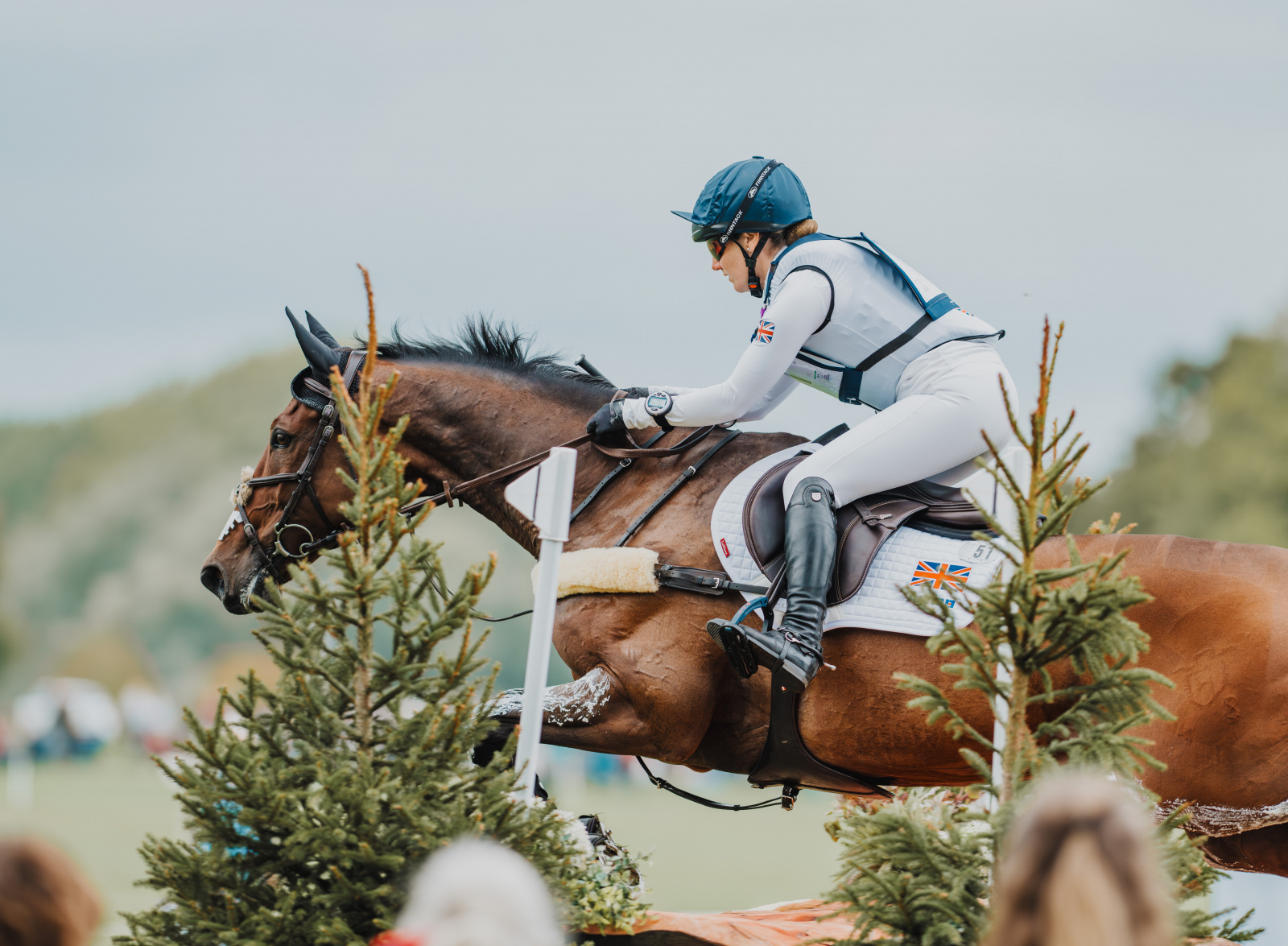
Laura Collett and London 52. Photo by Tilly Berendt.
Not, crucially, the top one, though. We finished dressage with a German leader in Michael Jung and fischerChipmunk FRH, and we end it with –mercifully for the home side – a British one. Laura Collett and London 52 happily erased any lingering question marks by attacking their way around the track, returning home in a time of 10:16 – 15 seconds over the 10:01 optimum time, but the second fastest round of the day in the first European Championships this millennium in which nobody has made the time.
“I can’t quite believe it, to be honest,” says Laura, who breaks a chain of bad luck at Europeans with today’s round. “We have a great partnership now, and we really needed it out there – it was hard work from start to finish. But he dug so deep.”
Laura’s round came in the final few of the day, and it was “pretty hideous”, she admits, to have to wait through all the British disappointment of the day for her turn.
“I watched the first two and then thought, ‘oh god,’” she says. “But then when I got on him I thought to myself, ‘look, he’s my horse of a lifetime, and he’s given me no reason not to trust him.’ Chris Bartle’s really helped over the last few years by saying, ‘just trust him. Trust his jump, and don’t try to do too much. Just put him on the line and let him do the rest.’ Really, this year, he’s shown me that that’s what he likes.”
She was helped, too, by having at least one compatriot home and clear: Tom McEwen had revitalised the home crowds hopes, laying down an excellent effort with the 2021 European Champion JL Dublin to add just 6.8 time penalties, in what would turn out to be the third-fastest round of the day.

Laura Collett and London 52. Photo by Tilly Berendt.
“I had great advice from Tom, who said ‘just save a little bit for the end – don’t use up too much at the start, and really get stuck in,’” says Laura.
It was sage advice, but as Laura left the start box, she wasn’t sure if she’d be able to stop the three-time five-star champion from using himself too much, too soon.
“He was quite feisty at the start, which sort of put me off a bit because I couldn’t really find a rhythm,” she says. “Halfway through I gave him a terrible ride through the rollercoaster complex [at 15AB], and then I thought ‘right, you’ve got to stop doing that!’ Then he was magic through the top of the course and coming home.”
‘Dan’ made it clear on course that at sixteen, he’s not about to start slowing down – but his gung-ho approach today isn’t just the result of a bit of luck.
“We’ve really worked on his fitness since Luhmühlen, because I felt there that I hadn’t quite got him to the point I’d had him before, whether that’s because he’s older or just a bit more laid back now,” explains Laura. “So we didn’t give him a huge break after Luhmühlen, and although he hasn’t run very much, we kept him really fit, which showed today.”
Laura had to exercise compartmentalisation to get her head in the game for today’s round after the chance of team gold on home soil slipped out of reach.
“There was a tiny bit less pressure not having the team riding on my shoulders, but I’m gutted for them as well – none of us wanted any of that to happen. So it was a bit of a mixed feeling going into it. But once I was on, it was just a job to do – whether that’s as a team or an individual we want the same result, which is clear and fast.” “He owes me nothing and he keeps on giving me more and more and more.”
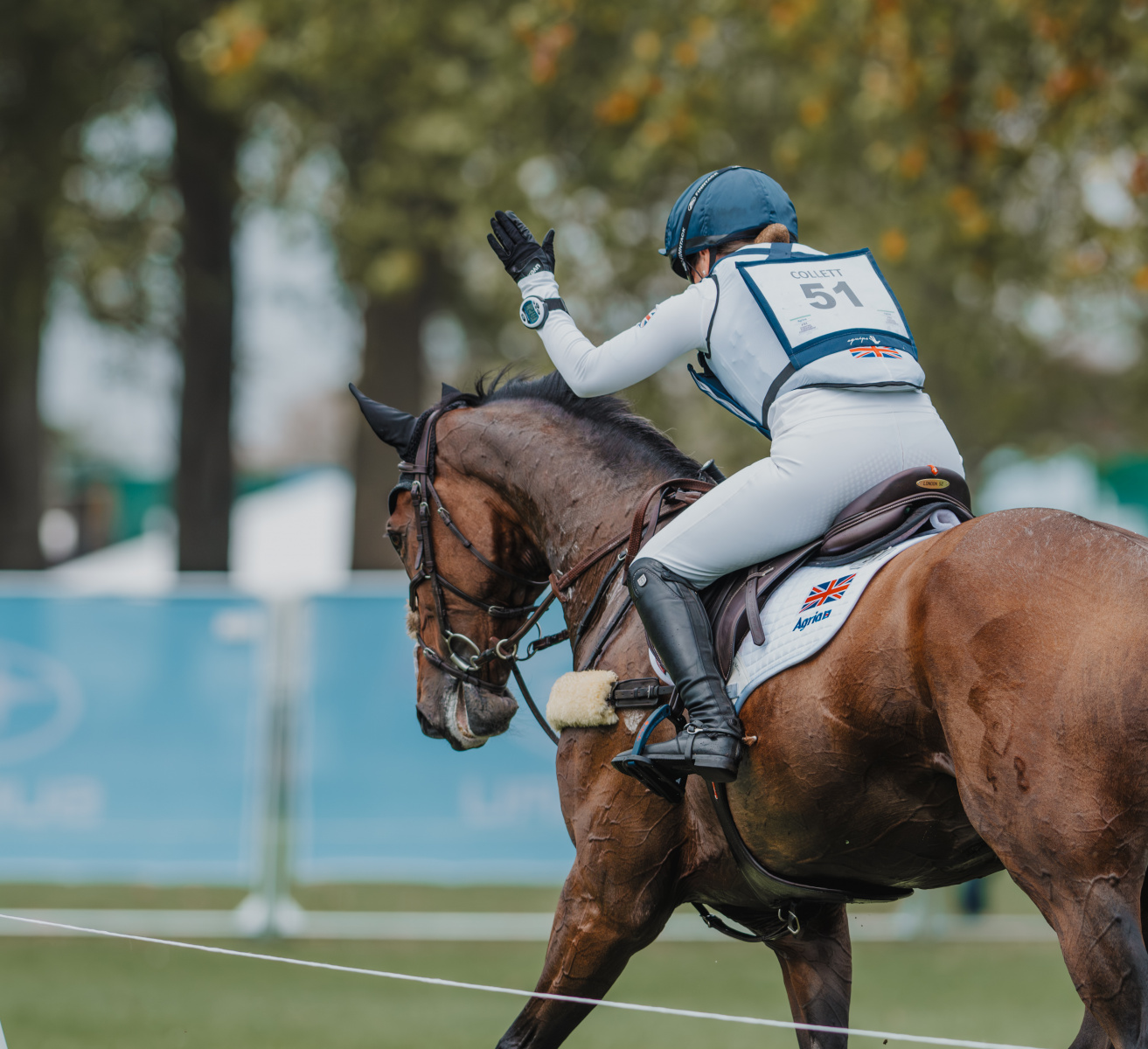
Laura Collett and London 52. Photo by Tilly Berendt.
Now, Laura will head into tomorrow’s finale with the tiniest of margins as she fights for her first senior individual gold medal: she sits just 1.7 penalties ahead of her nearest competitor, which gives her just a few scant seconds in hand.
“I’m not sure excited is the word I’d use,” laughs Laura, “but ‘Dan’s’ been in these positions before – not at championships, but at five-star, so I have to remember that and think of it as just another day of showjumping, and then what will be will be. He owes me nothing, and he keeps on giving me more and more and more.”
That 1.7 penalty margin sees Laura sit a whisper ahead of our first-phase leaders, Michael Jung and fischerChipmunk FRH, who left the start box just minutes after she did. The pair were classy around the Captain’s course but steadier: whereas London 52 can lengthen and open his stride more readily, the more traditionally continental Chipmunk travels with a bowling, round stride, and his comfortable cruising gallop meant he and Michi would finish ten seconds slower than our leaders.
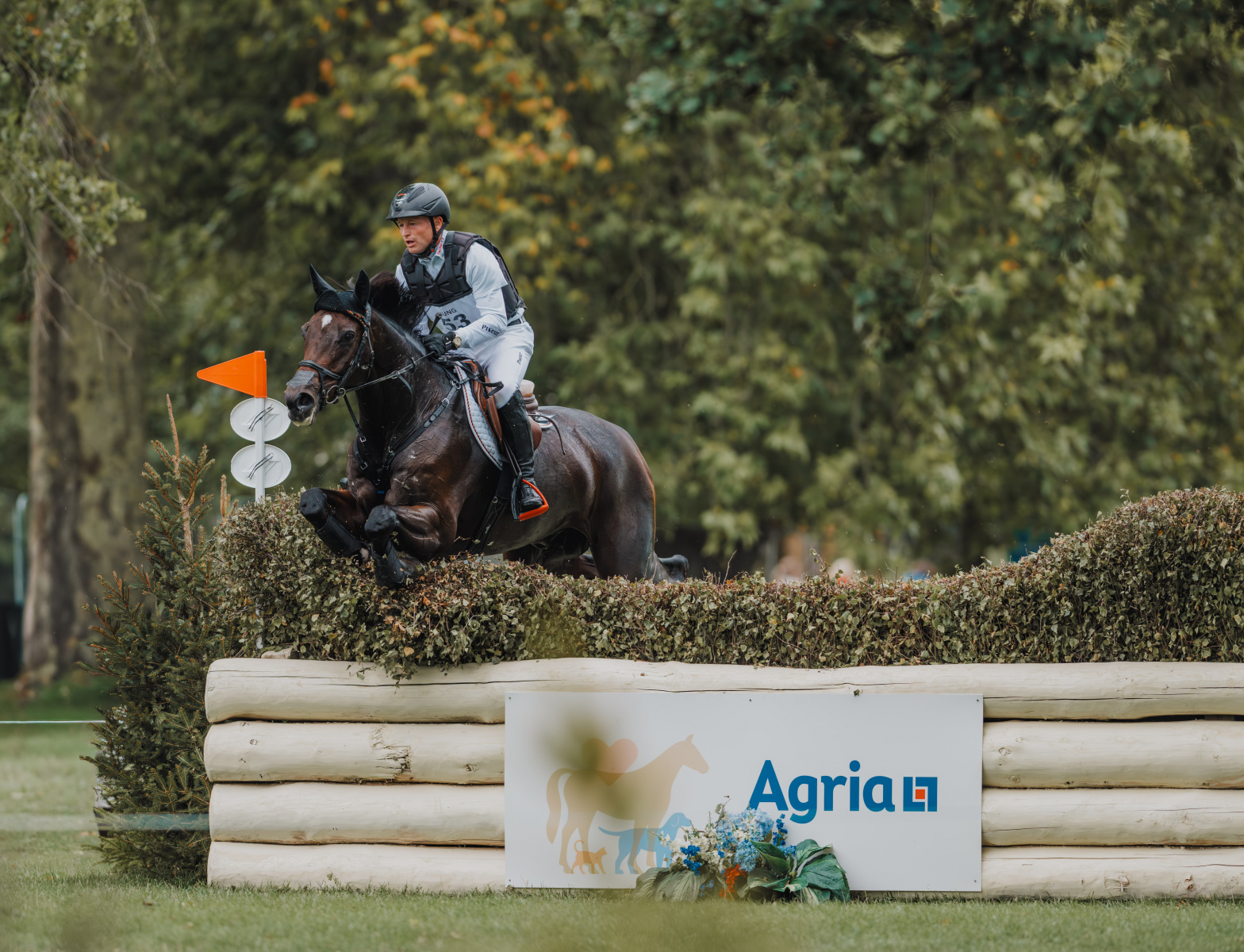
Michael Jung and fischerChipmunk FRH. Photo by Tilly Berendt.
Like many riders today, Michi found himself having to dig deep and really ride at the first combination.
“I think every horse was a bit surprised there,” he says. “But he had a great reaction and jumped it well, and everything else went as I wished. I tried to have a smooth round and not push him too much; to just let him gallop and let him breathe in some places. I had a great feeling everywhere.”
As the third-from-last rider, Michi, like Laura, had a long day of waiting – but, he says, that proved to be a great advantage.
“That’s the good thing when you start in the end, and because we’ve been very lucky with the weather, the ground stayed perfect to the end – so [starting late] meant I could get all the information I needed [without also having worse ground],” he says. “For sure, every horse is different, and every horse has different strong and weak parts, but team Germany had a great day [and gave a lot of information].”
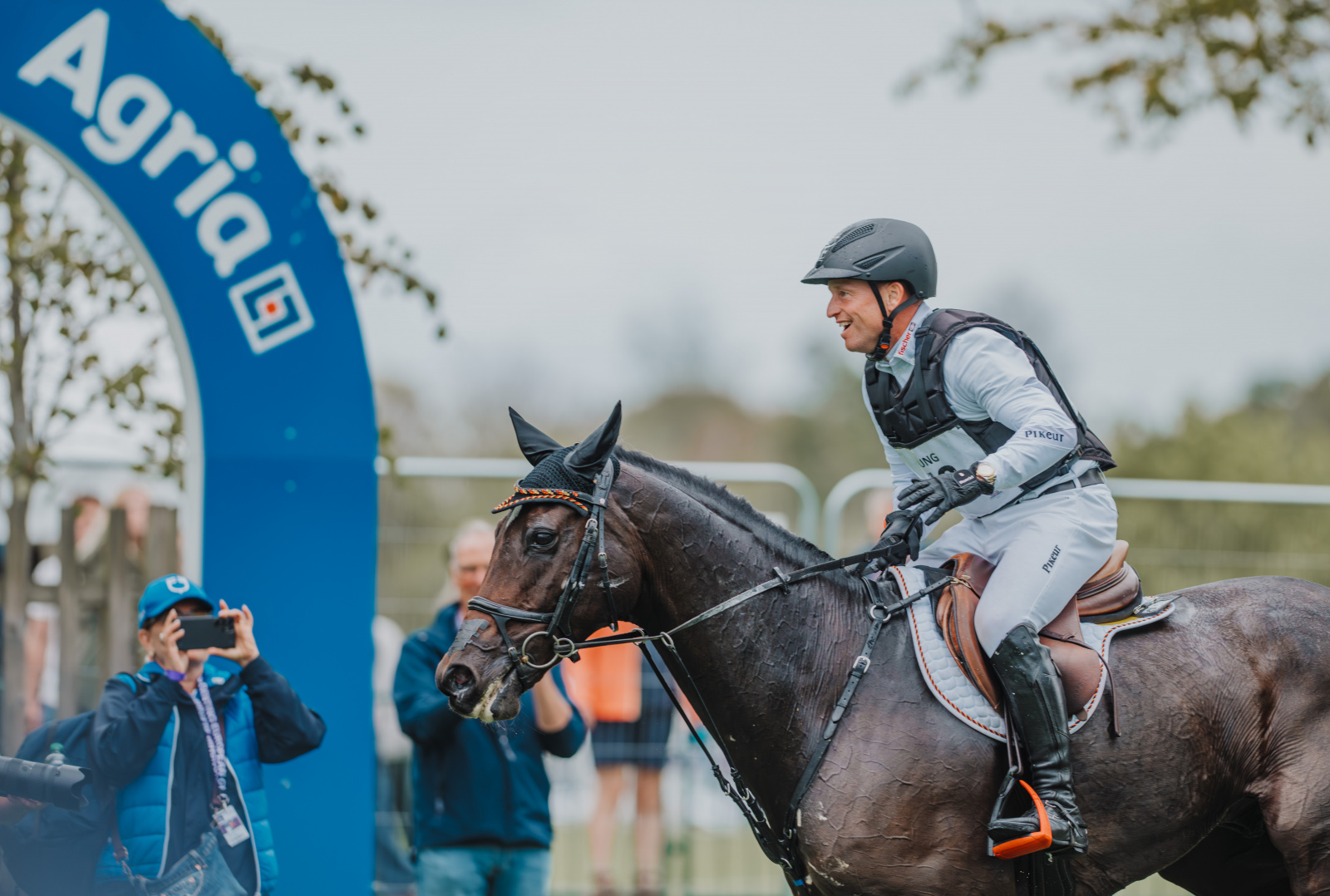
Michael Jung and fischerChipmunk FRH. Photo by Tilly Berendt.
It wasn’t just the riders themselves who contributed to that effort; Arne Bergendahl, here competing in the eight- and nine-year-old CCI4*-S, was stationed up by the palace’s influential early fences, armed with a walky-talky and feeding his observations back to the team at the start.
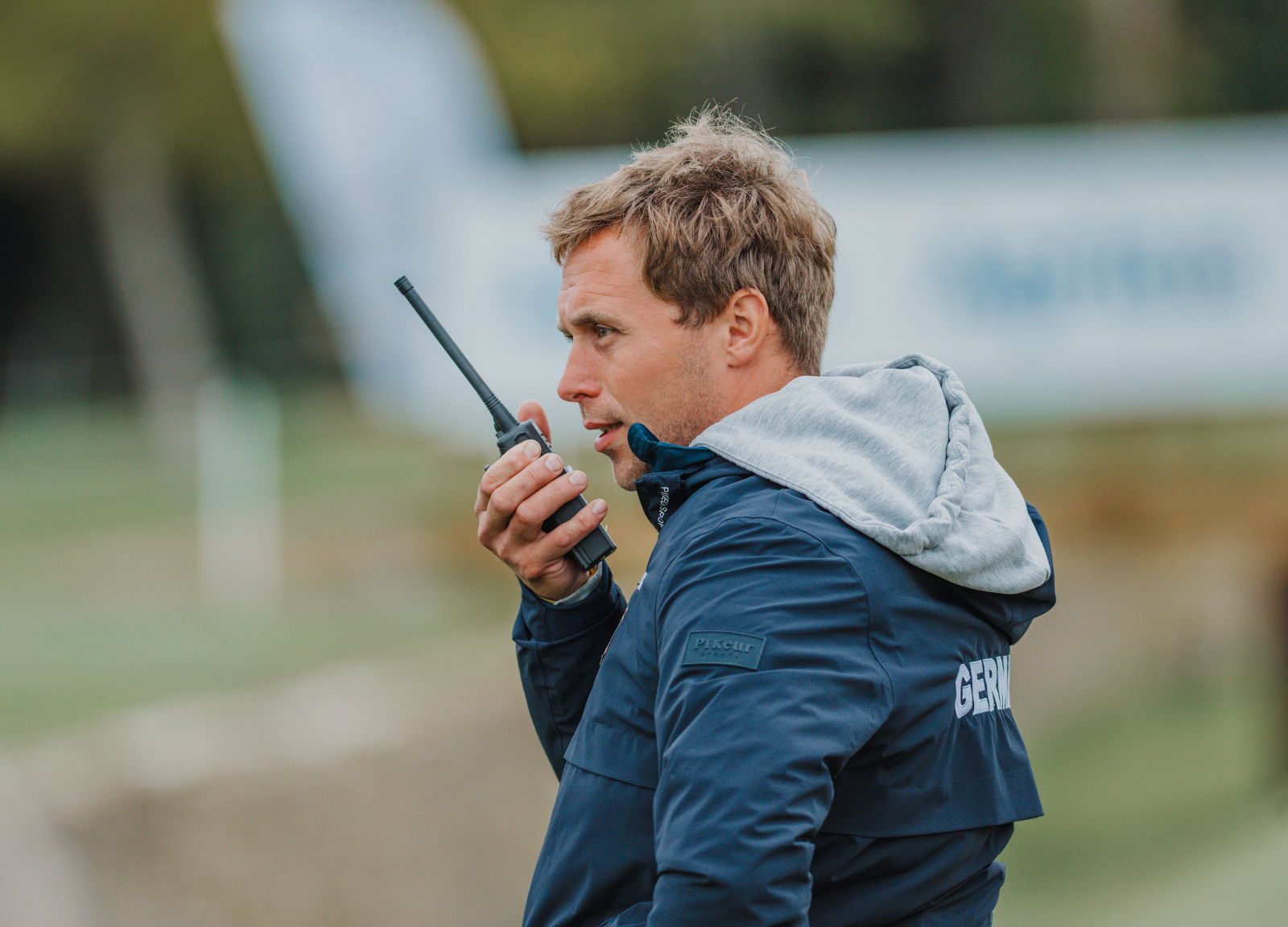
Here’s Arne Bergendahl and his radio if you need him, you’re welcome.
Once out of the start box, though, it’s every man and horse for himself, and in his usual style, Michi focused on rhythm rather than heroics.
“I tried not to over-ride him in the beginning,” he says. “I tried to keep a good feeling and ride as fast as possible in a few places, but then also on the other side, to let him breathe and try to have the last jumps still under control. The feeling was amazing after the last combination – he was full of running to the last fence and really fit.”
Of the Captain’s track he says, “I think it was a very, very good course, because it wasn’t just one combination that made problems for everyone. Everywhere you can have a flag, or you can have a run-out, and the time was really, really short. It was, I think, a good course.”
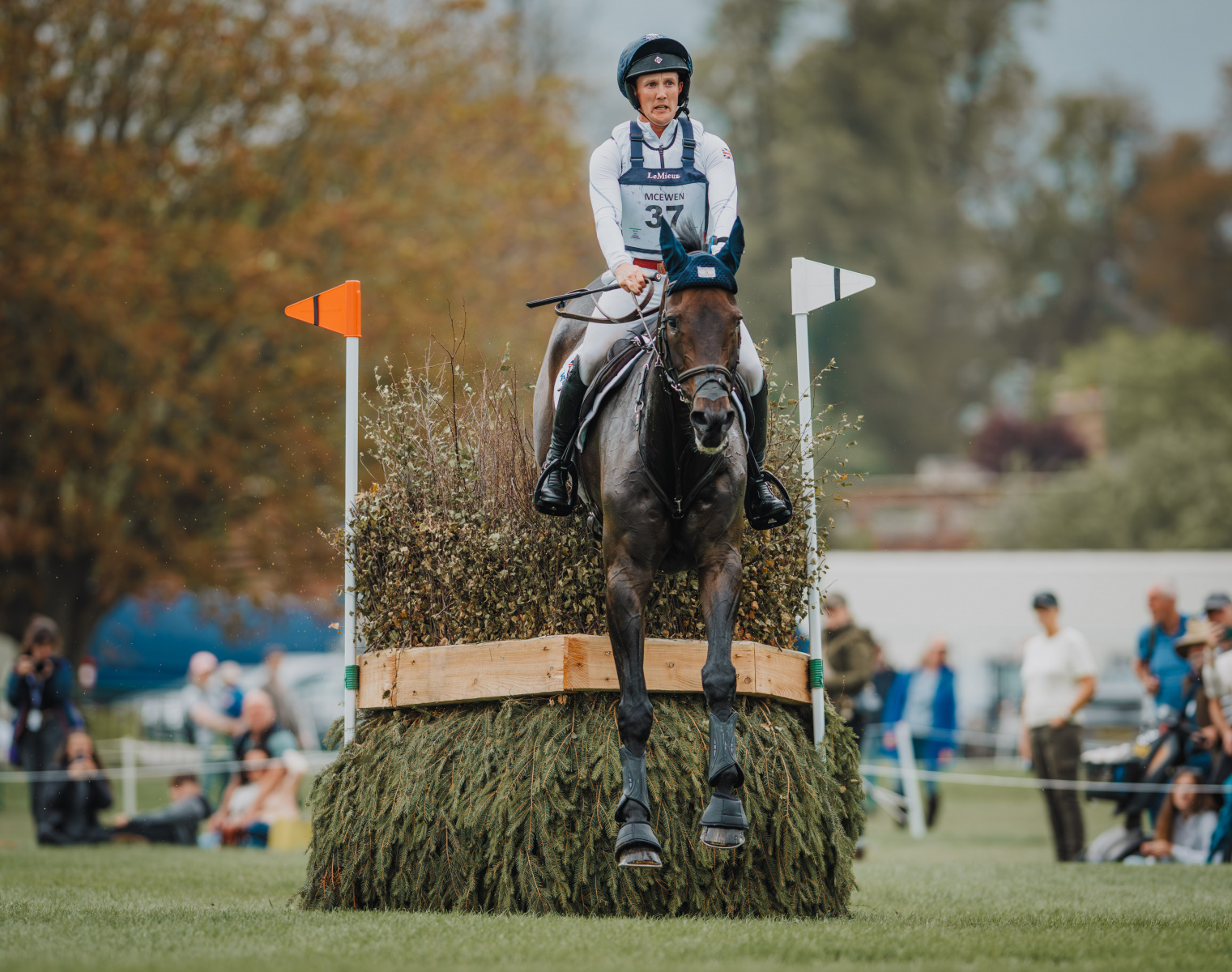
Tom McEwen and JL Dublin. Photo by Tilly Berendt.
Tom McEwen’s excellent effort with JL Dublin sees them retain the third place position they’d held overnight. Like Laura later on, he found himself with a double handful of horse as he set out on course, and a serious venue-wide support system.
“It’s amazing, the English public today,” he grins. “It’s completely full the whole way around, and there are areas where it’s totally packed out. Dubs was just loving it. For me, it was just about settling him down for the first few minutes. Luckily, all the combinations are built on very positive distances, because I was actually holding throughout all of them. He was loving it.”
The course, he says, “suited his way of going, and I could settle him down for the latter part of the course. Mark’s allowed you from beginning to end to be in a flowing rhythm, so the horses really got into that positive state of mind all the way. That meant that actually, the bigger distances later on came up pretty easily.”
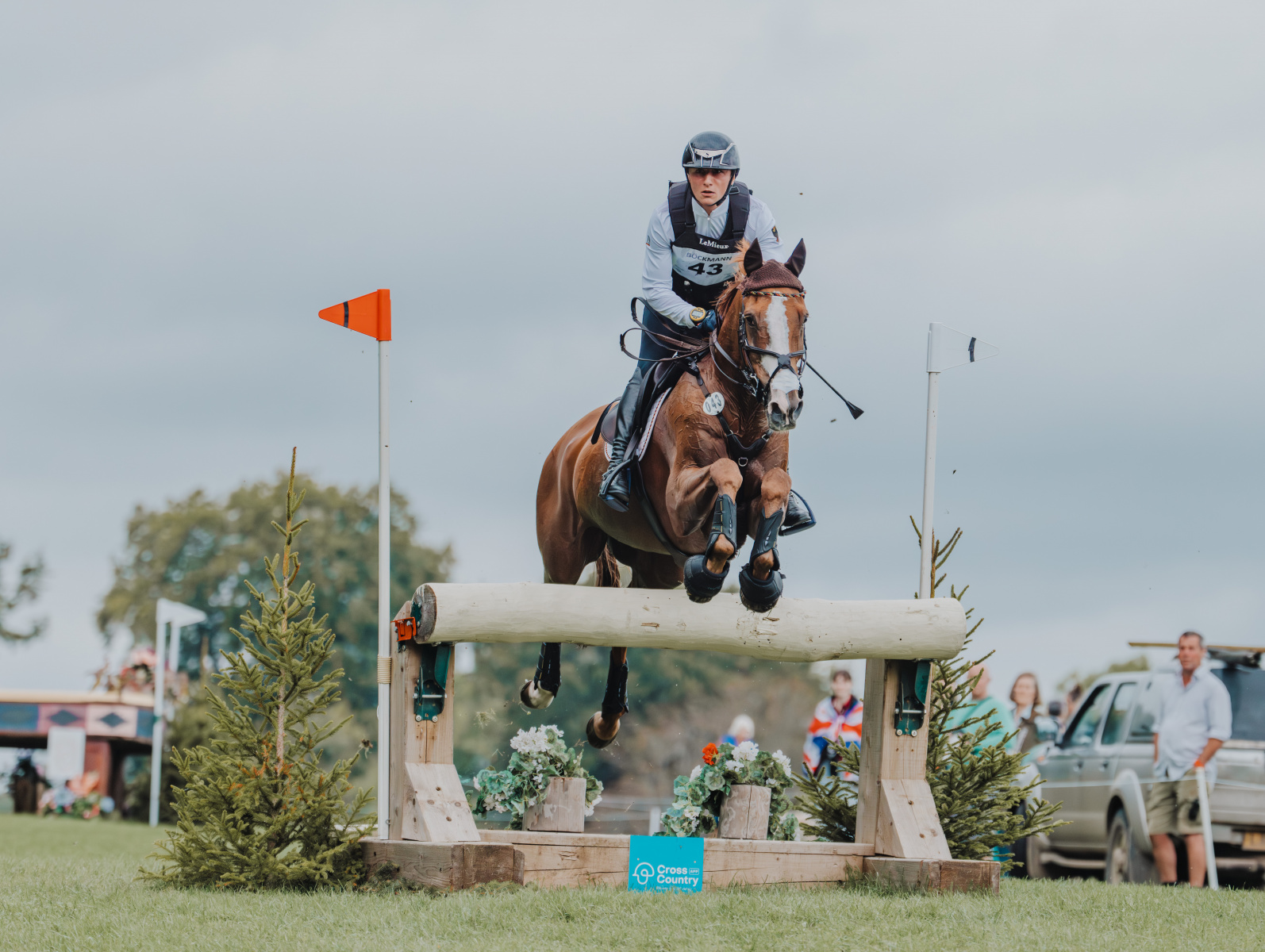
Calvin Böckmann and The Phantom of the Opera. Photo by Jan Frohne.
The fastest round of the day went to an individual competitor, rather than a team rider, but Paris reserves Calvin Böckmann and The Phantom of the Opera gave Germany yet another reason to celebrate when they crossed the line bold, fit, and fresh, on a time of 10:15. That was enough to boost them from 16th after dressage to equal fourth tonight.
“It’s my third time here at Blenheim, and I know Phanty inside and out, but already in the previous years it was tough enough to be inside the time,” says an emotional Calvin, who enjoyed a positive, open-strided ride around the track with his little chestnut gelding. “But that’s just his major strength. I’m quite lucky to have him as my partner because he’s bold, and most of the time being able to see those good distances to just leave out a stride in the turn. That’s where I believe he’s saving the time – that, and still being full of running as he comes up that last hill. It’s an unbelievable feeling – despite the fact that he’s been one of the fastest horses today, it just makes me really happy that he comes into the finish with his ears pricked and he isn’t tired at all; he feels like he could do it all over again.”
The 14-year-old Phanty came into his own on Blenheim’s hilly middle section.
“Whenever I give him some rein and say ‘let’s do this’, I don’t even have to say a thing: he’s an absolute galloping machine, and that was the major strength in this course, even though it was really, really technical. If you weren’t on point the whole time, it was so easy to have tiny mistakes.
“He’s always quite keen to go, and especially today. I truly believe that horses in general are very smart; all of my horses have big personalities and are unique, and with him, he knows when it’s important. Normally he’d be very fresh in the dressage, especially in a grass arena, but this week it was like he knew how important it was, and he behaved so well.”
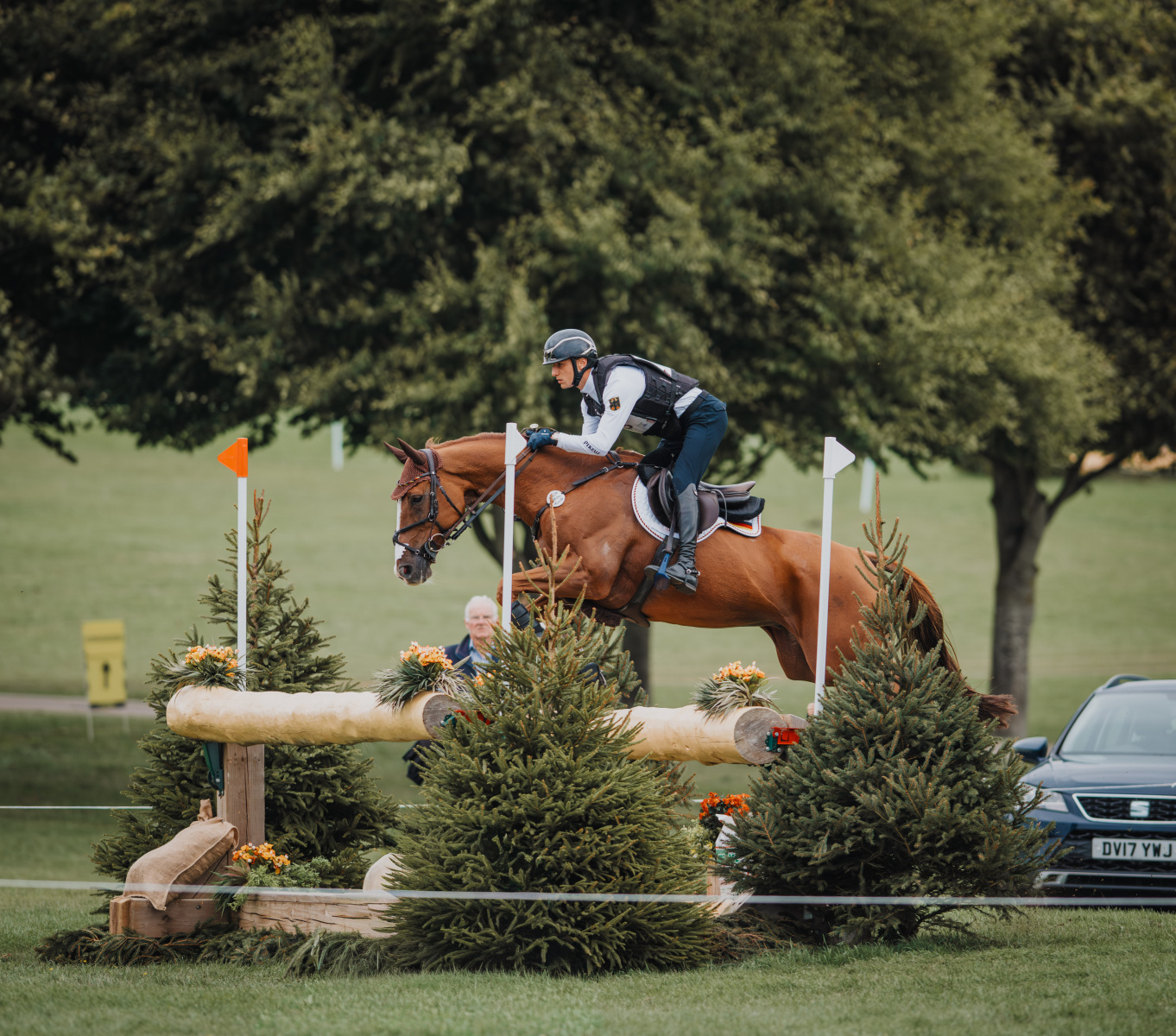
Calvin Böckmann and The Phantom of the Opera. Photo by Tilly Berendt.
24-year-old Calvin has tears in his eyes and his broad grin breaks for a moment as he thinks about his game little white-faced, wall-eyed horse, with whom he’s twice completed Kentucky, finished second at Aachen, and now made his Senior European debut.
“He means the world to me,” he says. “Just being able to have these experiences – of course, it’s amazing to have a good result at the end, but just to live in this moment and have these experiences with him, and to tackle a course like this with a crowd like this, it’s just something that means a lot to me. It’s something that me and my family and my whole team have worked towards for many years now, and I’m very grateful that it’s all coming together now.”
The pair are excellent showjumpers, without a rail to be seen in their last seven FEI jumping rounds, but, says Calvin, “I’m going into tomorrow without any expectations – I’m just grateful for today. Most of the people on the leaderboard around me have been here quite a bit longer than me already, and so I’m just grateful to be here with them – and to have had Phanty by my side today.”
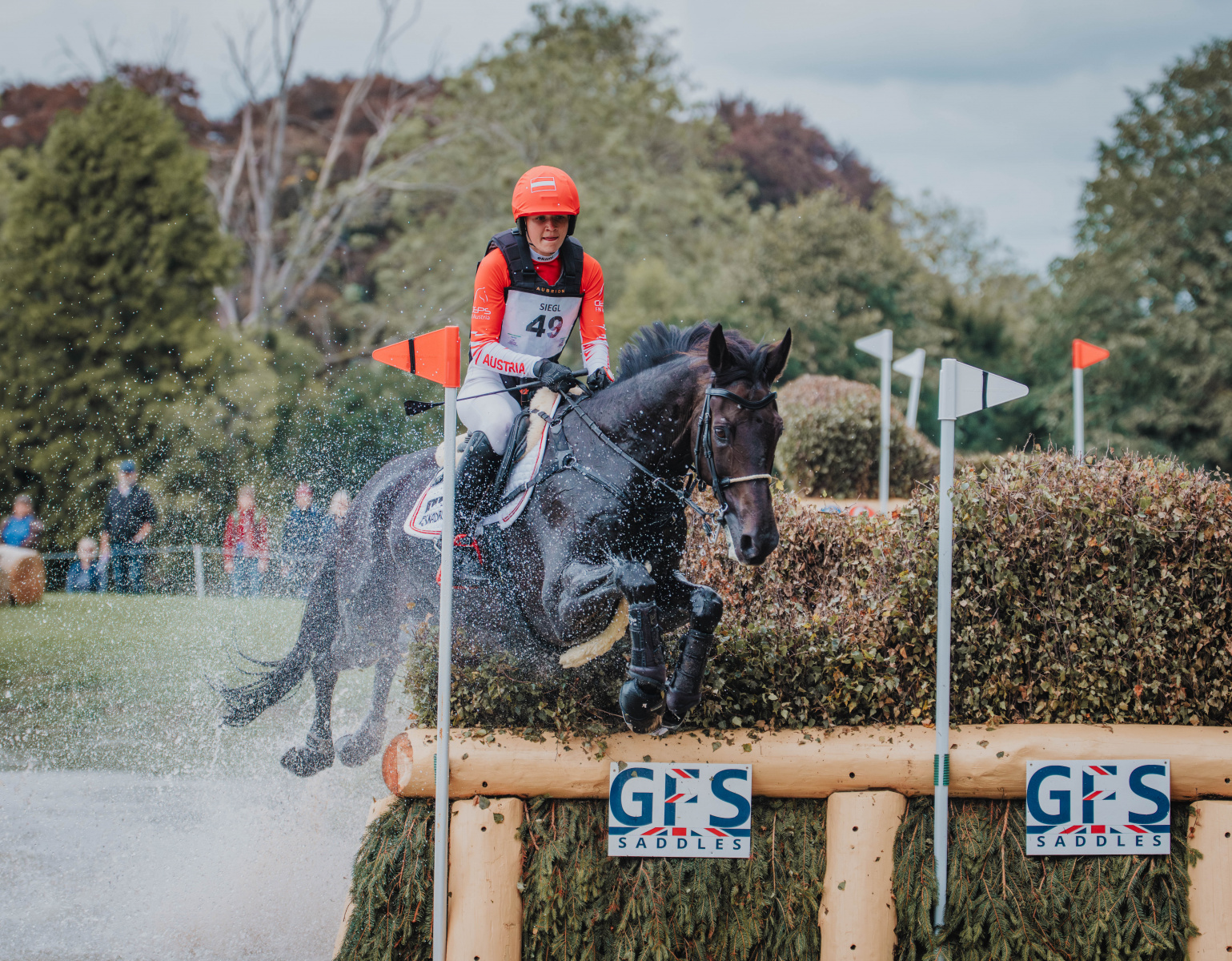
Lea Siegl and Van Helsing P. Photo by Jan Frohne.
Austria’s Lea Siegl and Van Helsing P added 9.2 time penalties to sit equal fourth with Calvin, and secure overnight fifth place for her team, too, in an incredible plot twist for this week’s team leaderboard.
“It was amazing,” she says with a smile. “It was fun to ride, and the audience was incredible, and we just enjoyed it. We had a forward rhythm, and I was so proud of how brave he was.”
Her ride, she continues, went “according to plan” – other than an unexpected hold of a few minutes, while fence repairs were carried out ahead of her.
“I got stopped at minute four, between fence 13 and 14, and so I tried to cool him down there,” says Lea. “The people standing there were quite nice and had sponges to help cool him down, so he was calm and relaxed. But it’s a bit of a rhythm-breaker if you have a stop in the middle of the course, so we had to make sure to find that forward rhythm again quickly.”
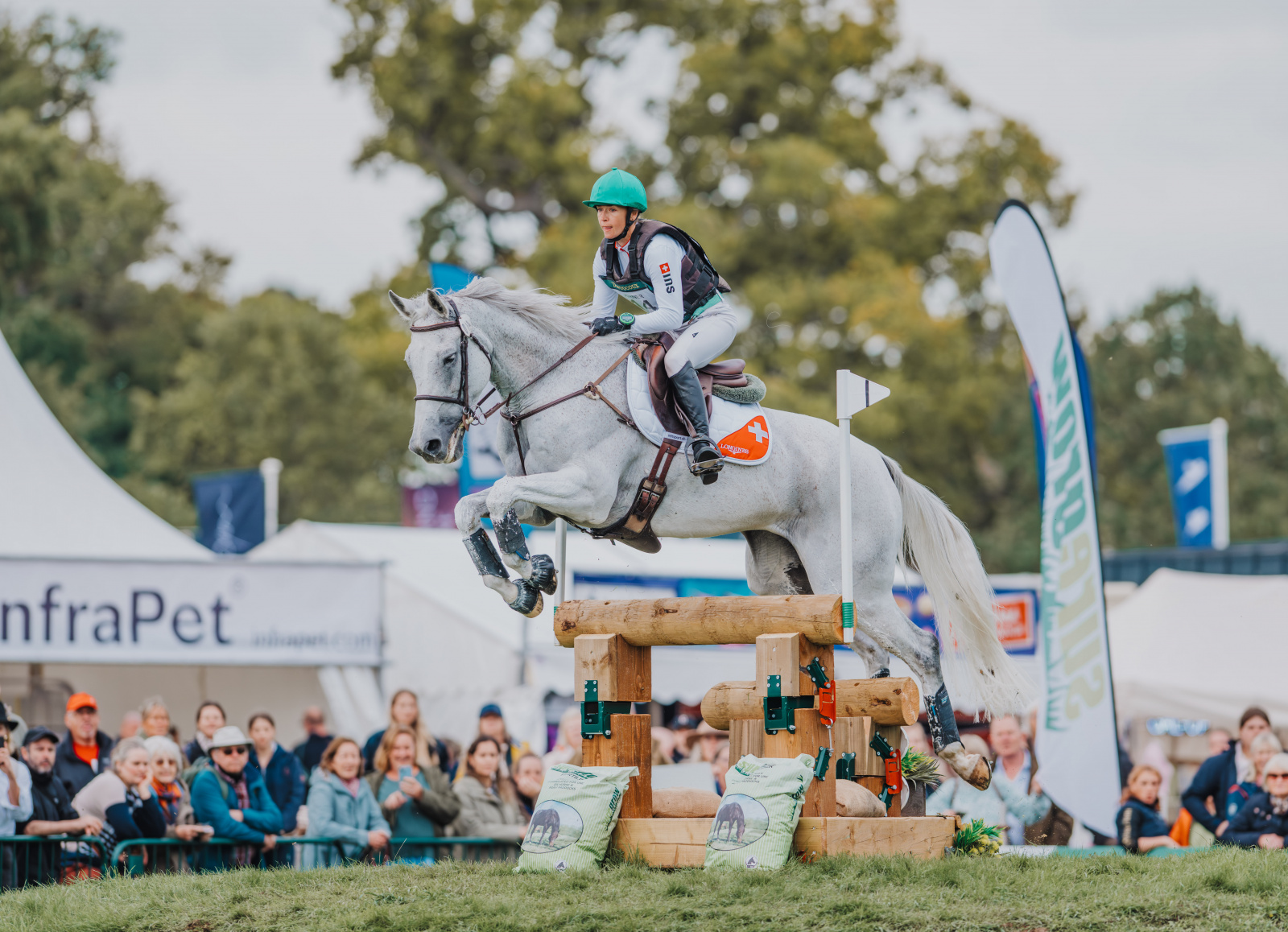
Mélody Johner and Erin. Photo by Tilly Berendt.
The Swiss team this week is full of experienced riders, all four of whom have been on the last handful of championship teams, but three of the four are riding young, inexperienced, or ‘second string’ horses, in a bid to create strength in depth for the next Olympic cycle. This isn’t a bad start: though both Felix Vogg and Frieda and Robin Godel and Global DHI picked up 20 penalties on course, Nadja Minder’s pathfinder round and the smart, swift clear of Mélody Johner and Erin mean that the team finds itself in bronze medal position overnight. Mélody, for her part, will head into the final day in sixth place, having added 8 time penalties with the ten-year-old Spanish-bred gelding and climbed up from 18th as a result.
On course, she says, he both thrived and learned.
“Everywhere I rode as I’d wanted to, but just at the oxer to the corner at 22, that wasn’t so easy for him,” she says. “He just didn’t really know where he was supposed to go, but he trusted me, so that was good – but he lost a shoe somewhere, and I could feel that he was slipping a little in the turns, which meant I didn’t go as fast as I wanted. Luckily, he’s naturally fast.”
She did, she admits, have a moment of doubt just before heading out onto the influential track.
“We make a crazy sport, I think. When I’m in the starting box, I really ask myself every time why I’m doing this sport,” she laughs. “But when we’re going, it’s such a pleasure and so wonderful to ride that I answer the question for myself.”
Mélody has been entrusted with the ride on Erin by Swiss team cross-country coach Andrew Nicholson, who produced him to CCI3*-L.
“It’s a special one for Andrew, and it’s special for me that he trusts me to ride this horse,” says Mélody, who took the reins in early 2024. “It’s a partnership not just between the horse and me, but between Andrew and I. I think we really have to work the future years together, and that’s really a pleasure.”
The long-term aim for the gelding, she continues, “was always for Aachen next year, and not necessarily the Europeans this year, but we were ready – and so it’s just 100% positive for the future and for the experience. The future looks bright!”
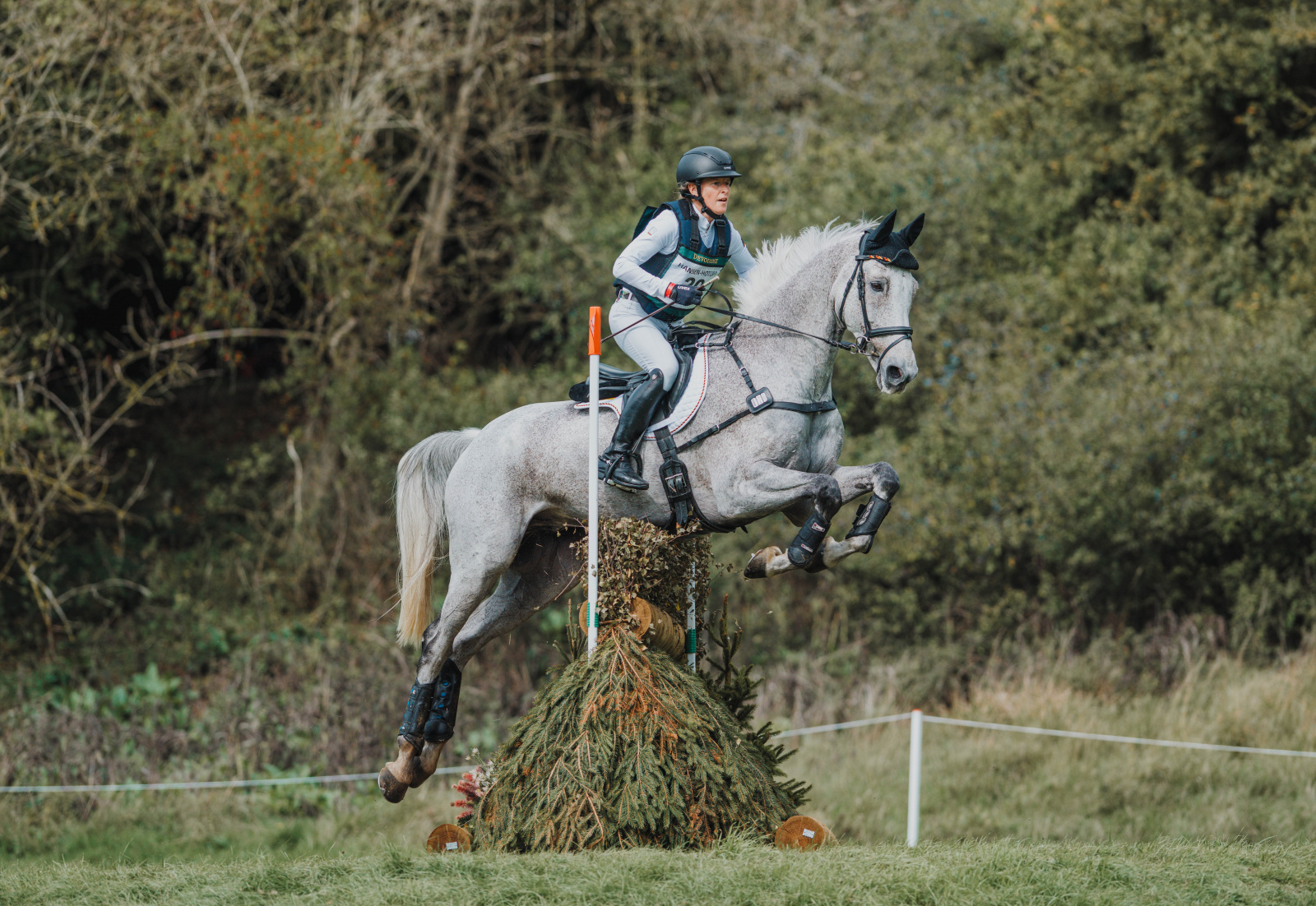
Malin Hansen-Hotopp and Carlitos Quidditch K. Photo by Tilly Berendt.
Germany’s Malin Hansen-Hotopp and Carlitos Quidditch K have previously won at Blenheim, back in 2022, and so huge hopes rested on their shoulders – and they didn’t disappoint, adding a respectable 14 time penalties to their tally to move from 6th to 7th place, and bolster that German bid for team gold.
“He was so focused on all the technical stuff – I could really ride him, and he really carried me,” says Malin. “I think it’s a really tough course: when we walked the first time we all said, ‘oh, it’s not very big’ – we’ve all ridden five-stars, so it didn’t seem so bad. But there are a lot of angles and technical things, and I spoke to Bettina [Hoy], and she said, ‘that’s typical for the Captain: the technical stuff gets you if you want to ride fast.’ So we all spoke about it and decided it would be a tough course, and it was.”
Her previous form here with ‘Schimmi’ was an enormous confidence boost as she left the start box.
“Three years ago, my horse was really full of power in the finish, so I had that in mind. I just made sure to let him breathe at the top after the water, and let him canter like he wanted to, and then I was able to speed up again when I needed to.”
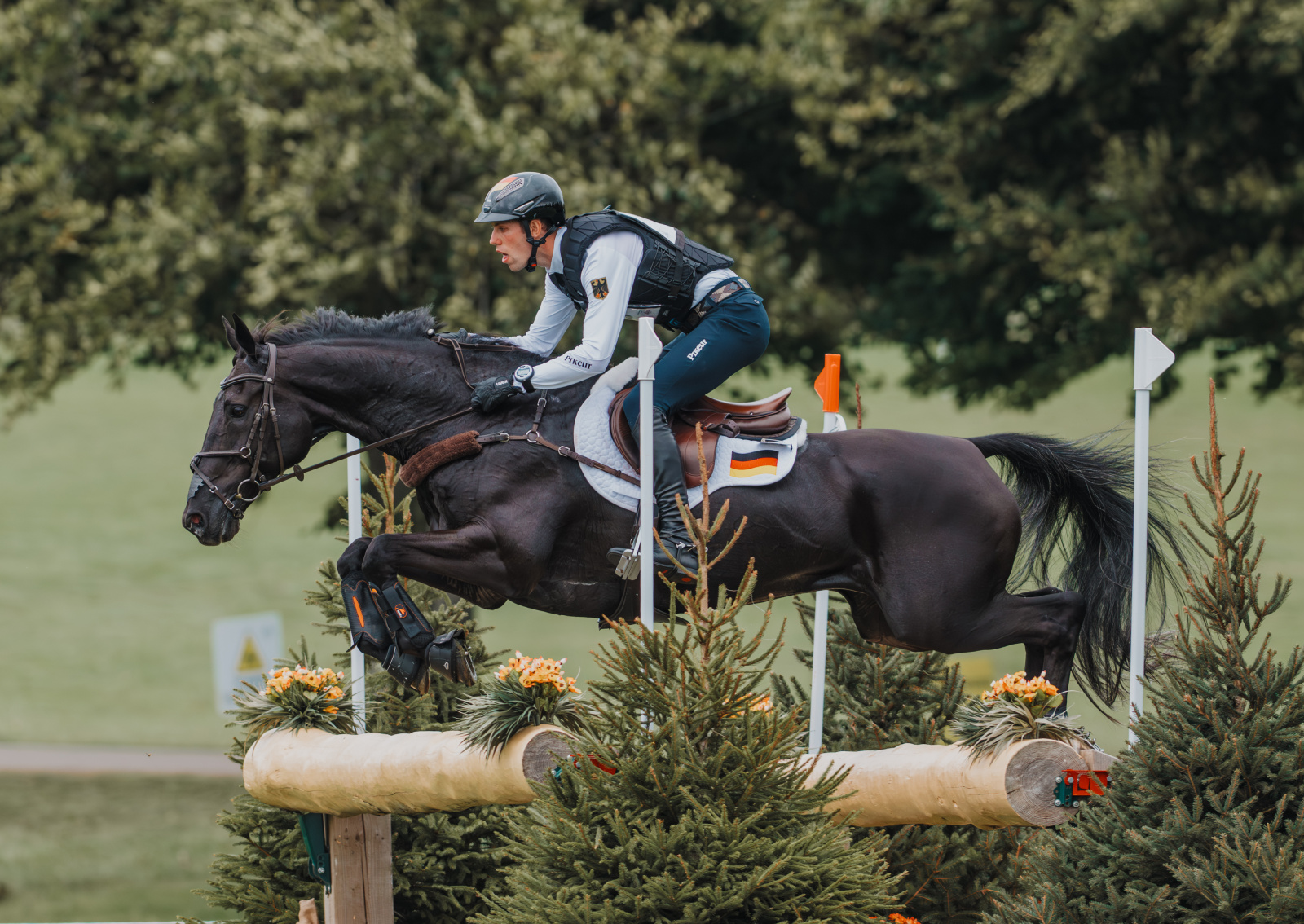
Jérôme Robiné and Black Ice. Photo by Tilly Berendt.
Germany also holds 8th place, thanks to a 13.2 time penalty round from young talent Jérôme Robiné and the crowd favourite Black Ice, whose long stride gobbled up the forward distances in the combinations on course. They had a moment of excitement at the top water at 20ABC when Black Ice opted to make a planned five stride line into four – but there was never a moment in which he wasn’t going to make it to the other side of the fence.
“I’m more than happy,” says Jérôme, who steps up from overnight 15th place. “He’s quite an honest horse – you just point him somewhere and he’ll go over it. In the first minutes I was quite happy with how we were galloping and we were quite good on the time, but the middle bit is quite intense with question after question, and that costs a lot of time.”
A later draw meant the Jérôme could absorb plenty of vital intel and adjust his plan of action – with some insights from a certain teammate, too.
“We could get proper information from the morning. There were some combinations we wanted to ride differently before, and then we realised [from watching] what was the best way. We learned a lot, and I think especially when you have an experienced rider like Michi on your team, it’s good to sit next to him and watch!”
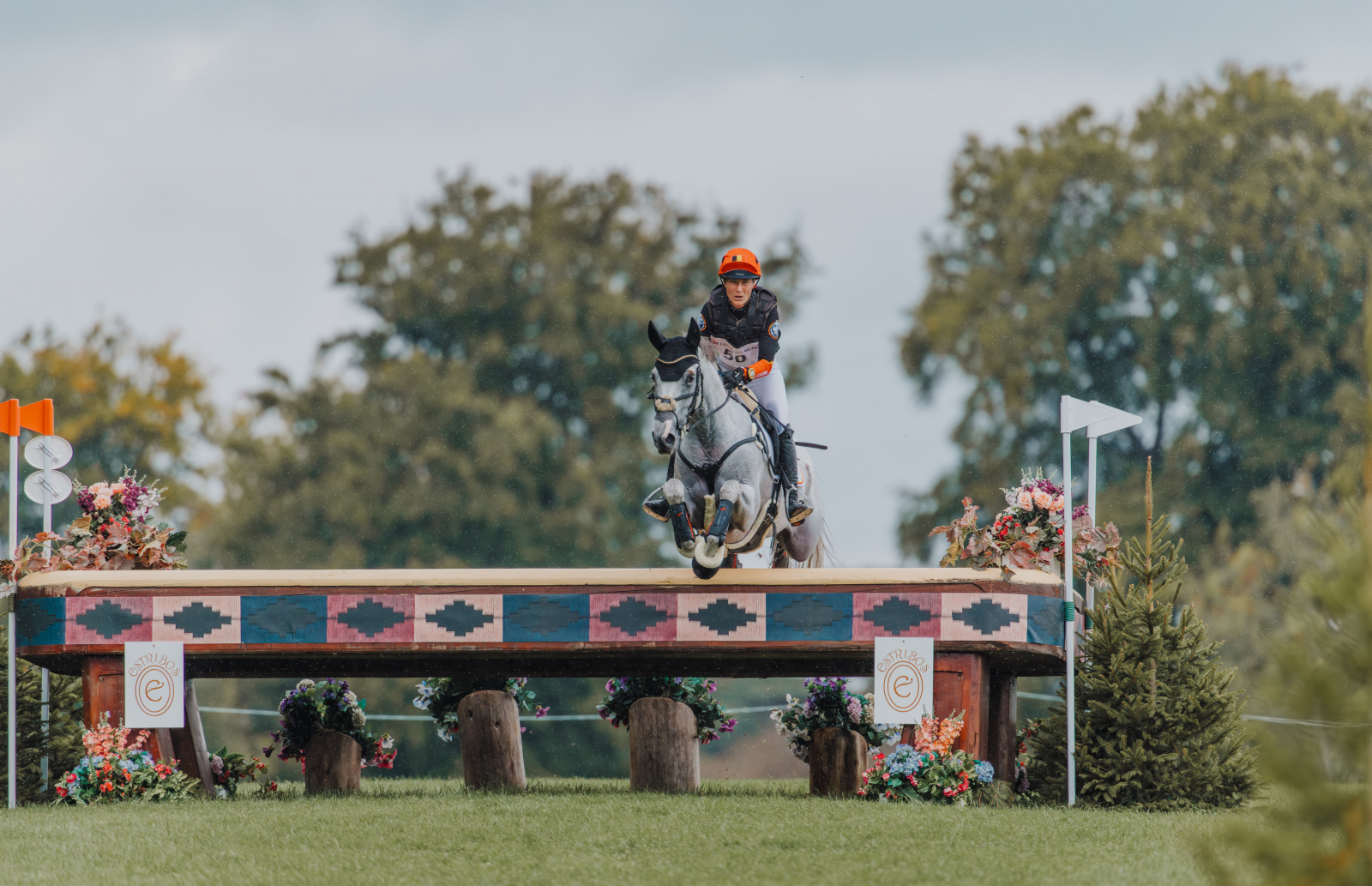
Lara de Liedekerke-Meier and Hooney d’Arville. Photo by Jan Frohne.
Belgium is, unfortunately, no longer a contender in the team leaderboard after the withdrawal of Senne Vervaecke and the retirement of Wouter de Cleene, but Lara de Liedekerke-Meier and her Luhmühlen CCI5* winner Hooney d’Arville can continue their bid for individual plaudits after a confident round saw them add 16 time penalties. That drops them down a few places; they were fifth after dressage on a smart score of 27.7.
“She did really well; she tried her heart out for me, and I’m really, really happy,” says Lara, who was initially awarded a flag penalty at the last combination, but swiftly had it removed from her scorecard.

Ian Cassells and Millridge Atlantis. Photo by Tilly Berendt.
Ireland’s Ian Cassells rounds out the top ten after closing out our day of competition with a super round aboard Millridge Atlantis, which added 13.6 time penalties to their tally, pushed them well up the rankings from 22nd – and secured Ireland’s overnight silver medal position.
“It’s amazing – this is my second championship, so to be part of the team with a little bit more experience than last time is amazing,” grins Ian. “There was a bit of pressure to put on for the team, but thankfully the orders came through and we’re in silver now, and in the top ten individually.”
Ian’s excellent and team-affirming round came despite a couple of little mishaps on course.
“It didn’t go to plan, as such, and we had to get it done, but that’s cross-country riding. At the rollercoaster I lost my stirrup at the B, and I thought I’d just drop down the hill, and then he drifted left, which caught me by surprise,” he says. Then, “I’d planned to do five in the pond [at 20ABC], but he landed so big that I thought I’d commit and go for the four.”
And, he tells us, the horse also lost a shoe: one of three Irish team horses today to lose the front left one, which is certainly a testament to consistency, anyway.
All the way around, he says, “there was definitely pressure. I wouldn’t think of myself as someone who gets nervous, but I think it’s more the will to do well, and in a team competition that’s heightened by the want to do the best you can for your team.”

Switzerland’s Robin Godel and Global DHI. Photo by Tilly Berendt.
Six of the top ten horses and riders after dressage remain in that business-ended bunch after cross-country, and we’ll head into tomorrow’s competition with 42 horses and riders still in the hunt. There’s that very tight margin of just 1.7 penalties between our individual first and second place riders, but in the team leaderboard, the gold is beginning to look pretty well sewn up: Germany boasts an overnight aggregate score of 113.7, 37 penalties (or nine-and-change rails) ahead of Ireland. Switzerland are just over ten penalties behind them in bronze, while France is waiting close behind in fourth place. Austria holds fifth overnight, Italy holds sixth, and everything after that is a thousand or more penalties behind, so we won’t rub salt in the wound by dwelling on that for much longer.
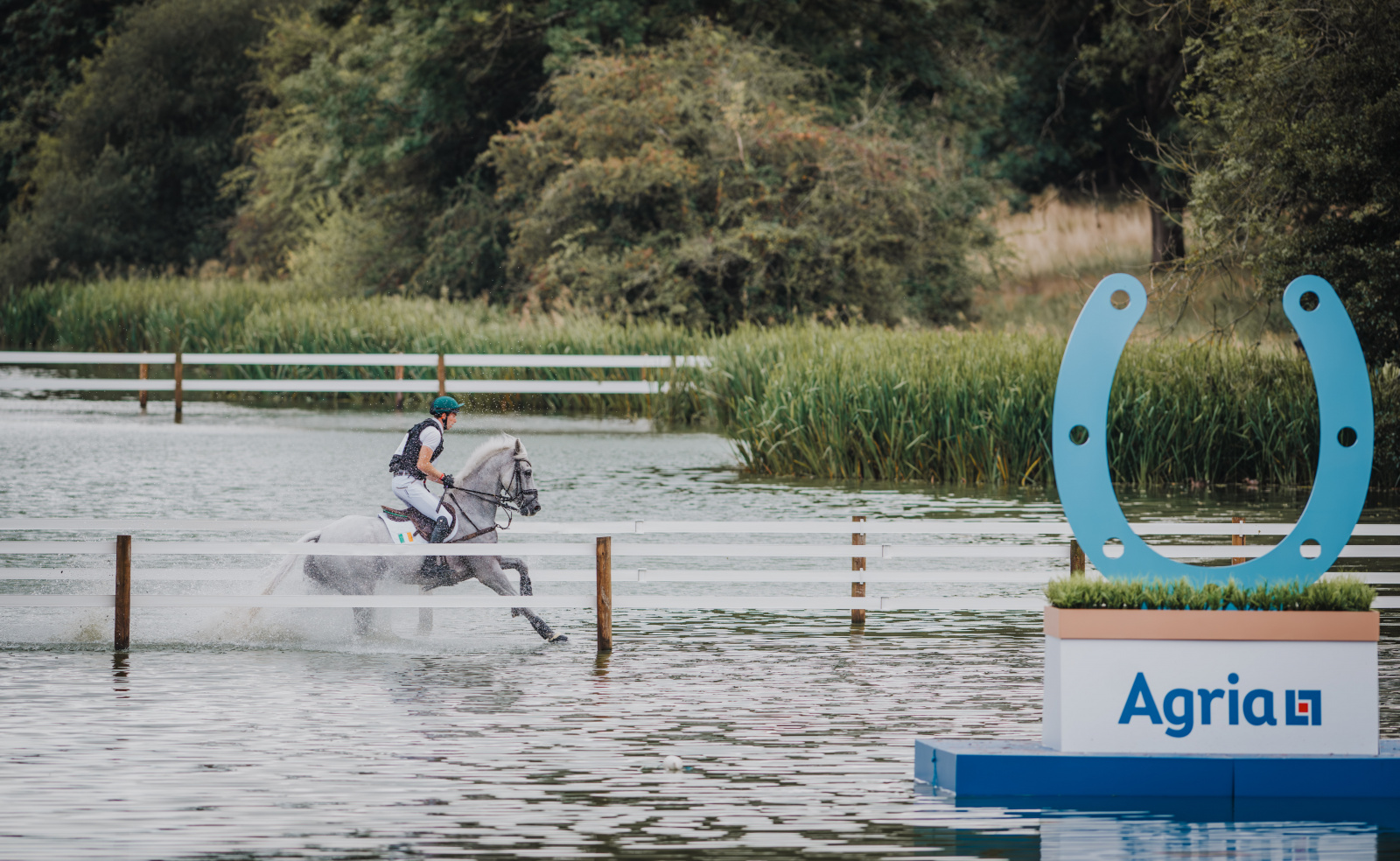
Ireland’s Robbie Kearns and Chance Encounter cross the river while delivering one of the most impressive rounds of the day. Photo by Tilly Berendt.
Course designer Captain Mark Phillips ended the day by making a salient point about what the top of our leaderboard means, especially where the conversation about good dressage horses in eventing is concerned.
“There weren’t that many horses here with the possibility of getting around inside the time, but actually, what you saw in the end was three of the best-trained horses, the horses that are the best-trained in dressage [getting close], because it was that training that allowed them to go quicker than nearly anybody else. Look at how economical they could be: it was just another league above most of the others.”
Tomorrow’s competition will get back underway at 8.00 a.m. BST (9.00 a.m. CEST/3.00 a.m. EST) with the final horse inspection. The showjumping will be split into two parts, beginning at 11.00 a.m. BST (12.00 p.m. CEST/6.00 a.m. EST) and resuming at 14.00 BST (15.00 CEST/9.00 a.m. EST). We’ll be back in an actually worryingly short amount of time with the next instalment of all the pertinent news you need from this year’s European Eventing Championships. Until then, Go Eventing!
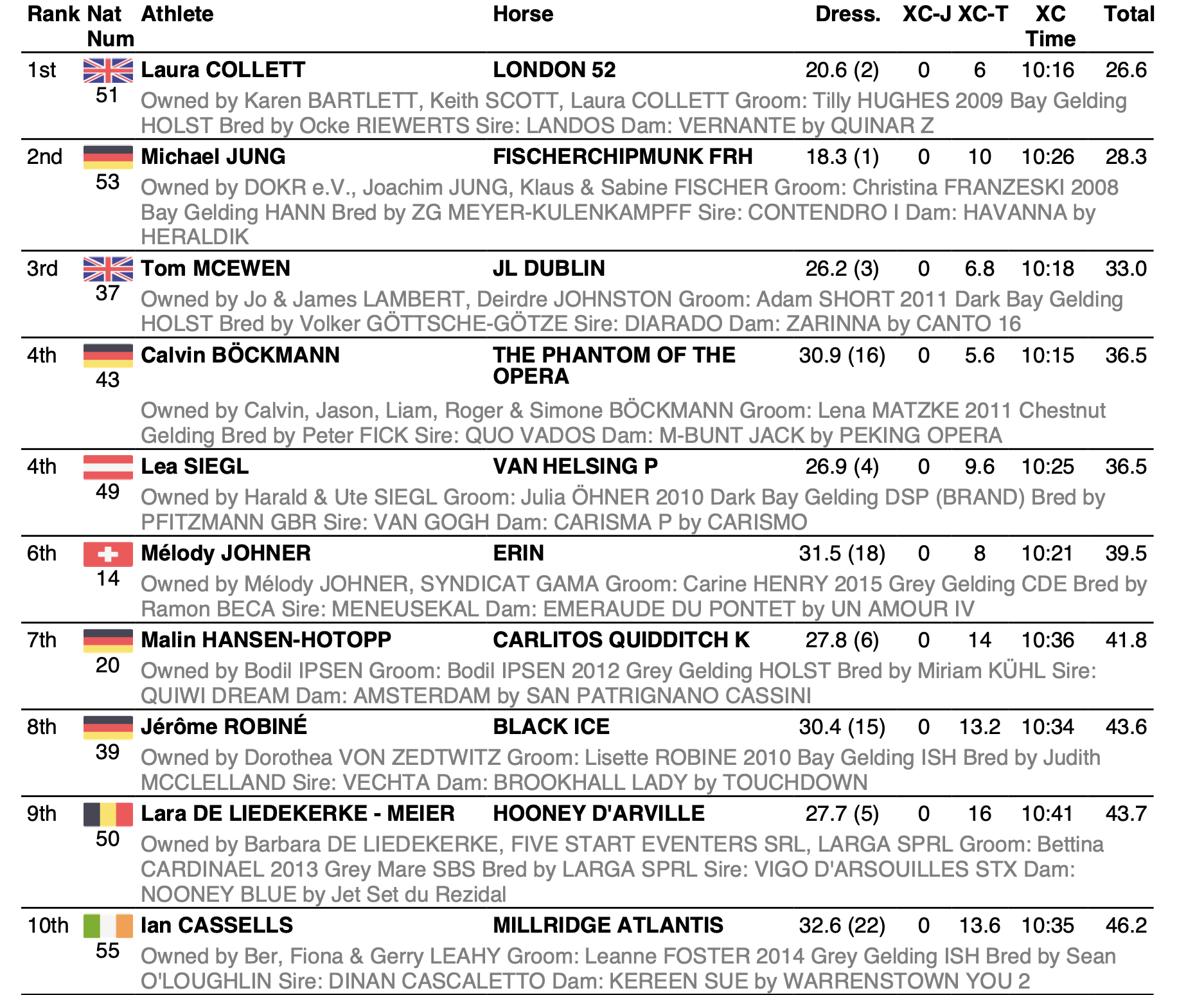
The individual leaderboard at the end of cross-country.
EN is proud to welcome Horsepal onboard as the sponsor of our European Championships coverage! Horsepal is a newly-launched heart rate monitor brought to you by Tom MacGuinness, founder of Horseware and an FEI eventer and endurance rider, who’s brought his decades of knowledge to practice in the design of Horsepal. You can now purchase Horsepal directly to the UK and Europe — learn more here.
Agria FEI European Eventing Championships at Blenheim: [Website] [Tickets] [Live Stream] [BBC iPlayer Broadcast] [FEI YouTube Streams] [Entries] [Timing & Scoring] [CrossCountry App XC Map] [EN’s Coverage] [Support Our Sponsor: Horsepal]