




Photo via Jumping International de Bordeaux 2026






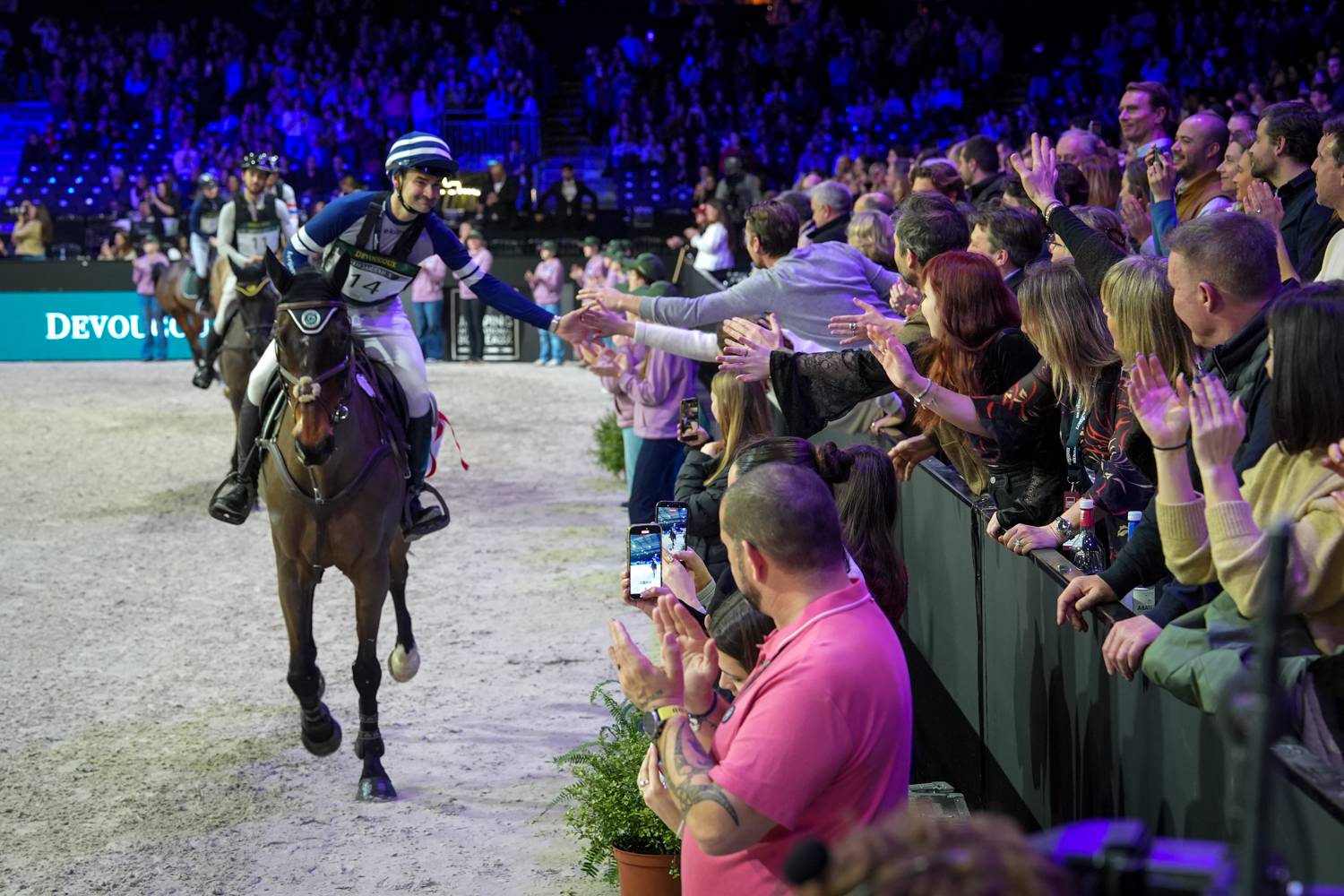
The Devoucoux Indoor Derby has become one of the most distinctive features of the Jumping International de Bordeaux, repackaging cross-country into a compact, spectator-first format. Run over roughly one kilometre, across around 20 obstacles and multiple technical zones, it transforms a discipline traditionally defined by open terrain into an arena experience built for atmosphere and crowd connection.
If show jumping delivers Bordeaux’s prime-time Saturday night headline, and Driving carries the late-night championship drama with the opening round of the FEI World Cup Final, Eventing provides something altogether different: Innovation.
It is, quite simply, Bordeaux’s invention, and it sits at the heart of what makes this show different.
With international four-star dressage joining the programme this year, Bordeaux now explicitly brings together Jumping, Eventing, Dressage and Driving under one roof; giving its audiences access to multi-discipline elite sport with a big-stadium feel often reserved for non-equestrian sports.
A Bordeaux signature
Cross-country is not meant to live inside exhibition halls, and yet Bordeaux has spent years refining a version that does exactly that. While Bordeaux cannot claim to have invented indoor eventing outright, it has been instrumental in turning the concept into a repeatable, elite competition format. Earlier indoor cross-country showcases existed elsewhere, but Bordeaux formalised the idea, shaping it into a core part of their programme.
The format of the Devoucoux Indoor Derby blends speed and accuracy from your regular cross country into a tightly designed course, asking riders to switch instantly between galloping rhythm and showjumping precision. It offers something rare: A fast, arena-based version of eventing that connects immediately with live crowds and broadcast audiences.
In a weekend increasingly defined by multi-discipline crossover, the Derby plays a crucial role. It bridges traditional eventing with modern indoor presentation, reinforcing Bordeaux’s ambition to be more than a Jumping qualifier and positioning the show as a genuine multi-sport equestrian gathering.
An international start list under Friday night lights
Friday’s Devoucoux Indoor Derby brought together a compact but international field, blending French regulars with riders familiar to the wider FEI circuit.
The start list featured combinations from France, Switzerland, the Netherlands, Thailand and Spain, including Mélody Johner, Janneke Boonzaaijer, Albert Hermoso Farràs and Korntawat Samran, alongside a strong French contingent led by Benjamin Massie, Quentin Faucheur and Julie Simonet.
It is a line-up that reflects the Derby’s growing international relevance, with riders who regularly feature on the outdoor eventing circuit now treating Bordeaux as a legitimate winter target.
Friday’s results: Speed decides everything

Benjamin Massie and Cupidon du Cardonne. Photo via Jumping International de Bordeaux 2026
The Derby rewarded commitment and pace, and riders entered the arena knowing that a conservative round would not pay off. The format of the class itself demanded decisiveness similar to that we love from any cross-country round: Attack the lines, trust the horse, and keep the rhythm through tight turns.
What makes the Devoucoux Indoor Derby particularly compelling is how it blends experience with experimentation. Seasoned campaigners approach it as a chance to test responsiveness and form, with younger horses gaining valuable exposure to a big atmosphere. The footing also gives riders the opportunity to experiment with lines and strategies they are less likely to attempt on a traditional course.
When the dust settled, it was France’s own Benjamin Massie who claimed victory aboard Cupidon du Cardonne, stopping the clock in 115.51 seconds with zero penalties. He was followed closely by fellow Frenchman Quentin Faucheur on RNH Mc Ustinov in 117.17, with Korntawat Samran (THA) taking third place on B.Grimm Uster de Chanay in 117.22, underlining just how narrow the margins were at the top of the leaderboard.
Behind them, Verane Nicaud, Julie Simonet, Janneke Boonzaaijer and Jeanne Rossez all produced clear rounds, with positions decided almost entirely on time, while Mélody Johner also finished fault-free further down the order. In total, twelve of the sixteen starters completed with zero penalties, turning the Derby into a pure race against the clock.
A founding venue, still pushing boundaries
As Cupidon du Cardonne crossed the line and the crowd responded to another tightly fought finish, the message was clear: Bordeaux is not just hosting eventing indoors. It is actively reshaping how the sport can be experienced, and that willingness to innovate fits neatly with Bordeaux’s broader history.
The show is one of the surviving venues from the inaugural World Cup season of 1978 to 79, a founding stage that has witnessed the evolution of indoor equestrian sport across generations. Today, that legacy is expressed not just through Jumping and Driving, but through eventing’s reinvention as an arena discipline. Once defined almost exclusively by sprawling outdoor tracks, the discipline is now increasingly experienced through arena-based formats like Bordeaux’s and CHI Geneva’s, extending accessibility during the off-season and reinforcing that eventing deserves the same visibility and airtime as the other FEI disciplines.
Modern equestrian sport increasingly relies on cross-discipline storytelling, and Bordeaux leans into that format, presenting a schedule where Jumping, Dressage, Driving and Eventing feel interconnected rather than siloed. The Devoucoux Indoor Derby is not simply a novelty class bolted onto the programme, and represents a central pillar of Bordeaux’s identity, offering fans a fast, dynamic version of eventing.
In a weekend defined by prime-time Jumping and the very height of the four-in-hand World Cup series, the Indoor Derby stands perhaps as Bordeaux’s most original contribution – a reminder that innovation, when done well, can sit comfortably alongside tradition.
This piece was contributed by Equerry / Co