


Articles Written 151
Article Views 229,477

Veronica Green-Gott

Achievements

About Veronica Green-Gott

Latest Articles Written

Welcome to Eventing: What to Wear to Your First Horse Trial

Photo by Christine Quinn Photography. Photo by Christine Quinn Photography.

Eventing is unique from any other discipline in that it has three different phases requiring a few outfit changes. If you’re getting ready to head to your first ever horse trial, it can be confusing to know what to wear for what phase. Whether you’re an adult amateur who’s new to eventing or a parent of a riding school student who’s about to take the plunge into the world of horse trials, the need-to-know info is largely the same.

Most riders wear one or two pairs of breeches per horse trial. The main requirement is that you have a pair of white breeches for the dressage phase, like these TuffRider Full Seat Breeches. Unlike riding tights, the breeches should have belt loops, a button and zipper, and be made of a slightly thicker fabric. While most competitors ride in white breeches, beige or light tan breeches are also acceptable. You can technically wear the same pair of white breeches for all three phases, but some riders prefer to change their breeches before cross country to protect them from stains. Nothing ruins a pair of white breeches faster than falling into the water complex!

If you’re going to change your breeches before cross country, keep in mind that there are very few regulations around the breeches you wear on course. They can be any color and made of any fabric. Many riders prefer to wear cross country breeches that are made of a technical fabric that has sweat-wicking and cooling properties, like the Equine Couture Coolmax Breeches. Whatever breeches you choose to wear, make sure they have good grippy knee patches or a full seat to help you stay in the saddle if you get into a sticky situation. 

For the dressage and show jumping phase, you’ll need a formal show shirt, like the Equine Couture Cara Show Shirt. It has to have a stand-up or wrap-around ratcatcher collar and be a conservative color, usually white. While it is most likely to remain hidden under your jacket, it’s important to wear a show shirt that follows all of the rules, so that if jackets are waived, you can ride without your show coat. Keep in mind that if you’re riding below preliminary level, you don’t have to wear a show coat. 

While your show shirt in dressage and show jumping can be either long or short-sleeved, it must have long sleeves to be appropriate for cross country. Most eventers choose a shirt that showcases their cross country colors. A bright shirt means you’ll be easy to spot from across the field. Look for something that uses moisture-wicking technical fabric that will still be breathable, despite the long sleeves. The TuffRider Technical Sport Shirt checks all the boxes for a great cross country shirt, plus it’s available in a variety of colors. 

Photo via JPC Equestrian, taken by Cassidy Brooke.

For the dressage and show jumping phase, it’s encouraged to wear a show coat over your shirt. While it’s not required until you’re riding at the preliminary level or above, most riders want to look their best and choose to wear a show coat. Recent rule changes have started to allow riders to wear a wider variety of colors. However, for your first attempt at a horse trial, it might be a good idea to wear a more conservative coat, like the Equine Couture Raleigh Show Coat. That way if you decide eventing isn’t for you, you can still wear the coat in the hunter/jumper ring or if you go out fox hunting.

If you’re wearing a show coat, then you have to wear a stock tie! It also works the other way around– if you’re not wearing a show coat, then it’s considered a faux pas to wear a stock tie. For your first horse trial, choose a pre-tied stock tie, like the Equinavia Cavalleria Venice Stock Tie. It’ll save you time fiddling with a tricky knot when you’re already nervous prior to entering the ring. 

Gloves are a must in all three phases. And they aren’t just for looks– gloves provide crucial added grip when you’re galloping around the cross country course or flying around turns in the show jumping ring. Your gloves should be black, white, or beige. Most riders, particularly at the lower levels, choose to wear black gloves as they’re easier to care for. Leather is technically fine for all phases, but consider wearing them exclusively in the dressage ring and choose gloves with more grip for cross country. If you only want to invest in one pair of gloves for all three phases, consider the TuffRider Grippy Riding Gloves. These gloves have the grippy palm you’ll need for jumping, but they look like leather. 

What you wear on your feet is just as important as the rest of your outfit. When you’re first starting out and riding in schooling horse trials, half chaps and paddock boots are technically allowed, but they’re not really the norm. If you’re not sure if you’ll continue your competitive eventing career, or have a child who’s still growing, half chaps and paddock boots are a fine choice, particularly if they’re leather. Make sure the half chaps match the paddock boots in terms of color and type of leather; black is a safe color choice. Look for a combination that’s designed to be worn together, like the TuffRider Belmont Half Chaps and Paddock Boots.

If you’re ready to invest in a pair of tall boots, look for something that’s economical, but still looks stylish. You can both compete and practice in the TuffRider Regal Field Boots, which gets you the most bang for your buck. Just take a little extra time to shine them up before your first show. 

There’s a big emphasis on safety gear at horse trials. Unlike any other equestrian discipline, eventers must wear a protective safety vest on the cross country course. The vest you choose should meet or surpass the existing ASTM standards, just like your helmet. While there’s many different types of cross country vests, the best vest is the one that fits you correctly. It should cover your last rib and end just below the tailbone, without interfering with your position in the saddle. 

Overall, the eventing community is a welcoming one, particularly to riders who are just starting out. Don’t be afraid to ask questions before the event. Your trainer should be an excellent resource who can help guide you in terms of what to wear to an event. If you ever have any questions about the rules and regulations regarding show apparel, particularly at schooling shows, reach out to the show administrator. 

This article is sponsored by Breeches.com, your online source for global brands that design, manufacture, market and distribute fine riding products. 

Gemma Stevens and Jalapeno’s Long Road to Badminton

Gemma Stevens and Jalapeño. Photo by Nico Morgan Media.

Many people know of Gemma Stevens’ most recent accomplishment, finishing in sixth place with her powerhouse mare, Jalapeno, at Badminton this spring.

Few know of the long, long road that she took to get there.

In 2019, Jalapeno, Christopher Stone’s mare, by 5*-winning stallion Chilli Morning out of a mare by Shaab, suffered an injury to her tendon at Pau. “Unfortunately, she had a really quite serious injury to her tendon,” Gemma said. “To the point where we weren’t sure, to be totally honest with you, whether she would be able to come back to eventing again.”

Jalapeno, barn name “Jala,” has beaten the odds not once, not twice, but many many times as Gemma has slowly and carefully nursed her back to health and back to winning status at the CCI5* level. After Jala’s 2019 tendon injury, Gemma took full advantage of the break COVID provided to really bring her beloved mare back slowly and carefully. Jala got an entire year, plus another winter, off before Gemma brought her back into work.

And then, with the type of luck that seems to plague horses everywhere, Jala fractured her splint bone in 2021.

“She came in the following year, and then unfortunately she managed to bash her leg, her other front leg, and fractured her splint bone,” Gemma said. “We were actually at a Nations Cup at the time and I had worked her on the flat the day before and she was beautiful, going so well and it felt amazing. And then my poor groom got her out in the morning and she was limping, and she’d fractured her splint bone in the stall overnight.”

After coming back into work at the end of 2021, Gemma and Jala competed in the Blenheim CCI4*-L and finished on her dressage score of 28.7, which earned them fourth place. After a wonderful performance at Blenheim, Gemma decided to play it safe and aim for Luhmühlen in 2022 instead of Badminton, as the venue’s track would place far less strain on Jala. Jala, apparently, had other plans.

“About four weeks before Luhmühlen, she was getting pretty fit. She’d gone really well. We’d just had a prep run and all of that,” Gemma said. “And then my groom found her in the middle of the night in her stall, laid out on her back. Jala had actually split her spleen and her spleen was bleeding. Luckily, my groom found her and basically put her in the lorry and drove her straight to the emergency hospital and they saved her life.”

So, all competition plans were put on hold, while Jala recovered from her near-death experience. For the rest of the 2022 competition season, Gemma decided to let Jala plan her own season. “So now in 2022, we thought okay, we’ll go back to Blenheim instead of Luhmühlen because we know you like Blenheim,” Gemma said, laughing. “We’ll do that again. And we know you don’t need too much stress and prep to get to Blenheim and we know we can manage you for that. We know it’s very within your capability.”

Gemma Stevens and Jalapeno. Photo by Tilly Berendt.

Gemma’s plan worked. While Jala had one rail on the last day that dropped her from second place to seventh, she came out of the competition stronger than ever before. “She came out of Blenheim bouncing. And when I say bouncing, she went out in the field and she ran around, rolled, and stood up and kicked out her front legs and she was so happy.”

Because Jala came out of Blenheim with flying colors, Gemma set her sights on Badminton in 2023. However, she didn’t take a single thing for granted due to the mare’s complicated history. She started preparing for the event extremely early and thoroughly. No detail was missed.

Starting in December, Gemma started preparing Jala for Badminton in May. “She did a whole month of strengthening work, hacking and gentle lunging and schooling. Then we started fitness work in the middle of January,” Gemma said. “So she had actually done six weeks of prep work before we started any sort of fitness work, if that makes sense. From there on, she galloped once a week and she swam in a pool once a week, since the middle of January. She also did two water treadmills per week. She pretty much didn’t miss a beat.”

While Jala was excellent for her prep work, the weather was not. Due to the extremely rainy English spring, Gemma was not able to ride in nearly as many events as she had hoped. “We didn’t get to do an Intermediate run at all. We didn’t get to just have a nice canter around an Open Intermediate to get your eye in. Then we had every intention of running her in the four-star Short at Thoresby. But I just felt that it was too risky for her,” Gemma said. Indeed, the weather at Thoresby had plenty of other plans, prompting multiple other pairs to pull out of what would have been their sole major prep for a spring 5*.

Because they missed all of their Intermediate opportunities, Gemma said she had to get her “brave pants” on and go straight to the CCI4*-S at Burnham Market. Luckily, despite the shortened spring season, Gemma and Jala had a wonderful run at Burnham Market. “We had a really good run there and she felt really fit, really up for it, and really focused.”

Gemma had Jala’s leg scanned after their run at Burnham Market, even though the horse looked spectacular. The scan showed no problems, leaving Jala clear for the homestretch to Badminton. Wanting to avoid any additional pounding on Jala’s legs, Gemma opted to gallop her as little as possible in the last three weeks before Badminton. “She doesn’t mind the gallops, but she’s not in love with it,” Gemma said. “Instead of pounding up the gallops, we took her for nice long hacks and did lots of trotting up hills and fun stuff that she enjoys doing.”

Gemma Stevens and Jalapeño. Photo by Nico Morgan Media.

Gemma also wanted to avoid overdoing it on the flat. “She’s beautiful on the flat and I didn’t want to overdo that too much. So instead of putting on a dressage saddle and doing flatwork, I put on a jump saddle and I’d have some poles and stuff up in the school and we just do loads of nice stretching and pole work.”

As Gemma explains it, the last thing she wanted to do was to make Jala’s body sore. So, instead of trying to cram in more fitness work, she focused on keeping Jala happy and keeping her body relaxed and strong. At the same time, Jala was also receiving top notch day-to-day management and was certainly keeping her groom, Charlotte Overton, busy. “At home she gets iced in the morning after going on the walker, and always after work, and then again in the evening,” Gemma said. “So at a minimum she gets it three times a day.”

Wanting to disrupt the sensitive mare’s routine as little as possible, Gemma maintained the same icing schedule for Jala during Badminton itself. Each day of the competition, Jala was iced at least four times. She also spent a significant amount of time walking around and using a magnetic rug. Gemma also had a “fantastic” physio, Sam Daplyn, come to work on Jala every day.

In terms of her riding schedule during the event, Gemma was quite brave. She got on Jala a mere 15 minutes before it was her time to ride on cross country day. “I’m not going to lie — I only got on her 15 minutes before my time,” Gemma remembers. “She actually had a really, really, good walk. She was kept out of her stall and then she got tacked up and walked in hand, like marching-walking, for 15 minutes. Then I got on her literally 15 minutes before my time and I jumped two jumps just to kind of remind me and then off we went.”

Throughout the entire event, Gemma’s priority was to keep Jala “fresh and happy.” Her approach paid off. Not only did Jalapeno come in sixth place, but she and Gemma broke their personal record to get their best dressage score yet, and Jala was also the highest-placed mare at the event.

Gemma said that her and Jala’s achievements at Badminton have inspired her to “crack on and carry on.” “It was just the best feeling and then to actually then go on and compete the way that she did so confidently, and so soundly was amazing,” Gemma said. “She’s amazing. The scans are amazing. She looks fantastic. Honestly, the sense of achievement was through the roof.”

When asked if mares required a different approach to success than geldings, Gemma had a humorous take on what mares need to succeed. “She’s a gritty, gutsy mare. And she’s really got her own mind,” Gemma said. “I think mares do get a little bit pissed off with kind of galloping constantly. Whereas with a gelding, you can kind of say, ‘Come on, you’ve got to put your back into it a bit,’ and they say, ‘oh, okay.’ I think with a mare that if you do that, you just piss them off. I absolutely love my girls, but you do have to find ways of getting them fit without making them unhappy. So I think doing different things with them, like swimming and hacking, is so important to keep them sweet and happy.”

Gemma Stevens and Jalapeno. Photo by Tilly Berendt.

Gemma’s dedication to Jala is really the epitome of what this sport is about. At the end of the day, the best horse(wo)men put their horse’s health and happiness first. Gemma’s dedication to keeping Jala healthy and happy, at the expense of opportunities to win and compete, not to mention the financial expense, is the only reason that this powerhouse mare is back to eventing and winning.

“If we get her to a big show in one piece and feeling good, the horse is going to be right up there every time because she’s so consistent and she’s got such a good brain,” she elaborated.

Gemma also notes that she could not have gotten Jala to Badminton successfully on her own. “I’m so thankful for my whole team, from my other girls at home who work endlessly to support me and then my home vet Ed Lysall, farrier Jim Cooper, and my home osteopath Liz Oakenfold,” Gemma said. “Without all these people taking such good care of Jala we would never have accomplished what we have. It takes a village!”

For a horse that was never supposed to event again, Jala is looking pretty good out there.

This article was sponsored by Achieve Equine, creator of FLAIR Strips. Gemma and Jala’s journey to Badminton embodies Achieve Equine’s slogan, “It’s All About the Horse.” Gemma has had personal experience using FLAIR Strips, and uses them in both show jumping and cross country. “When she gets tense, she actually makes a little bit of a noise,” Gemma said. “We have had her looked at and she has had a little bit of a little wind operation, but I find that when she’s got the FLAIR strips on, she actually stays relaxed and doesn’t make any noise.”

Learn more about FLAIR strips here.

5 Affordable Schooling Events to Attend This Summer

This article is brought to you with support from Blue Horse Entries.

Boyd Martin and Laura Healy. Photo courtesy of Laura Healy.

Anyone who knows me, knows that I’m frugal to a fault. Paying for things like horse shows and clinics makes me gulp. That being said, I still want to get out and have fun with my (very) green OTTB/dragon. Schooling trials and mini horse trials are perfect for me, because they’re low cost, there’s usually an emphasis on fun, and it’s a great way to get more miles on my Thoroughbred and build my own confidence in a low pressure atmosphere.

I scrolled through the Blue Horse Entries website to find five affordable horse trials all over the country, plus one more expensive, but very exciting, clinic. If one of these shows is local to you, consider adding it to your summer schedule for some low-cost fun with your horse.

Hitching Post Farm Schooling Trial 3: $120 – 140, Vermont

The Hitching Post Farm Schooling Trial is part of an unrecognized series in Royalton, Vermont. Presented by Hitching Post Farm, this horse trial is geared towards beginner eventers. Because everything is close together and the entire cross country course is visible, it’s a great event for parents with kids who are just starting to event. You’ll be able to see their entire ride without having to sprint around the entire cross country course! Available levels range from Starter to Training.

This one-day show takes place on Saturday, July 22nd. Registration opens on June 20th and closes on July 15th. If you do attend, let us know if the venue’s claim to have “the BEST food” around holds water!

Hackamore Farm Mini Trial: $75 – $85, Ohio

Ohio-ans! Is the Hackamore Farm Mini Trial in North Jackson, Ohio near you? This unique event has an interesting format that reminds me of the Eventing Academy hosted by Stable View. You can sign up to take your horse cross country schooling at the venue on the Thursday and Friday before the show. Then, when you compete, your green horse or rider will have already built some confidence with, or at least be familiar with, the cross country course.

As this is a low-key competition that’s designed to introduce young horses and new riders to eventing, available levels range from Intro to Novice. Take note of the “Very Green” level. Very Green riders will ride Intro Test B in the dressage phase.

The event takes place on July 2nd. Registration is currently open, but you may want to hurry to sign up– doors close on June 14th.

Flying Cross Farm July Mini Trial I&II: $75 – $140, Kentucky

The Flying Cross Farm July Mini Trial really gives you the most bang for your buck. Flying Cross Farm is actually hosting two separate horse shows in one weekend. You can choose to compete on either Saturday, Sunday, or both days. On either day, you can choose to compete in dressage only, event, or both.

This show is truly geared towards young eventers and green horses. They even have leadline classes available– I hope those parents bring their running shoes, because they’re really going to get their steps in. As a matter of fact, those leadliners owe their parents a big hug at the end of the day. Other levels available include grasshopper (ground poles only), baby starter (18” fences with a mix of logs and poles on cross country), starter, and beginner novice.

Attend the Flying Cross Farm July Mini Trial on July 1st and 2nd. Registration is currently open and closes on June 23rd.

Juniper Hill Stables Mini-Event Derby and Dressage Show: $30 – $75, Montana

The middle of the country doesn’t have a ton of opportunities to attend horse trials, so when I saw the Juniper Hill Stables Mini-Event Derby, I knew I had to include it in this list. Similar to the Flying Cross Farm Horse Trial, this event has two competitions going on in one weekend. Dressage-only riders can come ride three tests of their choice in the afternoons, while eventers will attend in the morning.

This show is particularly affordable for young riders, as formal attire is not required. The only stipulations are that helmets are required for all three phases and a protective vest must be worn on the cross country course. You’re in luck, you won’t have to invest in an expensive show coat just yet.

Available levels range from Intro to Modified for eventers, while dressage riders have the option to ride any USDF test of their choice. The event takes place on July 1st and registration is currently open. Doors close on June 26th.

Chagrin Valley Farms July Mini Trial: $25 – $85, Ohio

The Chagrin Valley Farms July Mini Trial lets you pick a phase to work on or go all-in and tackle all three phases in one day. You can sign up to compete in just the dressage phase, take on a combined training test, or event. Either way, there are plenty of schooling options available for both the show jumping and cross country phase on Friday from 12 to 6pm or on Saturday after the end of the competition.

Combined training and dressage-only riders have the option to sign up for Intro through Preliminary levels, while eventers can compete in Intro through Novice, including a Very Green class. The event takes place on July 22nd and 23rd. Keep in mind when you sign up that Intro, Very Green, and Starter Divisions run on Saturday, while Beginner Novice, Novice, Training CT, and Preliminary CT run on Sunday.

The event is currently open for entries; the last day to sign up without a late fee is July 11th.

Bonus Learning Opportunity for the West Coast: Boyd Martin XC Clinic, $350 – $700, California

Alright California, I have a very cool, but definitely not as affordable, opportunity for you. Boyd Martin is teaching a cross country clinic at RamTap in Fresno, California. Presented by Sunfire Equestrian, this clinic is open to ALL levels. Everyone is welcome, from Intro through Advanced.

The cost of the clinic includes lesson and facility fees. Stabling your horse at the venue is an additional $35 per night. If you’re looking for a more affordable way to learn from Boyd Martin, consider auditing! You can audit one or both days of the clinic starting at $50. The clinic is on June 26th and 27th, but there’s still time to sign up. Doors close on June 24th!

13 Products to Amp Up Your Summer Style from SmartPak

What are you wearing this summer? After digging out last year’s summer clothes, and feeling that disappointment when you realize that it’s not as exciting as you remember (is that a ketchup stain on your sun shirt from the barn BBQ?), it might be time for something new. Nothing sparks joy like a SmartPak shopping spree.

Take matchy-matchy to the next level with SmartPak’s summery melon collection.

Meet the Melon Collection

You’re relaxing at a barbeque, surrounded by friends and family. Your Aunt brought her famous brownies for dessert. There’s a circle of laughing dads with beers around the grill. You’re sitting at the picnic table with your cousins and your mom just put a big bowl of juicy, perfectly ripe melon in the middle of the table. What’s more quintessential summer than that?

SmartPak has captured this feeling with their new Melon Collection. Go all-out matchy-matchy with the Melon Horse Gear Matching Set, which includes polo wraps and either an all purpose saddle pad or a dressage pad. You can match your horse too, with the Limited Edition Melon Colorblock Sun Shirt. This long sleeve SmartCore shirt features technical fabric infused with UPF 50 sun protection to keep you cool without any harsh chemicals. Plus, it’s my personal favorite sun shirt thanks to the slightly darker shade of melon on the arms and sides and lighter shade in the middle.

Want to keep it funky without standing out? Boot socks allow you to wear your personality discreetly.

Trio of Tropical Boot Socks

Raise your hand if you are constantly losing your boot socks. (You can’t see me, but I’m raising mine right now.) A good thin boot sock is my favorite, particularly when they come in all the fun colors. Fun fact, when I worked retail at a local tack store, awesome boot socks and breeches were part of the uniform. The only problem is that I lose them all the time. So, I buy multi-packs to keep my drawer stocked for a little longer.

That’s why I’m obsessed with this trio pack of SmartPak Boot Socks in fun summer prints. This three-pack has watermelon, flamingo, and iris prints, so you can choose one to match your mood. Or, if you like to drive your husband crazy like I do mine, you can mix and match your socks to add a little extra fun to every riding outfit.

Cottage core meets arena chic with the new toile collection.

Trendy Toile

Toile prints reappear every few years and they make my day every time they do. While the print was first popularized in the 18th-century, it’s a timeless design that never truly goes out of style. SmartPak has created a new take on toile for their summer collection. Their Toile Horses pattern features modernized botanical graphics intermixed with line drawings of horses. Personally, I think this print is perfect for the aesthetic equestrian who is looking to work a little extra #cottagecorevibes into their riding style.

The Piper SmartCore Long Sleeve Sun Shirt and SmartPak Boot Socks are both available in the Toile Horses pattern. As a fair-skinned person with Northern European roots, I added that sun shirt to my cart as soon as I saw it. It’s made with SmartCore™  fabric, which has UPF 50 sun protection, outstanding moisture-wicking properties, and helps regulate your temperature without the need for any added chemicals.

Want some maximalism in your field? These fly sheets will add plenty of pizazz!

Fun Fly Protection

If you haven’t already figured this out from the other products in this article, I’m a bit of a maximalist. I think life is better when it’s colorful. I actually have a very vivid memory of torturing my conservative hunter/jumper trainer growing up with a pair of giraffe print polo wraps… so as you might surmise, boring white fly sheets are not really for me! So I was super pumped when I saw that SmartPak has come out with a fly sheet that is not only patterned, but made with earth-friendly fabric as well.

The SmartPak Deluxe Patterned Fly Sheet is available in two different patterns: floral and southwest. If you don’t want to fully embrace the maximalist lifestyle, I’d suggest going with the Southwest print, as it only borders the bottom half of the sheet. The floral print, on the other hand, will cover your horse in head-to-toe flowers. This sheet features full coverage fly protection, thanks to a belly band, hood, and tail flap.

If you do choose the Southwest pattern, be sure to buy your horse the matching SmartPak Deluxe Patterned Fly Mask.

Keep it minty fresh with the super-cute Eucalyptus set.

Elegant Eucalyptus

SmartPak knows what its customers want – I love that they sell complete matching sets of horse gear, so you don’t have to buy everything separately. Plus, the bundle is sold at a five percent discount compared to making individual purchases. The Eucalyptus Matching Set includes polo wraps, a saddle pad, and a fly net. SmartPak has several different shades of Eucalyptus available, ranging from light to dark, so you can create a matching tack set that has a little bit of variation.

If you want to get in on this summery color, the Piper SmartCore Sun Shirt and the Piper Evolution Breeches are both available in shades of eucalyptus. The sun shirt comes in a light eucalyptus that you could pair with the dark eucalyptus breeches if you wanted to go all out.

Want to keep it more traditional, with a fancy twist? We’ve got you.

A Twist on Traditional

Alright traditionalists who love a good leather halter, this one’s for you. The SmartPak Twisted Leather Halter and matching Twisted Leather Lead put a unique spin on a traditional leather halter– literally. Available in both black and brown, the Twisted Leather Halter features unique sections where the leather is separated and twisted in on itself, almost like a braid. Not only does this design elevate your standard leather halter, but it has all the practical benefits of working with leather, mainly the breakaway aspect. The halter also features a double buckle crown, adjustable chin, solid brass or silver fitting, and a snap at the throat.

Channel your inner Yasmin Ingham with a World Champion-worthy show coat in Merlot.

Make Your Mark with Merlot

The equestrian world is currently split into two schools of thought over the new dressage rules – one camp wants the focus to stay on the horse and the other is pumped to go all out with brand new colors. As someone who falls firmly into the second camp, I’m in love with the Piper Softshell Show Coat II by SmartPak.

This lightweight show coat is available in a stunning deep Merlot color. Black and grey horse owners – this is your moment to shine. Just picture riding into the ring with your merlot coat and saddle pad and white breeches on a black or gray horse. *chef’s kiss.* This show coat isn’t just beautiful, it’s functional, too. With an updated more flattering fit and details like a notched collar, secure zippered pockets, and double back vents, you’ll be bringing in the blue ribbons in style. Plus– you can’t beat the price!

This article is sponsored by, you guessed it, SmartPak. Whatever your personal style, SmartPak is here to help you look your best with trendy summer apparel for both horse and rider. Click here to shop on SmartPakequine.com. 

5* Eventer Matt Brown Helped UGA Eventing Team Let the Dawgs Out at Championships

The UGA Dawgs made quite the splash at the USEA Intercollegiate Eventing Championships at the end of May. They were easily recognizable thanks to their spiked football pads, bulldog onesies, and overall amazing display of team spirit. Well before the Intercollegiate Championships, I caught up with the University of Georgia Eventing Team to see how a clinic with five-star eventer Matt Brown of East West Training helped them prepare for their biggest event of the year. 

Julia Baumohl and Playground at the Matt Brown clinic at Stable View. Photo credit to Alaina Carroll

I spoke with Julia Baumohl, Charlotte Merrill, and Anna Stooksbury. Julia rode Playground, a 6-year-old off-the-track thoroughbred that she’s had the ride on for the last two and a half years. Together, Julia and Playground came in second place in their Novice division at the Intercollegiate Eventing Championships. According to Julia, Playground is “just a really fantastic athlete and loves to work and loves his job.”

Charlotte manages to juggle life as a working student at Full Circle Farm, being social media manager for the eventing team, and being a full-time student. She’s currently leasing a mare named Zara, who is adjusting to life with just one eye after she had an enucleation last September. Despite the challenges of losing an eye, Charlotte and Zara still competed at the Intercollegiate Eventing Championships and came in 12th place in their Beginner Novice division. 

Last but not least, Anna Stooksbury joined us for our conversation about the Matt Brown Clinic at Stable View. Anna rode Foxbury’s Finale, a very special Connemara pony that had never done a recognized event before she got the ride on him in 2023. Together, the pair came in fourth in the open Beginner Novice division at Championships, which is especially impressive when you learn that Anna’s previous ride was 17.1 hands– a whole three hands higher than her current one. But that’s not the only award Foxbury’s Finale is competing for. “He’s actually sitting in first for USEA Pony of the Year right now. So hopefully he keeps that because he’s really really cute. He deserves it.”

As the clinic chair, Julia was in charge of organizing the clinic. She and the team chose Matt Brown as their clinician. Having competed up to the CCI5* level, Matt has studied under well-respected trainers including Derek DiGrazia, Volker Brommann, and horseman and rancher George Kahrl. In 2017, Matt finished sixth at the Rolex Kentucky CCI5* with Super Socks BCF and was the USEA Gold Cup Advanced Champion at the American Eventing Championships with BCF Belicoso.

Charlotte Merrill and Zara at the Matt Brown clinic at Stable View. Photo credit to Alaina Carroll

Matt pulled from his extensive career and training experience to discuss everything from practical exercises to horse and rider confidence to mental resilience with the UGA Eventing Team. Each rider came away with different takeaways from their group lessons.

Matt developed unique exercises for each group of two or three riders, based on what the riders and horses were working on and where they were at in their preparation for championships. Julia’s favorite exercise involved placing both reins on the outside of the neck and then riding a 20 meter circle made of four poles at both the walk and the trot. “So that was a really cool exercise, especially for the young horses, to really understand without having any influence from that inside rein, what the outside rein was requesting them to do and then how that ties into jumping and/or flatwork,” said Julia. 

Charlotte’s biggest takeaway was more metaphysical. Because of Zara’s recent loss of her eye, they’ve both struggled with confidence issues, particularly over fences. Matt was able to help Charlotte not only feel more confident, but better understand where her horse was coming from. “Personally, one of the things he helped me realize was how much my horse is looking for me to trust her and for her to be able to trust me. So I realized the more that I gave her confidence in me, the better she went,” Charlotte said. 

Like so many equestrians, Anna struggles with being too much of a perfectionist when it comes to riding. Her lightbulb moment came after she missed a distance into a line of three fences, which caused her to overthink and “screw up” the entire line. According to Anna, “Matt said, ‘You need to get rid of that mentality. No, everything’s not going to be perfect because are horses perfect? No.’ I liked how he discussed it. Riding is mostly a mental game, even though it’s a physical sport. We need to think more about the mental side of things.”

Anna Stooksbury and Foxbury’s Finale at the Matt Brown Clinic at Stable View. Photo credit to Alaina Carroll

Matt’s instruction wasn’t the only beneficial part of the clinic. Julia had strategically chosen Stable View to host the clinic to help the team prepare for the Intercollegiate Championships, as the atmospheric arena and venue offers a competition environment. “I think it was really great that we had the opportunity to go to such a large venue like Stable View for our clinic. It helped all of our horses get more experience with those larger atmospheres as we got closer to champs,” Julia said. 

But it wasn’t easy getting the clinic hosted at their dream venue. The entire team had to work together to make the clinic a reality. “We’ve done a ton of fundraising all year long, our fundraising chair has worked really hard,” said Julia. “That’s how we were able to make a clinic happen at Stable View with such a big clinician. What we put in for dues and what we get from the school is not enough to make any of that happen. So the fundraising and the sponsorships and how everybody does their part– that’s what makes it all happen.”

The team’s hard work paid off. Stable View got rave reviews from the team members I spoke to. From the footing to the stabling, Stable View was an essential part of their preparation for Championships. Thanks to the venue’s stellar footing, the riders were still able to participate in the clinic despite the pouring rain. “It poured for two hours before my ride and we were worried about what the footing would look like, but it was just absolutely perfect,” said Anna. 

The fact that they could all board their horses together at Stable View was also a big benefit. Like most collegiate eventing teams, the Dawgs board their horses at several different barns in the area. Most teams won’t have the opportunity to have all their horses and riders in one place, including overnight, until the championship event. The Matt Brown clinic at Stable View gathered most of the riders and horses together for some peak team spirit building. As Julia puts it, “The ability for us to have all of our horses at the place where we were riding over the weekend was great. It allowed us to spend more time together as a team. Stable View had it all for us.”

The UGA Eventing Team at the USEA Intercollegiate Eventing Championships.

Matt Brown and Stable View gave the UGA Eventing Team the confidence they needed to get the results they were hoping for at the Intercollegiate Eventing Championships. The top-placed UGA team, “UGA Top Dawgs,” was made up of Julia Baumohl, Lauren Meyers, Anna Stooksbury, and Ansley Carroll. The Top Dawgs came in fourth place out of 23 teams. 

According to Charlotte, the team walked away from their clinic at Stable View with a renewed sense of confidence and positivity. “Matt was just really good at inspiring the team to be successful at champs. The clinic gave us more technical exercises to work on at home and just overall positivity that benefitted the whole team.”

This article was sponsored by Stable View, the Aiken gathering place for all things eventing. Check out their upcoming events here

The Race Car Driving, Skydiving, Astronaut-Marrying Eventer

Race car driving. Skydiving. Eventing. What do these three things have in common? All are sports that amateur Janine Shoffner has had a hand in. Did I mention her husband, John, is an astronaut and has just returned from a historic 11-day mission to the International Space Station this week? 

On behalf of World Equestrian Brands, we interviewed Janine to discuss the similarities between her two hobbies: race car driving and eventing at the two-star level. Our conversation took us from her career teaching competition-level skydiving to how the first horse she ever sat on was an unbroken three year-old — but while I would have originally called her an adrenaline junkie, she says that’s not quite the case. 

Skydiving over Lake Tahoe. Janine Shoffner is in blue, her husband John Shoffner is in beige

“I don’t know, I think I’ve lost all the adrenaline,” says Janine. “I think I may have started out as an adrenaline junkie, but over the years, I have tempered it with a lot of caution. I mean, I have over 300 base jumps. I’ve jumped off buildings and bridges and cliffs and stuff like that. But when you really get down to the bare bones of this kind of stuff, I think it’s a path to knowing yourself. And I think most sports are like that. We discover ourselves and who we truly are by competing.”

So, how did Janine go from adrenaline junkie to calculated risk taker? And what the heck does race car driving have to do with eventing?

Janine seems to have first started off in all of these fast-paced sports, including eventing, the same way: almost entirely by accident. She got into race car driving, she tells us, because of her husband’s midlife crisis: she encouraged him to get a fast car, but after he did, she was worried they’d both lose their licenses driving too fast, so they took it to the race track. “We went to Germany and to the Nürburgring, which is the world’s longest most dangerous track, and we learned to race there,” Janine says. “Within 18 months, we did our first race at the Nürburgring and we started an endurance racing Pro-Am team in Germany. That was 10 years ago.”

Her path to eventing was similarly direct. Janine and her husband had bought an 800-acre ranch near Lake Tahoe in California. Originally they bought the property because it was near an excellent jump zone for skydiving. But it came with one other unique addition – horses. They leased part of the property to cowboys who kept their horses on it, and while Janine says that she “didn’t know one end of a horse from the other” at the time, she would go out and give them scratches and love on them. 

One day, a cowboy said she could get on one of the horses. “The cowboy said, ‘Oh, you can ride him if you want, just jump up on him. Just grab a halter and a lead rope and you’ll be fine,’” says Janine. “Well, that f*&^#r was lying. It turned out they were all unbroken three and four-year-olds.”

After Janine figured out how to stay on, she took a few lessons, although it wasn’t quite what she originally expected. “That was my rationale,” Janine laughs. “‘It can’t be that difficult, I see people do it on TV all the time! You sit on the horse, go for a gallop, get off and drink a cocktail.’”

True to her personality, the first horse sport she tried was fox hunting. That early experience has led her to develop a unique style of eventing. As she says, “When you see me ride you’ll understand that I can get shit done, because that’s how I learned. I learned to stay in the tack, but I’m not the most elegant of riders. But I’ve managed to stay in the tack mostly and be reasonably safe over the last 24 years, so it seems to be working.”

Kilkenny Star and Janine Shoffner. Photo courtesy of Janine Shoffner.

Three years after she took her first riding lesson, Janine competed in her first one-star event (now a two-star). Today, she owns several horses, the majority of which are named after Quentin Tarantino characters. (I can’t say I’m surprised. Somehow I can’t imagine Janine enjoying a relaxing chick flick.) Her personal string includes O-Ren Ishii, a nine-year-old three-star event horse; Big Kahuna, a show jumping mare who is putting in an impressive 1.60m jump at home and is slowly moving up the levels in competition; and Komanche, a young clone from her first FEI horse, Kilkenny Star. Janine also owns Stuntman Mike, ridden by Harriet Mchord and Isselhook’s First Sight TSF, an eventing stallion currently ridden by Doug Payne, as well as being a part-owner of Turbo, ridden by Sorrell Klatzko, who is hopefully on track to be selected for the Irish dressage team for the 2024 Paris Olympics.

Janine has now been riding for almost a decade longer than she’s been racing cars, but her race car driving career is even more decorated than her riding career. “My claim to fame in racing – although I was Amateur Champion at the Nürburgring in 2021, which is very cool – is that I did a four hour race on my own,” Janine says. “That is unheard of and had not been done before. So it was quite a feather in the cap.”

Amateur race car driver Janine Shoffner in her AMG GT3 race car at the 2020 Nürburgring 24 hour race. Photo courtesy of Janine Shoffner.

While she loves both sports with a passion, Janine says that they’re quite opposite environments. “The racing is more glamorous; like, I turn up at the track and I have two engineers and six mechanics that work on my car. I don’t ever touch it, you know?” Janine says. “I get a big trailer with slide outs. There’s a girl there that makes me my cappuccino in the morning, just the way I like it. So it’s all very luxurious. And then I step into my car and I have to perform.”

On the other hand, the eventing competition atmosphere is quite different. “With horses, you take your muck bucket and your trailer to the show and you’re shoveling shit all the time,” says Janine. “And then you have to work your horse all the time. So you have to train it at home to get ready for a one or two star, which involves six months of training or fitness. Everyday, six days a week, you’re working on your horse.”

Janine also finds that eventing is different to racing in the number of factors that you have to consider when you’re competing. “Eventing is very different to racing. In racing, as soon as they plug you into the car, you go as fast as you possibly can. There’s no gray area,” Janine says. “Horses are very gray. There’s a lot of gray areas that involve the levels of training, rider ability, and fitness and health, both of the rider and of the horse.”

According to Janine, while race car driving and eventing are as different as “chocolate and cheese,” there are similarities as well — particularly when it comes to the mindset needed to win. “I think you can only really perform correctly if you’re out of your own way, like if you’re in your zone and everything’s kind of working automatically,” Janine says. “I think on a technical level there are similarities, too. In order to drive a car fast, you have to balance the car. In order to be effective on a horse, you have to balance the horse.”

While both sports require mental fortitude, nerves of steel, and great feel, Janine says that the type of balance is logistically different. “It’s a different balance because with horses we are always trying to lighten the forehand. And then in the car, we’re trying to load the forehand because that gives us better turning around the corners. So it’s a different balance, but it’s still balance and a similar skill set involved in achieving the correct balance in the correct way.”

Janine & John Shoffner’s 1952 Grumman Albatross airplane. Photo courtesy of Janine Shoffner.

Throughout my conversation with Janine I was often so stunned by her casual revelations – for example that time she and her husband refurbished a 1952 Grumman Albatross plane and flew it for Red Bull – that I’m afraid I probably sounded like a record of surprised noises stuck on repeat. But, after so many times of saying “Wow, that’s amazing!” Janine reminded me that “with enough money and time, there’s a lot you can get done.”

I often joke that horses have played their cards right. They used to be the ones pulling the wagon, now they’re riding in the backs of our trailers. Janine seems to have a knack for both modes of transportation, whether that’s modern race cars or performance horses. 

This article is brought to you with support from World Equestrian Brands — proud supporters of all riders, including the most adrenaline-driven amongst us! You can equip your equine athlete by visiting www.worldequestrianbrands.com.

Advice for Your First Time Cross Country Schooling

Photo by Christine Quinn Photography.

This article contains sponsored links. Be sure to visit our awesome supporters, Breeches.com, to find all the supplies you’ll need for your first time cross country schooling.

“Experience is what you get just after you needed it.” – Jimmy Wofford

There’s no better way to start off an article about cross country than with a quote by Jimmy Wofford. Quite possibly our nation’s best resource for the sport of eventing, Jimmy was an advocate for the importance of the cross country phase and published many, many books on the subject. If you’re preparing for your first time cross country schooling, this quote will ring true for you. 

While going cross country schooling for the first time can feel nerve-wracking, there’s no other way to get the experience you’ll need for the cross country course. But, before you put your horse on the trailer and hit the road, there are a few ways to tell if you’re ready to go cross country schooling. 

First, are you experienced with jumping in a controlled arena? You should be able to comfortably pop over a minimum of 2’ show jumps. Remember, cross country fences are solid and won’t fall down. This means that the risks increase. If you can’t jump a 2’ fence without knocking it down, you may need to practice a bit more before you head to the cross country field. 

You should have experience trail riding at varying speeds over varying terrain. You don’t have to gallop up and down steep hills during your first cross country school, but you should feel comfortable walking, trotting, and cantering over some hills and some rough terrain before you start adding fences into the mix. 

Cross country is widely-regarded as the most exciting phase of eventing for a reason– it combines the endurance needed for galloping with the scope needed to jump fences of considerable height. Before you head to the cross country course, practice some in-hand galloping, or at least a quick canter. You have to be comfortable with a faster pace than what you might experience in the ring. 

To keep yourself safe, make sure you’re wearing a well-fitted helmet and body protector. A safe helmet doesn’t have to be expensive. The TuffRider Carbon Fiber Print Helmet was rated in second place in the Virginia Tech Helmet Study and is a great budget option for your first time cross country schooling. 

Last but not least, are you able to compensate for some odd movements from your horse? Can you stay on if your horse takes a misstep? If you chip into a fence or take a long stride, are you able to avoid hitting your horse in the mouth? All of these are skills you should have at least some experience with before you hit the cross country course. You don’t have to be an expert– but you should at least feel comfortable in all of these situations before you add in the risk of solid fences.

A good pair of sticky full-seat breeches can help you stay in the saddle when something goes awry. Consider wearing a pair of high-quality breeches when you go cross country schooling, like the Equine Couture Heather Full Seat Breeches. These breeches have a silicone full-seat for even more grip, and less bulk, than traditional leather full seat breeches.  

Preparation is key– set yourself up for success for your first time cross country schooling. Bring your trainer with you. Having someone there to guide you, critique you, and share their experience with you is invaluable. Your trainer can also help you school the height you’re planning on jumping at home before you head to the cross country field. If you don’t have fences at home, you can easily create jump standards on a budget. All it takes is a few jumping blocks, like these ones, and a pole. 

If you don’t have a trainer to bring with you, that’s okay, but be sure to take a great support team. You should never go cross country schooling alone, especially not for your first time, as this can be a safety issue. Bring friends, family, or a more experienced rider with you. Make sure to bring a support crew who won’t pressure you to jump higher than you’re comfortable with. Instead, bring someone who will support your mission to have fun and learn for your first time out in the field. 

Bringing someone with you has logistical benefits, as well as emotional ones. Having a support team on hand means there’s someone there to help you load and unload your horse, tack up, and give your horse a friend. Having another horse will also give your horse the confidence they may need if they’re new to cross country. Following your friend from a safe distance over fences can give you and your horse the confidence to try something you may not have done on your own. 

If your horse does get stuck and refuses to jump, it’s important to stay calm. Having a trainer with you that can help you work through this is key, but a trainer can only help so much if you don’t have the right tools to work your horse. Always bring a crop on cross country for extra encouragement if you need it. If you have to get off and work your horse over the obstacle from the ground, you’ll need a lunge line, like this one. 

Your first time cross country schooling is not the time or place to put additional pressure on yourself. There’s going to be a lot of “firsts” when you go cross country schooling– your first time jumping a log, your first time using a water complex, maybe even your first time trailering to a cross country field. There’s no need to add pressure to the situation. After all, that’s why we practice before we perform. School a height you and your horse feel confident doing. This might be lower on the cross country course than it would be at home– and that’s okay! Don’t be afraid to jump just the logs if that’s what you feel comfortable with. 

Choose your fences carefully. Many schooling facilities have a wide variety of fences available for you to choose from, from coffins to ditches to water complexes. You don’t have to do a full course on your first time out, as a matter of fact you probably shouldn’t. Instead, the jumps will be set up so that you have plenty of options. You can either tackle a fence on its own, or you can make a short course of your own. Jumping a few different lines will help you to get a feel for what it would be like to ride a full cross country course, without having to gallop for miles.

Consider the technicality of the elements you’re jumping. Don’t dive right into highly technical elements like skinny fences or corners. If you build up to that by the end of the day, that’s great. But start off with straightforward simple fences, like logs. 

Cross country schooling can be hard on your horse’s legs, even if you’re jumping non-technical fences and keeping the galloping to a minimum. Always use leg protection on your horse’s legs when you go cross country. We recommend using boots like these ones, as they won’t hold water when you go through the water complex.

You want your first cross country schooling session to be a fun confidence-building exercise. Don’t worry if you get a few bad distances or don’t jump all the same fences as your friends. Be wary of overfacing yourself or your horse, particularly if you’re on a green horse who doesn’t have much experience with cross country. Start small and build your confidence over some logs. Don’t dive straight into your max height and don’t worry if you don’t jump what you and your horse consider to be big on your first session out.

Diego Farje & EQ Scorpio: Chasing Down the American Dream

You may remember Diego Farje from an article we ran last month. This “highway rider” grew up in Peru, where eventing was essentially non-existent, and after a prodigious showjumping career, he switched to the nation’s eventing team as the only civilian member (the rest of the team were in the army). In order to train, he would ride his horse down the median of the highway, jumping the brush and dodging telephone poles along the way. His hard work paid off – he finished 11th at the Pan American Games in 2019. 

Diego’s background has made him an underdog. Coming from a country where he had to create his own opportunities to event, he came to the United States at a point in his career when he thought his eventing days were over after an unfortunate fall left him with a broken collarbone.

Then, in 2021, he had the opportunity to work as head rider for Boyd Martin. He jumped at the chance and is now fully entrenched in the Windurra lifestyle, complete with ice baths. Diego is the epitome of someone who has worked hard to chase down a dream. He is building his career from the bottom up and has big goals for the future. 

Diego Farje and EQ Scorpio. Photo courtesy of Equestly.

Recently, a new underdog has joined Diego’s team, thanks to his sponsor, Equestly: EQ Scorpio. Just like Diego, Scorpio comes from a country that isn’t typically thought of as an eventing powerhouse: Argentina. Diego, along with Equestly CEO Sam Potter and COO Carlos Hernández, chose to source Scorpio from Argentina for just that reason. “We had this idea to source Scorpio from a market that was untapped,” said Diego. “Argentina for eventing is untapped, so it’s nice to open a new market. You know, Solaguayre California, Tamie’s mare, is from Argentina. She’s been doing four-star and has been very successful.”

With the addition of Scorpio, Diego has finally achieved something that he has dreamed about since he was a child riding with his family in Peru: a horse of his very own. Equestly purchased Scorpio for Diego. “One of my dreams was always to be able to develop my own horse,” Diego said. “Sam and Carlos from Equestly just said, ‘Okay, let’s find you a horse.’ I was completely surprised that they wanted to support me in that way. I don’t know of many brands who would invest in a rider like that.”

Scorpio is a 3 year old Argentinian sporthorse, registered with the Asociacion Argentina de Fomento Equino (AAFE). Carlos, Sam, and Diego bought him with help from agent Juanita Caminal, who was working developing jumpers for Gustavo Surgen’s program at the San Patricio Equestrian Center. Scorpio’s grandsire is the renowned Stolzenberg, the 2019 Hanoverian stallion of the year. Equestly and Diego chose Scorpio’s strong show jumping bloodlines carefully. “Most successful horses in equestrian sports come from really good show jumping bloodlines,” Diego said. “It’s important they have enough scope and are careful enough not to have a rail on the last day of an event.” 

True to his bloodlines, Scorpio has jumping talent to spare. “He’s an incredible jumper,” Diego said. “I try to jump crossrails, but he always jumps the standards.”

Diego and Scorpio have a lot in common. They both come from a show jumping background and both come from Spanish-speaking countries that are still up-and-coming on the eventing scene. According to Diego, “No one would ever think a Peruvian is gonna come all the way here and leave everything to start a dream. And Scorpio is from an untapped market, too. I want to be able to start from the beginning with him, from nothing, and produce him to the highest level of the sport.” 

Their similarities have allowed the pair to bond quickly. “It’s funny, sometimes I talk to him in Spanish because I know he probably understands Spanish better than English,” Diego said. “We developed a bond, a really good connection, pretty fast. I feel he sees me and he feels me, and he’s started trusting me a lot.”

It’s a good thing that Scorpio has seen a kindred spirit in Diego so quickly. Back in Argentina, Juanita and Gustavo of San Patricio Equestrian Center were very straightforward and honest with Diego when they told him that Scorpio was sensitive. Like, really, really sensitive. “At the beginning, they told me they couldn’t let him out of the stall because he wouldn’t let them catch him,” Diego said. “But then they said that when he trusts you, he will jump a wall for you, you know?”

Diego Farje and EQ Scorpio. Photos courtesy of Equestly.

Equestly COO Carlos is also thrilled about how close Diego and Scorpio are already. “It’s astounding to see how quickly they’ve developed a bond,” said Carlos. “I think it’s just Diego’s nature. He’s very patient and understanding, just wanting to get to know Scorpio, instead of trying to make a square peg fit a round hole.”

Scorpio made quite the entrance to the United States. Diego said that while he felt like he was dreaming when the horse landed at the airport all the way from Argentina, he was actually feeling a small amount of apprehension when he finally met Scorpio face-to-face. “He was a little bit overwhelmed for sure,” said Diego. “He’s so, so sensitive. He was huffing and puffing and I was like, ‘Whoa, am I gonna be able to ride him?’”

Despite his initial apprehension, Diego quickly fell in love with his fiery personality. “He has this extra power, this fire inside, that will get us over those big fences,” he said. “We hope this horse can reach the highest level of the sport, right? As a professional, my job is to develop the horse to the highest level it can reach. That’s what I’m dreaming of. If it happens, we will have a really nice story to tell.”

Equestly is working hard to make sure that Diego and Scorpio’s story gets the attention it deserves. Sam and Carlos developed a new initiative, Equestly Horses, to build a community around Diego and Scorpio’s journey. Equestly Horses is an innovative new program that will allow members to follow along with and learn from Diego’s journey as he develops Scorpio from a three year old to an upper level eventing star. “Sam, myself, and Diego want to essentially build a community of people that are interested in supporting initiatives like ours, which is supporting a rising star in getting to the highest echelons of the sport,” Carlos said. “It essentially gives a window into the development of a horse, into the development of the athlete, while obviously incorporating some perks to the end user. Whether it’s discounts on Equestly products or VIP exclusive updates on the progress of Scorpio and Diego at the highest tier. We also do giveaways, like giving away tickets to the Kentucky Three Day.”

Equestly Horses will take normal everyday spectators who are passionate about eventing and give them a way to directly support up-and-coming riders. Before the launch of this program, one of the only direct routes to support riders would be owning one of their horses, which most people cannot afford. With Equestly Horses, equestrians can feel connected to a community of rising stars in a way that benefits both parties – the professional eventers will get much needed monetary support, and subscribers will be able to learn from and get an inside peek into the hard work that these professionals are putting into their horses and their careers. 

Diego put it best when he said, “Equestly Horses is a program that is going to be able to start a community with members that want to be part of this journey. They want to support the athletes, they want to be part of the dream.”

This new program is delivered via email subscription, where the end user can learn directly from Diego. “Equestly Horses will reveal how Diego’s going about delivering all of his skills and knowledge into this horse, really trying to mold this raw talent into an upper level eventer,” said Carlos.

If you do sign up for a subscription, you can rest easy knowing that you’re directly supporting the riders. “100 percent of every dollar of the subscription goes towards the support of the horse, the rider and all future Equestly Horses projects,” Carlos said.

EQ Scorpio, Diego Farje’s new ride. Photo courtesy of Equestly.

So far, Scorpio is taking to eventing like a duck takes to water. His first cross country schooling experience was remarkable. “I went for a hack with a couple of friends and they started jumping some logs and said ‘Oh, you can just follow us,’” Diego recounts. “It was so funny because Scorpio was jumping three to four times the height of the logs. By the end of the ride, he was really enjoying it. The first thing he wanted to do in the water was lay down. He wasn’t afraid at all.”

While they have plans to do a few shows this summer, for now Diego is taking it easy with Scorpio. “I’m not that worried about jumping. I’ve been focusing on the flat. I already know the horse jumps.” Diego mentioned some advice that Nelson Pessoa famously says: “Each horse has a limited number of jumps in their life. So, you need to be careful about how you spend those jumps.”

Welcome to America, Scorpio. We cannot wait to see what dreams you and Diego make a reality in the years to come. Check back into Eventing Nation for regular updates on how Diego and Scorpio are progressing as they work towards their goal. 

The Lesson of a Lifetime

Liz Halliday Sharp and Miks Master C. Photo by Tilly Berendt.

It’s not every day you get to take a lesson with Liz Halliday-Sharp — and for amateur Leslie Maslowski, doing just that truly was a once in a lifetime experience. 

As part of Eventing Nation’s 12 Days of Giveaways over the holidays in 2022, Ocala Horse Properties sponsored a prize of one lesson with Liz Halliday-Sharp. Ocala Horse Properties owns several of Liz’s horses, including Deniro Z, Miks Master C, Cooley Nutcracker, Cooley Moonshine, Cooley Quicksilver, Shanroe Cooley, and Cooley Be Cool. 

Leslie entered the giveaway with plans to gift the lesson to her trainer, who would ride her horse. “I had hoped my horse would benefit from a jump lesson with her, as I don’t jump any more and wanted my trainer to ride,” Leslie says. “But I couldn’t work out two busy women’s schedules! Liz was most gracious about emailing back and forth several times. In the end, I rode in what was to be a dressage lesson.”

Far from inexperienced herself, 63-year-old Leslie has been riding horses for six decades. “I’ve had a succession of horses and never outgrew my love of all things equine,” Leslie says. “I’ve ridden and shown hunters, done barrel racing, shown on the Quarter Horse circuit, and competed in dressage and eventing. I’ve worked for two stables, including managing, riding and showing client’s horses, breeding, foaling and starting the young ones under saddle.”

Leslie’s dance partner for the day was her horse, She’s My Valentine (barn name “Swizzle”). She bought Swizzle three years ago when the OTTB was just 6 years old with a goal to go low-level eventing. Unfortunately, their plans were sent awry when Leslie had a fall while jumping. Together, Leslie and Swizzle work on the flat, while Leslie’s trainer takes her jumping and to competitions. According to Leslie, “Swizzle is very laid back, definitely a kick ride. She’s grey and very thin-skinned, and she hates to be groomed.”

Many riders would be intimidated by the thought of taking a lesson with a world top ten eventer, like Liz — and Leslie was no different. She admits she was more than a bit nervous for her lesson.

“I’ve been riding, taking lessons, and showing for over 60 years, but I was so undone by presenting myself to Liz, I was an anxious, nervous wreck,” she says. “And it showed! I didn’t ride well at all and consequently my horse wasn’t at her most cooperative.”

Despite the challenges of having the “yips,” Leslie kept her spirits up and Liz helped her work through some of her nerves throughout the lesson. The two focused on impulsion, transitions, maintaining connection, and Leslie’s “death grip” with her thighs. According to Leslie, “These were all things I already knew, but with emphasis on how MY riding was affecting my horse’s performance.”

This lesson sunk in deeply, as on that particular day Leslie’s nerves were having a big impact on how Swizzle was going. Despite the challenges, Leslie stayed positive throughout the lesson and had a great mindset. “But that’s why one takes lessons, to learn from our mistakes and improve, which we did by the time our lesson concluded.”

By the end of the day, Leslie and Swizzle were working together once again and had learned a few new tricks thanks to Liz’s expert guidance. “In the end we produced a couple trot-canter 20 meter circles, a proper transition here and there, connected and forward! Liz reminded me that I must always prepare for and ride proper transitions, no matter what, when or where. Even just hacking.”

Leslie took her lessons learned from Liz back to her own barn. She says that she’s been working on Liz’s advice at home, and it’s paying off. “At home we practice. Of course I’m much more relaxed, without feeling I had to be outstandingly perfect and impressive in Liz’s presence. My thighs are more relaxed and I’m working on keeping my right shoulder back and my upper body straighter. And Swizzle is responding to my conscious efforts — she’s much happier, which makes me happy and our rides less frustrating.”
A big thank you to Liz Halliday-Sharp for her time and effort and to Ocala Horse Properties for sponsoring such a great prize. Congratulations on winning this giveaway, Leslie!

Doing Our Best for Our Horses with Allison Springer

Allison Springer is perhaps best known for her close partnership with her late horse, Arthur. The two spent 12 years together competing at the FEI level — which is no small feat. And while it would be a rare horse who could fill Arthur’s hoofprints, Allison has some very exciting new horses in her string. We caught up with her to discuss the best way to produce these horses up the levels and how to maintain them for a long career, while putting their health and happiness first.

Allison Springer and No May Moon. Photo by Tilly Berendt.

Meet Her String of Up-and-Comers

Allison has quite a few new and exciting horses on her string, including full brother and sister Crystal Crescent Moon and No May Moon, both bred and owned by Nancy Winter.

Allison describes nine-year-old No May Moon as a “beast.” The quarter Connemara mare is sensitive and feisty, with a big personality, and lots of talent. She now has two CCI3*-L finishes under her belt, most recently claiming fourth place in the 3*-L at Tryon International. According to Allison, “She’s little, and she is fierce, and she’s fabulous. She’s on a roll.”

Her brother, 10-year-old Crystal Crescent Moon, unfortunately suffered an injury in 2021, but is on track to be back in the competition arena later this spring or summer.

Vandyke, owned by the RICO Syndicate and bred by Deborah Palmer, was purchased from Karen Dixon in Northern Ireland. The nine-year-old Irish Sport Horse gelding has been tricky to produce, but, as Allison said, “The juice is worth the squeeze.” While he was the Preliminary Horse of the Year when he was six, he’s had a few tricky years since then. “I think he got overwhelmed a bit as a seven year old at the Maryland three-star at the end of the year with all that atmosphere. So his eight-year-old year, he was a little bit tricky in the dressage. He’s just matured a ton since then. He’s a super, super jumper, so I’m really excited about where he’s at.”

Allison recently got the ride on Castle Howard Romeo, owned by Fran Robinson and previously competed by Leslie Law. While he’s currently at the at the three star short level, Allison is currently looking to move him up to a three-star long.

Last but not least, Allison has 6 year-old Monbeg Zebedee, owned by the Zebedee Group. Buying this horse took a little bit of faith, as Allison bought him sight unseen, off a video forwarded to her by Richard Picken and Joanie Morris. “I bought him off a video about this time last year from Kitty King. Kitty’s just such a straightforward, easy person to deal with and we just did a lot of videos back and forth on him and then I had my friend Rebecca Howard just go sit on him in England.”

Allison Springer and Castle Howard Romeo. Photo by Shannon Brinkman Photography.

A Standard Week on Allison’s Farm

Every top eventer has their own “secret recipe” for creating an upper level horse. Whether it’s their unique approach to fitness or daily horse care, they each have a different philosophy on producing young horses. Allison’s approach is to go slow.

Whether it’s a client horse or one of her own competition horses, all of the horses on Allison’s farm follow roughly the same schedule. “It’s a couple days of flat work, a day of jumping, a couple days of fitness sort of work and a day off. That sort of fluctuates a little here and there.”

When you hear words like flatwork and fitness work, your brain may immediately think trot sets, intense hill work, lots of collection, and the like. If this were a movie, it would be the montage scene with the Rocky theme song playing in the background. In reality, Allison’s standard work week is nothing like this. Her fitness and flatwork focuses on taking things slow – literally.

“They’re actually just doing light walking cavalettis in my field and some trot poles and canter poles. So it’s a really stretchy, over the back, short ride. I love walk cavalettis, because it really loosens their backs, makes them lift their legs. They’re not on the bit. It’s just kind of a loose rein. I think it’s just so good for their body.”

Allison is a big believer in walking and hacking. “My horses all do a ton of walking every day; even on their show jump days or dressage school days, they still go on long walk hacks. I just think that’s really important for their bodies, their minds, their everything.”

Depending on the horse, Allison may also include a day of work on the aqua treadmill at a nearby facility. Allison reserves this particular tool for horses who have a conformational defect that could benefit from strengthening without the added pounding of additional fitness work. For example, horses with a club foot or slightly crooked leg would get a day of work on the aqua treadmill under Allison’s watchful eye. “The aqua treadmill is great if you want to improve the top line. Actually, even the horse’s gait and walk really improves a ton.”

Allison’s goal with her fitness and conditioning routine is simple: to keep her horses happy. “I’ve always been someone who believes it’s my job to make my horses’ jobs as easy for them as possible, easy for them to understand, and easy for them to do physically. I feel like we have a real responsibility to keep them comfortable and happy.”

Leslie Threlkeld Photo.

Day-to-Day Care

If you walk into Allison’s barn at any point in time, you may find a horse getting a little extra TLC in the form of the latest technology. “We are always doing some sort of therapy. I have my Equilibrium back massager to warm up certain backs and that’s amazing. I have a Bemer system that I use on a number of horses. RevitaVet, I love the poll cap on some horses that have different issues. And I have my Multi Radiance laser. We can use all kinds of therapies that I have depending on what a horse may need.”

Allison also credits her horses’ good health to the team she has working with her. All of her horses get a monthly massage from Kendra McQuillen, who also checks the fit of her horses’ saddles — a check that Allison schedules in very regularly. “Most of my horses are pretty easy keepers, which is amazing even at a high level of sport, but their bodies will change quite a bit as they get fitter towards your long format events. So I think that correct saddle fit and having a consistent therapist be hands on is super important.”

She also works closely with her veterinarian, Dr. Susan Johns, and her long-time farrier, Sean Crocker, to ensure all of the horses get exactly what they need, when they need it. According to Allison, her horses wouldn’t get the care they need without the collaborative effort of her team. “Between those three, they notice whatever changes, and they’re always so good at communicating certain changes, and things that they may feel. It’s a pretty good collaborative effort.”

At the core of Allison’s horse care is her belief in listening to the horse. Of course, she says, some of her horses are more vocal about what they need than others. “[No May Moon] is super sensitive and fabulous, so she’s very good about letting us know if something’s wrong. She’ll give us her little angry llama face. Like ‘oh, Mazie’s not happy, what is it? What can we do for you?’”

Allison believes that the key to healthy, happy horses is in the day-to-day riding and management. “Their long-term soundness and health relies so much on how we ride and train them and make them happy, balanced, and correct athletes.”

Allison Springer and Crystal Crescent Moon. Photo by Shannon Brinkman Photography.

Planning a Competition Season for Long-Term Soundness

Everyone talks about planning a competition season, especially earlier in the year when I talked with Allison. Because she has a great record of maintaining horses at the upper levels, I wanted to hear her approach to planning a competition season specifically with an eye to putting the horse’s health and soundness first.

Allison’s response focused on two key concepts: working backwards and leaving room for flexibility. “You work backwards as to what competitions, what fitness schedule [you’ll plan] leading up to your goal; what that’s going to look like and what’s the best thing for those horses. Always, when you’re planning a schedule, you have to have a little flexibility.”

Flexibility in a competition schedule is big for Allison, as it leaves room to make decisions that are best for the welfare of the horse. For example, says Allison, “What if the ground is hard and it’s not going to rain, and you’re going to miss your typical gallop day? Feeling like you have to gallop anyways is what’s not going to be good for your horse. You have to have some flexibility and then you also have to be smart about what that particular horse needs.”

“You make your plan, and now you have to listen to them and be able to change your plan if you need to.”

A horse and rider canter through a water obstacle on cross country

Allison Springer and No May Moon. Photo by Tilly Berendt.

When to Move Up the Levels

How do you decide to move your horse up the levels, while also taking their long-term soundness and overall health into account? Every move-up is a risk, and depending on the horse, that risk could be big or small, but each time, we risk their safety and confidence. Allison’s approach of tuning in to the horse and letting them guide your goals mediates that risk.

“You just have to have patience, consistency, and belief,” she says.

According to Allison, it’s best to let the horse tell you when they’re ready to move up, which is no small feat. “It’s knowing your horse and doing everything you can for them to be fit enough and prepared enough for the competition you’re presenting them with. It’s hard. It takes a bit of experience for people, too. I mean, a lot of times you don’t know how your horse will handle the competition or what your horse needs.”

For example, No May Moon was a particularly challenging ride that Allison chose to take her time going up the levels with. “She was a baby and she was so fractious, and spooky, and irrational, and all those things. I took an extra long time with her. I just waited for her to tell me, and now she’s just so fierce and bold. I think that’s only because I just kept cooking; just let her stay where she needed to be.”

At the end of the day, my biggest takeaway from talking with Allison was that every rider, no matter how experienced, always has more to learn. What matters most is our intention, our goals, and that we keep trying to put our horses first.

As Allison says, “I don’t have it all figured out, but I’m trying my best to do the best for my horses all the time.”

This article is brought to you thanks to sponsorship from World Equestrian Brands, also longtime supporters of Allison and her program. Allison is grateful to be partnered with sponsors that have the same approach to horse welfare as she does. “Certainly Robin Moore with World Equestrian Brands is a long-time friend and she’s so committed to what’s best for the animal. And has always been so involved with that, and I’m so grateful to her.”

Allison’s favorite saddle isn’t just high-quality — it’s sentimental as well. “I, of course, love all my Amerigo saddles, but I have a special connection to my ‘Arthur’ dressage saddle! We just have one horse in the barn that goes in it now, but every time I sit in it I can feel him and all the great memories we made together.”

Allison Springer on Arthur beneath the iconic Rolex Stadium sign at Kentucky Horse Park

Allison Springer and Arthur. Leslie Threlkeld Photo.

The Inside Scoop on Equestly Riding Gear from the Eventing Nation Team

Team EN has been looking pretty stylish lately: if you saw us at the Land Rover Kentucky Three-Day Event, presented by Mars Equestrian, you may have noticed our matching jackets, vests, and shirts. This year, we’re showing off our Equestly gear every time we hit the road! Check out what our team has to say about their new Equestly clothes.

On the Seamless Sun Shirts

These are SLIMMING! I have always been a zip-up sun shirt gal, but I’m obsessed with these shirts. – Allie Heninger

So, I’ve always been self-conscious about the belly pooch that has seemingly attached itself to my body since I graduated college. (Thanks a lot, freshman 15 that never went away). Because of that, I try not to wear too many shirts that are form fitting. With these sun shirts, I actually feel confident and stylish in a tight shirt. I don’t know what wizardry is embedded in these, but I need more of them. – Veronica Green-Gott

As a long-armed, long-torsoed gal (my trainer, in the latter part of my teenage years, used to send me into the ring with a pat on the thigh and the enormously unencouraging “go get ‘em, Gorilla Arms”), I’ve long since given up on the idea of one of those nice thumb-holed tops working for me. A bummer, really, as I’m also, deep down, a closet emo kid, and that’s about as close as the world of My Chemical Romance albums and horse shows get to colliding. 

Anyway, Equestly has really done me a solid and changed all that with their Seamless long-sleeve top, a little godsend that has become a staple in my reporting and riding wardrobe since I requested one in basically every single colour from the company. (My favourites are the black – hello, emo, duh – and the rusty orange one, which is a real nice hue, all things considered). It’s just about the only top I’ve ever had that’s actually generous in the arms (I feel like I could actually have a jump school with my thumbs through those holes, which is SAYING SOMETHING for my knuckle-dragging general outline), and although I’d love the body to have an extra inch or two of length to be perfect, I’ve found these bad boys stay put all day if I tuck them into my jeans or breeches, and that’s good enough for me. They’re crazy comfy, super cute, and they don’t hold onto armpit stank, which is an issue everyone I know — myself included — has always had with riding tops. A real win. – Tilly Berendt

I love the material of the shirts and how long the sleeves are, but I think they could be more size inclusive. I usually wear around a medium or large in most shirts, but this large was quite tight and a little short in the length. I feel like if it was slightly longer the tightness wouldn’t have been as noticeable. – Shelby Allen

On the Lux GripTEQ Breeches

Love love love the Equestly breeches and spring line of shirts! They’re cute, flattering, but more importantly keep me comfortable all day between teaching, riding, and managing the farm. Especially with this hot weather rolling in, I’ve been able to stay cool while still getting work done. The one thing I’d love to see would be more pockets!! But the flap over the one pocket is awesome to keep hay/dirt out! – Gillian Warner

The pants are crazy comfy and I love that they have belt loops, so I can try to pass them off as show breeches this summer! – Allie Heninger

These breeches combine the comfort and breathability of leggings with the look of a traditional breech. As someone whose leggings are always rolling down, I love that I can wear a belt with them. My one wish is that they came in a knee patch version! – Veronica Green-Gott

I picked up a cute green pair of breeches, and while I’ve mostly just worn those around the house so far (welcome to the lame horse club, boo), they’re going to join my gymming line-up, because they’re super comfy, super cute, and extra grippy so I won’t fall off my spin bike while I try to stay fit enough to not fall off my horse next time she’s rideable. I’ve never been a riding tights kind of girl, but these ones have swayed me. I suspect they’ll keep me stuck tight to the saddle when I really need that extra bit of help. – Tilly Berendt

I love the breeches! They’re so allowing and stretchy, but still flattering. The silicone patches are very sticky and help keep me in place. I love the big phone pocket too. – Shelby Allen

On the Lux 2-in-1 Jackets

In North Carolina, we regularly experience at least 3 seasons, sometimes 4, in one day. The versatility of the jacket paired with the long sleeve shirt allows me to be comfortable outside throughout all the changes, and look stylish at the same time! – Cassidy Oeltjen

My best experience with Equestly so far has been their Lux 2-in-1 Jacket. I ordered this in hopes of having a layer for being out in all types of weather at events. It has been SO great – I love how the inner shell zips in and out, leaving a nice light rain jacket if you just need something to shield you from the rain. With the inner shell in, it’s nice and warm. I also love the length of the jacket. Nothing makes me feel more marshmallow-esque than wearing multiple layers that don’t go past my waist. I’m also pleased to report that I stood out in a downpour at Stable View a couple weeks ago and the outer shell held up great! No leakage, and the generously sized hood also did wonders to keep me sheltered. – Sally Spickard

You know how Marie Kondo says that your clothing has to spark joy? Well, my Lux 2-in-1 Jacket is just about the joy-sparking-est thing in my closet. It’s been worn everywhere from horse shows to the barn to bougie jazz bars in Philadelphia and it made me happy every time. It kept me dry in a tornado warning/thunderstorm in the streets of Philly and kept me warm typing away in the media tent at Carolina International. The hood stays up on its own without constantly fiddling with it. Plus it’s my horse’s lucky color– yellow. – Veronica Green-Gott

I’ve worn the jacket nearly daily since getting it, because not only is it probably the only truly waterproof coat I’ve ever owned, it’s also SO handy – on warm days, I take the fleece insert out; on cold ones, I pop it back in, and that kind of versatility (plus the touch of waist-cinching) is what I’m here for. I wear my white vest less, purely because I’m a hot mess and I’m trying to keep that thing nice so I can stop looking like a homeless person who’s just snuck into the press conference, but it’s very cute and flattering. – Tilly Berendt

I’m obsessed with the jacket! It’s light enough without the liner to wear all spring but plenty toasty when you pop that liner back in. – Shelby Allen

Our one piece of advice from the entire team: size up for a perfect fit. 

Equestly doesn’t just make great clothing. They’re also driven by their mission to give back to the equine community. They truly go above and beyond for their sponsored riders and for the eventing community. Learn more about their carbon neutral initiative and the founders of Equestly here

To shop all of their great riding gear, click here

We Asked SmartPak Employees for Their Best Product Recommendations

My assignment was to pick five things from the SmartPak booth at the Land Rover Kentucky Three-Day Event, but since I’m a firm believer in the phrase, the more the merrier, I decided to get some outside help. I roped in five lovely SmartPak employees to give me the inside scoop on their favorite products. (Sorry for the ambush SmartPak team!)

Ian Macartney holds the Nantucket Ergonomic Dressage Bridle

Ian Macartney: Nantucket Ergonomic Dressage Bridle

As my first victim, Ian was probably thinking “who is this person” when I walked into the booth and started creeping on the staff. But as soon as I said the magic words, “what’s your favorite product,” he immediately got into the fun. Ian had a tough time deciding between the Nantucket Ergonomic Dressage Bridle and the SmartPak Soft Padded Leather Halter. While he did say that he admired the Amish craftsmanship on the halter, the ergonomic design of the dressage bridle won out in the end. 

This bridle features high-quality English leather combined with soft, comfortable padding. The crown piece offers poll relief, complete with a 2-inch air gap. The anatomic noseband and curved crystal browband won’t put pressure on your horse’s sensitive TMJ and nerve clusters near the nose. You won’t have to worry about a flash restricting your horse’s breathing with this bridle– the ergonomic flash avoids squeezing the airways. Have a sensitive horse? The integrated noseband stabilizes the bit and makes the aids clearer. 

Annina McMillan holds the SmartStride Ultra Pellets

Annina McMillan: SmartStride Ultra

Annina McMillan is the go-to supplement wonder woman at the SmartPak booth. Her favorite product at LRK3DE is the SmartStride Ultra, and let me tell you, she could tell me all about it without even a glance at the back of the label. Annina was explaining to me that this supplement was her favorite because it not only supported joint health, but also contains support for bone and soft tissue, too. 

According to the SmartPak website, a 28-day research study at Texas A&M found that this supplement supported joint health and increased range of motion in the hock. Not only does it have tried and true ingredients, including glucosamine and chondroitin sulfate, it also has boron for bone health and collagen and silica to support your horse’s tendons and ligaments. 

In one three minute conversation, Annina had me convinced that this was the supplement for me. My 23-year-old show horse could absolutely use this supplement to keep him thriving and happy in his retirement. 

Megan Kantor holds the SmartPak Ultimate Mesh Fly Sheet

Megan Kantor: SmartMesh Ultimate Fly Sheet

Megan gave me the low-down on the SmartMesh Ultimate Fly Sheet. Megan and her horse have put this blanket through its paces. Apparently, she has a blanket destroyer. And judging by the look on her face, this blanket-destroying horse could put most other hard-on-blankets horses to shame. I’m picturing blankets hanging off his back in ribbons or viciously stomped into the mud. 

The SmartMesh Ultimate Fly Sheet has reportedly held up brilliantly for her and her horse for the past couple years, with no issues to report. The secret to her success is most likely embedded in the fabric itself, which is a durable ripstop material. If your horse truly hulks out and really does destroy its blanket, no worries– it’s backed by SmartPak’s 3-Year Durability Guarantee. It’s also a good choice if you’re located somewhere with particularly toasty summers. The lightweight and breathable fine mesh offers maximum airflow to stop your horse from overheating. 

If your horse is a sensitive nelly like mine, you’ll appreciate the belly band closure and removable neck cover for complete insect protection. 

Sophia Hall holds the SmartPak Slow Feed Hay Bag

Sophia Hall: Slow Feed Hay Bags

As soon as I mentioned the phrase “your favorite SmartPak product,” Sophia essentially sprinted to these SmartPak Slow Feed Hay Bags. Sophia swears by these sturdy bags. She leaves hers outside 24/7/365 and has had them for several years and hasn’t needed to replace them yet. The gator mouth allows her to stuff the bags without needing fifteen extra sets of hands. While the SmartPak website advertises them in two and four flake sizes, Sophia says these puppies can handle quite a lot of hay. 

According to the SmartPak website, even the craftiest horses won’t be able to open the hook and loop closures that hold this bag closed. It comfortably fits 10 to 15 pounds of hay that your horse can enjoy through 1.5-inch or 2-inch square holes. If your horse is an easy keeper, stall-bound, or prone to GI issues, this hay net is a great way to provide entertainment and continuous access to forage.

Brigid Thompson holds the SmartTherapy ThermoBalance Ceramic Mesh Sheet

Brigid Thompson: SmartTherapy ThermoBalance Ceramic Mesh Sheet 

Just like Sophie, Brigid hardly had to think before running over to this SmartTherapy ThermoBalance Ceramic Mesh Sheet when I asked her what her favorite product was. She uses it personally on her own horses on a regular basis. Even her coworkers automatically pointed to the Mesh Sheet when they heard me ask what her favorite product was.

This sheet can be used year-round thanks to the combination of mesh and ThermoBalance fabric. Ideal for cold-backed, stiff, or performance horses, throw this blanket on your horse before you ride to increase circulation and warm up those muscles, or use it after a tough event to hasten recovery. The ergonomic fit, shoulder gussets, and fleece padding at the wither ensure your horse can relax in comfort. 

We always live for a trip through the SmartPak booth each year at Kentucky — be sure to snag your favorite items from this list online, and stop by in 2024 for even more great finds.

This article is brought to you thanks to support from — you guessed it — SmartPak.

4 of the Most Innovative Products We Saw at Kentucky

The Land Rover Kentucky Three-Day Event isn’t just a competition. It’s also a meeting of the minds for some of the best brands in the sport. We prowled the halls of the Trade Fair and Sponsor Village to find four of the most innovative products available this year at LRK3DE. 

A Passion Project for Safety | ARRO Helmets

This helmet made a big splash at the Trade Fair, thanks to its unique look and high-tech design. ARRO is President Reese Powell’s passion project. He set out to make the absolute safest helmet on the market, no matter the cost. Fun fact, ARRO is actually an acronym for his family’s names: Antoinette, Reese, Ryder, and Owen.

The ARRO helmet’s most visually distinctive feature is the chin guard that wraps around the jaw of the rider and buckles in on either side of the helmet. This feature is what makes it look the most like a Motocross helmet, but if the look isn’t for you, you can simply unbuckle it and not wear it– the helmet looks great either way. The chin guard is surprisingly lightweight, thanks to its carbon fiber and kevlar construction. Overall, I was surprised at how comfortable the helmet was including the chin guard. I could barely see the guard in my peripheral vision and could speak, breathe, and move my jaw freely. 

If I had to choose one product to help me survive the apocalypse, this would be it. While it includes MIPS technology, it’s also SNELL certified, which means his helmet is rated for flat impact, hazard edge impact, spike impact, crush resistance up to 225 pounds, and is hemisphere anvil and horseshoe anvil rated. The carbon fiber and kevlar shell won’t crack, but will instead spiderweb, like safety glass. A quick release metal buckle minimizes movement of the rider’s head and neck if it needs to be removed in an emergency situation. 

At first glance, the visors on these helmets seem standard, but they hide a secret. In the event of a fall, the visor will snap up and away, preventing your neck from getting pulled up and back if you land face first. The breakaway visors aren’t just for safety– they’re also quick change, so riders get three looks for the cost of one helmet. Simply remove the visor altogether to have the appearance of a skull cap, or swap it out for a wider sun visor for hunter/jumper-esque sun protection. 

Leather Meets High-Tech | Majyk Equipe Bionic Boots

These cleverly-named boots are brand new on the market. In fact, the unveiling of the Majyk Equipe Bionic Boots was on day one of LRK3DE. “Bionic” refers to the marriage of organic leather and the latest dilated foam technology. At first glance, you could be forgiven for thinking the open-front boot was just a particularly good-looking set of show jumping boots. In reality, there’s a lot going on beneath the surface. 

The back of each boot features a carbon fiber strike guard that covers a layer of dilated foam technology to protect the horse’s tendons and provide shock absorption against impacts. The liner is breathable and easily removed, so you can clean it conveniently or replace it if needed. 

Available in five colors, this boot offers you a subtle way to match your cross country colors or match your saddle, if you’re more of a traditionalist. 

The Safety Alert System that Does It All | EquineTrac

Fellow thoroughbred owners and solo trail riders – this device is on the very top of my shopping list and it should be on yours, too. EquineTrac company president Tanner Oliphant created the device to keep his wife safe while he traveled for work. She would ride alone at home with just their two young kids for company. The EquineTrac was developed so that he would be alerted if she fell off. 

This small device attaches to your saddle easily via a metal clip that slides onto a D-ring. It’s a simple set it and forget it device, which is my favorite type of safety device. The battery lasts for 12 months, so you can turn it on, clip it to your saddle, and forget it exists. It connects to an app on your phone that tracks a lot of data– including where you are, what speed you’re going, how many miles you’ve covered, and how long you’ve been riding for. 

EquineTrac measures the distance from your phone to the device on your saddle, so if you’re the kind of person who regularly dismounts without unclipping your air vest, you may wind up sending a lot of false alerts to your emergency contacts if you dismount before stopping your ride on the app. If you do fall off, your emergency contact will receive a customizable message with your location. 

All Natural Immune Support | SmartImmune Mushroom

I would have never thought of giving my horse mushrooms, but SmartPak did! The SmartImmune Mushroom supplement combines the health benefits of adaptogenic botanicals with the fruiting body extracts of chaga, cordyceps, maitake, shiitake, and reishi mushrooms. I spoke to one SmartPak employee at the booth about the SmartImmune Mushroom supplement and what someone would use it for. She stated that she started giving it to her horse with pastern dermatitis (scratches), and they’ve started to heal. 

The antioxidant-rich extracts in the formula are said to help support cellular health, restore homeostasis, and mitigate the impact of stress on the body. The mushrooms contain high concentrations of beta glucans, the polysaccharide component of the mushroom known for its ability to support your horse’s digestive microbiome. Research has indicated that beta glucans can increase the body’s production of pathogen-fighting white blood cells and may be beneficial for your horse when consumed before stressful events. 

What did we miss?

That’s what I’ve got on my list of thought-provoking products, but I’m sure I missed something you also found fascinating. Tell us all about what caught your eye this year in the comments! 

Editor’s Note: While EN does partner with SmartPak and Majyk Equipe, inclusion in this article did not come by way of sponsorship. All observations and opinions are the author’s.  

Handling the Heartbreak of Horses with 5* Rider Valerie Pride


Valerie Pride and Favian at LRK3DE in 2022. Photo by Shelby Allen.

Valerie Pride’s riding career is perhaps best described as an emotional roller coaster. From postponing big dreams as a young rider to the recent retirement of her five-star horse, Favian, just days before their biggest event of the year, Valerie sometimes probably wishes someone would hit the stop button on this ride. Admirably, she’s able to take it all in stride thanks to one simple philosophy: being grateful. 

While these days she’s able to focus on that gratitude for everything she has and find the silver lining in almost every struggle, it wasn’t always this way. As a teenager and young adult, Valerie “was definitely an overachiever, driven by a fear of failure,” she says. “I would miss the extra credit on an exam and be upset for two days because I only got a 106 and 108 was possible. That was my mindset. I was valedictorian of my college.”

Growing up like this had its pros and cons. On the one hand, she got amazing grades and was an all-star lacrosse player. But it also instilled in her the idea that if you work hard enough, you’ll always be successful. And, unfortunately, that’s not always how it works with horses. You can bend over backwards yourself working so hard and your horse can still pull up lame with an abscess two days before a show. Valerie says she had a lot to learn about shifting her mindset as she got older. 

“I got my Pony Club A when I was 16, I went to young riders, and then I thought, ‘wow, I’m gonna be at the Olympics by the time I’m 24,” she says. “And then, fast forward, it’s another 20 years. I’m 41, 42 years old. And I’m proud of everything that I have done and achieved and all of that, but I think when I was that age, I probably thought the people that were 41 were has-beens.”

Favian and his road-trip buddy, Theodore — who, yes, made the 2021 trip to Kentucky with the crew!

Recently, Valerie has had this heartbreaking lesson hammered home once again. Sadly, she had to retire her only five-star horse, Favian, from the upper levels just ten days before they were due to compete at the Land Rover Kentucky Three Day Event. Favian’s retirement was due to a chronic issue in his left front foot, and while this has been a carefully managed issue for the entirety of his career, it finally caught up with him.

“We will never know why his left front foot has issues,” says Valerie. “It’s just that it’s always shown more chronic wear and tear. He has excellent conformation, and I have an excellent farrier, but just from the start, this was a problem.”

Throughout his career, Valerie has been working with a team of highly-qualified veterinarians and farriers to make sure that he stays comfortable and that they’re doing everything possible to ensure he’s happy doing his job. For example, before every five-star run, Valerie has paid for him to have an MRI, to ensure that they’re not missing any source of pain or hidden changes to his hoof. While Valerie knew this might be coming, she had been hoping that Favian had just one more five-star in him, so they could retire on a high note.

“I think that I just knew in my heart of hearts that it was heading that way. And you were hoping for him that he could do one more amazing thing. You know, he was so close,” says Valerie. “He was a bit on borrowed time his whole life. But that just makes him that much more of a champion, you know? That’s how awesome he was.”

Valerie Pride and Favian. Photo by Abby Powell.

Mentally, she wasn’t just dealing with “Black Beauty’s” retirement, but also with pressure from sponsors and trying to decide what would be best for her barn and her clients. “Should I just go and do a dressage test? Because it means so much to sponsors. This year, Kentucky was just back on again in full force, with autograph signings,” says Valerie. “But at the same time, being short staffed is a big thing. You know, even if I go to Kentucky just to be a presence, which is so important, I’m leaving my groom behind, my clients behind. It just didn’t help.”

At the end of the day, Valerie decided to stay home. She says she would rather retire him before the Land Rover Kentucky Three-Day Event than risk him breaking down during the run. “This horse owes me nothing. He’s been amazing.” 

Despite knowing she made the right decision with Favian’s best interests at heart, all of this stress caught up with Valerie. After deciding to stay home, she didn’t have any desire to watch footage of LRK3DE and wasn’t finding joy in being at the barn for long hours and teaching lessons in the same way she was before Favian’s retirement.

Valerie Vizcarrondo Pride and Favian. Photo by Leslie Threlkeld.

But in true Valerie fashion, she’s been working hard to find the silver lining in Favian’s retirement. “I’m grateful for this free time that I have. I’ve been trying to catch up on some sleep that I haven’t had since like November and have a day off here or there. I’m just trying to spin this into a positive and take some time,” says Valerie. “I know it’s maybe not ultimately what I wanted, but I’ve got to make the most of it.”

It was a sign of her return to normalcy and of better things to come when she started to look forward to watching footage of Badminton. “I was actually really excited to be aware of how excited I was about Badminton,” says Valerie. “I was bouncing back. I’m grateful that there was another five star one week later to kind of redirect my attention and my focus and be like, okay, you know what, the month of May is going to be really light; let’s go horse shopping.”

Looking to the future gives Valerie some hope. While Favian will still be in her life as a lower level horse for a lucky young rider, she’s hoping to get a new upper level horse in her barn quickly. In the past, Valerie has been happy to be the sole owner of her horses. She enjoyed the reduced pressure that comes from not having owners and being able to make her own decisions when it comes to her horse’s future. But, she’s looking to switch things up for her next horse. 

“I do have syndicates that have been put together and it might be time to utilize that, to align people,” says Valerie. “The goal is to get something that can go to like the CCI3*-L at the Maryland Five Star, because I just think it’s a fantastic event.”

Caring so much about the horses, her clients, and the sport of eventing only to be constantly let down can wear a person out quickly. “I’m a very empathetic person. I care for my horses. I care for my clients. I care for the sport of eventing and that sort of thing can be easily overwhelming,” says Valerie. “You don’t want to stop caring, that’s not the right answer.”

A side effect of caring so much is the toll it takes on those around you. According to Valerie, you can try so hard to make everything perfect, which is impossible, that you wind up burning through your support team. “I think when you first start your career you want everything to be ideal, and you work so hard for it to be ideal. And you can burn through yourself and your staff and the horses. It’s not malicious. It’s because you just try so hard to do everything right and then eventually the real world just beats you down.”

Valerie’s solution to this problem is to prioritize, realign, and focus on a growth mindset for herself and her staff. “Everybody’s here to learn and unfortunately learning does take time and mistakes and you just have to try to minimize that,” said Valerie. “But that is part of the process. And I think that that is something that I’ve probably gotten a little bit better about. You assume that people know what you know, and that’s not right. You have to really kind of think about where is that person coming from and how can you best use them on the team.”

Valerie Pride and Favian at the Maryland 5 Star. Photo by Abby Powell.

At the end of the day, Valerie focuses on growth and positivity. Whether it’s training horses, judging, or working with her staff to run her home base of Blue Clover Eventing, Valerie is someone who definitely celebrates the journey, not just the end result. “We’re all trying to achieve the same thing, and sometimes a different horse or person might need to go about it in a slightly different way,” Valerie says. “It’s when you have that learning process and that growth – that’s really what makes life fun.”

Her growth mindset and unending positivity just might be Valerie’s secret weapon. One word that kept coming up throughout our conversation was gratitude. She always keeps in mind that even on her hardest days, she gets to live some little girl’s dream of riding horses for a living. “I’m very grateful. I kind of went through this phase where you think to yourself, ‘hey, when your right foot hits the ground and when your left foot hits the ground be grateful. There’s some people that didn’t even wake up this morning.’ So it puts things in perspective that we get to play with horses.”

Valerie didn’t develop this mindset on her own, but has been working with a sports psychologist to help her create tools and techniques to handle the day-to-day stress that comes from being a professional eventer. “I do have a sports psychologist. He is probably one of the most important people on my team,” says Valerie. “He just listens to me and helps with exercises.”

It was actually Valerie’s sports psychologist who helped her figure out the source of debilitating migraines. After she got knocked out going up a bank, Valerie began to have migraines so intense that she would be forced to lay in bed, unable to sit up without vomiting. Finally her sports psychologist figured out that they were occurring when she became too stressed. 

“Those migraines are the universe literally putting me in bed on my bum. And it’s just saying ‘girlfriend, you’ve got to chill out.’ Because you pretty much can’t sit up or you’ll vomit everywhere,” Valerie says, laughing. “It’s horrible.”

While these migraines could be a form of torture for Valerie, she’s actually managed to use the enforced downtime for the better. “I literally just have to lay there and think about nothing except gratitude and how I’m grateful for so many things.”

Valerie Vizcarrondo-Pride and Favian. Photo by Sally Spickard.

Valerie focuses so hard on being grateful because she’s a big believer in the power of the universe, and that everything happens for a reason. “I think like attracts like, so you have to keep projecting these good thoughts,” Valerie says. “You have to be aware of what mentality you’re projecting to your colleagues, your horses, your owners, and to the other members on your team, right? It’s definitely your aura coming out. And if you sit there and think about the negative then I think the universe thinks that’s what you’re asking for and it’s just going to send it your way.”

But, Favian’s retirement has tested that faith. “The universe must think I’m a pretty strong person because it’s not going to give me stuff that I can’t handle. But I don’t know that I believe I’m as strong as the universe does right now, because it’s really given me a lot.”

To help young riders avoid setting unrealistic expectations on themselves, in the same way she did, Valerie has this advice: “Anything is possible. Never stop dreaming and never stop learning! Work hard, the right people will notice and know that the right people come into your life at the right times. The universe always has a plan, be grateful, and enjoy the ride.”

Undercover Superheroes: A Day in the Life of an LRK3DE Vet

While we’re all staring wide-eyed in wonder at the horses and riders who tackle the unbelievable challenge that is the Land Rover Kentucky Three Day Event, there’s an unseen hero hiding in the background. You may have walked right by them without a second glance on April 29th. They may have even been standing right next to you. Like Clark Kent in his business casual, the veritable army of veterinarians working at LRK3DE go almost completely unnoticed until they’re needed.

Dr, Chris Elliott stands in front of the iconic Bruce Davidson & Eagle Lion statue at LRK3DE

Dr. Chris Elliott was one such undercover hero. As an FEI veterinarian, Dr. Elliott was one of the many vets who were tasked with the job of standing by to help the horses running in the past weekend’s CCI5* and CCI4* events. While he has been working at FEI events for nearly 15 years, he also stays busy with a full roster of clients from Palm Beach Equine. In the past, he’s held titles including Private Athlete Veterinarian, Team Veterinarian, Permitted Treating Veterinarian, and Official Veterinarian. At the 2023 Winter Equestrian Festival, he was the Veterinary Services Manager for FEI Competition. His goal as an FEI veterinarian working at events like LRK3DE is to collect the whole five-star set. 

“I’ve now worked at Badminton, Burghley, Adelaide, and Kentucky. I’m working towards trying to collect the set of all the five stars around the world,” said Dr. Elliott. “And then I’ve worked at two Olympic Games, two world championships, a European championships, all for eventing, and then for dozens and dozens and dozens of eventing competitions. All the way from the tiniest little pony club eventing day, in the pouring cold rain during my internship, through to some of the some of the most amazing cross country venues around the world.”

At a show as big as the Land Rover Kentucky Three Day Event, Dr. Elliott is one of a veritable army of veterinarians. The USDA veterinarians are there to supervise and manage the quarantine process. The team vets are there to treat and care for horses on national squads, like Dr. Susan Johns, the current veterinarian for the American Eventing Team. Then there is the veterinary delegate, or chief FEI veterinarian. This vet supervises and manages everything that’s going on at the horse show and is the decision maker. At LRK3DE, this role was filled by Dr. Anne Baskett. There are the treating vets who stand along the cross country course, ready to jump in at a moment’s notice to help. Last but not least, there are private athlete veterinarians that travel with each rider to supervise the care and treatment of their horses specifically. 

According to Dr. Elliott, “There was probably somewhere between 30 to 35 veterinarians present at the Kentucky horse trials, with probably another 40 or so veterinary students as well.”

Events like LRK3DE provide veterinary students with a crucial learning opportunity that they can’t get anywhere else. Dr. Elliott remembers starting his own FEI veterinary career in much the same way as these students. “I certainly started my career right from the very beginning of graduating, just standing next to more experienced veterinarians on course, discussing scenarios, thinking about how we would go and manage an incident with our horse the best we can. Each and every course we go on shows us something new or we see something different. We learn through the process. Many 1000s of hours on cross country courses is what is required to become good at this kind of unique skill set.”

The Zoetis Vet Lounge at LRK3DE. Photo by Dr. Chris Elliott

Cross country day is the biggest day of the event for Dr. Elliott. His day began at 3am when he drove back from a veterinary conference. He picked up a veterinary student at Hagyard who was shadowing him for the day and then continued on to the horse park. “So I picked her up at seven and then we were in the Zoetis Veterinary Lounge by about quarter past seven, where we had some breakfast,” said Dr. Elliott. “Then I signed out my radio, double checked that I’ve got all my cross country maps, talked to the veterinary delegate, and made sure that they know I’m present and accounted for and then just chat to them about anything extra I can do.”

Next, Dr. Elliott heads out to the cross country course to make sure he’s familiar with his designated section before the first rider leaves the start box. Once there, he develops a plan and familiarizes himself with the area so that he’s ready for any emergency that may occur in his section. Far from standing by and waiting for an emergency to occur, these veterinarians are always prepared for any scenario that may come their way. 

“So, for the five star I was looking after the Rolex Grand Slam, fence 10ABCD, and then fence 13, which is the Blade and Bow Bourbon table,” said Dr. Elliott. “I parked my car in an appropriate location and then walked the area, making sure that I knew how to access the takeoff and landing of all of the jumps and looking after all the components and then worked out where I could stand to see everything going on. Then I worked out how I would attend to horses if they were pulling up before or after 10 A, 10 B, 10 C, or 10 D and then know where the galloping lane is from 10 D onwards. I also make certain I know where the horses would come back into my vision going into the takeoff side of 13 and then on the landing side, as well.”

Dr. Elliott stands in front of the dachshund on the LRK3DE cross country course

Each veterinarian on the course has their own section of fences that they’re responsible for. Far from being overloaded with multiple fences per vet, there’s almost one vet per fence. For example, there were 28 fences on the CCI5* track, with a little over 20 veterinarians on course. The main role of the treating veterinarians is to react if there’s an emergency situation in their section, but they can also radio the veterinary delegate if a horse looks as though it is too tired to continue. 

“If we as the treating veterinarians out on course see something that we might be concerned about, we will radio that to our veterinary delegate and say ‘hey, this horse may be looking tired, or this horse might have a little speck of blood somewhere.’ If we notice something, we report that to the veterinary delegate in control,” said Dr. Elliott. “Almost always the veterinary delegate is watching it on TV, so they can easily just focus on that horse on the television and monitor it closely. The veterinary delegate will communicate with the ground jury about the concerns of that horse and it is the ground jury and the veterinary delegate who will then come to a decision if they would like that horse stopped for whatever reason.”

In an emergency, Dr. Elliott’s job would be to stabilize the horse, get it off the course and into the hands of another veterinarian back at the stables, and then get back to his assigned section of the course before the next rider comes through. “The role of the veterinarians on cross country course is emergency triage. You can think of them almost like the EMTs. We’re positioned strategically around the course so that we can act quickly and promptly get to these horses as quickly as possible. And then we have our emergency kit bags to be able to provide treatment to injuries that may occur out on course. One of our roles is to stabilize the patient, address the suspected injury that we have, and then get that horse on to horse transport.”

While many shows have no better option than to transport the horse back to the stables, the Kentucky Horse Park is in a great position to provide the horses with the best care possible. “We are literally across the road and down the road from two of the world’s leading equine hospitals, Hagyard and Rood & Riddle. If there is an injury, often the horse will be taken directly to an off-site veterinary clinic to have second opinions, specialist treatment and diagnosis.”

Dr. Elliott stands on the LRK3DE course. Photo by Dr. Chris Elliott

In terms of transportation, Dr. Elliott said not to worry too much if you see the horse ambulance pull up on course. Often, it’s not related to the severity of the injury, but is simply the easiest way to get the horse back to a more controlled environment. “One of the key goals of our treatment protocols is to minimize any further damage. If we are suspicious of an injury, we will utilize transport as much as possible, because that’s going to be the best welfare for the horse,” he said. “Another factor that we need to think about is crowds. There’s a lot of crowds out there and getting these horses to walk back through those crowds can at times be challenging, because there’s just people everywhere and also it can be a challenging scenario for the horses who are used to galloping through the green fields to then be asked to walk home through a crowd.”

At the end of a hopefully uneventful day, there’s one more important task the treating veterinarians need to attend to. “At the end of the day, all of the veterinarians around on course come back to the finish.” said Dr. Elliott. “We return our radios, and we have a quick little debrief on what things occurred on cross country today. And, like all good medical systems and all good processes, we talk about what went well and what could have potentially been improved. Debriefing and being honest with ourselves to ensure that we are providing the very best of care is vitally important.”

It was a long day at LRK3DE for Dr. Elliott. Photo by Dr. Chris Elliott.

Being a volunteer vet is a labor of love. Often, these veterinarians don’t get paid or don’t get paid much and work long hours. Dr. Elliott’s day was a bit longer than most, thanks to driving back from a conference and from having some clients in the show jumping division at the end of the day, but his Saturday began at 3am and ended at 11pm. Despite the long hours, he says that it’s one of his favorite things to do. “For me and I think for a lot of veterinarians, the reason we enjoy working in competitions in a multitude of different roles is that it’s something different than our day to day veterinary medicine,” said Dr. Elliott. “Normal veterinary medicine is stressful. It’s very rare that clients ring you up and say, ‘Hey, I’d like to pay you some money to come and look at my totally normal horse and we can all have a big smile about it.’ You know, it’s a strange relationship veterinarians have with their clients because we love seeing our clients. We love seeing the horses, but it’s usually because something’s not quite right with them. And so doing competition work gives you a change of scenery.”

Of course, it does help to have a great sponsor like Zoetis, who provided the vets with breakfast, lunch, and a nice spot to debrief and network in the Zoetis Veterinary Lounge. 

Dr. Elliott says in a perfect world, you’ll never know that these veterinarians are there at all.  “It’s a whole layer of support that ideally, no one knows about. On one hand, we want you to know that we’re there supporting you and your horse. But on the other hand, we’re in the background so that riders and grooms can focus on their performance. We’re there in the background making sure that this competition runs well and that everyone’s being looked after.”

Next time you’re out on course and see someone in the background with only a stethoscope or veterinary pinny to mark their presence, don’t forget to say thank you. These vets work hard to make sure that everyone, horses included, can enjoy this sport in a safe way. 

A long career (and, more importantly, a long and healthy life) is always a goal for our horses. Ask your veterinarian about Zoetis’ line-up of health support options that can help support your horse for a long-lasting and comfortable career and life.

Good Luck Cookies: 11-year-old CEO Wins World Equestrian Brands’ Contest to Meet Hawley Bennett-Awad & Jollybo at LRK3DE

Lots of little girls dream of owning a pony of their very own. Not many will start their own horse treat business to make that dream come true. Kayleigh Kendricks isn’t just any pre-teen.

Kayleigh wears more hats than some adults: student, businesswoman, baker, and eventer. The 11-year-old has been running her business, Galloping Goodies Treats, for the last two to three years after one of her favorite horses left her barn. Hoping to give him the send-off he deserved, she looked up a recipe and baked him some horse treats. Since then, the business has evolved into a nearly full-time pursuit.

Galloping Goodies Treats handmade by Kayleigh Kendricks

“I’ve always loved to bake. I started baking treats when one of the horses at our barn was sold and I wanted to make him the cookies as a goodbye treat for him,” said Kayleigh. “I’ve seen it from different companies, so I just tried it. The first ones were horrific, but I’ve gotten much better.”

Galloping Goodies Treats plays an important role in Kayleigh’s life. She perfected the flour-and-molasses recipe after several months and now sells them online and at local schooling shows to pay for her horse’s board. She also works at the barn twice during the week and cleans stalls on the weekend.

“I’ll package them up and take them to schooling shows when I’m watching my friends and sell them there,” said Kayleigh. “Sometimes I do okay, but I’m still really shy.”

At this year’s Land Rover Kentucky Three-Day Event, Kayleigh had the unique opportunity to test out her treats on an equine celebrity: 5* event horse Jollybo. 2023 was Kayleigh’s second year in a row attending the event, but it was her first time meeting a 5* horse and getting individual one-on-one time with a 5* rider. Kayleigh and her mom, Katherine, entered the World Equestrian Brands contest to win a Meet & Greet with Hawley Bennett-Awad and equine celebrity Jollybo via Eventing Nation’s instagram.


View this post on Instagram


A post shared by Eventing Nation (@goeventing)

“I’ve met the riders at autograph signings, but never a five-star horse. Boyd Martin and Hawley are my favorite five-star riders, but I really loved meeting Jollybo. She was very sweet,” said Kayleigh, reflecting on the experience.

She didn’t know it, but Hawley also won a prize when Kayleigh was selected for the Meet & Greet: a big gift bag of Galloping Goodies Treats, including custom-made Jollybo cookies. Katherine said that Kayleigh made the cookies as soon as they entered the contest, in the hopes that they would win.

Hawley Benett-Awad and Kayleigh Kendricks showing off the custom Jollybo cookie

“I was hoping after I entered us that she would win,” said Kayleigh’s mom, Katherine. “She just decided that she was going to make Hawley some cookies and if we didn’t win, she was hoping to give them to her at an autograph signing.”

The good-luck cookies worked. Kayleigh won the social media contest and walked away from the World Equestrian Brand’s booth with a brand new Vespucci leather halter and memories to last a lifetime, after Hawley brought Kayleigh and her mom back to the barns to meet the famous and personable Jollybo.

Hawley introduces Kayleigh to Jollybo

For her part, Jollybo could not have been more thrilled with the fan attention from Kayleigh. She showed off several tricks, including her bloodhound (or should we say treathound?) skills. After a quick demonstration thanks to Hawley’s husband, Gamal, Kayleigh got to play a game with Jollybo where she hides a carrot in one fist and nothing in the other, and holds them both out to the horse. Without fail, Jollybo picked the hand with the carrot every time.

The Meet & Greet was almost like a mini clinic for Kayleigh, who got to ask Hawley lots of questions. The conversation covered topics from horse care to Jollybo’s personality to advice for the future. “Hawley told her not to be afraid to talk to the upper-level professional riders and ask questions, because they’re always happy to answer them,” said Katherine. “She also told us about a young Thoroughbred she has and showed us pictures.”

Perhaps most importantly, Hawley talked about the importance of being a good horsewoman with Kayleigh. “Hawley talked about how she keeps her horses sound and healthy and how involved she is in taking care of Jollybo,” said Kayleigh. “She also told me how that helps her to notice any issues before they become a problem.”

Kayleigh and Katherine are a family of Thoroughbred lovers. While Katherine has had her Thoroughbred for the better part of the decade, Kayleigh just got a horse of her own less than a year ago, a nine-year-old Thoroughbred named Shoot for the Stars (barn name Bold). “He had recently had an injury to his leg. I think he got it caught in a fence, but now he’s perfectly fine,” Kayleigh said. “We’ve done a little bit of Beginner Novice, but mostly just starter events. He’s just so perfect.”

Hawley with Kayleigh showing off her new haul of Galloping Goodies Treats

Like a true Thoroughbred lover, Kayleigh loves the adrenaline rush of riding Bold. “I just love jumping,” she said. “I have a love-hate situation when he launches over things. Because it’s fun, but then I go flying, like a squirrel.”

Looking to the future, Kayleigh said that she doesn’t know if she wants to ride in a CCI5*, but she’s looking forward to competing on Bold this summer. While she says he’s still green and gets anxious, they’ll get to go out and have some fun at a few local starter events. When I asked her if she could ride one horse, any horse, who would it be, she didn’t have to think for long. She simply said, “Bold.”

[Click here to catch up on all of EN’s coverage of the 2023 Land Rover Kentucky Three-Day Event]

Behind the Barn: Get the Inside Scoop on the 5* Riders at LRK3DE

How well do you really know the LRK3DE CCI5* riders? To get answers to all the questions you’ve been dying to ask, Athletux brings us Behind the Barn 2023. We’ll get the inside scoop on some of our top riders. and discover how well they know their LRK3DE history. Can you beat Buck Davidson at Kentucky trivia?

Get ready to laugh at this one! Learn everything you never wanted to know about Boyd Martin, including whether he wears boxers or briefs, and discover a family secret. Is there a possible fourth Martin child living wild in the Australian outback??

Who’s won the most Kentucky titles? Which 5* rider has the right answer? Listen in as we test riders including Tom McEwen, Buck Davidson, Boyd Martin, and Yasmin Ingham on their Kentucky knowledge. (Our money’s on Buck).

LRK3DE: [Website] [5* Entries] [4* Entries] [Schedule] [Live Stream] [Tickets] [EN’s Coverage]

[Click here to catch up on all of EN’s coverage of the 2023 Land Rover Kentucky Three-Day Event]

Want more LRK3DE info each day during competition? Sign up for the free LRK3DE Daily Digest email, which will be sent each day through Monday, May 1. Find all of EN’s latest coverage, sponsor promotions and discounts, chances to win daily giveaways, and much more! Click here to sign up.

The CCI1*: For the Riders, For the Horses, For the Future of the Sport

Mallory Stiver and Hennessy Venom in Carolina’s CCI1*. Photo by Tilly Berendt.

It’s easy to get caught up in the glitz, the glam, and the unforgettably amazing riding in the four-star divisions, especially at major events like the Setters’ Run Farm Carolina International. But while it doesn’t get as much spectator attention as the major leagues, the newly instituted one-star division plays an important role in keeping horses and riders safe, confident, and thriving.

To get the inside scoop on the one-star division, I spoke with the winner of the 2022 Dark Waterspoon LLC CCI1*-S at Carolina International, Olivia Coolidge; 2023 SRF Carolina International Dark Waterspoon LLC CCI1*-S rider Mallory Stiver; and the sponsor of the division, Camilla Vance of Dark Waterspoon LLC.

The introduction of the CCI1* in 2019 created a bit of an uproar. What was the point, asked eventers. How would it change the sport? Are we “dumbing down” our beloved cross country? What were the risks involved with making the FEI levels more accessible to greeners horses and riders? Now in its fourth year, Mallory and Olivia gave the Dark Waterspoon LLC CCI1*-S at the SRF Carolina International rave reviews.

Mallory and Olivia both wound up in the one-star division for the same reason: to build confidence. According to Mallory, “I was apprehensive. I waited until the closing date to enter because I wasn’t sure if I should do the CCI2*-S or the CCI1*-S. My horse, Hennessey Venom, has done four or five preliminary events, all of which were pretty good,” said Mallory. “But my mindset was that if we do the CCI1*-S and he’s backed off because of the crowds and everything, at least the jumps are small enough that he can confidently get over them, even if everything else is distracting him. It’s not a jump issue with him, it’s an environment issue.”

Olivia Coolidge and Bold Impression. Photo by Brant Gamma Photography.

Last year, Olivia rode in the one-star division at the 2022 Carolina International and it completely transformed her outlook and set her career on a new path. After her horse, Bold Impression, was injured and rehabbed in the winter of 2021, the pair had had a rough start to the 2022 show season. After two falls at the preliminary level, both had a setback to contend with. According to Olivia, “I lost all my confidence. I was wondering, should I even do this anymore? Is this the right path? So it was really discouraging.”

As a last ditch effort, Olivia and “Benny” dropped down to the one-star level in an attempt to get their confidence back. “It was also my first FEI, so it was really nice to be able to experience the jogs and the vet box and all this stuff, and you get to learn the rules and regulations of it in a less stressful environment and with less pressure,” said Olivia.

Her plan worked out well, as she and Benny went on to win the CCI1* division and had a successful move up to the CCI2*-S this year. Olivia still has her giant check from 2022 proudly hanging over a door in her home, a daily reminder of her most affirming win.

Mallory used the Dark Waterspoon LLC CCI1*-S at SRF Carolina International to build her and Hennessy Venom (“Vinny”)’s confidence in an FEI environment. “Seeing himself on the Jumbotron, and all the vendors, and the trade fair, and especially with how windy it was, and the whistles blowing. That’s a lot of stuff that normally blows his mind,” said Mallory. “So I didn’t want to blow his mind with new hard questions at the level and the environment.”

When Mallory first made the move up to the FEI level, her only option was to ride in today’s CCI2*, as the CCI1* didn’t exist. It didn’t go smoothly, to put it lightly. “It was me and my horses’ first time at the FEI level and I was, for lack of a better word, terrified. It was so big and I was so intimidated by everything. All of a sudden I went from five or six Midwestern preliminary events to what essentially felt like an intermediate course.”

Olivia and Mallory are the perfect example of one reason why the CCI1* is so important; it allows riders to move up and experience an FEI environment in a safe way. An unconfident and overfaced horse and rider are more likely to wind up in trouble. It’s long been known that it’s a big leap from training level to preliminary. Even moving up from preliminary at the National level to preliminary at the FEI level can lead to significant challenges. The CCI1* allows riders to more safely make the leap to FEI, as fences are set to modified height.

Lainey Phillips and Global Excellencia Z. Photo by Tilly Berendt.

Building rider confidence in order to prioritize horse/rider safety is one reason Camilla Vance chose to sponsor the one-star division. “I think that the opportunity to take on the CCI1*-S is really important. Sometimes you need that extra time to reaffirm or to confirm that you and your horse are at the right place at the right level,” said Camilla. “And I would rather be able to offer that as a CCI1* where you can do that without hurting yourself or your horse and have the time to do it right.”

Camilla’s statement was echoed in Olivia’s sentiments. “I feel like a lot of people tend to over-face themselves and their horses, not meaning to, but usually preliminary is the next step. Whereas I think the CCI1* is a really good safe zone, even for adult amateurs. Then they can go and do an FEI and have that experience but not be literally killing themselves or their horses,” Olivia said. “The thing is this sport is so dangerous that you want to have every sort of safety precaution imaginable. And I think that the modified level is this incredible safety feature for a lot of people and horses.”

Sponsoring the CCI1*-S at Carolina International was part of a personal mission to improve the safety of eventing for Camilla. “I want to have a safe sport and that’s a great concern to me. I do not want to be involved with a sport where you accept injury and death as a cost. Ever. I’m also a trauma nurse and so that’s not my instinct to accept those high stakes. That’s not my interest, and it’s never been my position,” said Camilla. “My interest is in providing a CCI1*-S at such a top quality competition and to establish that the CCI1* is just as important, if not more important than the two, three, and four-star divisions, because you want everybody to succeed.”

Riders often feel peer pressure to move up to the bigger levels as fast as possible, which puts horse and rider safety at risk. Mallory admits that when the new division was first developed, she had her doubts. “When they first came out with the modified level, I thought it was unnecessary. Like I thought, there’s no point because I was already going prelim at that point. And then when I finally did the modified level I was like, ‘Oh, yeah. We needed this.’”

As a lifelong volunteer and owner for many professional eventers, Camilla has seen what happens firsthand when riders move up the levels too quickly. “You don’t want people going into the CCI2* and finding out that all hell is breaking loose on the course, people are falling off, or horses are doing the wrong thing. Then you just have mayhem,” said Camilla. “To me, those are the people that should be given the opportunity to enjoy the CCI1* where they can get through those issues, and resolve them and be happy about them. And when you face the next level, you shouldn’t be going into that saying ‘God, I hope I can do it.’ You want to say to yourself, ‘We got it!’”

According to Olivia and Mallory, preparing riders to level up is one thing that Carolina International does very well. Olivia experienced this firsthand. “Carolina is great. They prepare you for the next level very well. On the CCI2* you’ll see questions that are very similar to the CCI3*, only just a little bit easier than the next level up. You’ll have the same combinations, but it’ll be just a little bit lower and maybe a little bit spread apart. But it’s still the same question, and it’s just a matter of slowly closing in and making it a little bit more difficult as you go up the levels.”

Olivia and Mallory are the poster children for why the one-star division is so important. As a result of riding in the 2022 Carolina International CCI1*-S, Olivia successfully made the move up to the CCI2*-S at the 2023 Setters’ Run Farm Carolina International, putting in a fantastic round and coming in 13th in a highly competitive class. She credits her 2022 win in the one-star division as setting her career back on track. “Before the CCI1*, I was probably in the darkest place I’ve ever been. It was nice to come out and be like, ‘You know what, I took a step back, and I went out and just crushed it.’ That was so empowering because then you start to think, ‘Okay, if it doesn’t go well, it’s fine. It will eventually.’”

As for Mallory and Vinny, on top of having their best dressage score ever at this level, Vinny really benefited from the confidence boost the one-star division gave him. “After this weekend, I was like, wow, this horse feels like he’s the real deal for the future,” said Mallory. “He just really stepped up the harder the things got, the bigger the environment got. Whereas two years ago, the Setters’ Run Farm Carolina International would have blown his mind.”

Thanks to the hard work and collaboration between sponsors, like Camilla Vance of Dark Waterspoon LLC, and venues, like Carolina International, you can expect to see the CC1* becoming more and more popular as riders, like Mallory, try it out for themselves. With benefits for horse and rider safety, confidence, and education, the one-star division could be the key to a bright future for the sport of eventing.

Diego Farje: From Highway Rider to Up-and-Coming Eventing Star

I have vivid memories of sitting in the backseat of my parent’s car, imagining I was galloping my favorite lesson pony down the median. I would think about how much fun it would be to jump that brush, soar over that ditch, and keep pace with the cars. What horse-crazy kid hasn’t had these exact thoughts? Well, if you grew up near Diego Farje in Peru, you may not have had to use your imagination…

Diego is best known in the United States as the current head rider for Boyd Martin. But Diego’s story really begins in his hometown in Peru, where he originally got his start with horses as a show jumper. Unlike in the States, horseback riding is not a casual hobby in Peru. Those who have access to horses are either extremely rich or have ties to the military or law enforcement. Diego was lucky enough to have ties to horses through the mounted police.

Horseback riding was a family affair for Diego Farje. Photo courtesy of Diego.

“It was kind of a family tradition since my great grandfather got into the mounted police. While they use the horses for protests and for security, they also have a show jumping team. The same horses they would use for police work, they would use for show jumping. I got my start riding because my father was working for the mounted police at that time. My brother and my mom used to compete as well. So, we would all go together,” said Diego. 

It was actually Diego’s father who first suggested he make the switch to eventing. “[Peru] was hosting the qualifications for the Pan Ams, and my dad had this idea. He said, ‘I heard about this thing called eventing…’” 

The idea was that since you didn’t have to jump as high in eventing as compared to show jumpers, the horses wouldn’t be as expensive, Diego would have the opportunity to learn about other disciplines, and he would be more likely to get onto an eventing team. 

The only problem? The only eventers to be found are part of the Peruvian army. According to Diego, “The army is really the only place where we have eventing, and even then, it’s not actually a huge thing. There were only four riders and I was the only civilian eventer. Everyone else was from the army.”

Another big obstacle was Diego’s access to terrain to practice on. He had to get creative: “The place I was riding at didn’t have any cross country jumps and it was pretty close to the beach. I used to do my conditioning work by going to the beach, and then just galloping on the coast, on the shore, to get conditioning. I would figure it out as I went.”

But here is where Diego casually drops a bomb into our conversation.

His options for cross country schooling weren’t just limited — they were non-existent. His solution? Use the median of the Peruvian highway as his own personal cross country course (don’t try this at home, kids).

A between-the-ears view of Diego Farje training on the median of a highway in Peru.

“On the way home from the beach, we had this highway with the big grass down the middle and big brushes. The brushes were almost Advanced height with telephone poles and cables in between. So I would have lines of like four or five strides with brushes in between and I would jump like ten in a row. I mean, for sure they were not designed to be jumped, but…” he pauses and then adds, almost sheepishly, “It was the only thing that I had that looked like a cross country jump!”

Diego is the poster child for being a student of the sport. Even when he had zero access to resources and was living in a country that had hardly ever heard of eventing, he persevered. “I was trying to figure out how to do things by myself in a decent way, when I didn’t even have an idea of how to do it properly. I was watching videos, you know YouTube videos, on how to do it, how to ride dressage, or even show jumping. I was really trying to do anything that could help me.”

Two years before the Pan American Games, he enlisted the help of Brazilian trainer Rafael Annunciaçao to take a horse who had never done anything but show jumping and transform him into an eventer. Their hard work paid off. “At the Pan Ams, I got the best place ever achieved by a Peruvian rider. I finished cross country clear, finished show jumping clear, and I finished in eleventh place. And my only goal was just to finish it.” 

Diego Farje and Qouter at the Pan American Games. Photo by Amando Cavero

Diego credits his success to Rafael’s tutelage and to his close connection to his ride at the time, Qouter. “We connected really, really, really, really well, this horse and I. This horse just gave me everything.” 

The high of winning didn’t last long. Sadly, at a later event Diego and Qouter got a bad distance into a jump and had a rotational fall, causing Diego to break his collarbone. Diego’s Olympic eventing dreams and immediate hopes of a professional eventing career vanished. “All my dreams were just like, poof.”

Fate had other plans. A year later he got a call from an old connection offering him a position in Florida. Two days later, he had booked his ticket and was on his way to the United States. Today, Diego is happily riding and training with Boyd Martin. 

Photo courtesy of Equestly

His favorite part of working with Boyd? “All the learning opportunities. It’s one of the biggest programs in America, I would say, and it’s one of the busiest, too. I’m so lucky to learn from Boyd and his coaches and every time they come I get to learn from them.”

It’s clear that Boyd and Diego have a close relationship. “He knows I want to make a living out of riding and be a professional at the highest levels of the sport one day. We met at the Pan Ams, so, I think it would be a dream to one day compete together at the Olympics. I feel like he’s a father to me, you know, especially with not having my family here.” 

Diego has even gotten hooked on Boyd’s famous (infamous?) ice baths. The two had a competition going on to see who could stay in the water the longest. But Diego says that once they got up to 15 minutes at a time, he called it quits. Now, he limits his ice baths to five minutes and says there’s massive benefits. “One of the nice things I’ve learned from ice baths is how to train yourself for competitions, for pressure, for stressful situations.”

Diego Farje and Boyd Martin’s Schmick show off the after-burners en route to winning the 2022 USEA Young Event Horse 4-Year-Old East Coast Championship. Photo by Shannon Brinkman Photography.

His biggest dream for the future is to have a horse of his own. “One day I would love to have my own horse. I hadn’t had my own horse, ever. And it’s hard not to get attached [to client horses]. But I think that’s part of your career as a professional. You cannot be attached, unless you have a horse of your own.”

While his days of dodging telephone poles and galloping down the median of his local highway may be in the past, I think we’ll see a lot from this rider in the years ahead, particularly with the added support of his sponsor, Equestly — stay tuned for more on this in our next blog following Diego’s journey as a rising pro in the sport! 

This article and series following Diego Farje is brought to you with support from Equestly.


View this post on Instagram


A post shared by Equestly® (@equestly.shop)

5* First-Timers of LRK3DE: Sydney Solomon’s Secret Weapon

It’s the most wonderful time of the year! As the spring CCI5* season kicks into high gear, we’re pleased to bring back our much-loved 5* Rookie profiles. Get to know some of the first-timers tackling the CCI5* level for the first time at both Kentucky and Badminton in the coming weeks. Want more coverage from EN? Be sure to sign up for the free #ICYMI and Daily Digest emails! #ICYMI is sent each Monday morning, and Daily Digests are sent for each major 5* and Championship. Sign up here.

Click here to read all of EN’s LRK3DE coverage.

Sydney Solomon and Early Review CBF. Photo by Shelby Allen.

As we gear up for the #BestWeekendAllYear, we’re continuing our tradition of highlighting some of our CCI5* rookies. First up, Sydney Solomon!

Sydney will be tackling Derek di Grazia’s formidable course onboard the 14-year-old Hanoverian mare, Early Review CBF, bred in the U.S. and owned by Laurie Cameron. Sydney has had the ride on Early Review, or “Coco”, for nearly a decade now. That close connection and familiarity will be a great weapon in their arsenal as they make the move up to the top level of the sport.

Sydney is understandably a bit nervous to move up, but raring to go. “I’m feeling pretty ready,” she said. “You know, it’s always nerve-wracking moving up a level, but I’ve ridden Coco for eight years now, so we know each other pretty well, which can only help. I’m really excited, but definitely nervous.”

The pair has had a strong start to the 2023 season. So far, they’ve tackled Chattahoochee Hills, Three Lakes, and last weekend’s CCI4* at Stable View. “We actually had our personal best score at the Advanced level in dressage at Chatt,” Sydney shared. “I was really happy with her there. She stayed pretty relaxed in the arena, and then she felt great around cross country. It was definitely a good fitness run, and I did increase my fitness a bit after that. She felt decent but we’re going to need more ‘engine’ for a five star.” The pair wrapped up their prep with a top-15 finish on a soggy Capt. Mark Phillips track at Stable View.

Sydney Solomon and Early Review CBF. Photo by Shelby Allen.

Dressage has always been a bit of a tricky phase for Coco. “Sometimes, actually, more often than not, she likes to throw in a buck or two in the flying changes. So that’s always exciting,” Sydney laughed.

If Chattahoochee is anything to go by, as long as Coco can keep her heels down, this pair can offer some stiff competition in the dressage phase.

Sydney and Coco have also been working on their fitness in the lead up to the big weekend. Thanks to some insider knowledge from friend and Canadian Olympic veteran Colleen Loach, Sydney and Coco have even found a good hill to train on in notoriously flat Ocala. “She’s actually galloping every five days now. And Colleen Loach showed me a really nice hill here, so I’ve been going out with her every five days. Before February I was doing slow canters every few days, and a lot of jogging, and just a lot of hacking and making sure that she just is moving enough every day.”

One of the biggest obstacles for Coco, in terms of fitness, is her history of tying up. “She didn’t start tying up until she was 12 years old, and that’s happened only a couple of times since then. But now that’s sort of at the back of my mind, so we’ve done a lot to manage her feed and we make sure that she’s not getting too much sugar in the grass. We just try to keep her moving as much as possible.”

Sydney’s goals for her first 5* event are to go clear and not be too far off the time. “Coco does tend to go better if I run her faster, which is something I’ve learned over the years, but I also have to be strategic about it. I can’t just run flat out at the jumps. I’m gonna go out guns blazing because, from what I’ve seen, it seems like you can’t go out casually — so I’m definitely going to have my foot on the gas pedal, but I’m not going to take any crazy risks.”

Sydney Solomon and Early Review CBF. Photo by Shannon Brinkman.

The events leading up to Kentucky will be extra important for Coco’s confidence. “I definitely have to be careful in not running her too fast in the events leading up because I just don’t want her to lose confidence. She tends to be best if I can have a couple of steady runs and then really go for it at the big one.”

There will also be a sentimental aspect to Sydney’s time at the Land Rover Kentucky Three Day Event. This will be her first time back at the Kentucky Horse Park since she was there for the North American Junior Young Rider Championships with her horse, Lillian Pink. Sadly, that was Sydney’s last FEI event with ‘Lily’, as the mare tragically passed away after a horrific accident in her stall. Lily, Sydney tells us, was the horse that really inspired her to pursue eventing as a full-time career.

Sydney anticipates there will be some reminiscing going on at LRK3DE. “That was just a really amazing experience for me. Lily just had so much heart. She was really awesome. So yeah, I think being at the Kentucky Horse Park will bring back some memories.”

Coco and Sydney will have a secret weapon in their back pocket to guide them through the weekend: experienced 5* groom, Emma Ford. “She is amazing. She was Phillip Dutton’s head groom for probably fifteen years, and I worked for Phillip for a while and she always said she would groom for me at my first five-star event. I’m so, so lucky to have her, because she knows that event like the back of her hand — so that’ll be a huge advantage.”

Keep an eye out for this trio at the Land Rover Kentucky Three Day Event. Give an extra cheer for this five-star rookie when they gallop by on cross country and be sure to congratulate Coco for giving Sydney clean, buck-free flying changes in their dressage test. A little bit of manifestation never hurt anyone, right?

Yanmar Tractors: Supporting the Horse Community

You may have noticed a new name circulating around the Carolina Horse Park at the Setters’ Run Farm Carolina International earlier this month.

Everywhere you looked, bright red tractors appeared. By the dressage ring, carrying the EMTs, hiding behind record-setting winner Will Coleman. You may have even heard the name Yanmar associated with the feature division of the show, the 4*-S.

And yes, you may have also seen an eyebrow-raising Instagram reel dropped on the EN feed in the late hours of last Saturday evening…


View this post on Instagram


A post shared by Eventing Nation (@goeventing)

We took some time to get to know the story behind the tractors and side-by-sides that swarmed the Carolina Horse Park, and why the company wants to support the horse community.

Meet Jon Richardson. Jon is the Director of the Rural Lifestyle division for Yanmar, the tractor company that sponsored the 4*-S division and is making a big entrance into the world of eventing. While this was his first time watching eventing, Jon is no stranger to what it takes to be a horseman.

As a child growing up in southern Ohio, Jon was entrenched in the world of Western riding. “I grew up in southern Ohio on the family farm, where my parents still live. It wasn’t anything big, just five, six acres. My brother and sister and I, we grew up riding and had horses for as long as I can remember, probably since I was two or three years old. I started showing Western in 4-H when I was seven or eight years old, and continued all the way through high school and then on to college, as well.”

Some kids have a dog for a best friend. Jon had a palomino quarter horse named Majestic Prince, Major for short. Although, perhaps a better name would have been Escape Artist. Jon fondly remembers his father and Major as being locked in a near daily battle, as the clever little horse would escape from his stall constantly. “He was beautiful, white mane and tail, and the full palomino color. He was ornery at times, always found a way to get out of the barn, get out of the stall, but he was fun.”

SRF Carolina International Yanmar 4*-S Winner Will Coleman stands with Jon Richardson, Yanmar’s Director of Rural Lifestyle

Jon wasn’t a weekend warrior or fair-weather rider. He and Major had quite the successful competition career. “We found him as a great deal and next thing you know, I had this little Quarter Horse palomino. I showed for 10-11 years, qualified for state a few times with him, and came close to placing at state. Never grand champion, but we certainly tried.”

Like most farm kids, Jon is no stranger to the hard work required to have a horse. “My brother had the morning duty and I had the evening duty, so we cleaned a lot of stalls, used tractors and equipment, manure spreaders and so on around the property.”

From farm maintenance to shoveling manure, Jon was involved in every little bit of horse care. That hard-working mentality and familiarity with what it takes to be a true horseman has followed him to his career with Yanmar. As the executive spearheading the company’s push into the eventing market, Jon is well aware that equestrians aren’t buying tractors for the love of machinery. They’re buying tractors so they can get back to what they really love doing that much faster – riding.

“Equestrians’ main priority is not to spend the entire day doing farm work, right? It has to be done; what they really want is to go ride. We want to make it simpler — make it easier for them to get the work done, get the stalls cleaned, get the hay moved around the property, whatever it might be, so they can get back to riding and spending more time on the back of the horse.”

Yanmar’s got some of the most useful bits of kit on the market for horsey folks.

Yanmar isn’t just here to sell tractors. This company is all about supporting the horse community as well, which is why Jon was so excited to sponsor the 4*-S at Carolina International. “One of the reasons we sponsored Carolina Horse Park and the Carolina International CCI 4*-S is that we enjoy sponsoring sports. We focus on supporting local communities and are grateful to be able to support the equine world with good, high quality equipment that they know is dependable.”

As for Jon, he has four kids and his daughters are hoping for their own version of Major someday. As we watched the nation’s best riders tackle a complicated show jumping round, I asked him if he could see himself with a horse of his own again. “I don’t think I could compete at this level, watching some of these equestrians here today and yesterday. But yes, I would love to get back in the saddle. My daughters want to ride. We’d love to get back into horses as a family. Like Winston Churchill said, the outside of a horse is good for the inside of a man.”

When it comes to compact tractor companies, few seem to have their finger on the pulse of the horse world like Yanmar. Learn more about their tractors here.

This article is brought to you with support from SRF Carolina International and Yanmar America.

Meet Equestly: The Clothing Company That Makes Dreams Come True

At first glance, Equestly seems like just another top-of-the-line equestrian apparel company fighting for space in a competitive market. The products are high-quality, the prices fit most budgets, and the fashion is cutting-edge and stylish. According to COO Carlos Hernández, the silicone on their full seats is the best in the market. All of their products are tested and designed with help from their sponsored riders, which includes eventing riders such as Diego Farje and Woods Baughman.

But it’s not the high-quality clothing or the support from top riders that sets this company apart. What’s really different about this up-and-coming clothing company is their dedication to giving back, to supporting the eventing community and their sponsored riders. That’s the real heart of the company: making their sponsored riders’ and customers’ dreams come true.

The clothing is simply a means of making that mission a reality.

Carlos emphasized this point of view when I sat down and talked with him and CEO Sam Potter over the phone on one rainy afternoon. “One thing we really wanted to focus on, is delivering and giving back. Delivering a really good experience, while also not being strictly focused on being the most profitable company in the world. At the end of the day, we feel like if we’re giving back, we’re basically perpetuating the circle of giving, really.”

One way the company gives back is through their carbon neutral initiative. The amount of carbon that each shipment releases is calculated and then carbon offsets are purchased to make the shipment carbon neutral. According to Carlos, “We contribute financially to the green initiatives by offsetting every single shipment with some sort of carbon neutral purchase. In addition to that, we went to recyclable packaging to ensure that we are trying to stay as true to carbon neutrality as possible.”

Carlos and Sam aren’t just focused on giving back to the earth through Equestly — they’re also focused on going above and beyond for their sponsored riders. And when I say above and beyond, I mean it.

Equestly CEO Sam Potter.

Equestly COO Carlos Hernandez.

For example, sponsored rider Cindy Anderson Blank recently had to move farms. Carlos and Sam saw it as their chance to help out. “We saw it as a perfect opportunity to give Cindy the opportunity and the space that she needed. So, we leased a barn in Berryville which she operates out of. As part of the sponsorship, we really want to help these athletes achieve their goals.”

We all know that there isn’t a ton of money in eventing for most riders. So, to be sponsored by a company as generous as Equestly can be life-changing for an eventer. This cycle of giving back came up many times throughout our call and it was clear that it was truly something that both Sam and Carlos believe in wholeheartedly.

For their part, the sponsored riders have a lot of say in the creation of the products themselves. According to Carlos, “We were just in Aiken last weekend with Diego [Farje] to give us the final ‘okay’ on a project that he had a direct hand in, which is the development of the men’s ELITE breeches. He might say, ‘Hey the inseam needs to move one inch up, or I really don’t love where this button sits, or I wish the cloth was just a hair thicker.’ You know, these are all things that we take into account because at the end of the day, the professional athletes ride twelve horses a day. Amateurs might ride once or twice a week. If they hold up and the professionals like them, then we almost guarantee the amateurs will love them. So, we work directly with our sponsored riders in the development of our products before they even hit the market.”

All this is to say that when you buy a pair of Equestly breeches, you can rest assured that they’re professional-approved.

This cycle of giving also benefits their customers. The company’s origin story is one that many riders are familiar with. Sam had decided to get back into riding and went to the tack store to buy some essentials. She wound up spending $500 on only three items.

Carlos tells the story: “With all of our cumulative skill sets that we have, we can deliver a really really great product and experience to people that doesn’t cost an arm and a leg. You know, because she spent $500 on just three things and I was majorly confused. So that was really the start of Equestly. It was just the two of us trying to figure out how to deliver a really great product at a great price.”

Carlos and Sam’s journey to creating a great product at a great price resulted in Equestly’s high-quality breeches at a price point lower than the average luxury breech brand. The two of them hope that this will allow those who may be new to eventing to be able to try the sport and look fashionable without overspending their budget.

Next time you’re shopping for a new pair of breeches or a new riding shirt, stop and take a look at Equestly. When you support small businesses like this one, you’re not just getting high-quality products. You’re also supporting the riders, owners, and eventing community as a whole.
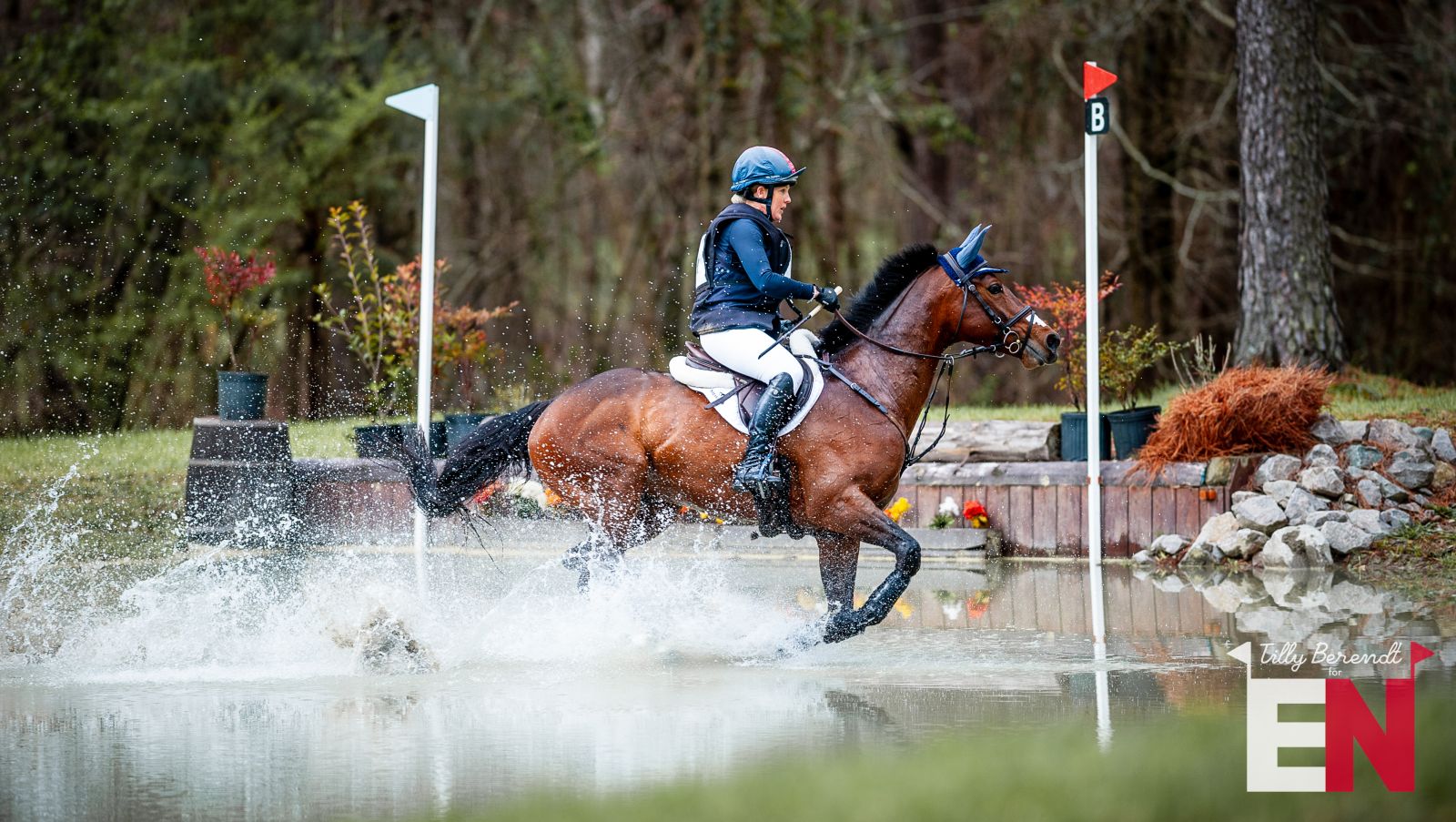
The Eventing Nation team is proud to be powered by Equestly on the road this year. Stop by and check out their full line of comfortable and stylish apparel by visiting equestly.com. This article is brought to you with support from Equestly.

Wrapping Up The Grand Prix Eventing Festival at Bruce’s Field

Liz Halliday-Sharp celebrates the taste of sweet, sweet victory. Photo by Shelby Allen.

Now that the dust has settled, we’re looking back on the Grand Prix Eventing Festival at Bruce’s Field for a final wrap-up. The competition was lively, with a tight race to the finish for our top three leaders. At the end of the day, Liz Halliday-Sharp with Miks Master C came in first with a dressage score of 23.8, a small time penalty for stadium, and zero cross country penalties for a final score of 24.6. Liz and Miks Master C were closely followed by Doug Payne and Starr Witness in second place, and Boyd Martin and Fedarman B in third. 

How’s a sub-20 sound for dressage superstar Starr Witness? Something tells me she’s probably pretty pleased with herself. Photo by Shelby Allen.

The first day of dressage had some big moments, particularly from Doug Payne and Starr Witness. Doug dazzled everyone in the dressage phase, with Starr Witness scoring a perfect 10 on the first flying change and finishing on a mind-blowing score of 19.9. While this isn’t an FEI sanctioned competition, it’s still the best score of the mare’s international career. After dressage, the leaderboard was showing Doug Payne in first place, Boyd Martin and Tsetserleg TSF in second, and Liz Halliday-Sharp and Miks Master C in third. 

After show jumping, Liz lost her lead by two seconds and Doug Payne had a rail down. But per usual, cross country day shook up the scores once again. While Doug Payne was the master of the dressage ring, Liz and Miks Master C, owned by Debbie Palmer and Ocala Horse Properties, were the clear champions of the cross country course. Liz was the only rider of the day to make the time, and she did it on both of her horses, Miks Master C and Cooley Quicksilver (owned by the Monster Partnership). Liz and Cooley Quicksilver came in 5th place, just behind Phillip Dutton and Z. 

Defending champions Boyd Martin and Fedarman B make a podium bid. Photo by Shelby Allen.

We can’t forget about our third-place finishers, Boyd Martin and the Annie Goodwin Syndicate’s Fedarman B. As last year’s defending champion, a back-to-back win turned out to be too much to hope for, but the pair still put in a picture-perfect performance that was just two seconds too slow to catch Doug and Starr Witness. 

And, of course, the reason the event was held in the first place – the charity teams! An event like no other, the Grand Prix Eventing Festival at Bruce’s Field was organized to fund various local organizations, from the Aiken County Pony Club to the Brothers & Sisters of Aiken County. Fans made donations to vote for the most popular team, which was combined with the riders’ purses to create sizable donations for each charity. 

The winning team was Team Orange, which included Liz Halliday-Sharp, Shannon Lilley, Sydney Elliott, and Woods Baughman. A purse of $2,500 will be donated to the Aiken County Pony Club, along with another $800 from fan voting.

In second place, and winner of the popular vote, was Team Blue, which included Phillip Dutton, Amanda Beale Clement, Will Faudree, and Erin Kanara. A purse of $1,500 will be donated to the Great Oak Equine Assisted Programs, plus an additional $1470 from fan voting.

Finally, in third place, we have Team Purple, which included Boyd Martin, Ryan Wood, and Sarah Kuhn. A purse of $1000 will be donated to the Tri-Development Center of Aiken, plus $215 from fan voting.

Colleen Loach was awarded the Richard Picken Style Award. She and FE Golden Eye delivered a classy clear round. Photo by Shelby Allen.

Special awards were also given out to deserving riders and horses. First up is the Richard Picken Show Jumping Style Award, which is a new award in memory of coach Richard Picken, whose career highlights included coaching Phillip Dutton to an individual bronze medal at the 2016 Olympic Games on Mighty Nice and Alexandra Baugh to individual gold at the North American Young Rider Championships. Receiving this award was Olympian Colleen Loach & FE Golden Eye for their beautiful show jumping round. 

Will Faudree and Pfun. Photo by Shelby Allen.

Next was the Annie Goodwin Sportsmanship Award, given in memory of rising star Annie Goodwin, who was a frequent competitor and volunteer at Bruce’s Field. Presented by Peter Goodwin, this award was won by Will Faudree. 

Shannon Lilley and Ideal HX. Photo by Shelby Allen.

Finally, Top Rookie was awarded to Shannon Lilley, who came in 11th place with Ideal HX, owned by Alex Lilley. 

Other awards given out included High Point Thoroughbred, received by Erin Kanara & Campground; Triple Crown Best Turn Out Award, received by Grace Harris and Sallie Johnson; Leading Lady Rider, received by Liz Halliday-Sharp; and Top Young Rider, received by Amanda Beale Clement. 

All in all, the Grand Prix Eventing Festival at Bruce’s Field did not disappoint with a race to the finish and a total of $9,235 donated to charity. Another year has gone by with another great start to the summer show season thanks to the Grand Prix Eventing Festival. Who will win in 2024? We can’t wait until next year to find out!