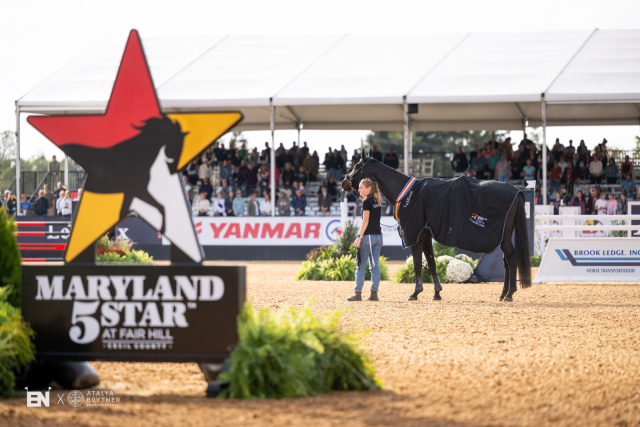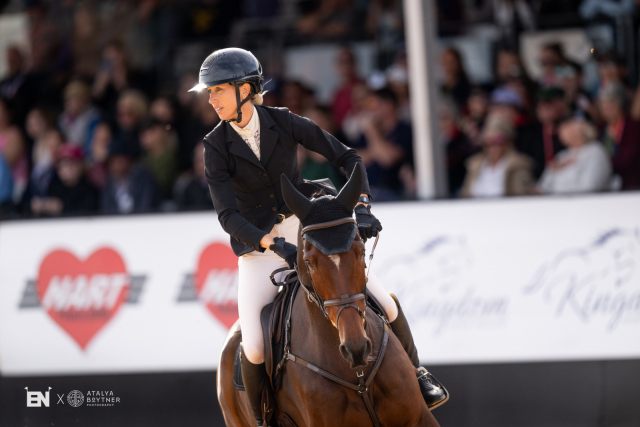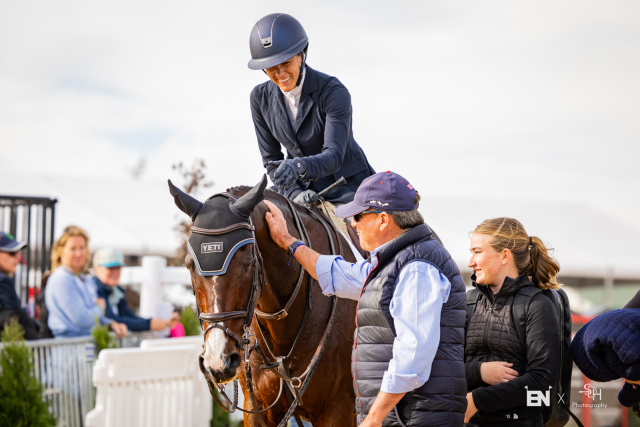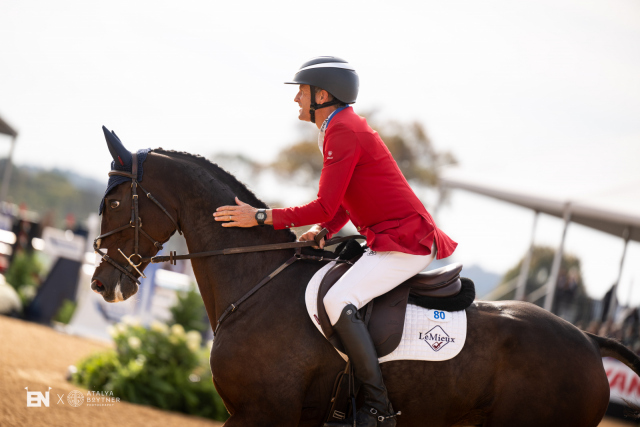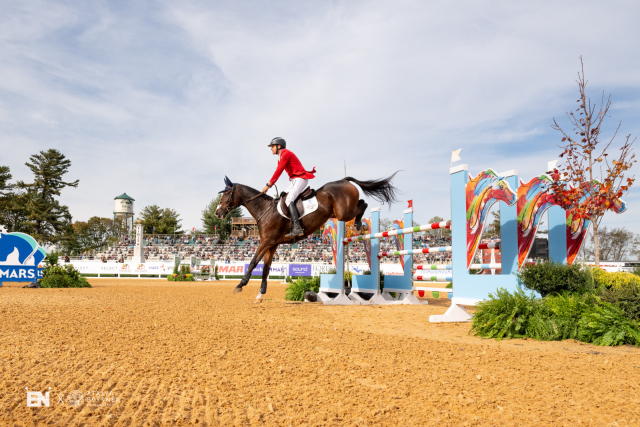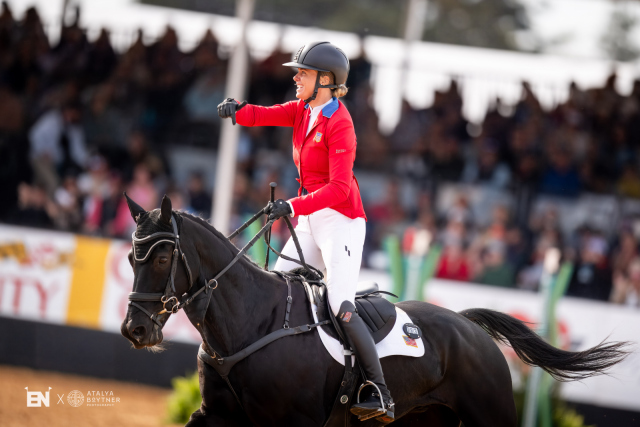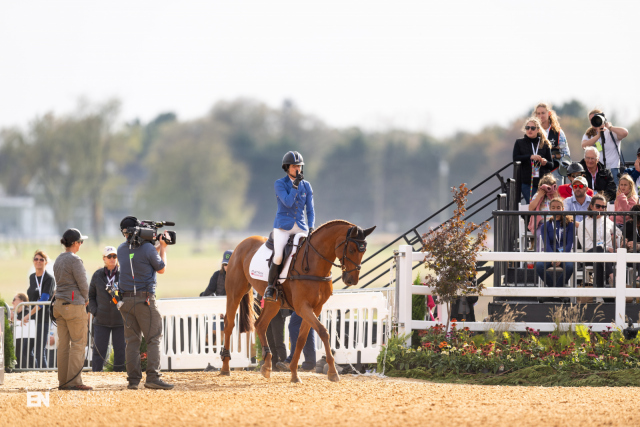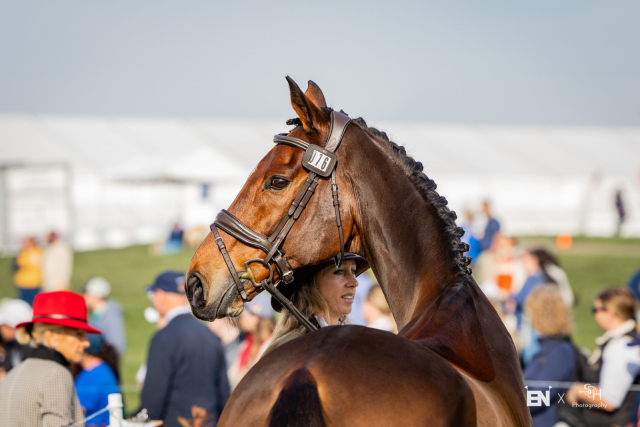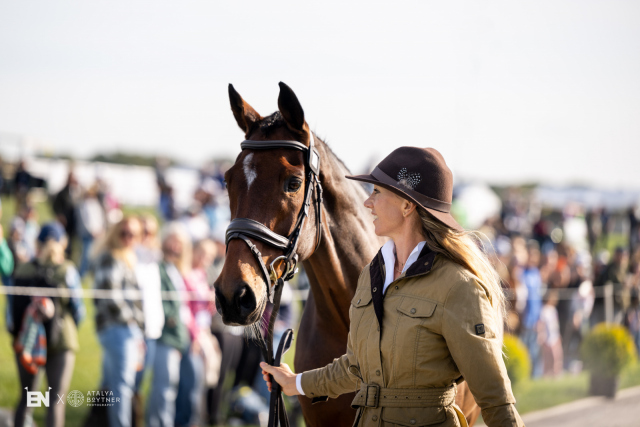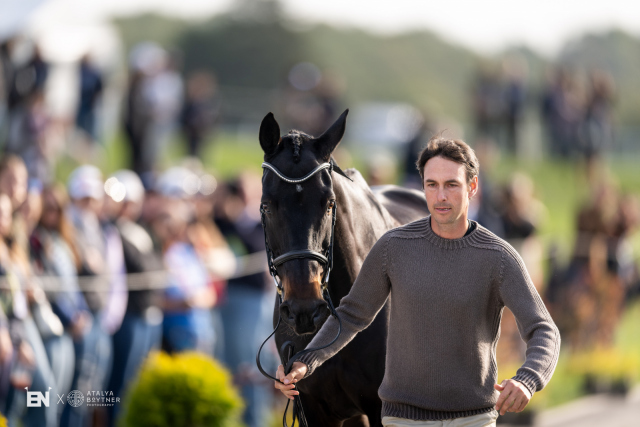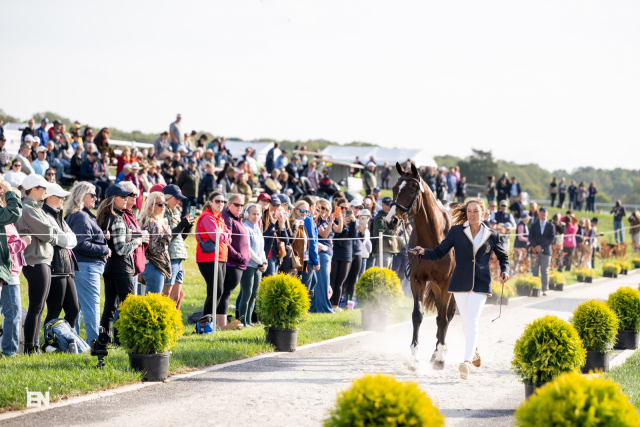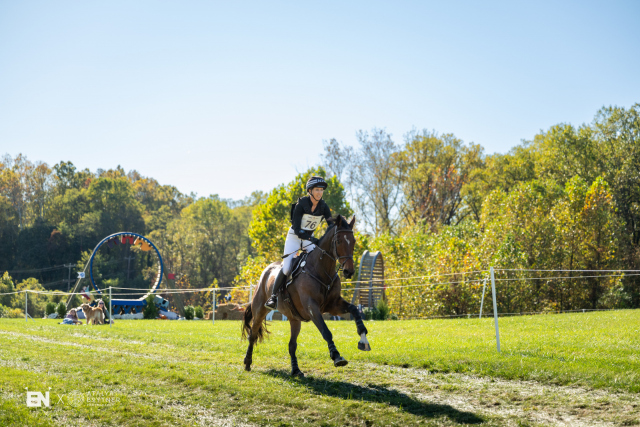
Monica Spencer and Artist. Photo by Atalya Boytner Photography.
I’m pretty confident I got more sleep last night than the riders competing at the MARS Maryland 5 Star, but as I stared at my phone as the clock ticked toward 3 a.m. last night, the questions were swirling. I had a good gut feeling about the course (which, like, take with a grain of salt, because I’m not sure my gut feeling accuracy average is anything to brag about), but boy, was it different. The chatter I listened to from the riders added to the questions. Many of them didn’t realize they could jump a table as a corner on their initial walkthroughs. Some called a few of the lines and questions “nearly unjumpable.” Others referred to it as the hardest cross country they’ve ever seen (which, to be fair, I think is probably what they say a lot, because the thing about eventing is you can do this really incredibly difficult thing and wonder why on EARTH you choose to do it because it was just so hard, only to forget that part and turn around to do it again the next weekend).
It was always apparent that the horses that would cope the best today would be the horses who had experience on tough 5* terrain, and horses who were either Thoroughbreds or flush with Thoroughbred breeding influence. This hunch was confirmed when you look at the top four horses at the top of the standings following an influential day of jumping in absolutely perfect conditions: all four of these horses, three of which finished inside the optimum time of 11:00, are Burghley horses. Two of them are Thoroughbreds. Again, as I wrote at the outset of the week, I think this big picture is very much in focus as we continue to learn the identity of Maryland.
Let’s talk about the Thoroughbreds first, because it’s one of the best parts of the day.
The number of pure Thoroughbreds we see at this level isn’t as large as we’d love it to be. Many Thoroughbreds struggle in the dressage and in the show jumping. There is a reason we don’t often see them at the top levels of these two individual sports. Where they tend to really shine, with some anomalies who have become three-phase specialists of sorts, is on Saturdays.
Before cross country at CHIO Aachen this summer, Monica laughed when recalling her Kentucky cross country round earlier this year. “When I watched my video back, I was like, ‘oh my goodness, Monica, this is show hunter! What are you doing?'” she chuckled. “So I need to just tighten up my sit ups a bit, and hopefully I’ll be closer to the time.”
She did that in Aachen that weekend, adding two seconds on time on a twisting course that wouldn’t necessarily be the most suited for galloping. “Just keep kicking,” she said of her pep talk to herself that day. “It’s my nature to get too sympathetic and be like, ‘Oh, he needs to rest,’ but [I need to] just to rely on that fitness that I know he has and trust that he’s got the stamina to gallop the whole way.”
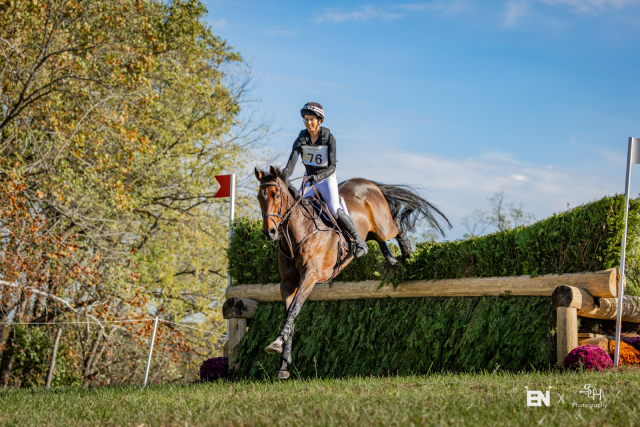
Monica Spencer and Artist. Photo by SDH Photography.
This spring, Monica and her family moved to Pennsylvania from Virginia and have had the ability to take advantage of the famous Nelson’s Hill in Chester County for conditioning. “Max” does his gallops every five days leading up to a three-day, plus he now has had eight other Long format events under his belt at the 4* and 5* level to build a right proper base of fitness on top of his pure Thoroughbred breeding.
All of these things, the little details, led up to today. Monica stopped the clock at 10:36, an astounding 20 seconds inside the time (even better than the 15 she thought she had in hand when she checked her watch) to collect her first clear inside the time at the 5* level and her first at any FEI level since 2022. You could see it, too, in Artist’s gallop. He’s always been a long-striding, efficient horse, but there was almost a noticeable difference in power as he charged around the track today. And coupled with that power is something that’s sometimes rare in such a horse: rideability. So much so that Monica admits this adds another nuance to planning her rides.
“He’s a hard one to decide how to ride the course on, because he can do anything,” she explained. “Some horses, you always know to go on the big stride, and some you know to add one. But he can do anything, so he’s so adjustable and that’s come in handy.”
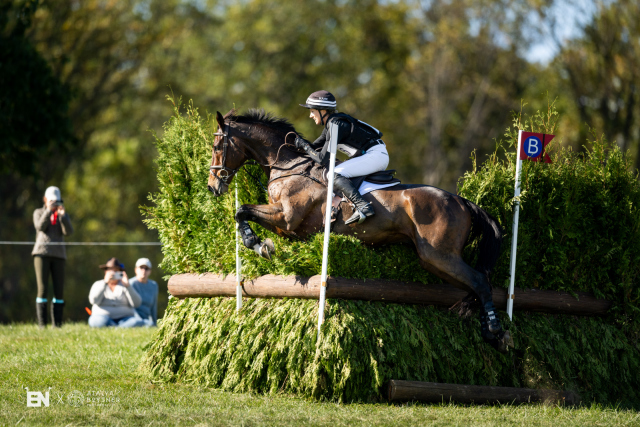
Monica Spencer and Artist. Photo by Atalya Boytner Photography.
Monica stays on her dressage score of 23.7 and will have one rail and some time in hand over second-placed Felix Vogg (SUI) and Cartania (28.3). Statistically, it’s likely she’ll need that rail (though Cartania is not the strongest show jumper herself, nor is third-placed Phelps with Mia Farley (32.2)). Artist has the second-best average of the three in the final phase, lowering an average of 1 rail in his last 6 FEI starts; Cartania has averaged 2.7 jump penalties in her last 6 FEI starts.
“[Thoroughbreds] are bred for running, and we enjoyed that today,” Monica said. “I had one down at Burghley last year, which was a good effort. Let’s put it this way: when I left the start box today, my priority was to keep that rail in hand. We may need two, but I came to this event hoping to get on the podium after swinging and missing for many top tens. He’s been a very consistent boy for me, and I came here wanting a podium, and I’m gonna keep it real and just hope that we can do our best job tomorrow.”
There is something to be said for the extra power and strength Artist showed today. Yes, he could have left it all out on the cross country course, but the other scenario is that the additional hill work and added fitness over time lends itself well to tomorrow, and wouldn’t that be one of the best stories to be able to live?
But we’re lucky this year. Looking at, well, basically the entire field, the stories are incredible, and whoever emerges on top tomorrow will be a unique and historical winner in their own right.

Felix Vogg and Cartania. Photo by SDH Photography.
Felix is one rider who could tamper Monica’s ambitions tomorrow if he can deliver a clear round with Phoenix Eventing S.à.r.l.’s Cartania. It will be a tall task, statistically at least, as she’s never jumped a fault-free round at a 5* in three attempts. Her best round came at Burghley last year, where she had just one down to finish in the top 15.
“Her breeding is jumping, and she can jump high, otherwise she wouldn’t come around these courses,” Felix said. “We weren’t always good, we had one down, two down, but I think it got a little better. We worked quite a lot on that. Tomorrow, anything can happen, but of course, like everyone, I hope she jumps clear.”
Like Artist and Phelps in the top three, Cartania is also a cross country specialist — again, the horses for courses conversation comes up here — but this was also her first clear inside the time at the level. Perfect ground and conditions certainly aided this possibility; a total of four pairs caught the time (three of which were Thoroughbreds, including Sophia Hill (AUS) and Humble Glory, in seventh on a 46.2).
Cartania’s only got about 46% blood on paper, though this Thoroughbred influence originates from the damline, C Tenda, by Clinton, so our in-house lineage expert, Amanda Chance, reckons the Thoroughbred influence is likely higher than listed. Felix, though, says there are other ingredients that make this mare such a specialist.
“It’s about the fitness, and [she’s] a mare,” Felix said. “It makes it easier: they don’t often stop, they keep fighting for you.” Felix is on a new property this year, which similarly to U.S. Olympian Will Coleman has resulted in some new adjustments in terms of fitness training. The fact she had been fit for Burghley in September also helped (Felix’s shoulder injury prevented him from taking her there). “I was bit worried beginning of the year to go to Badminton, and she might be not fit enough. But turned out the opposite — she was way too fit, maybe. Now she was Burghley ready. They have to be fit, and as well now, I think she was perfect. She didn’t get tired, so I think it was part of the fitness.”
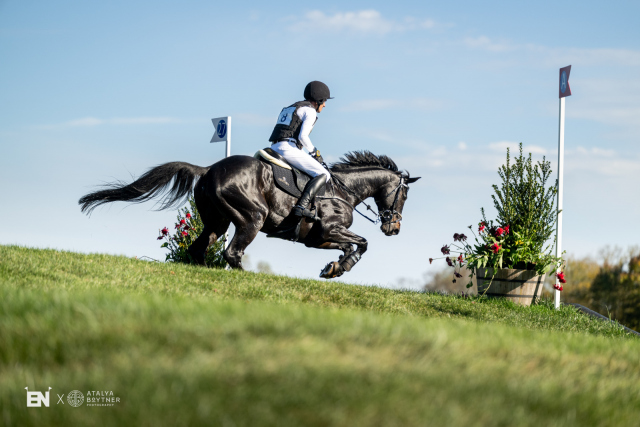
Felix Vogg and Cartania. Photo by Atalya Boytner Photography.
Felix switched to a Dutch gag type of bit for this week, changing away from a Pelham, which he felt worked. The mare can be strong on cross country, as he referenced about Badminton this year, where they had a surprising fall that seemed to result from a general lack of rideability.
“I was a bit worried about the time at the beginning, because I was always on the minute, not ahead of it, and I knew what is still coming,” Felix said after his ride. “But it changed that minute before the coffin. And then I was always ahead of it quite a lot, sometimes 20 seconds. So I had to slow her down, calm her down a bit uphill, which was actually really good, so she doesn’t use herself up.”
So while he felt he lost a few marks despite scoring a 5* personal best on the horse in the dressage, Felix said his intention to not do “too much dressage” in the lead-up and instead focusing on fitness has paid off. “The dressage, I don’t think, is the big problem about her, especially when you build up to these events, mostly you do too much dressage,” he explained. “So for me, it was important that she stays fit, she keeps jumping.”
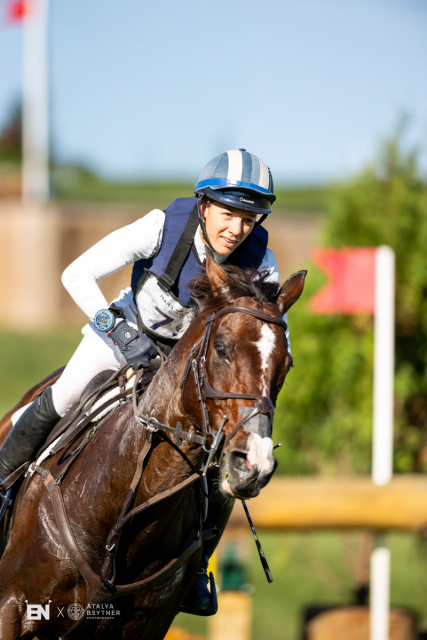
Mia Farley and Phelps. Photo by Atalya Boytner Photography.
Mia Farley earned her third 5* double clear in four starts, building off of her debut here at Maryland in 2023 to bring David O’Connor’s Phelps home inside the time by one second. She stays on a score of 32.2 heading into tomorrow, and while she’s never all that optimistic about show jumping, she knows just how special of a cross country horse she’s sitting on today.
One of the biggest indicators Mia said she felt even before she left the start box? Phelps was grazing in the warm-up. This may seem innocuous, but he’s somewhat gained a reputation for being..er..a bit..unrideable for the first few fences on course. He’s really not a Short format horse, Mia says. He needs the stretches of gallop and the terrain to really take up his efficient stride and allow him to move forward, but sometimes this results in that aforementioned loss of control. But today, he grazed, and Mia says that’s his tell that he’s particularly relaxed. When she left the start box, she could flow right away, rather than fighting Phelps for control and getting away with a few hairy distances as she’s had to in the past.
“I got kind of the same feeling that I did at Kentucky, where I could just ride on a long rein,” she said. “He just gets everything, so he makes my life easy.” Mia chose to go long at the Pierre’s Puzzle coffin complex, having not had an ideal jump over the first corner in the arena at fence 7, resulting in going long. “I think a lot of people know he does have a little bit of a little bit of a right drift. So I was like, even if I ride that perfect, I can’t guarantee it. So I just wanted to play it safe and go around and I know I’m on a fast horse, so he just covers the ground.”
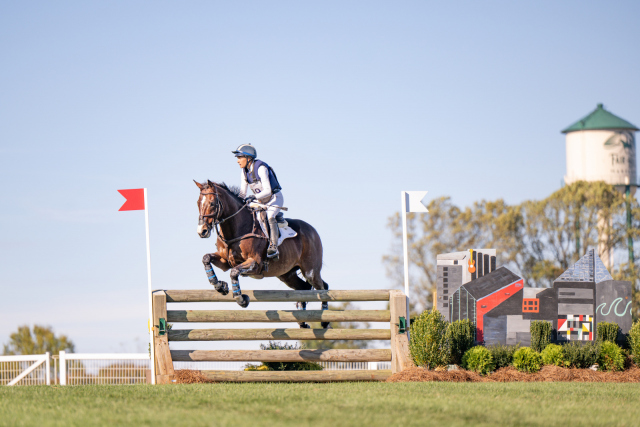
Mia Farley and Phelps. Photo by Veronica Green-Gott.
Mia had a heartbreaker of a 20 at Burghley, coming to grief at the Joules at the Malting’s Corner but otherwise jumping a strong round. She learned from this experience. “I know not to see a distance from 10 out and leave six strides out,” she laughed. “I came in with no expectations my first year, and he was great. And then Kentucky, I was like, ‘Okay, I know I can do this. I can be competitive.’ And then out here, because of my decision at Burghley, I just wanted to come out and not try to make time, because I’ve tried to make time twice on him, and I’ve had a mistake both times.”
She was also a bit stressed this morning after having two three-star horses and not having much time to walk her 5* course. “I would be crying if I were on any other horse, but I knew Phelps would kind of cover me for what maybe I wasn’t there for him,” she said.
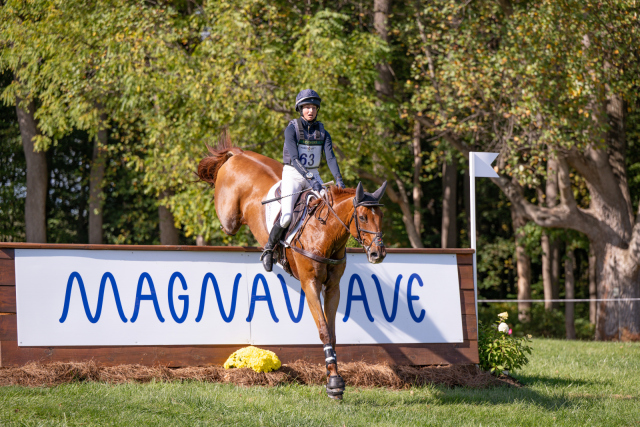
Jennie Brannigan and FE Lifestyle. Photo by Veronica Green-Gott.
Jennie Brannigan showed her grit today, jumping an all-class clear with Tim and Nina Gardner’s FE Lifestyle, adding 3.6 time to go onto a 36.4 for fourth place overnight. This is another pair that’s jumped around Burghley (they finished 12th in 2023 and won Best First Timer and 23rd in 2024), and that experience came in handy today. “Foxy” recovered well after a lengthy rehab from a gruesome injury in the trailer en route to Badminton earlier this year, and Jennie herself badly sprained her ankle in a fall with another horse at Morven Park last week, so conditions were not exactly ideal for her today. She debated this morning about going out, but after consulting her coaching and medical team, she decided she was ready to give it her best shot.
“You get a lot of feedback from people telling you, you know, you’re a good person, you’re a bad person,” Jennie said. “But I knew that I was okay to ride him, and I also know that I can pull up when things aren’t going well, or I wouldn’t do my horse justice. I just tried to keep breathing and taking it one one step at a time. But it did ride what Phillip [Dutton’s] and Peter [Wylde’s] plan was for me.”
She says both she and Foxy were a bit low on fitness (and this horse is another without a ton of blood in his system, coming in around 37%), but it was her priority to listen to him out there today and allow him to travel if he felt comfortable. “I’m kicking myself for the few times, but I think I took care of him the whole way around, and that’s what I wanted to do,” she said. “It’s my responsibility to look out for him. And I think I read him the whole way around.”
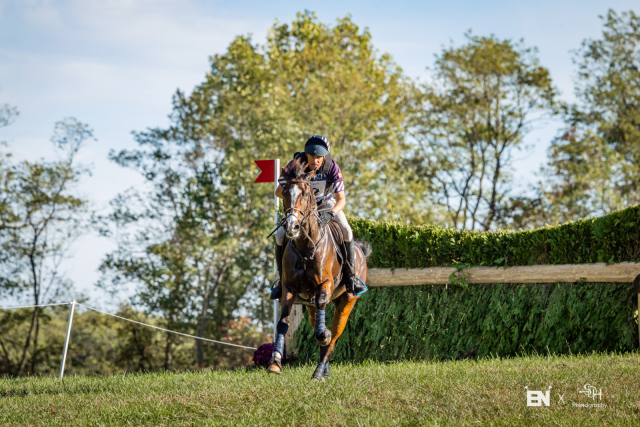
Boyd Martin and Commando 3. Photo by SDH Photography.
Boyd Martin finally got a cross country completion here at Maryland, after having a tough run of luck here since he won the inaugural event in 2021 with the Turner family’s On Cue. This time, it was Yankee Creek Ranch LLC’s Commando 3 that stepped up to the plate after stablemate Luke 140 (owned by the Luke 140 Syndicate) and Boyd had a parting of ways at Pierre’s Puzzle earlier in the day. “Connor” did tire a bit on the back half of the course, but he finished well with eight time penalties added. They’ll head into tomorrow with a two-day score of 38.3 and in fifth place.
“I think I was going a bit too quick, to be honest,” Boyd said. “I was ahead of my minute markers, and then at the top of the hill, he really started to tire, so I got into the water and thought I’d just go the alternate way, which cost me a lot of time. But to be fair, once he turned around and headed back down the hill towards home, he perked right up, so I was very proud of him to just tough it out and get home the last couple of minutes.”
Boyd’s sitting on the best-ranked show jumper in the remaining field by EquiRatings, and Connor did jump a clear on Sunday after finishing his first 5* cross country with a similar amount of time as today.
How It Started vs. How It’s Going on the Maryland Cross Country

Caroline Pamukcu and HSH Blake stormed around as the final pair to go into sixth on a score of 39.4. Photo by Atalya Boytner Photography.
We saw a completely different look this year on cross country, and really the track was quite front-loaded with intense combinations, all of which caused quite a stir amongst the riders (well, amongst everyone, really) ahead of today. What really gave me a lot of confidence about today was listening to Felix Vogg talk about the track (I wrote about this in my cross country preview here). Felix would know Pierre Le Goupil’s designs relatively well, more so than most of his competitors, and he was always fairly optimistic about it. You had to ride well, and you might be a little scared, but it was doable, because details matter to Pierre. And even if something wasn’t obvious, there is a level of trust that’s built between designer and rider, a thought outlined by 2022 winner Austin O’Connor during Friday’s Maryland Masterclass. That trust is built mutually, and it can be hard when riders don’t have much context aside from a handful of courses from a given designer.
I think that trust may have grown some today.
Yes, I believe people will scream about the numbers again this year. This year’s event saw a 59% completion rate, a marked improvement compared to 2024’s 38% completion rate, with eight of 22 starters completing. Again, I’d love to remind you that with a field this small, it’s hard to make proper comparisons or direct comparisons with the other 5* events.
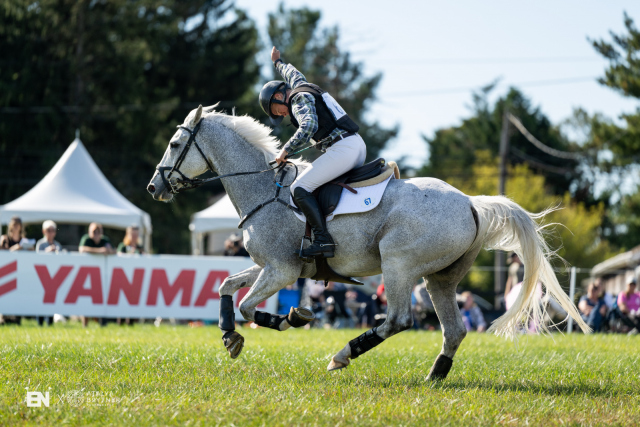
Arden Wildasin and Sunday Times earned their second 5* cross country completion and were quite quick despite picking up one 20. Photo by Atalya Boytner Photography.
But here’s where I take less issue with the numbers this year. When it comes down to it, the course was influential in all the right ways. The intensive questions at the very beginning – the keyholes in the arena at 7 and the Sunken Road at 11 and 12 all rode quite well throughout the day. Yes, some problems were had and some long routes were taken, but nothing was particularly gasp-inducing. Pierre’s Puzzle, this year at fence 16, is always an influential spot here. This fence caused four issues including an elimination in 2024 and elicited four problems including one elimination this year. The Sawmill Slices in 2024 caused a whole heck of a lot of problems, while this year the same complex (a timber drop followed by a bounce of timber rails after the water) caused zero as it had been made more straightforward and, in my opinion, kinder to the horses after the big pull uphill.
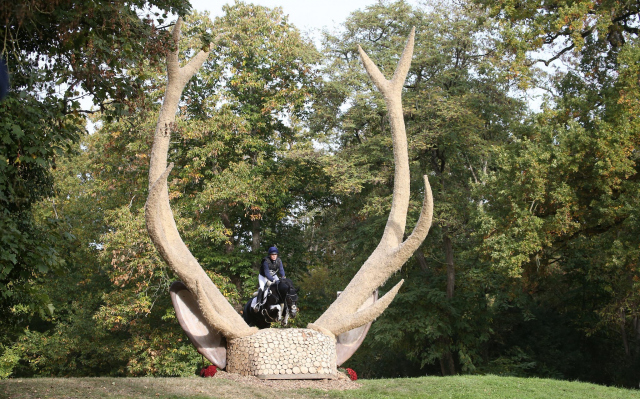
The gigantic ditch brush Fox Catcher Flyer is perennially influential and did exert its influence this year, including one horse fall from Caroline Pamukcu and She’s the One (who are happily both uninjured). Other eliminations or problems came in the form of refusals or falls at single fences, incidents that would happen at any proper 5*.
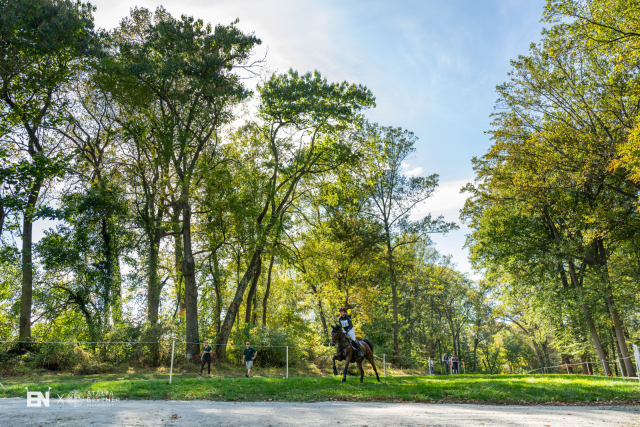
Photo by Atalya Boytner Photography.
So, when you dig into the numbers, yes we only saw a little over half the field finish, but had there been 40 horses here, I think that percentage would have been much higher. The biggest thing for me is how the horses looked coming home. Similar to Burghley this year, they primarily finished looking fresh, fit and well-prepared for the job. Their ears were pricked, they galloped easily, and cooled out quickly. No one lingered too long in the vet box.
That, to me, is the sign of a good day. I know it wasn’t such for everyone, and that’s ok — that’s 5* sport at its best. Some riders like Boyd commended Pierre but requested he lighten up a bit next year, and I know I’m far from qualified to be truly evaluating courses like this, but I actually feel Pierre achieved a lot this year and set a track that was yes, intense and yes, incredibly scary to look at, but also that was fair and kind and readable by the horses. Less the one misread of the Fox Catcher Flyer, no one seemed to misread a question in any way other than greenness or a loss of focus.
The reality is, there will be courses that see a 70% completion rate, and there will be some that see 40% of the field get home. I return now to the overarching story of this weekend (besides the Thoroughbreds!): there truly are horses for courses, and now we’re beginning to really see the identity of the “type” a rider needs to find success here at Maryland.
Whatever tomorrow brings, it’ll be an incredible story. And like the riders who had success today, we’ll enjoy it today (well, it’s not really today anymore, sorry), and we’ll write the rest of the story tomorrow.
Go Eventing.
You’ll be able to follow along with the finale tomorrow live on USEF Network on ClipMyHorse for our U.S. readers. Instructions on how to link your USEF Account are here so you can access the ClipMyHorse stream for free. For local viewers, Maryland Public Television also carries a great live stream that can be accessed here. For anyone needing an easy way to convert time zones for viewing in your local area, this website is a really handy tool.
The Final Horse Inspection will take place starting at 9:00 a.m. with the 3*-L, followed by the 5*. Show jumping for the 3*-L, which is led by Isabelle Bosley and Conner, will begin at 10:30 a.m., followed by the 5* starting at 2:30 p.m.
EN is pleased to welcome Deirdre Vaillancourt Real Estate as the sponsor of our coverage of this year’s MARS Maryland 5 Star. If you’ve got Aiken, SC on your list as a place to base or even move to, Deirdre should be your first call! You can find all properties available and contact Deirdre directly by visiting AikenSCProperties.com.
MARS Maryland 5 Star at Fair Hill (MD): [Website] [Tickets] [Schedule] [Entries] [Live Stream] [Scores] [EN’s Coverage]