Sally Spickard is a Korean adoptee living in San Diego, California. Sally joined the Eventing Nation team in 2013 and has subsequently written for Noelle Floyd, Heels Down Mag, and other publications both in and out of the equestrian world. Sally is an eventing fan through and through and enjoys telling the stories of riders who are not well-represented within equestrian media.
Julia Krajewski (GER) and Nickel 21 will be the first to see in dressage and the pathfinders on cross country in Paris. Photo by Tilly Berendt.
Following the First Horse Inspection and a chef d’equipe meeting, we now have the confirmed start list and times for the Olympic eventing, which commences with dressage tomorrow at 9:30 a.m. local time.
1. Germany
2. Australia
3. Canada
4. Ireland
5. Switzerland
6. USA
7. Poland
8. Sweden
9. Great Britain
10. Brazil
11. New Zealand
12. Japan
13. Italy
14. Netherlands
15. France
16. Belgium
The remaining spots are given to individual riders:
Spain
Hungary
Czechia
China
Ecuador
Finland
Denmark
Portugal
Austria
Morocco
South Africa
Looking to the times for dressage (and remember, the riders will go out on cross country in the same order they were put in for dressage), Germany’s Julia Krajewski and Nickel 21, who slotted into team Germany late after the withdrawal of Sandra Auffarth and Viamant du Matz, will be the pathfinders. As expected, Michael Jung and Chipmunk FRH will anchor the Germans, with Christoph Wahler and Carjatan S sent out second.
Caroline Pamukcu and HSH Blake will be the pathfinders for the U.S., with Liz Halliday and Nutcracker out second and Boyd Martin anchoring the team as last to go with Fedarman B.
For the reigning gold medalists, Team Great Britain will send Tom McEwen and JL Dublin out first, followed by Laura Collett and London 52 and Ros Canter and Lordships Graffalo as anchors.
If you’re planning to follow along live, be sure to check out our How To Watch guide for information on timetables and where you can watch. Full timing and scoring will also be available here.
Boyd Martin and Fedarman B. Photo by Tilly Berendt.
We certainly weren’t lacking for tension this morning as we gathered for the First Horse Inspection back in the stabling area here at the Versailles Olympic equestrian venue.
Across the 81 horses presenting for 27 nations, including individuals, we saw five pairs held and one subsequently not accepted on second presentation.
Lea Siegl and DSP Fighting Line. Photo by Tilly Berendt.
Sent to the holding box were Moroccan individual Noor Slauoi and Cash In Hand, Switzerland’s Melody Johner and Toubleu de Rueire, Austria’s Lea Siegl and DSP Fighting Line, Sweden’s Malin Asai and Golden Midnight, and Great Britain’s Yasmin Ingham and Banzai du Loir. Unfortunately, Lea Siegl and DSP Fighting Line were not accepted on their second attempt and will end their individual Olympic bid prematurely. All other pairs held were accpeted.
This now gives us a field of 80 horses, including Traveling Reserves, moving forward to the commencement of competition on Saturday. Dressage begins at 9:30 a.m. local time / 3:30 a.m. ET. [For additional timetables and how to watch info, click here.]
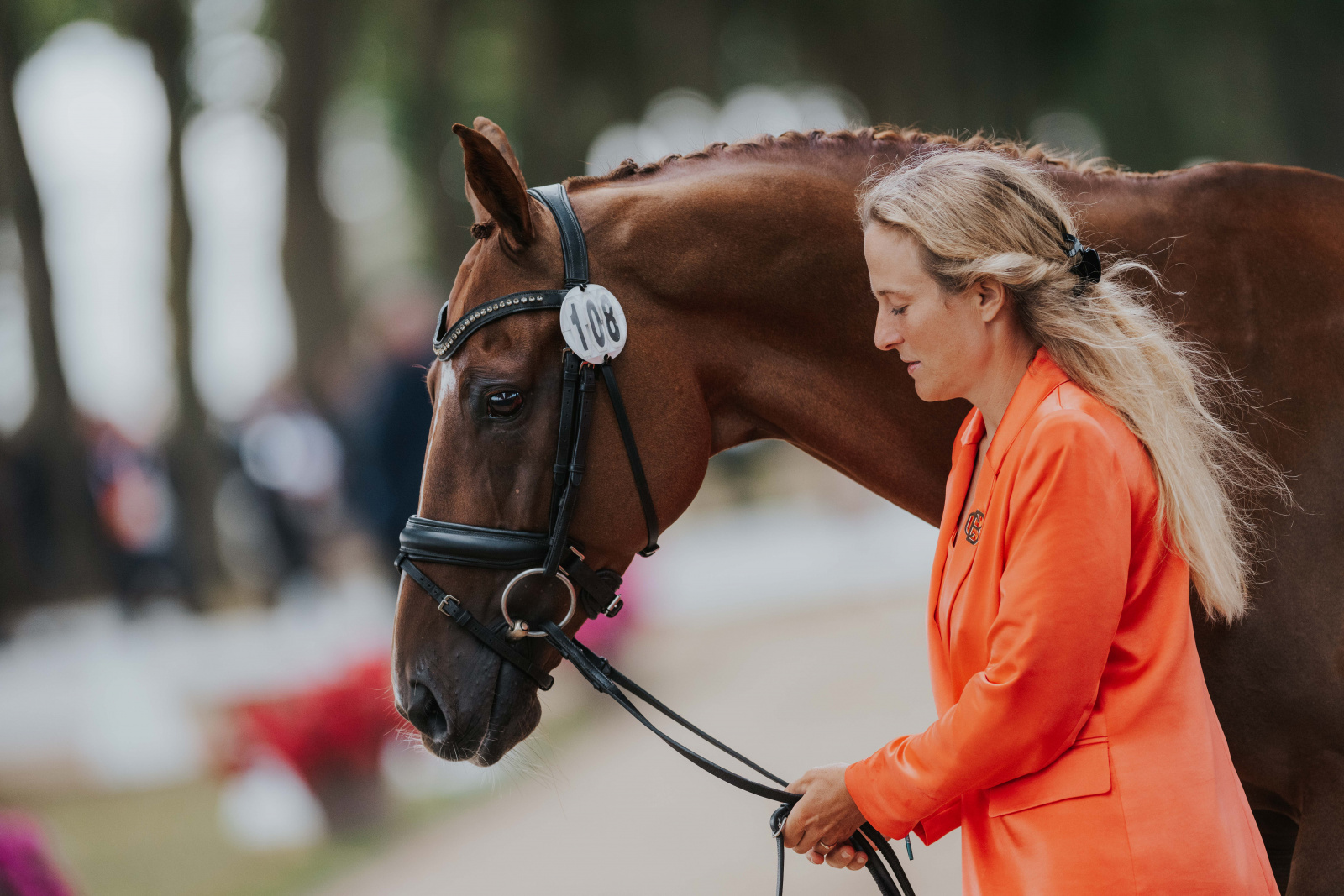
Caroline Pamukcu and HSH Blake. Photo by Tilly Berendt.
We also broke news earlier that Will Coleman has sadly had to withdraw the Diabolo Group’s Diabolo, his Direct Reserve horse who was substituted for the Off the Record Syndicate’s Off the Record during training camp, due to a suspected abscess in the right front foot. Liz Halliday now gets her first Olympic call with Chris Desino, Rob Desino, Deborah Halliday, Liz Halliday, and Renee Lane’s Nutcracker, and Sydney Elliott with now replace Liz as Traveling Reserve with Carol Stephens’ QC Diamantaire.
Liz Halliday and Nutcracker. Photo by Tilly Berendt.
This post will be updated with additional photos, so stay tuned for more from Paris.
Sydney Elliott and QC Diamantaire. Photo by Tilly Berendt.
Yasmin Ingham and Banzai du Loir. Photo by Tilly Berendt.
Noor Slaoui and Cash In Hand. Photo by Tilly Berendt.
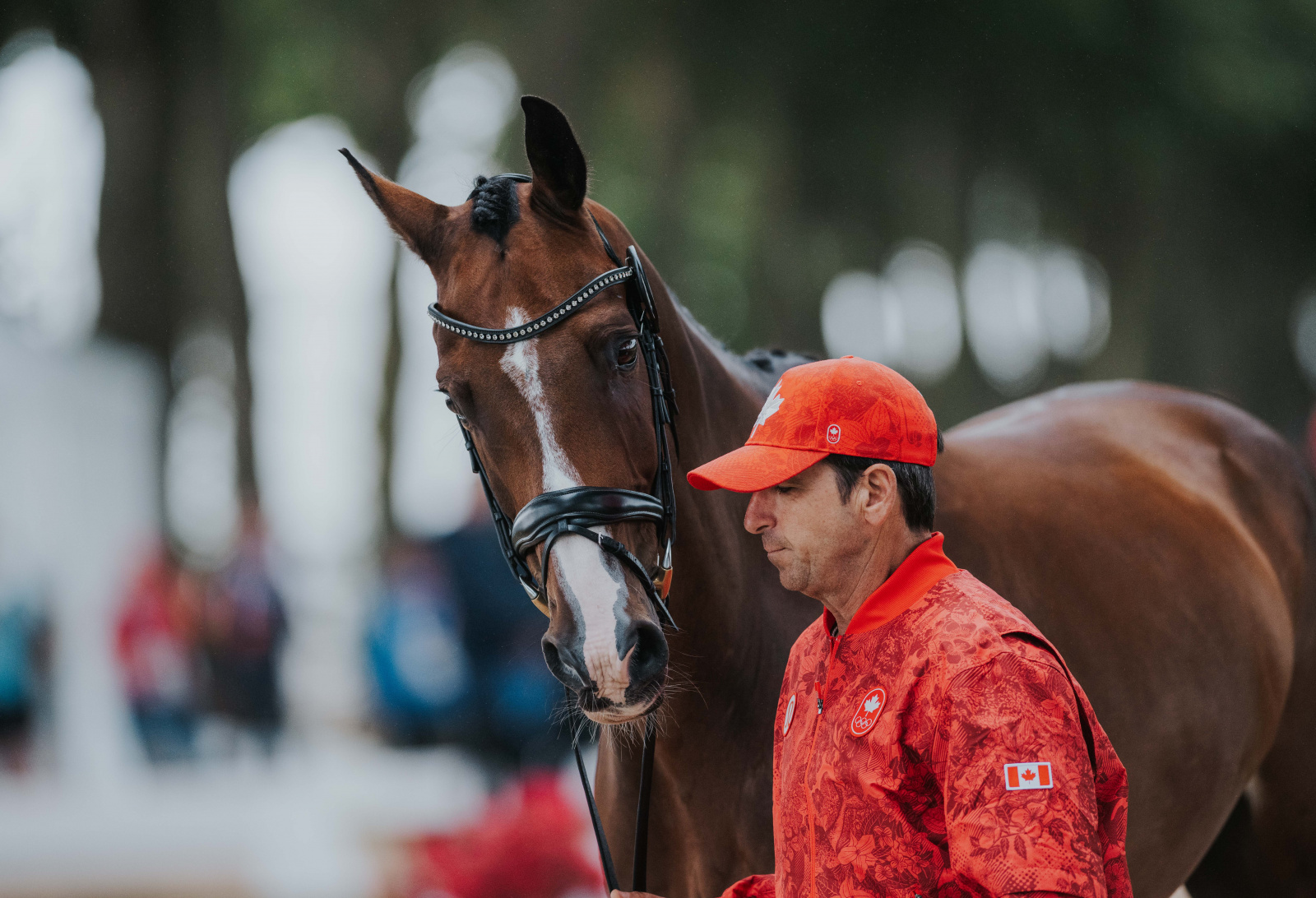
Mike Winter and El Mundo. Photo by Tilly Berendt.
Mike Winter and El Mundo. Photo by Tilly Berendt.
Melodie Johner and Toubleu de Rueire. Photo by Tilly Berendt.
Malin Asai and Golden Midnight. Photo by Tilly Berendt.
Karl Slezak and Hot Bobo. Photo by Tilly Berendt.
Karl Slezak and Hot Bobo. Photo by Tilly Berendt.
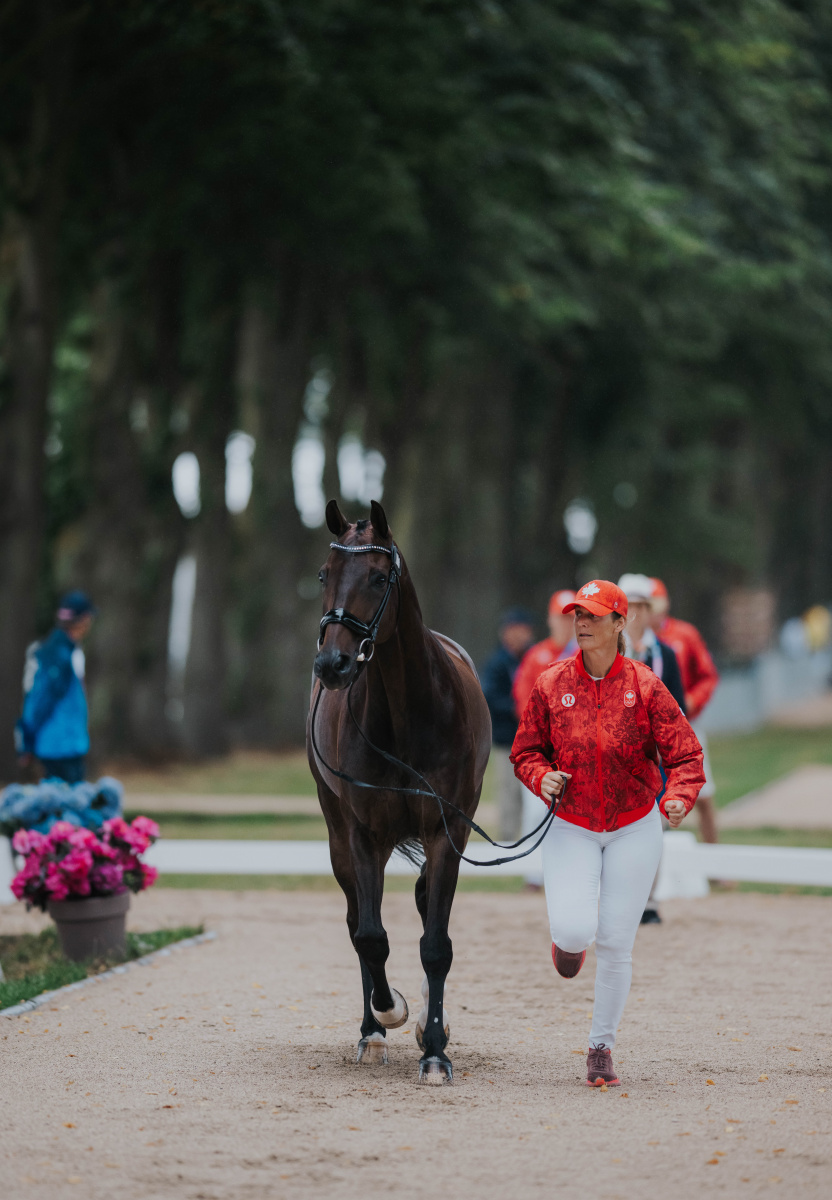
Colleen Loach and FE Golden Eye. Photo by Tilly Berendt.
Louise Romeike and Caspian 15 (SWE). Photo by Tilly Berendt.
Karim Laghouag and Triton Fontaine (FRA). Photo by Tilly Berendt.
Tine Magnus and Dia Van Het Lichterveld Z (BEL). Photo by Tilly Berendt.
Lara de Liedekerke-Meier and Origi (BEL). Photo by Tilly Berendt.
Calvin Böckmann and The Phantom of the Opera (GER). Photo by Tilly Berendt.
Julia Krajewski and Nickel 21 (GER). Photo by Tilly Berendt.
Janneke Boonzaaijer and Champ de Tailleur. Photo by Tilly Berendt.
Gireg le Coz and Aisprit de la Loge (FRA). Photo by Tilly Berendt.
Nicolas Touzaint and Diabolo Menthe (FRA). Photo by Tilly Berendt.
Stephane Landois and Chaman Dumontceau (FRA). Photo by Tilly Berendt.
The home crowd keeps a close watch on their boys in blue. Photo by Tilly Berendt.
Karin Donckers and Leipheimer van’t Verahof (BEL). Photo by Tilly Berendt.
Lara de Liedekerke-Meier and Origi (BEL). Photo by Tilly Berendt.
Miroslav Prihoda and Ferreolus Lat (CZE). Photo by Tilly Berendt.
Kazuma Tomoto and Vinci de la Vigne (JPN). Photo by Tilly Berendt.
Yoshiaki Oiwa and MGH Grafton Street (JPN). Photo by Tilly Berendt.
Alexander Peternell and Figaro des Premices. Photo by Tilly Berendt.
Alex Hua Tian and Jilsonne van Bareelhof (CHN). Photo by Tilly Berendt.
Photo by Tilly Berendt.
Boyd Martin and Fedarman B. Photo by Tilly Berendt.
Carlos Diaz Fernandez and Taraje CP 21.10 (ESP). Photo by Tilly Berendt.
Carlos Parro and Safira. Photo by Tilly Berendt.
Caroline Pamukcu and HSH Blake. Photo by Tilly Berendt.
Caroline Powell and Greenacres Special Cavalier (NZL). Photo by Tilly Berendt.
Clarke Johnstone and Menlo Park (NZL). Photo by Tilly Berendt.
Esteban Benitez Valle and Utrera AA (ESP). Photo by Tilly Berendt.
Harald Ambros and Vitorio du Montet representing Austria in Paris. Photo by Tilly Berendt.
Huadong Sun and Lady Chin Van’t Moerven Z (CHN). Photo by Tilly Berendt.
Jan Kaminski and Jard (POL). Photo by Tilly Berendt.
Photo by Tilly Berendt.
Kevin McNab and Don Quidam (AUS). Photo by Tilly Berendt.
Laura Collett and London 52 (GBR). Photo by Tilly Berendt.
Malgozata Korycka and Canvalencia (POL). Photo by Tilly Berendt.
Robin Godel and Grandeur de Lully (SUI). Photo by Tilly Berendt.
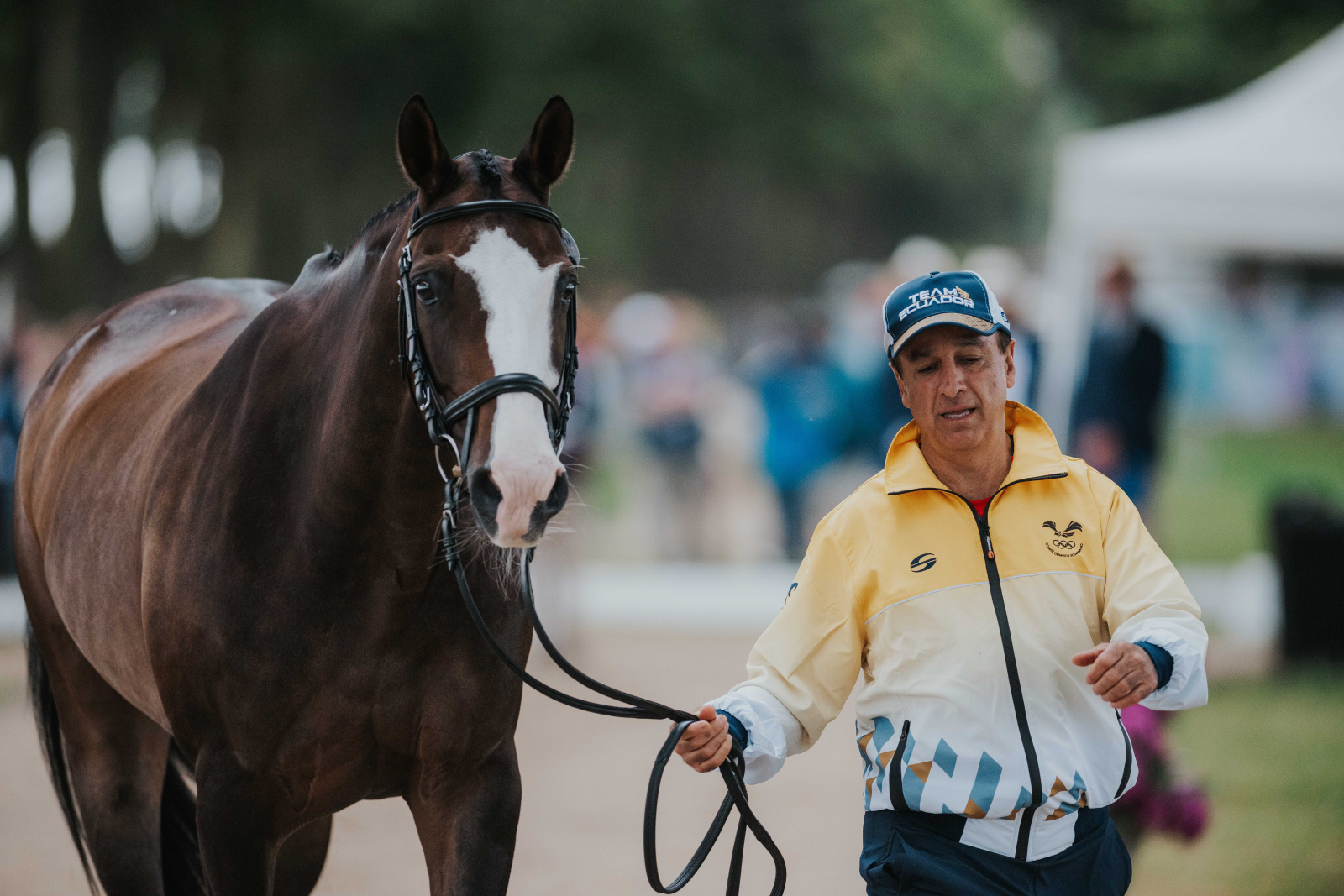
Ronald Zabala Goetschel and Forever Young Wundermaske (ECU). Photo by Tilly Berendt.
Ros Canter and Lordships Graffalo (GBR). Photo by Tilly Berendt.
Ruy Fonseca and Ballypatrick SRS (BRA). Photo by Tilly Berendt.
Sanna Siltakorpi and Bogey Click (FIN). Photo by Tilly Berendt.
Shane Rose and Virgil in Paris. Photo by Tilly Berendt.
Photo by Tilly Berendt.
Sydney Elliott and QC Diamantaire. Photo by Tilly Berendt.
Tim Price and Falco (NZL). Photo by Tilly Berendt.
Tom McEwen and JL Dublin (GBR). Photo by Tilly Berendt.
Emiliano Portale and Future (ITA). Photo by Tilly Berendt.
Yasmin Ingham and Banzai du Loir (GBR). Photo by Tilly Berendt.
US Equestrian has announced the replacement of Will Coleman’s ride, Diabolo, this morning ahead of the First Horse Inspection. Liz Halliday and Nutcracker, originally the U.S. Traveling Reserve, will now be slotted in to team competition, while Sydney Elliott and QC Diamantaire have arrived on site and trotted up for the Ground Jury to ensure their eligibility to sub in if needed.
This comes as a devastating blow for the Coleman camp, who had already switched from Off the Record to Diabolo earlier during training camp in France. Diabolo began to show signs of discomfort after moving into stabling at the venue and will be treated for a potential abscess in the right front.
“The last 48 hours have truly been tough for our team, but particularly for Will Coleman. Off The Record looked well in training camp, but Will’s direct reserve, Diabolo, continued to impress and was physically in such great condition, so we made the decision to place him into the team roster before moving to the venue. Diabolo trotted up 100% sound prior to shipping from training camp and arrived at the venue happy and fit. Unfortunately, shortly after settling into stabling he showed significant signs of discomfort and the team immediately got to work to address a potential abscess in the right front foot. Team Farrier Beck Ratte, Dr. Susan Johns, Diabolo’s groom Hailey Burlock, and Will’s wife, Katie, were so diligent and tireless in treating Diabolo and he did in fact trot up sound last night,” said Chef d’Equipe Bobby Costello in a US Equestrian statement. “With that said, we felt after weighing the risk, it was not in Diabolo’s or the team’s best interest for him to move forward with the competition this week. We’re all truly devastated for Will and his entire team. It takes so much work to get to this moment and it’s just such an unfortunate turn of events. We’ve got to look forward though, and with that said, we’re heading into this competition with four competitive horses, and l still feel very confident in this team’s ability to be successful here in Paris.”
I popped onto a Facebook Live interview with EquiRatings‘ Nicole Brown and Horse & Hound‘s Catherine Austen to recap the first day on the ground in Paris. Tune in for some thoughts on the venue and the official unveiling of Pierre Le Goupil’s cross country course (stay tuned for Tilly Berendt’s full preview coming later!).
This week, we’ll be bringing you a breakdown of each phase and its Olympic nuance with the help of several experts who were gracious enough to lend us some of their time and knowledge. So far, we’ve published a breakdown of the unique Olympic dressage test as well as the cross country phase. Now, let’s wrap this series up with some thoughts on the show jumping.
Traditionally speaking, show jumping culminates the three days of eventing as a final test of endurance and accuracy for both horse and rider. Coming into show jumping, horses and their riders will be feeling the exertion of the past two days, particularly at an intense event like the Olympics.
The show jumping is particularly influential at the Olympics for one big reason. Let’s dive in.
What makes show jumping at the Olympics unique?
Julia Krajewski and Amande de B’Neville. Photo by Shannon Brinkman Photography.
Unlike all other competitions for eventing, the Olympics requires two show jumping rounds to determine medals. The International Olympic Committee does not hand out multiple medals off the results from one event. You can see this mirrored in other events such as gymnastics and swimming. So, the eventing show jumping works as follows:
Round 1: All remaining team riders and individuals, including any substitutes, will jump in this round. In the first round, fences can be set up to 4* max height, which is 1.25m. This round will see anywhere from 11-13 numbered fences, with a maximum of 16 jumping efforts.
Round 2: The top 25 individual riders, regardless of nation/team, will move forward to the final individual round. Substitute riders cannot go forward to this round. This round can see fences up to 5* height, which is 1.30m. The number of fences decreases for a maximum of 9 fences and 12 jumping efforts.
The second round will come after a short break for rearranging the course, meaning there isn’t a ton of time in between for recovery.
Factors to consider
Laura Collett and London 52. Photo by Shannon Brinkman Photography.
I sat down with Michel Vaillancourt, who’s an Olympic individual medalist in show jumping and a Show Jumping Hall of Fame member, as well as a course designer for major events like Spruce Meadows and the Pan American Games, for some intel on things to consider when looking at show jumping through the eyes of a designer.
“Adding the two rounds changes the outcome of the competition for the individual riders a lot,” he remarked. “The second round is a little shorter, which is kind of a blessing, but a lot of the factor for me will come to the fitness level.”
As the schedule currently stands, there will be about an hour and a half or two hours in between the conclusion of the team round and the start of the individual final. This can be advantageous for some, and challenging for others.
“It really depends on the horse you’re on,” Michel said. “The break gives the horses a chance to rest, but it also gives them a chance to get a little tighter or to mentally switch off. None of these horses will be anticipating jumping again — that’s not how it works in eventing as a standard. As a rider, I would prefer to come back an hour later, especially looking at everything you would have done to that point. At the same time, you don’t want to break that zone.”
Boyd Martin and Tsetserleg TSF. Photo by Shannon Brinkman Photography.
The designer for Paris will be Spain’s Santiago Varela, assisted by co-designer Gregory Bodo of France. Santiago is a lifetime student of the sport, earning the title of “Local Course Designer” at just 15 years of age in Madrid. He’s since gone on to design at World Championships, World Cup and Nations Cup competitions, as well as the last Olympics in Tokyo. There, his jumps received much recognition for their beauty and attention to detail. He’s been teamed up with Gregory since the 2014 World Equestrian Games in Normandy, France.
While we certainly see an increasing number of courses designed by designers who spend most of their time in the show jumping space, there is a level of nuance involved with the two different sports.
“It’s very different to design an eventing show jumping,” Michel noted. “The horses are a little more fatigued on this last day. There has been a lot of rideability that was lost during the cross country phase, so when you come into the show jumping you’re not as sharp as you would be if show jumping was first.”
“One thing the designers may do is go with slightly deeper cups or slightly heavier rails [that what you would see in pure show jumping]. I remember very well when we did Kentucky for instance, we weighed all the rails and kept the lighter ones for the show jumpers and the heavier ones for the eventers. But at an event like the Aiken Showcase, I use lighter rails and shallower cups. At the Games, you might just want to give them a bit of a chance — or not! It is the Olympics.”
Speaking to what he’s observed of Santiago’s design style, Michel says he looks forward to seeing what he lays out for our eventers. “I would say he’s a very classic course designer,” he said. “If you’ve done your homework and are totally prepared, I’d say you can do really well. Some course designers might suit certain types of horses and riders and not so much others. I don’t think that’s really going to be the case with Santiago, I think he will give us a real quality of work.”
What can we take away from watching?
Tom McEwen and Toledo de Kerser. Photo by Shannon Brinkman Photography.
Michel will be the first to tell you — regardless of what level you compete at — that practice in the jumping ring is invaluable. Many eventers now dedicate portions of their competition calendar to some extra time doing jumpers. This will pay off in Paris, he says.
“I do praise the guys that do it,” he said. “Show jumping is becoming more and more important in this discipline, and there was a time when the riders weren’t spending enough time on it. It’s different at an event. You have no opportunity to come back in, fix an issue, solve a problem. You go back home and then you’re getting ready for your next dressage test or conditioning. I would suggest to at least twice or three times a year to give yourself a block of three weeks where you do show jumping and nothing else. And then you go back to your routine. But really take advantage of the jumping show, and that includes everybody. You can be a Beginner Novice rider and go in the ring and jump four rounds and then come back and do it the next week. In two weeks, you’ve jumped the equivalent of eight events. It can only help you.”
And that practice will pay off for many this weekend. In Tokyo, just four pairs came away with two clear show jumping rounds. One pair, Nicolas Touzaint and Absolute Gold HDC, jumped clear in the second round but had one second of time. Seven of the top 25 jumped clear in the first round but had rails down in the second round. 80% of the individual field had at least one rail down. This goes to show just how influential the final phase stands to be (as it should be!), and it will make for some fascinating, nail-biting action.
“It comes down to slight little mistakes and errors,” Michel said. “But the top riders will make every technicality look very simple. Many of our eventers now are good enough that they could blend in as show jumpers. There was a time when jumps got demolished in this phase. Not so much anymore. The cream will rise to the top, it always does. There are no lucky winners in the Olympics.”
With that, our breakdown series concludes and we hope you are feeling prepped and ready for the action to begin in just a couple of days! We’ll see you very soon. For more from EN on the Olympics, click the banner below.
Before we dive into Paris, let’s take a moment to do some digging on the teams and individuals, and how we feel things will shake out come Monday.
Our friends at EquiRatings have been hard at work with tons of preview content on their various podcasts, and we’ve got two episodes to share with you today. We highly recommend diving into their full roster of shows, though, so be sure to look up EquiRatings wherever you get your podcasts.
The Team Preview
Tune in to this episode where we break down the teams heading to Paris! Hosts Nicole, Sam, Diarm, and Rosie dive into the top teams and dark horses, giving you all the insights you need to follow the action. From analyzing past performances to predicting future triumphs, this episode is packed with data and expert opinions.
Highlights Include:
Detailed analysis of teams
Predictions and potential game-changers
Behind-the-scenes insights into preparation and strategy
The Individual Preview
Get ready for an exciting dive into the equestrian world’s most anticipated event – the Paris Olympics! Join Nicole Brown, Catherine Austen and Sally Spickard as they bring you exclusive insights and expert analysis on who could claim the coveted individual titles.
What to Expect:
Top Contenders: Who will stand on the podium? Will it be the consistent Ros Canter, the dynamic Laura Collett, or the ever-impressive Michael Jung?
Course Challenges: How will the unique Paris course impact the competition?
Expert Opinions: Hear from industry leaders on what it takes to win gold at the Olympics.
Surprise Elements: Who could be the dark horse that surprises everyone?
This week, we’ll be bringing you a breakdown of each phase and its Olympic nuance with the help of several experts who were gracious enough to lend us some of their time and knowledge. Yesterday, we published a breakdown of the unique Olympic dressage test. Now, let’s continue with some context on Olympic cross country.
The cross country test at the Olympics shares many commonalities with its 4* and 5* counterparts around the world, but there are some key differences in designing an Olympic track to be sure.
What makes cross country in the Olympics unique?
Małgorzata Cybulska and Chenaro 2. Photo by Shannon Brinkman Photography.
The first element of uniqueness in the Olympics when we’re talking about cross country is the technical specifications.
The Olympics are, generally speaking, put onto pieces of land that are not ordinarily used for equestrian competition, or they are put on specifically-built venues that are new and have not been used for competition before. A recent example would be Sea Forest Island, the manmade island in Tokyo on which the cross country was built and has since been converted into public parkland. The most recent similar environment that comes to mind in direct comparison is London, during which cross country took place in Greenwich Park. This year, cross country will take place on the historic parklands of the Chateau de Versailles.
The reinforced mound that’ll afford further possibilities for interesting questions on cross-country.
For this reason, the maximum distance of the cross country is set out in the rules as 5800 meters. This is just a hair higher than the FEI 4* minimum distance of 5700 meters, making this course on the shorter side in terms of 4*-L-classified competitions, which the cross country at the Olympics is considered. The maximum amount of jumping efforts is 42, which is slightly higher than the 4* maximum of 40.
This ground is protected, which means there wasn’t much that could be done in terms of removing any of the existing horticulture or changing the makeup of the ground to, say, build up some terrain (though there was an artificial mound that was created to provide some change in terrain, as well as several crossings of the canal and other water questions). Much earlier on in the process, designer Pierre Le Goupil would have laid out the general track he would have wanted to use. Those areas were subsequently gated off to preserve and maintain the footing and keep it safe from the millions of visitors who frequent the Chateau and parklands each year. A layer of turf was also installed before any construction, including in the grandstand area, was begun, to ensure the protection of the grass underneath and to provide a level surface and avoid sloping ground.
Below is a very early map of the route that was planned, taken back in 2023 at the test event. The final route and course plan has yet to be revealed, but it should be set at about 5.3 km or a little over 3 miles.
The map of the cross-country track that’s been extensively prepped for 2024, with the chateau on the right-hand side and the back of house area on the left.
You can read much more on the work that’s gone into the creation of the equestrian venue and the cross country in our report from the 2023 “test event” here.
The unique challenge of designing at the Olympics
Andrew Hoy and Vassily de Lassos. Photo by Shannon Brinkman.
When you think about designing a cross country course on a venue that’s never had a course before, the challenge facing the designer becomes clear.
“The thing is that when you have an Olympic course, especially on a venue that has not been used, it’s like running a brand new event,” Derek di Grazia, who was the designer for the postponed 2020 Olympics in Tokyo, said. “You don’t know how a different piece of ground is going to ride. You have an idea, but you certainly don’t have full knowledge like you would if you’re designing at a venue like Kentucky or Badminton.”
Here, Derek references the importance of hosting a test event (Paris did not host a full test competition as is tradition, opting instead to send four riders to the venue in 2023 for a shortened test of the facilities) as a valuable information-gathering opportunity.
“It makes a huge difference to work the site so you understand where the deficiencies are and where the strong points are,” he said. “You can try to improve on those things in the time between the test and the Olympics. In Tokyo this was quite useful for me.”
“Flow” would perhaps be the word most riders or designers would toss out when asked to describe an ideal cross country course in one word. A course that allows horses to gain a rhythm and stay in it is invaluable (not to mention safer), but it’s not easy to do when you’re limited in space. Remember, even though this park isn’t small — it’s got about 2000 acres to call home — the usable space, with it being protected land, is much more limited.
Michael Jung and Chipmunk FRH. Photo by Shannon Brinkman.
“It’s apples and oranges,” Derek said when asked how a design here and its challenges would differ from another event. “When you go to a Burghley or a Kentucky or any sort of parkland course, it’s quite different than designing on these smaller venues. You’re always trying to create a course that flows and is at the level that you want, but the route to the end result is much different.”
Another aspect that must be considered is the competition you’re designing for. At the Olympics, we’ll see the cream of the crop from around the world, but as with any Olympic sport there will also always be competitors from countries that do not have the privilege of strong funding and opportunity for world-class preparation. This is true for any course, especially a championship: test the best, without punishing the rest.
So how does a designer balance the need to challenge the best in the world (while also not having the freedom to design to the most difficult technical specifications, such as 5*), while also ensuring that those who did not have as stiff of preparation can finish safely?
“Long routes are key,” Derek said. “Especially when I was in Tokyo, the whole thing was being worried about how the heat was going to affect the horses. We knew it was going to have some effect and it certainly proved to, and so I think the one big thing was the long routes. We were really concerned about trying to make sure we kept the horses going and weren’t making them go in circles to eat up time. In fact, you’re designing a whole course within a course when you really start to think about it. You’re always designing what we call the straight way, at a real championship four-star level, and then you have your alternate routes where you need them. That’s the way I went about it.”
Of course, Pierre Le Goupil will have his own stamp and style and way of thinking about his designs. North American readers will likely have seen clips or watched footage from the 2023 Pan American Games in Chile, which was designed by Pierre. He also designed at the most recent European Championships last year at Haras du Pin. Team USA did send a small contingent of observers to this event to research Pierre’s design.
You can watch reigning European Champion Ros Canter and Lordships Grafflo around the Haras du Pin track below:
How riders and horses will stand out
One of the influential factors on cross country day can be the team’s draw and subsequent order of running. In a team competition, the placement of each rider’s round can be invaluable. Generally the final rider a team sends out will be the most experienced, but it remains a Chef d’Equipe and team decision to sort out what will be the best strategy.
We can also anticipate the optimum time to play a strong role, especially given the expected twisting nature of the cross country. While dimensionally not as imposing as a 5* event, this track will be mentally and technically challenging in particular and will task riders with managing speed where they can and accuracy everywhere. As with any course, a rideable horse will be faster and more competitive than a strong horse that requires much communication.
Crossings like this will feature for both spectators and horses.
We expect hot, humid conditions to be sure, but not quite to the excess that we saw in Tokyo. Fitness will of course play a large role, but the flatter topography and meticulously-maintained footing of this year’s Olympic course should not make this as grueling of a fitness challenge as some championships before.
Coming next, we’ll dive into the details of the two show jumping rounds that are unique to Olympic competition. Stay tuned and Go Eventing.
This week, we’ll be bringing you a breakdown of each phase and its Olympic nuance with the help of several experts who were gracious enough to lend us some of their time and knowledge. Let’s kick things off with the Olympic dressage test, which you can view yourself here for reference.
Phillip Dutton and Z in Tokyo. Photo by Shannon Brinkman.
As we mentioned in our scoring guide to the Olympics published last week, the dressage test for this weekend, while still considered a 5*-level test, is quite different from the tests we typically see in competition. The major difference is its length: while the four existing CCI5* tests average about 4:45 to 5 minutes, this test has a run time of 3:50. There is one anomaly here in CCI5* test D, which we don’t see too often in competition but has a similar run time of 4:05.
Time crunch
Why is this test so much shorter — nearly a full minute shorter than most of its counterparts? This change came down from the IOC, which approached the FEI and required all eventing dressage to be completed within one day to aid in spectator-friendliness, among other reasons. Generally in 5* competition, you’d see rides spaced at about 7 to 8 minutes apart. With this new requirement, this would no longer possible. It was decided that the newly-written test must come in at under 4 minutes to allow upwards of 80 horses to complete dressage in one day.
“To get everybody in, in one day, we had to do the four-minute test — or we were out of the Olympics,” Marilyn Payne, who most recently served as president of the Ground Jury for eventing at the 2016 Olympics in Rio de Janeiro and was on the committee that wrote the new Olympic test for the postponed 2020 Olympics in Tokyo.
“So we had to get creative,” she explained, describing the decisions to cut out lengthier movements such as a large amount of walk work or a canter stretching circle. “There’s no halt on the first centerline, which saves you about ten seconds. But we had to keep all the compulsory movements. We had to have four changes, half-passes in both directions, medium and extended gaits. So it was a lot to cram into four minutes.”
An intense test of skill
Doug Payne and Vandiver. Photo by Shannon Brinkman Photography.
The lack of a first halt will serve the competitors well, Marilyn says, as it allows them to establish a vital forward rhythm right off the bat. An extended trot immediately follows the first centerline. The riders then go straight into their first lateral movement, a shoulder-in to a steep half-pass. And once you’re into it, the test is unrelenting.
“Everything comes up so quick. It’s hard,” Marilyn said. “When we were drafting the test, we had to ride it ourselves or have our students ride it. And let me tell you, they struggled. Even pure dressage horses, for one they weren’t used to doing these movements, but it was really interesting because you couldn’t get a winning ride out of what I judged as a test.”
Another interesting component of the test comes at the start of the canter work. After completing the extended and medium walk work on short diagonals, riders must pick up the right, counter lead at A. This is not a movement we see in typical 5* tests, and it was put here intentionally by the test writers in order to fit in the compulsory amount of lead changes.
“In order to get four changes, two of them are normally singles done on a diagonal line. So what we had to do is put two changes on the same diagonal, but we didn’t want to make them sequence changes so we spaced it out so it was on each quarter line. But in order to do that, you had to start on the counter lead, or you’d finish on the counter lead. That was very creative, I thought,” Marilyn said.
Another interesting fact about this test is that it marked the addition of a “Harmony” mark, replacing the former collective marks found at the conclusion of each test. While this addition has many roots, one of them was simple: by replacing a cluster of collective marks with a single additional score, it saved the judges time at the end of a test, therefore aiding in the adherence to the 4 minute timeframe.
So we could have a proper visual of the test, we asked German Olympic rider and dressage score record-holder Bettina Hoy for her help. Watch the video below with sound to see Grand Prix dressage rider Annika Korte with her horse Fürst zu Bentlage demonstrate the test with commentary from Bettina:
For her part, Annika, who competes in pure dressage, found the test intricate and challenging, even if it’s not a Prix St. Georges or Grand Prix equivalent. The steepness of the half-passes and the strike off in counter canter are two elements that are particularly challenging within this test.
The evolution of dressage in Olympic Eventing
It’s no secret that dressage in eventing has evolved for the better. As the types of horse bred for and used in eventing trended toward quality movement and the tests have demanded better riding, scores have lowered and become increasingly influential in the final standings.
“Oh, it’s improved leaps and bounds,” Marilyn agreed. “I can remember a few Olympics ago when I was coaching and I couldn’t believe what those riders didn’t know — some of the basic things they didn’t know. And when we introduced the stretch circle in, that was a big deal. They just missed a lot of basics because they were trying to do three things so they never really delved that deep into dressage, but now they are. They get the top dressage trainers to help them. When you make the test harder, they step up to the plate and it makes them work at it more.”
So while this test is challenging and intense, yes, it will certainly serve its purpose, Marilyn believes. “It’s really going to separate them,” she said. “And it’s the Olympics. It should be the top. There are some countries that aren’t as strong in the dressage but the horses can run and jump. It’s not going to be easy, and you only have three scores to count.”
How can riders best prepare for the Olympic test?
Francisco Gavino Gonzalez (Spain) and Source De La Faye. Photo by Shannon Brinkman Photography.
“They’ve got to not practice the test,” Marilyn emphasized. “The horses will start to anticipate. You keep changing it up, you mix it up so the horse is not anticipating. The riders themselves do need to practice the test so that they don’t even have to think about where they’re going, but this can be done on other horses.”
Really, the test does what any dressage test is supposed to: tests the responsiveness of a horse to the rider’s aids. This test, at the Olympic level, does so in spades.
“Practice to get the horse going better, get the quality of the gait better and the quality of the connection better,” Marilyn continued. “And you’ve really got to practice that walk to counter canter. Get yourself into the space where you can really focus on the horse that’s underneath you.”
Coming next, I sat down with Derek di Grazia, who designed cross country for the 2020 Tokyo Olympics, to talk about what we can expect to see on an Olympic course.
We’re quite excited to finally unveil a project six years in the making from director Jessie Deeter. Hoof Dreams is a documentary following three women as they chase the Olympic eventing dream. Featuring in the program are reigning individual Olympic gold medalist Julia Krajewski (GER), Kentucky CCI5* winner Tamie Smith (USA), and 2016 Olympian and Central American Games gold medalist Lauren Billys Shady (PUR).
For her part, Jessie produced the HBO docuseries The Inventor: Out for Blood in Silicon Valley and is also currently working on a film about Tesla and SpaceX founder Elon Musk.
Hoof Dreams can now be viewed on Peacock for US audiences or on Hoof Dreams VOD globally. The film will also have a theatrical run this year and there will be a series of screenings hosted; to inquire about this, please email [email protected].
Let’s share this film far and wide and help our sport reach more people!
It’s time for another check in on our Paris-bound athletes! This week, the horses and riders based in North America began their respective journeys to Europe, where teams are basing around France for a final training camp ahead of the Olympics.
Here’s a look at some of the more recent social media posts chronicling the travel, which we all know is immense and takes the effort and care of many!
Burghley Horse Trials and Burghley House have many Olympic connections, but one that is especially significant this year.
Exactly a century ago, David, Lord Burghley — who founded Burghley Horse Trials in 1961 — competed as a 19-year-old undergraduate in the 1924 Paris Olympics. He went on to win individual gold in the hurdles at the following Games in Amsterdam four years later, and silver in the team relay in 1932.
With these links in mind we invited two of the greatest Olympians ever — Burghley Ambassador and twice Burghley champion Andrew Hoy, and Defender Ambassador and dressage legend Carl Hester, who also gives a Main Arena Masterclass on the Friday of the horse trials — here for a very special meeting.
After learning about Burghley's own Olympic history from Miranda Rock, Burghley President and granddaughter of Lord Burghley, they headed out on course in a Defender to compare notes about their own Olympic triumphs, disappointments and other memories, and to chat about how Olympic success compares with becoming Burghley champion.
Enjoy their wonderful meeting here — and find the full programme on Burghley TV: https://burghley-horse.co.uk/burghley-tv
You may or may not have already been aware, but the historic site of the Burghley Horse Trials, the UK’s fall CCI5* event, has much tie-in to the Olympic Games. Recently, Burghley ambassadors, dressage Olympian Carl Hester and multi-Olympian in eventing, Andrew Hoy, stopped by for a special visit to the hallowed grounds. You won’t want to miss the video above to help you get even more excited for next week’s Olympic action.
Tickets for Defender Burghley are on sale now! Snag them here.
Phillip Dutton and Z. Photo by Shannon Brinkman Photography.
The Olympics provides a competitive opportunity unlike any other in the eventing space, due to some differences both in format as well as how medals are determined at the end of competition. We did the legwork unpacking the rules to make them easier to understand (maybe) – let’s dive in.
What makes the Olympics unique?
While the Olympics (currently, at least) follow the same three-day schedule as a traditional event — dressage, followed by cross country, followed by show jumping — there are a few key differences to note.
Starting in 2020 (or, 2021 when the postponed Olympics in Tokyo actually happened), the four-person-team format, which saw the highest score dropped in each phase, was done away with. It was replaced with a three-member team – and no dropped score. Instead, teams have three opportunities to make a substitution before and during competition, at the cost of 20 penalties added to the score of the team. This was put in place in an effort to open the sport up to more qualified nations, and the substitute allowance gives a team a shot at completing the Olympics, though with the penalties imposed that team could be rendered out of medal contention.
The dressage test for the Olympics is unique and was specifically written for the Games. It is not used in any other competition worldwide.
The show jumping is held over two rounds. First, all remaining members of teams as well as the individuals remaining will jump in the first round to determine team medals. From there, the top 25 individuals (based on their individual score to date) will move forward to a final round of show jumping over a slightly modified course. This determines the final individual placings, with any penalties accrued added to their overall score to calculate the finishing score. Why? Because the International Olympic Committee cannot give out more than one medal (team and individual medals, for example) via one competition. To avoid having to do the whole shebang over again, the second round of show jumping ticks this box.
While CCI5* is the loftiest level of the sport, the Olympics are not run as a 5*. The dressage test is a 5* test, though it’s been shortened compared to its counterparts to take 4 minutes or less. Cross country is set at CCI4* specifications, with a speed of approximately 570 meters per minute, which is the same speed as 4*. The cross country at the Olympics will be set at approximately 8 minutes’ optimum time with a maximum of 42 jumping efforts, which falls in between 4* and 5* regulation but is the maximum number of efforts set out for World Championships and Olympics by the FEI. For show jumping, the team round will be held over a maximum height of 1.25m (4* height), while the individual round can see fences up to 1.30m (5* height). 11-13 jumps, with a maximum of 16 jumping efforts, will be found in the team show jumping round, and 9 fences with a maximum of 12 efforts will be put into the individual round. An “effort”, remember, can be a related combination, so a jump number 5ABC would count as 1 jump, but 3 efforts.
Substitutions
Photo by Sally Spickard.
Before the start of dressage, a pre-competition change may be made at no penalty. For this reason, the Traveling Reserve pairs will participate in the First Horse Inspection. The deadline for this type of change is two hours before the start of dressage competition.
Once competition begins, a substitution may only be made for reason of injury or illness on the part of either the rider or the horse. You cannot, therefore, substitute a pair because they are “stronger” in one phase or another — there must be a confirmed illness or injury made by the veterinarians or team doctor to determine eligibility for this. A team may substitute one horse/rider per competition. For eventing, there are two windows in which a substitution can be made: after dressage and up to two hours before cross country, and after cross country up to two hours before team show jumping. Reserve horses will also trot up in the Second Horse Inspection to maintain their eligibility to slot in for this phase.
Substitutions carry 20 penalties, which are added to the team’s overall score if used. Remember, a team may only make one substitution throughout the entire competition. Pairs that are called in as substitutes are not eligible for individual medal contention.
There’s another important layer to this substitution concept. Unlike other FEI competitions, pairs that encounter elimination in a phase can, in some scenarios, go on to complete the competition, albeit with heftier penalties. For dressage and show jumping, this penalty is 100 points per rider. For cross country, it’s an additional 200 per rider.
Here are some visual representations of the information I just shared, in case your brain is feeling as mushy as mine is (am I 1000% confident I’ve interpreted the rules correctly? No. Am I 1000% confident someone on the internet will let me know if I’m wrong? Yes.). Thanks to our resident data wizard Allie Heninger for slapping these babies together:
We’ll lay this out in a series of scenarios, using cross country as the primary example:
Scenario 1: All competitors on a team complete cross country, but in the Second Horse Inspection a horse is not accepted or is withdrawn due to lameness. At this point, the team can opt to use a substitute if they have not already, incurring a total of 20 additional penalties. The substitute pair is not eligible for individual medal contention. The team does not incur the additional penalties of 100 or 200 marks because the eliminated or withdrawn horse completed the previous phase.
Scenario 2: One pair is eliminated on cross country for refusals, by technical elimination, missing a flag, or for fall of rider. That pair can actually still continue on to the team show jumping round, but this will incur a larger penalty. For cross country, this is 200 penalties (per rider). Pairs disqualified for a Horse Fall or lameness are not eligible to continue the competition in the next phase, but a team may then choose to substitute a reserve pair without the original rule of the substitution needing to be only for injury or illness. Any other substitution scenario must still qualify with an illness or injury to horse or rider, unless otherwise stated in the rules.
[Editor’s Note] The way the rule for substitution is written is wholly unclear, to be honest. I checked with several colleagues and a Technical Delegate to help myself clarify the sub rule, which does indicate that if a pair is eliminated for something like refusals on cross country, another pair can in fact be substituted at that point if the team chooses. Doing so, however, does not negate the incurrence of 200 additional penalties for failure to complete the phase.
Scenario 3: A team has one rider complete cross country, but its other two team riders are eliminated on refusals. Those two eliminated riders can continue on to show jumping (provided, of course, there is no injury and the horses pass the Second Horse Inspection) with a total of 400 penalties added (200 per rider). Yes, the team could choose to substitute (again, in the event of illness or injury only), but doing so would not negate the additional 200 penalties for each pair that did not complete.
Scenario 4: A pair is eliminated for Abuse of Horse or Dangerous Riding. At this point, the team is not eligible to submit a substitution, nor is that rider eligible to proceed in competition.
Scenario 5: All but one pair in a team completes the team qualification show jumping round. The team incurs 100 additional penalties for failure to complete a phase. At this time, the team would not be eligible for a substitute, as this must be done no less than 2 hours before the start of the team show jumping round.
Who goes first?
Doug Payne and Vandiver in Tokyo. Photo by Shannon Brinkman Photography.
While we know which horses and riders have been selected, what we don’t yet know is the order in which we’ll see the competitors. This can be influential, particularly on cross country day! To determine the order of nations, a draw will be held prior to the First Horse Inspection. After the trot-up, there will be an official Chef d’Equipe meeting during which the heads of each team will declare their starters and the order in which they will compete. The resulting order will be used for dressage and cross country.
For show jumping, the individual riders will be the first to jump in the team/qualifying round, in reverse order of standing. The team riders will follow, competing in turn and also in reverse order of standing by team and individual scores. For the individual medal round, the top 25 individuals, regardless of nation, will return and jump in reverse order of standing.
What if there’s a tie?
Laura Collett and London 52. Photo by Shannon Brinkman Photography.
It’s fairly unlikely, but if there is a tie between two or more athletes for individual medals, the first tiebreaker used will be the cross country score, including faults at obstacles and time penalties. Basically, the pair that had the fewest time penalties will win the tiebreaker. If there’s still a tie, the breaker will then go to the highest dressage score. Five additional tiebreaker steps are also in place and can be viewed here.
In the event of a team tie, the first tiebreaker will be using the top three-ranked individual scores, with priority given to teams that have not used a substitute. If there is a tie between teams that have used a substitute, the tie will be won by the team with the highest placed individuals who completed all three phases. Additional tiebreakers can be found here.
Make sense? No? Cool, we’re on the same page then. I hope this has been somewhat informative for you as it truly is a rather complicated array of rules. Personally, I’d rather see the return of a four-member team with a dropped score and none of this substitution and continuing after elimination nonsense, though I also see how this can be useful for helping teams complete which was the IOC’s intention in encouraging the format changes.
Coming next, we’ll be bringing you a breakdown of each phase in the Olympics, including expert commentary on what to expect. In the meantime, if you want to dive into the Olympic rules yourself, don’t let us stop you! Click here to view them.
Congratulations to our giveaway winner, Sarah Mottalini! A big thank you to our stable of sponsors who made this giveaway possible and to everyone who entered.
Today’s the day! We’re launching our biggest giveaway yet, with prizes on offer valued at over $4,000 USD to one lucky winner.
Included in the prize pack:
2 Tier 1 VIP 4-Day Passes to the 2024 MARS Maryland 5 Star, presented by Brown Advisory
The Fine Print:By submitting your information, you agree to subscribe to EN’s *free* weekly email newsletter, In Case You Missed It. Already subscribed? No problem, but we still need your entry! You will also be subscribed to marketing and promotional updates from the sponsors of this giveaway. You are not obligated to stay subscribed and may unsubscribe at any point in time, and your information will not be sold or shared to any additional third parties, including future promotions from EN. Our apologies, but at this time only residents of the U.S. and Canada are eligible to win this prize. Contest is open from July 17 – 24, 2024, with one (1) winner drawn and notified via email during the week of July 29.
Liz Halliday and Cooley Moonshine. Photo by Shannon Brinkman.
Before we dive into all things Paris, we first have one of the summer’s hottest destination events on the docket this weekend: The Event at Rebecca Farm in Kalispell, MT.
This event is well-deserving of a spot on your eventing bucket list, whether it’s to compete or simply to spectate or volunteer and take in the spectacular views and all that nearby Glacier National Park has to offer.
We’re looking at a strong field of entries for this year’s Rebecca Farm, which more often than not elicits a wait list in the majority of its divisions ranging from Beginner Novice up through CCI4*-L. Competitors also look forward to a robust USEA Classic Series offering, with long format Novice and Training Three-Day divisions also available and heartily supported.
How to Follow
This year’s event will be offered on live stream via Ride On Video as well as free of charge on H&C (no membership or one-time pass required). Competitors can also sign up to purchase videos of their rounds in each phase from Ride On Video here. Your official show photographer is Shannon Brinkman Photography.
The live stream schedule, which is subject to change, is below:
You can also keep an eye on the Rebecca Farm Facebook and Instagram pages. While EN does not have a dedicated reporter on site this year, Allie Heninger will be checking in periodically on our Instagram throughout the weekend.
If you’re a Young Rider, there are a couple of great opportunities on the books for you!
FEI Team Challenge: The Young Rider Coordinators have put together an FEI Team Challenge for all Young Riders competing at FEI Levels. If you are a Young Rider is competing at an FEI Level at Rebecca Farm, use this link to sign up and you will be placed on a Team. This is a great way to meet new young riders from other areas and gain valuable team competition experience.
Young Rider Pizza Party + Q&A: Area VI’S Young Rider program will be hosting a pizza party and a Q&A session with Olympic short-listed rider and Rebecca Farm champion Jennie Brannigan on Tuesday at 6:30 p.m. This event will be hosted on site in a tent on Spectator Hill.
Competitor Dinner: Join the Rebecca Farm team and your fellow competitors with the always-hopping competitor party, happening on Saturday at the Pavilion starting at 7 p.m.
Trade Fair: Get your shopping fix with the Trade Fair vendors. The Trade Fair will be open from 10 a.m. – 5 p.m. Thursday through Saturday and from 10 a.m. – 3 p.m. on Sunday.
Photo by Shannon Brinkman Photography.
Entry Preview
We’ll see several pairs in the CCI4*-L and CCI3*-L from different parts of the country, many making the trek to Montana with the financial support of a Broussard Family Charitable Organization/USEA Foundation Rebecca Farm Travel Grant. Click here to view the riders who were given grants this year after submitting applications and sitting for an interview with a panel of selection board members.
While James Alliston and Karma, who were most recently members of the silver medal-winning Team USA at CHIO Aachen earlier this month, will not be returning to defend their CCI4*-L, the pathway this pair has taken en route to a berth on the Olympic short list is demonstrative of the influence a strong result at Rebecca Farm can play in a horse’s trajectory. Ian Stark has designed the FEI cross country at Rebecca Farm since 2011 and is currently in the midst of his final year as an active designer. His courses, which will be sorely missed after the 2024 season, have earned a reputation as strong but understandable and readable tracks that truly test the bravery and preparation of both horse and rider. Most of the riders you’ll see in the 4*-L and 4*-S divisions this weekend will be making their preparations for a step up to the 5* level or, potentially, overseas competition.
In the CCI4*-L we will also see last year’s CCI3*-L winners, Jennie Brannigan and Pascal, return for a go at the headlining title. Originally piloted by Alexa Lapp before Jennie took over the ride, Pascal is a real one to watch as a future 5* horse in the making. This is his first season at Advanced and will be his first 4*-L.
We also see several other travelers on the 4*-L list, including Julie Wolfert and SSH Playboy, who are ticking closer and closer to a 5* move-up as are Dani Sussman and Jos Bravio, Ashley Adams and Charly, and Karen O’Neal and Clooney 14. For their part, Pacific Northwest-based Karen O’Neal and Clooney 14 are coming off a strong win in the 4*-S at Aspen Farms and will be making their first 4*-L start together this weekend.
The CCI4*-S division also has several pairs to watch, including Australia’s Bec Braitling and Caravaggio II, who delivered a strong 5* debut at Kentucky this spring and are now aiming for the Maryland 5 Star this fall. Alexa Thompson has made the trek from Kentucky, with Just To Be Clear hitching a ride with Jennie Brannigan’s Pascal to Montana for a go in the Short division. Renee Kalkman and her Twin Rivers Advanced winner, Flame Eternal, will also contest this division. Additionally, Woodside Advanced winners this spring, Taren Hoffos and Master Class, are entered in their third 4*-S start.
There are still plenty of spots available to lend a hand for a few hours as a volunteer! Score running, warm-up stewarding, cross country jump judging, and many more fun jobs are currently available.
The Event’s impact goes beyond the horse world with Halt Cancer at X. The charitable initiative was launched in 2012 by the Event’s organizer Sarah Broussard in honor of her late mother, Rebecca Broussard, who founded the competition in 2002.
Through Halt Cancer at X, Montana Equestrian Events has so far provided more than $1 million in grant funds to innovative breast cancer research projects and to local non-profits that offer financial and wellness services to breast cancer patients. Those interested in making donations can do so here.
It’s very nearly go time for the 2024 Summer Olympics, hosted this year in Paris, France. Of course, we’re highly focused on the eventing competition, which will run from July 27-29, but our sister site, Horse Nation, will be providing additional resources for following the schedule of dressage and show jumping.
For now, we’ve gathered as much information as is available currently regarding watching the action live, no matter what sport you want to tune in for. You can also save the graphics embedded below for an easy reference on the eventing timetable in different time zones around the world. Failing that, the easiest way to tell exactly when you’ll need to tune in is to check this page, which will automatically convert the times into your local time zone. WorldTimeBuddy is another free resource that allows you to easily calculate time differences — click here to use it.
The Schedule
Eventing will begin with the First Horse Inspection at 9:30 a.m. local time / 3:30 a.m. ET on Friday, July 26. The Second Horse Inspection will take place on July 29 at 7:30 a.m. local time / 1:30 a.m. ET on Monday, July 29. The trot-ups will not be live streamed, but we will be keeping you up to date on both jogs using Threads (follow EN here).
Dressage: 9:30 a.m. – 6:30 p.m. local time / 3:30 a.m. – 12:30 p.m. ET on Saturday, July 27 Cross Country: 10:30 a.m. – 3:00 p.m. local time / 4:30 a.m. – 9:00 a.m. ET on Sunday, July 28 Show Jumping – Team Round: 11:00 a.m. – 1:00 p.m. local time / 5:00 a.m. – 7:00 a.m. ET on Monday, July 29 Show Jumping – Individual Round (Top 20 Individuals): 3:00 p.m. – 4:00 p.m. local time / 9:00 a.m. – 10:00 a.m. ET on Monday, July 29
The full equestrian timetable can also be found here.
Timetable Guides
Live Streaming and On Demand Options
The full list of Media Broadcast Rights Holders, or networks on which you can find Olympic coverage in your country, can be found here. Some worldwide content will be available on the Olympic channel here.
Please note: The list below is a collection of information we have found based on the document linked above provided by Paris. We cannot guarantee the availability of all sports and/or on-demand access — you’ll want to check the specifications for your home platform for the most up to date information! If we have missed any information, please email [email protected].
Below are links to the various platforms you can tune in to for the countries the majority of EN readers hail from:
USA
Peacock is your best bet in the U.S. to access all events from Paris. Some coverage will also be shown live on NBC’s family of platforms, but we recommend getting a Peacock subscription so as not to miss a moment and also to have access to on demand replays. We are not sure how quickly events will be available for replay but will update this article with more information as we find it.
CBC is the sole broadcast rights holder in Canada. The streaming schedule for CBC can be found here. Be sure to select “Equestrian – Eventing” AND “Equestrian – Dressage” to view the schedule for all phases – thanks to EN reader Denya for the tip as we initially thought there would not be a live stream of eventing dressage!
United Kingdom and Europe
Warner Brothers Discovery is the rights holder in the UK and Europe, but for the UK audience BBC has licensed these rights to allow it to also provide streaming coverage of the Games. You can stream the BBC’s coverage via its iPlayer platform here. Eurosport will also carry some broadcasts, which will be found here. Discovery+ is another option for accessing Olympic robust coverage. In European countries, check your local listings as there may also be additional sub-licensing that was granted from Warner Brothers.
[Update] Additionally, Warner Brothers Discovery has rolled out Max, which together with Discovery+ has been touted as the primary source for Olympic coverage in the UK and Europe. You can view more information on this platform here, and check your local Max platform for more details if you’re in Europe.
Australia
Nine is the provider of Olympic broadcast for Australia, the Christmas Islands, and the Cocos Islands. You can view their Olympic channel here.
New Zealand
Sky Sport is the host broadcaster for New Zealand. Click here to view their platform and options for watching.
Asia
CMG is the Olympic broadcast host in China. Japan Consortium is the provider in Japan. SBS is the provider in Korea. To view all carriers in Asia and beyond, click here.
We know the eventing globe spans many more regions than what we have listed above! Click here to see where you can view Olympic coverage in your country. Additional information may also be found here during the Games.
This week, we’ll see much movement from our Paris-bound athletes as the various horses and riders named to represent their countries at the Olympics put the finishing touches on and begin their journey from all corners of the world to France.
We’ll be providing periodic updates this week as more athletes embark on their travels, so keep checking back!
And some updates from the U.S. operations. The U.S. horses will fly from JFK airport in New York tomorrow evening (July 16), and their riders will meet them in Europe where they’ll be basing for a final training camp ahead of the Games.
And last but certainly not least, perhaps the longest trip of any of the horses comes for those traveling from Australia. This includes the ever-young Virgil, partner of Shane Rose, as well as Shenae Lowings’ Bold Venture, who have safely arrived on European soil after a few days’ worth of air travel that took them from Australia, to the Middle East and finally to Europe.
Tim Price and Vitali represent New Zealand in the Tokyo Olympics. Photo by Shannon Brinkman.
We are inching closer to the start of eventing competition in Paris, and we thought it would be useful to help you (and ourselves!) keep track of the named teams and individuals heading to the Olympics.
Eventing competition in the Olympics has evolved over time. In 2021, the year of the postponed 2020 Olympics in Tokyo, a new team format was introduced with a total of three riders on a team along with a Traveling Reserve that does not compete unless substituted. This meant the elimination of the four-person, one drop score format and allowed for the IOC to include a larger number of participating nations. The change and its associated scoring updates (teams are heavily penalized for substituting a reserve in during competition — more on this coming soon in our Scoring Guide) was met with mixed reviews, as most changes are, but the underscoring factor remains that it now has become that much more difficult to complete a team, much less medal at the Olympics.
The eventing quota in Paris is a total of 65 combinations, comprised of 16 three-pair teams (48 combinations) and 17 individual combinations. Each of the 16 teams are also given the option to send a Traveling Reserve, meaning we’ll see up to 81 horses arriving in Paris for eventing. [Update, July 11] With the confirmation of Definite Entries, we’ll see a total of 81 horses and riders come forward for eventing, including Traveling Reserve pairs.
[Update, July 11] Definite Entries have been published here, and our tracker below is now up to date with the final rosters of each nation.
Qualified Nations
Team Germany stamped their ticket to Paris at the 2022 FEI World Championships for Eventing in Italy. Photo by Tilly Berendt.
The FEI has divided the world up into competition groups:
A – North Western Europe; B – South Western Europe C – Central & Eastern Europe; Central Asia D & E – North America, Central & South America F – Africa & Middle East G – South East Asia, Oceania
Teams had two primary chances to qualify, regardless of group: one via FEI World Championships and the other via the 2023 FEI Nations Cup. Qualifiers for each group were also designated for additional opportunities to secure a spot. As the host country, France automatically earned a spot for a team, meaning they did not need to qualify in any other way. (Note: If a team qualified and sent competitors to another qualifying event (i.e., the U.S., after qualifying with their silver medal finish at Pratoni in 2022, also sent a team to Pan Ams in 2023), the Olympic spot would go to the next highest placed team that did not already have a berth secured.)
The 16 teams were delegated as follows:
Host Country: France
Top 7 teams from FEI World Championships for Eventing (2022 – Pratoni del Vivaro): Germany, USA, New Zealand, Great Britain, Ireland, Sweden, Switzerland
Top 2 as-yet-unqualified teams from FEI European Championships (2023 – Le Pin au Haras) – Groups A/B: Belgium, Netherlands
Top unqualified team from Group C FEI Designated Olympic Qualification Event (2023 – Babarowko): Poland
Top 2 unqualified teams from 2023 Pan American Games (Santiago) – Groups D/E: Canada, Brazil
Top 2 unqualified teams from Groups F/G FEI Designated Olympic Qualification Event (2023 – Millstreet) – Groups F/G: Australia, Japan (Japan were retroactively awarded this place after China’s disqualification)
Top unqualified team from 2023 FEI Nations Cup series for Eventing: Italy
In the event any of the above nations become unable to send a team, the Reserve nations are Spain, China, and Finland.
Individual Qualifications
Lea Siegl and DSP Fighting Line compete as individuals for Austria in Tokyo. Photo by Shannon Brinkman Photography.
Through the acquisition of FEI World Ranking points, smaller federations can qualify for one of the 17 individual quota places. Nations that are sending a team are not eligible to send individuals. The quotas were determined based on the best four results per horse/rider combination during the qualification period of January 1 through December 31, 2023. The two top-ranked individuals in each FEI group referenced above could secure an individual quota spot, with a maximum of two berths available per country.
Countries that have qualified for their individual quota spots are:
Below, we’ll keep track of the teams and individuals that have been confirmed. As of July 11, the Definite Entries were released here, and we’ve updated our lists below accordingly.
Team List (Alphabetical by Country – Rider | Horse | Owner): (* indicates Traveling Reserve pair)
🇦🇺 AUSTRALIA
Christopher Burton
Shadow Man
Chris Burton and Guy Bloodstock Ltd.
Kevin McNab
Scuderia 1918 Don Quidam
Scuderia 1918 and Emma Mcnab
Shane Rose
Virgil
Shane and Niki Rose and Michelle Hasibar
*Shenae Lowings
Bold Venture
The Lowings family
BELGIUM 🇧🇪
Lara de Liederkerke-Meier
Origi
Johan Vankersschaever
Karin Donckers
Leipheimer Van’t Verahof
Joris de Brabander
Tine Magnus
Dia van het Lichterveld Z
Kris van Vaerenbergh and Tine Magnus
*Cyril Gavrilovic
Elmundo de Gasco
Rider
BRAZIL 🇧🇷
Marcio Carvalho Jorge
Castle Howard Casanova OR Kilcoltrim Kit Kat
Rider, Arabella and Hugo Mackenzie Smith, and Annabel Vere Nicoll / Helen and Alistair Mordaunt, Annabel and Alistair Vere Nicoll
Ruy Fonseca
Ballypatrick SRS
Rider and Renata Rabello Costa
Rafael Mamprin Losano
Withington
Rider, Helen Tayton-Martin, and James Noble
Carlos Parro
Safira
Rider and John Chambers
CANADA 🇨🇦
Jessica Phoenix
Freedom GS
Charlotte Schickedanz
Karl Slezak
Hot Bobo
Katlyn and Karl Slezak
Michael Winter
El Mundo
Jonathan Nelson, Emma and Mike Winter
*Colleen Loach
FE Golden Eye
Peter Barry, Amanda Bernhard, Maureen Hallam, and Rider
FRANCE 🇫🇷
Stéphane Landois
Ride for Thais Chamon Dumontceau
S.C.E.A. Ecurie du Cerisier Bleu
Karim Laghouag
Triton Fontaine
Phillippe Lemoine, Guy Bessat, S.A.R.L. Ecurie Karim Laghouag, and Camille Laffitte
The finishing touches are being put on the newly-constructed temporary stadium at the Palace of Versailles grounds ahead of the Olympics, which begin in just under two weeks.
While we have yet to get an official look at the cross country course Pierre le Goupil has been hard at work designing, we’ll take these sneak peeks as they come!
The following excerpts are taken from an FEI press release, which can be read in full here.
Infrastructure
The cross country test will take place in wooded areas of the Park, along the banks of and across the Grand Canal. Visitors to the Park rarely walk through these areas and works to clear the woods had to be conducted. These have made them sounder and have improved their overall condition thus leaving a positive legacy for the estate.
The sports facilities as well as the grandstands put in place for the Olympic and Paralympic Games have been constructed with the greatest care to provide ease of access and comfort for the athletes, horses, support personnel, media and spectators. They have been built to showcase the picturesque setting without harming the exceptional historical heritage.
Stabling
The horses will be stabled by discipline at Paris 2024. All the stables will have spacious, comfortable boxes (4m x 3m) with rubber mats. Bedding – either straw or shavings – is all sourced in France. Each horse will be accompanied by a groom who will care for its comfort and well-being at all times, both in competition and in the stable.
There will be plenty of areas for the horses to go out and graze. The large surface of these areas will allow for good availability adapted to the number of horses present on the site at any one time.
Horses have been stabled at Versailles for centuries. The Great and Small Stables were commissioned by Louis XIV during the 17th century to accommodate the household’s horses and became the greatest royal construction project for housing horses ever undertake
More on the Palace of Versailles
The Palace of Versailles is one of the great achievements in French art and architecture. It grew from being a small brick and stone hunting pavilion in the 17th century to the grandest palace in Europe during its heyday under Louis XIV, the Sun King. This magnificence estate remained the home of the French monarchy until the Revolution of 1789.
Since then, it has found a new role as Museum of the History of France and major tourist attraction. The Estate of Versailles is composed of the Palace, the gardens, the Park, the Trianon estate and several buildings in town. It spreads over more than 800 hectares – more than twice the size of New York City’s Central Park – while the Palace contains 2,300 rooms. The Palace of Versailles welcomes almost eight million visitors a year and is France’s third most visited attraction.
We shared this video earlier this week inside News & Notes, but it’s also worth sharing on its own!
Our most recent CCI5* winner, Lara de Liedekerke-Meier, is gearing up for a trip to Paris representing Belgium in the Olympics. But first, a stop at CHIO Aachen, where she finished two horses inside the top 7 individually. Hermione d’Arville is the horse for which she donned a helmet cam, complete with SAP tracking technology to provide data and analytics as she made her way around Rüdiger Schwarz’s twisting CCIO4*-S track. Lara narrates this round for us, which would eventually pave the way for the 11-year-old mare by Birkhof’s Royaldik to finish in seventh overall on the weekend.
Foundational horse care is something every horse owner and rider should be well-versed in, but let’s be honest: we didn’t all learn these basics at the beginning. Really, horse care is something of an ongoing learning process, and there is always something new to add to your tool box.
World Class Grooming, which started as a book and has now flourished into a full-blown program offering clinics and other forms of continuing education behind the brain power of #supergrooms Emma Ford and Cat Hill, recognizes that these skills not only further the knowledge of a horse person, they also benefit the horses themselves.
To that end, World Class Grooming has announced a new virtual learning opportunity centering around the topic of “Foundational Horse Care”. The course will be delivered via Zoom and is a great option for those who may not be able to attend or book a World Class Grooming clinic or who simply want to learn some new everyday techniques that can benefit their horses.
Six Zoom lessons and four on-demand Video Courses make up the curriculum for Foundational Horse Care:
Video Lessons:
01 Basic Haltering, Leading, Handling & Tying
02 Stall Cleaning
03 Grooming Techniques
04 Cooling out and Bathing
05 Leg care
06 Hoof Care
Live Zoom Sessions with Emma Ford and Cat Hill:
(Must have access to Zoom and a good internet connection to participate)
August 5, 2024 7:00-7:40pm EST
Emma and Cat introduction and initial questions
August 12, 2024 7:00-7:40pm EST
Emma video review and Q&A
August 19, 2024 7:00-7:40pm EST
Cat video review and Q&A
August 26, 2024 7:00-8:00pm EST
Emma and Cat course review, Q&A and wrap up
This course is appropriate for kids and adults, amateurs, aspiring grooms, first-time horse owners and anyone else who wants to brush up on their horse care knowledge. The cost to attend this course is $150, and you can book your spot by clicking here.
Rosalind Canter with Michele and Archie Saul’s Lordships Graffalo
Groom: Sarah Charnley
Laura Collett with Karen Bartlett, Keith Scott and her own London 52
Groom: Tilly Hughes
Tom McEwen with James and Jo Lambert and Deirdre Johnston’s JL Dublin
Groom: Adam Short
Traveling Reserve:
Yasmin Ingham with Janette Chinn and The Sue Davies Fund’s Banzai du Loir
Groom: Alison Bell
In a true example of the monstrous depth the Tokyo gold medalists retain, this means that reigning World Champions (2022) and 2024 Luhmühlen CCI4*-S winners Yasmin Ingham and Banzai du Loir will travel to Paris as the alternate and will only slot into competition should the team opt for or need a substitute (substituting a rider after competition start will incur significant penalties, and is only done in the event another horse is injured and/or the team is in danger of not completing).
If you want to remind yourself of all of the other Olympic Teams named thus far, you can catch up here.
Our final list of Italian horses and riders has now been published by the Italian federation ahead of the Paris Olympics, which get underway in just over two weeks.
The combinations named to the traveling squad for Italy are:
Evelina Bertoli and Fidjy des Melezes, a 13-year-old Belgian Warmblood mare owned by az. agricola di campello argenta and Evelina Bertoli
Emiliano Portale and Scuderia 1918 Future, a 16-year-old Swedish Warmblood gelding owned by Scuderia 1918 Capital srl and Emma McNab
Giovanni Ugolotti and Swirly Temptress, a 12-year-old Anglo-European mare owned by Krin and Kristina Rausing
Traveling Reserve: Pietro Sandei and Rubis de Prere, a 19-year-old Selle Francais gelding owned by az.agr. Galanthus di Castellani S.
If you want to remind yourself of all of the other Olympic Teams named thus far, you can catch up here.
Michael Jung and fischerChipmunk FRH. Photo by Tilly Berendt.
Following their final observation event at CHIO Aachen this weekend, which saw reigning individual Olympic gold medalist Julia Krajewski take her second win in the CCIO4*-S, Germany has identified the four pairs it will send forward to Paris in a few weeks’ time.
Sandra Auffarth and Viamant du Matz. Photo by Tilly Berendt.
The final team is as follows:
Sandra Auffarth and Viamant du Matz, a 15-year-old Selle Francais gelding owned by Nikolaus Prinz von Croy
Michael Jung and fischerChipmunk FRH, a 16-year-old Hanoverian gelding owned by Deutsches Olympiade-Komitee für Reiterei e.V., Klaus Fischer, Sabine Fischer, & Hilmer Meyer-Kulenkampff
Christoph Wahler and Carjatan S, a 15-year-old Holsteiner gelding owned by the rider & Lena Thoenies
Traveling Reserve: Julia Krajewski and Nickel 21, a 10-year-old Holsteiner gelding owned by Sophia Rössel
Christoph Wahler and Carjatan S. Photo by Tilly Berendt.
This team is absolutely full of experience and depth, with multiple Olympic and World Champions and 5* wins to their name. Sandra Auffarth won individual gold at the 2014 World Equestrian Games in France, while Michael Jung certainly needs little introduction as a two-time individual Olympic gold medalist and two time team medalist for Germany.
Julia Krajewski and Nickel 21. Photo by Tilly Berendt.
Germany as a nation is the owner of back-to-back team gold medals in Olympic competition (2008 – Beijing, 2012 – London). They won team silver in Rio de Janeiro in 2016 but did not hit the podium in Tokyo in 2021.
If you want to remind yourself of all of the other Olympic Teams named thus far, you can catch up here.