Articles Written 2,016
Article Views 5,518,757

Tilly Berendt

Achievements

Become an Eventing Nation Blogger

About Tilly Berendt

Latest Articles Written

Tom McEwen Tops the Bill in Pau Cross-Country

Tom McEwen and Toledo de Kerser. Photo by Kingfisher Media Services.

A curious thing happens at the beginning of cross-country day at a major three-day event: either the first riders out of the box make the whole shebang look laughably easy, and then a false sense of ease settles upon the rest of the pack and it all unravels again – or the first few fail to make it to the finish, and everyone begins to pay very close attention to every stride. The latter is what we saw today at Pau, where 29 of the 41 starters completed the course, but just 16 did so without adding jumping or flag penalties. Throughout the day, we saw problems scattered evenly across the course, with the myriad skinnies providing ample opportunity for drive-bys.

At the end of the day, though, dressage leader Tom McEwen would prevail, romping home just two seconds over the optimum time with Toledo de Kerser.

“Usually I don’t get that excited about things, but I was in that round,” laughs Tom, who piloted Figaro van het Broekxhof to a completion – albeit with a 20 – earlier in the day. “It’s been a long day for me; we’ve been to our Burghleys, and our Europeans, and so on, but it’s a strong field here and it’s just caused problem after problem all day. It’s a long old wait until the end of the day, and the first one wasn’t as precise as we’d like, although he went well. But Toledo was ready to go to the Europeans and he’s carried that over, so we were very fresh out of the start box. We just got into the flow of it – we were right down out the back and he just picked it back up, and as the round went on he just got smoother and smoother. For a horse with not much blood, he can run well enough.”

Though this is the first time Tom will go into the final phase with this amount of pressure, one thing must surely make him breathe a little more easily: Toledo de Kerser has one of the most impeccable showjumping records in the field.

Alex Bragg and Zagreb. Photo by Kingfisher Media Services.

The fastest round of the day – and the only round to stop the clock under the optimum time of 11:15 – was that of Alex Bragg and Zagreb, who finished with three seconds to spare and climbed from eighth to second place. For the pair, who have twice been fifth here on double-clear performances, making the time at Pau is a first.

“I think it shows the improvement in both of us along this journey,” says Alex. “He doesn’t have the biggest stride, considering he’s such a big horse, but he does have a lot of experience now and I’m able to ride up to fences without interfering or setting up too much, so I could keep a good pace and rhythm all the way around the track.”

Watching the riders before him impressed upon Alex the importance of finding that rhythm.

“I watched Tim [Price and Ascona M] and thought they looked like they were travelling well, but suddenly they were 40 seconds up on the clock,” he says. “It was clear to me that you were going to lose time in the last part of the course because the horses would be tired, and you’d be able to run straight past fences. You don’t want to be pulling their heads off and killing their power; you needed to relax to the fence and let them slow up themselves. Then, when you put your leg on, you’d get a response – and that’s the crucial thing.”

Alex roundly praised Michelet’s course design, which exerted considerable influence: “When I walked the course I knew it would have accumulative effect on horse and rider – you needed to make a decision about adding or leaving out before you got to a combination,” he explains. “If you were indecisive you had a slip-up – but that’s why it’s a clever course. You didn’t have major incidents and injuries, but it had an effect. This is a three-phase competition, after all.”

Chris Burton and Quality Purdey. Photo by Kingfisher Media Services.

The fastest man in the world didn’t quite deliver the fastest round of the day today, but Chris Burton couldn’t fault five-star debutante Quality Purdey, who added just 2 time penalties to move up to third place from sixth.

“I’m so proud of her – she’s a lovely mare, and I’m so lucky to have the ride on this horse,” says Chris. “She got a bit tired like they all did; Pierre Michelet does a great job of slowing us down in that last and second-last minute. It’s just impossible to take the fences out of a gallop and be quick. There’s a lot going on. But she’s really astonishing in how she looks for the jumps and wants to jump them – she steals my heart.”

Quality Purdey’s success is something of a miracle for her connections, who nursed her back from an injury last season.

“She broke her pedal bone after Aachen last year, and she’s come back from that getting better and better,” says Chris. “She’s amazing; she’s defied all the odds, and our team vet just can’t believe it – he’s absolutely in love with her.”

Chris and his team affectionately refer to the mare as ‘the dragon’ – despite her placid, sweet nature at home, she starts to breathe fire (though not literally, one must hope) at events.

“She must count down the days to an event – she knows when it’s cross-country day,” laughs Chris. “At Lignières we couldn’t get near her in the stable – she was wild, snorting fire, and she did a little bit in the dressage there, too. But she’s a lovely mare and we absolutely love her. You’ve never met a horse who wants to do it so much.”

Ros Canter and Zenshera. Photo by Kingfisher Media Services.

Reigning World Champion Ros Canter made good on her postpartum five-star comeback, cruising around with 15.2hh Zenshera. Though small, the fifteen-year-old gelding has become a mighty Pau specialist, finishing in the top ten on both his runs here – and today, both he and Ros showed us exactly why, adding a relatively tiny 6 time penalties to their 27.2 dressage to sit fourth overnight.

“We didn’t have a bad jump – he was just fantastic,” says Ros, who gave birth to her daughter, Ziggy, in July. “He’s such an honest horse, and he turns easily, and he comes back easily, and I don’t have to set him up too much, so from that point of view, he’s great. He just doesn’t have the gallop – you get out onto the racecourse and you think ‘right, now we can go’, and we don’t go any faster. I just have to be chugging away the whole time – he just doesn’t take me. It’s really hard if you have to slow down, because it takes quite a while to get back up again. I’ve got used to it now, though. The first time I came here I was slogging away at minute two, and so I slowed down thinking, ‘I’ve got all this way to go and he’s already tired’ – but he wasn’t getting tired, he’s just level in his rhythm and he doesn’t get any faster. But you know what? We didn’t buy him ever thinking he’d go around something like this, and I can live with a few time faults – I wouldn’t want to be on any other horse coming back. He and Allstar B are extremely special to me.”

Despite this, Ros admits that she felt the prickle of nerves this morning.

“I thought of just having a word with my partner and saying, ‘is this a stupid idea?’,” she says. “I had a bit of a wobble this morning – I went out early to have a practice fence, for my benefit not the horse’s, because I just haven’t been doing it like everyone else has this year. But I ended up pulling out of a brush fence that was only about a metre high, and I thought, ‘what the hell am I doing?! Come on, woman, buck your ideas up!’ And I just found it really hard out there this morning. So I had to give myself a bit of a talking to, but actually, in the warm-up the second time around, I was fine.”

Helping her along were some sage and simple words of wisdom from British chef d’equipe Chris Bartle.

“He always gives me the best advice, and he just said ‘stick to the system – it’s all about the eyes,'” she explains. “You’ve got to be on the ball with these types of courses, and you’ve got to almost be looking at part C when you’re jumping part A, and almost go through part B. You’ve got to have long reins and be strong with your body, and that’s so important for me right now because I’m not that strong. When I think I’m sitting up, I’m not – so I was trying to get out the back today.”

Shane Rose and Virgil. Photo by Kingfisher Media Services.

You know you’re speaking to a true competitor when they lament their 1.6 time penalties as a slow round, but that’s just what Shane Rose did after coming home with Virgil, who steps up to fifth place from 14th.

“I probably went out a little bit more conservative than I would normally, just because no one had gone close to the time when I left,” says Shane. “The plan was to be a little bit further up at the two-minute mark, but other than that early change to the plan, all the distances that I’d planned came off. It’s been five weeks since he’s had a start, so he was just a little keen and I had to touch his mouth a couple of times, about which he wasn’t as obliging as he can be. But he was great.”

Unusually on a Pierre Michelet course, the Australian rider – who travelled for five days with his horse to get here – opted to add a stride in one of the major combinations, the rolltop-corner-skinny combination spiralling down a mound.

“The plan was to do four and four, but he got quite close to the rolltop on the hill and he actually waited more than I expected him to, so I did five and four,” explains Shane. “I think I could have done either, but I decided to play it a bit safe and add.”

Kevin McNab and Scuderia 1918 Don Quidam. Photo by Kingfisher Media Services.

Australia’s Kevin McNab soared up the leaderboard from 15th to 6th with Scuderia 1918 Don Quidam, adding 10.4 time penalties and enjoying a successful return to the level, at which we last saw him in 2015. It was an impressive debut for the eleven-year-old gelding, too, who finished eleventh in Hartpury’s CCI4*-S at the tail end of the summer.

Tim Price and Ascona M. Photo by Kingfisher Media Services.

It’s been a day of two halves for Tim Price, who had a chance to recapture the World Number One title after finding himself in the top ten with both Wesko and Ascona M. But fortune didn’t quite play in his favour: though Ascona M, who fell in the water here last year after an exuberant jump, finished clear, Tim took an extraordinarily unlucky dunking when Wesko, placed second after dressage, stumbled en route to the final element of the last water combination on course – a nasty moment of deja-vu after Tim’s similar fall from Ringwood Sky Boy at Burghley.

His ride on Ascona M, who won Luhmühlen this summer, wasn’t plain sailing either. They added 16.4 time penalties after some lapses in communication on course, which forced Tim to change his plan of attack and focus on giving the eleven-year-old mare an educational round.

“She’s been particularly feisty this week,” says Tim with a laugh. “She was just wanting the job, and it’s really difficult with her because she’s got so much talent, and scope, and ability there that I need to take away a bit of the gallop at the fences to do the job, and that costs time. I was aware of that, but it was important to jump the jumps first, and so I did that. It wasn’t probably the most suited to her, this track – it’s particularly twisty this year, and there’s a lot of places you’ve got to be quite nimble. I would have to say ‘right, you need to stay like this,’ and she’d argue a bit, so I’d take away some of the canter and we’d pop the fence and leave one out. I wanted to focus on some fences and then have another look at the clock, then jump a few out of the gallop and try to get her on a bit. That’s my normal way of riding, and the guys who make the time make it look smooth – but it’s not like that when you have to do a little bit of work. On balance, though, she’s still young, and I’m not disappointed – I know who she is, and I’m well used to not being able to always harness her ability.”

Andreas Dibowski and FRH Butts Avedon. Photo by Kingfisher Media Services.

Though we haven’t seen FRH Butts Avedon at his peak in some time, Germany’s Andreas Dibowski knew that the sixteen-year-old’s time at the top level was coming to a close – and so, spurred on by a win in a CCI4*-S at Strzegom, he decided to bring his formerly prolific five-star mount out for one last shot at a great run.

“He’s the most beautiful horse in the eventing world,” says Andreas fondly of his long-time partner. “I decided very late to come here, but he gave me such a good feeling in the last competition so I made this decision. For me, it was only to enjoy this ride – we will see what happens after this competition, but I think he’s sixteen-years-old and he’s done everything, and for me it’s important to give him a good last competition.”

It paid off. Despite failing to complete here last year, the stalwart Hanoverian picked his way neatly around the troublesome track, adding 16.8 time penalties to climb one spot to eighth.

“He was really motivated and he jumped very well,” says Andreas, who stuck to his guns and went long at the final major combination at 31ABC. “This is his last big competition, and for me, a good result was more important than winning. He had one moment only in the first water, where he didn’t really jump over – he jumped on the top – but then he reacted immediately and the rest was really perfect. At the end, it’s a tough course with all the turns and it needs a lot of power. After every turn, you have to go back to the speed, and that costs a lot of power from the horse.”

Mathieu Lemoine and Tzinga d’Auzay. Photo by Kingfisher Media Services.

Rio team member Mathieu Lemoine snuck his way into the top ten, finishing in ninth place at the end of the day with the young debutante Tzinga d’Auzay. They added 14.8 time penalties, necessitated by the 10-year-old Selle Français mare’s tiredness at the tail end of the course.

“I nursed Tzinga home after the eighth minute, and it was an obvious choice to take the long route at the final major combination,” he says. “But I’m really pleased with what she’s shown today in her first five-star.”

It’s certainly good news for followers of the much-lauded French rider: after the sale of his Rio mount, Bart L, to Japan’s Yoshi Oiwa, his horsepower has looked thin on the ground. But Tzinga – who he admits isn’t always the easiest horse to ride in the showjumping – looks quite the part at this fledgling stage of her career.

Regis Prud’Hon and Tarastro. Photo by Kingfisher Media Services.

There was plenty of scope for big move-ups today, and buoyed along by an extraordinarily enthusiastic home crowd, Regis Prud’Hon and Tarastro got the job done, adding 20.4 time penalties and moving up 23 places to round out the top ten overnight in the horse’s first five-star, despite a 20 in their final run at Waregem.

Holly Jacks and More Inspiration. Photo by Kingfisher Media Services.

Holly Jacks has long held the belief that Pau would suit her ex-racehorse More Inspiration, who she used to ride out as a two-year-old on the track, down to the ground – and that conviction proved true today, when they crossed the line with a clear under their belts. That they’d picked up 24.4 time penalties along the way would prove almost inconsequential as the day unfolded: such was the influence of today’s cross-country that they moved from 29th place up to 12th overnight.

“This horse has done so much for me – he’s come back from injury and been my first five-star horse,” says Holly, who describes her ride today as the best of her life. “I’ve always wanted to come here – the last three years I’ve tried to come, and I left the start box the calmest I’ve ever been. Once I jumped through the first water I just knew that we could get through the rest, and I think I did some things here that I didn’t know I could do – he’s always really short-strided, and a few times I saw the big one and just kicked him on. He just pricked his ears and went, and gave me more options than I’d ever had.”

For Ontario, Canada native Holly, this is affirmation of her decision to focus on her education over five-star tracks, rather than putting all her eggs in the championship basket.

“I really just want to get five-star miles, and I have a lot of amazing people behind me, so I wanted to ride with my coaches and follow my system,” she says. “It’s put me in a different mindframe to focus on that, rather than to chase teams.”

Tomorrow sees us head into the final horse inspection at 9.30 a.m. local time/8.30 a.m. BST/3.30 a.m. Eastern, followed by showjumping from 14.30 local/13.30 BST/8.30 a.m. Eastern. We’ll be bringing you all the news that’s fit to print – so join us tomorrow with plenty of French attitude. Until then – Go Eventing! (Or Pau eventing, we guess?)

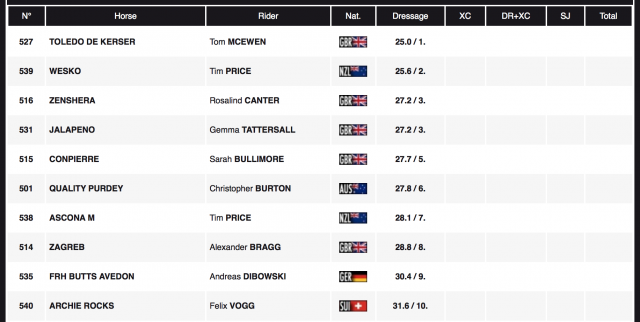
The top ten at the culmination of cross-country at Pau.

5 Etoiles de Pau: Website, Entries, Form Guide, Live Scores, Live Stream, EN’s Coverage, EN’s Twitter, EN’s Instagram

Suck It In and Pray: Your Pau CCI5*-L Cross Country Preview

“I’ve eaten slices of pizza that were wider than this, y’all.” –Wylie. Photo courtesy of CrossCountryApp.

You’ve heard of show condition, but let us tell you something: there should be a spot on the equine body-scoring chart called Pau condition. This year’s course, designed by Pierre Michelet –– affectionately dubbed Michelet the Menace — is full of all the teeny-weeny, itsy-bitsy, thinner than a supermodel skinnies we’ve come to expect from France’s five-star … and then some. You wanna get through those flags and not take 15 penalties with you? You better suck it up, buttercup.

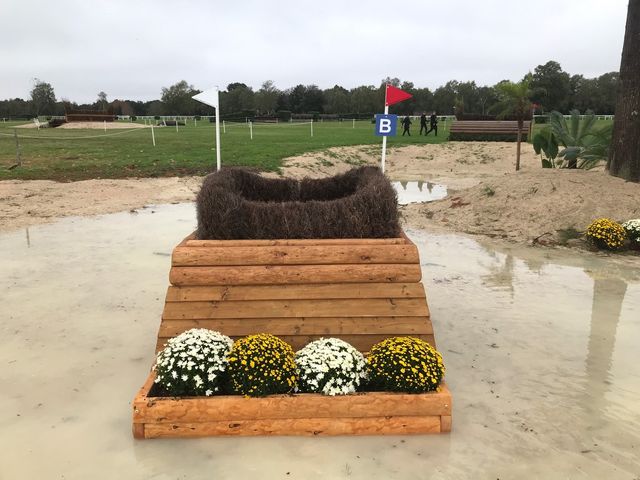
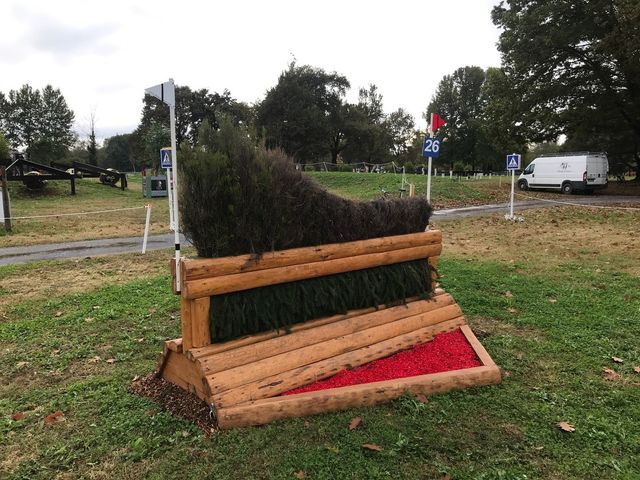
Check out this (not comprehensive) sampling of the course’s skinnies and corners:

Woof. Lots of technical stuff out there, straight from the dark, labyrinth depths of Michelet’s brain. But it’s not just the dimensions of the fences that make it difficult – and we’re certainly looking at some of the biggest, boldest questions we’ve ever seen at this event – it’s the go-kart turning, too.

There are a few things you need to know about the Pau course: first of all, it’s a city event, and so it has much less space to play with than the likes of Badminton, Burghley, and Kentucky. This means that the first and last third of the course wend their way through a tightly-packed wood, requiring horses and riders to be on their A-game — and their lines — from the word go. The middle section of the course opens up into the middle of the racecourse, where we’ll see our competitors try to make up the time they lost in the early slow minutes, and that they won’t be able to make up in the final slow ones, either. This means that the combinations in these first and last sections are as tricky as it gets: the waters, for example, require dizzying circles and hairpin turns to navigate the myriad obstacles placed within them. The second crucial detail is that the French favour a forward stride — their style is to open up, slip the reins, and ‘allez! Allez! Allez!‘ their way through. If something looks like a compact three, you better plan to land running and make that long two happen, baby. Positivity will be the watchword, and those catty pony types who can problem-solve on their quick little feet will have a ball.

But for all that the course looks like the devil’s playground at first glance, overnight leader Tom McEwen asserts that this course in three parts is actually rather fluid. We’ll certainly be looking forward to seeing his plan of attack in action with his two very different horses, Toledo de Kerser and the oversized Figaro van het Broekxhof.

The official length is 6,410 meters, with an optimum time of 11 minutes 15 seconds.

Here’s the course, via our friends at CrossCountry App. Many thanks to Paul Tapner for the recording.

Pau’s cross-country phase begins at 14.00 local time/13.00 BST/8.00 a.m. Eastern time, and will be live-streamed with English commentary through Horse&Country TV (dressage and show jumping are free; cross country requires a subscription) or here with French commentary (player embedded below). You can find ride times here.

Best of luck to all for a safe, happy day of cross country. Go Eventing!

5 Etoiles de Pau: Website, Entries, Form Guide, Live Scores, Live Stream, EN’s Coverage, EN’s Twitter, EN’s Instagram

Pau, Day Two: Tom McEwen and Toledo de Kerser Dance to Dressage Lead

Tom McEwen and Toledo de Kerser. Photo by Tilly Berendt.

And so the sand-dancing comes to a close, and the wine-quaffing begins in earnest – and at the culmination of a day and a half of closely-fought competition, a French horse sits in the top spot. But Selle Français Toledo de Kerser doesn’t wear the tricolour – instead, with Tom McEwen in the irons, he’s one of Great Britain’s brightest stars, though his 2019 season hasn’t afforded him quite as many golden opportunities to shine as it could have done. Selected for the European Championships, he was sidelined at the eleventh hour after slipping on the yard – and now, at the tail-end of the season, he proved that his brief break from the spotlight hasn’t done his form any harm. He and Tom scored an unsurpassable 24.9 to take the lead going into cross-country.

“It’s great to be in the lead going into cross-country – for me, it was just a nice, elegant, fluent, uphill test, which is what the judges have been looking for all week,” says Tom, who has never led the dressage at this level. “It’s definitely nice to be in the lead against such stiff competition – I’m looking forward to tomorrow.”

Tom will certainly have his work cut out for him over tomorrow’s cross-country course, over which he’ll need to pilot two distinctly different horses: Figaro van het Broekxhof, who sits eleventh after dressage, will act as the pathfinder of his two horses.

“You come here expecting a twisty track just because of the dimensions of the setting, but for me it’s really fluid – though there are big fences and clever lines, and a lot to be done,” he says. “I’ve got two completely different horses here, and it’s basically a course of three parts. Toledo can do all of it – the twisting parts, the open bits. He’s fit and ready to run, and he’s not coming here to just get round any more. Basically, he’s a good French-running horse!”

Tim Price and Wesko. Photo by Tilly Berendt.

Tim Price, already in seventh place with first ride Ascona M, certainly gave Tom a run for his money aboard his 2014 Luhmühlen winner Wesko today – and although his score of 25.6 would relegate him to second place overnight, he gives Tom just a second in hand over tomorrow’s time-sapping track.

Ros Canter and Zenshera. Photo by Tilly Berendt.

The World Champion has been on superb form since her return to competition after having her daughter, winning three internationals from four starts and adapting remarkably quickly to life as one of eventing’s myriad supermums.

“I’m trying not to let [my eventing life] change at all, really – you’ve kind of got to stick to the game plan, and my desire to win hasn’t gone at all,” says Ros. “That’s all I want to do, and I really want to gear up for next year and have a good crack at getting Olympic selection. But it obviously is very different; fifteen minutes before I got on today, I was breastfeeding! There’s an awful lot to contend with, but I’m very lucky that I’ve got so much support – I’ve got my mum here this week, and my partner, Chris, who will take Ziggy whenever I need him to, so it’s all good so far.”

Today, she rode 15.2hh Zenshera – a horse she’s described as being quiet enough to work in a riding school – to equal third and a score of 27.2. For Zenshera, this looks to be the start of another successful week in the Pyrenees – he’s finished 5th and 7th here on his two previous visits, proving that sometimes, small really does equal mighty.

“It’s very special – we didn’t actually know until last week if I was going to come here, and I felt a little bit rusty at times since coming back, so we’ve played it a bit by ear,” she says. “But Zenshera’s a real professional by now; he’s fifteen, and we’ve known each other since he was four years old, so if I was going to come back on anything, I wanted it to be him.”

Gemma Tattersall and Jalapeno. Photo by Tilly Berendt.

Gemma Tattersall made good on a fledgling partnership with Jalapeno who, like other ride Chilli Knight (13th), is by Badminton winner Chilli Morning. But unlike Chilli Knight, who Gemma has produced through the grades, Jalapeno has spent the formative part of her career under a different flag, being piloted by Belgium’s Karin Donckers. Though the eleven-year-old mare only changed hands at the end of last year, the pair have enjoyed several high-profile successes in their young relationship, including second place in Bramham’s CCI4*-L, 9th at Chatsworth CCI4*-S, and a win in the Event Rider Masters series finale at Lignières. But that doesn’t mean that it’s always been plain sailing, as Gemma explains.

“Karin has done the most wonderful job on her and everything was installed, but we’ve had to fine-tune it for me,” she says. “We’ve had a few blips on the cross-country, but in the dressage, up until Lignières we were doing superb tests, but we weren’t doing clear rounds. We were still late 20s, whereas at Lignières and Millstreet we were right on the money getting low 20s, which she’s so capable of doing every time out. I wouldn’t say it’s been straightforward; it’s just a case of her getting to know what I want and me getting to know what she wants.”

Their test today saw them score a 27.2, putting them in equal third place overnight.

“It’s our first five-star test, and we’re still finding each other out,” she says. “I’m really pleased with that – the changes can be better, but I had four clean changes. We’re doing really good, straight changes at home, but sometimes when we’re in the arena she’s so laid-back that she just drops behind my leg and I have to force them a little bit. Then you lose the straightness. Instead of being potentially an 8, they then drop to a 6.5 or a 7. But she’s got so much ability in this phase – it’s just about getting the best out of her now. She’s so rideable and trainable – you could have set fireworks off in there and she’d still have done it. She’s got an amazing brain on her.”

Sarah Bullimore and Conpierre. Photo by Tilly Berendt.

Sarah Bullimore rounded out a near clean-sweep for the Brits to sit fifth overnight on Conpierre, who made his five-star debut at Luhmühlen in June, finishing eighth. Today, he scored a 27.7, despite a dramatic spook as he entered the main arena – a dance move that’s not entirely outside his usual oeuvre.

“I’m chuffed to bits with him – he’s a lovely, lovely horse, but he’s quite cheeky,” says Sarah with a smile. “He’s got a real sense of humour, and he can have a little squeal and a squirt and spook at something at just the wrong moment. But he was fabulous [in the ring] and so rideable, and what’s really exciting is that there’s so much more to come from him.”

Improvement in some of the trickier movements certainly proved that point, with ‘Toby’ expertly navigating the test – which features as many twists and turns as Pau’s cross-country track – with balance and ease.

“He finds the changes really quite difficult; he can almost be a little bit too extravagant, but only in front, and then just a little bit wrong behind,” says Sarah, reflecting on the highlights of his test. “But he was much more symmetrical front and back today. The lateral work is always quite easy for him. I was so pleased with the trot work – there’s a lot of changes of bend, and when I was watching yesterday I saw so many people missing the centreline, because it’s quite hard to judge it with the sand, so I hope we got that right!”

Though Toby has been rather overshadowed by stablemate Reve du Rouet, it turns out that he’s an essential part of the latter’s life.

“We call him the social worker,” laughs Sarah, explaining that turning Reve du Rouet out with Toby has taught the formerly reclusive horse to open up. “He never used to want to be around people, or around other horses, and we turned them away together and by the end of it, they’d stand at the fence scratching each other. Now, we let ‘Blou’ loose on the yard and he goes from box to box, scratching everyone – even the mares, who aren’t always so sure about it, but they let him because it’s Blou.”

Now, though, it’s Toby’s time to shine – and possibly to help Sarah to her first five-star win, which she lost out on here two years ago by a matter of less than a second.

Chris Burton and Quality Purdey. Photo by Tilly Berendt.

Chris Burton sits sixth overnight on Quality Purdey, who makes her five-star debut on a score of 27.8.

“We’re very happy with her – she was a naughty girl last time at Lignières and she got very feisty in the dressage, but she was a good girl today,” says Burto. But even the fastest man in the world is aware of the challenge that tomorrow will present: “What Pierre Michelet does is a lot of turning back and twisty turns to slow the riders down. But we’re going to give it a good go.”

Yesterday’s leaders, Tim Price and Ascona M, move down to overnight seventh on their score of 28.1, while Alex Bragg and Zagreb sit eighth on their 28.8.

Andreas Dibowski and FRH Butts Avedon. Photo by Tilly Berendt.

We’ve enjoyed many years of watching Germany’s Andreas Dibowski and FRH Butts Avedon at this level, and we’ll be paying extra attention this week – because it’s likely to be the last time we’ll see the experienced gelding, who was second here in 2014, 12th in 2015, and ninth at Luhmühlen in 2013, among his myriad accomplishments. But the last few seasons have been trickier – in fact, the last five-star the horse completed was Badminton in 2016, and on his four attempts since then, he’s failed to complete. But now, off the back of a win at Strzegom’s recent CCI4*-S, Andreas is hoping that his late entry to Pau will allow the horse to bow out on a high.

“Now he’s sixteen, and I think it could be the last big competition with him,” he says. “The decision came only last week after Strzegom, and at Waregem and Strzegom he gave me such a good feeling that I decided to try it again.”

The week got off to a competitive start for the pair, who are consistent performers in this phase. They posted a 30.4 to hold ninth place overnight.

“I had a very good feeling; he was calm and he was with me,” says Andreas. “Only on the last change he was a little bit before me, but everything was fine.”

Felix Vogg and Archie Rocks. Photo by Tilly Berendt.

Switzerland’s Felix Vogg had plenty to celebrate after piloting the American off-the-track Thoroughbred Archie Rocks to a personal best across all levels of 31.6, putting them into tenth place going into cross-country. Previously piloted by Maya Simmons, who bought the gelding – then named Smittys Messiah, but renamed for Maya’s grandfather, who served during World War II – from Chris Talley, and latterly competed by Buck Davidson, the gelding has never quite forgotten his roots, but today, that inclination to go forward worked for him, rather than against him.

“I did a few mistakes, sadly, and that always costs more than when the horse does it, but he was pretty good,” says Felix, who moved back to this side of the pond after basing in the States until just after Kentucky this spring. “It’s not always easy with him, because he’s still a little bit a racehorse in the ring, but he’s absolutely a trier. He tries really hard every day and I’m really lucky to have him.

The walk was really good for him; I’ve always had a few issues in walk with him. The centreline was good too, and in the medium canter he wanted to go a little bit too much, maybe, but overall it was a good test for him.”

Though Archie Rocks makes his five-star debut this week, he gained useful experience when stepping in for Felix’s top horse, Colero, at the European Championships this summer, where he romped home clear inside the time. Now, Felix is confident in his ability to read and tackle Pierre Michelet’s track, which has something of a dual identity: though it’s tight, twisty, and packed with dizzying turnbacks in the first and last thirds, the middle section opens up onto the racecourse and allows for a much more open, forward ride.

“He’s really honest, and he’s fast, and I wouldn’t want to be sitting on another one for a first five-star,” says Felix, who thinks the horse’s future lies at this level, rather than as a championship mount.

“I think this level will suit him more, because it’s not so much of a dressage competition,” he explains.

Holly Jacks and More Inspiration. Photo by Tilly Berendt.

We caught up with our sole North American competitor, who makes her return to Europe after four years. Canada’s Holly Jacks and her ex-racehorse More Inspiration sit in 29th place on 36, a personal best for them at this level.

“I’m thrilled with him,” says a beaming Holly, who has twice contested Kentucky with the gelding. “He’s been a difficult horse on the flat, and I’ve really changed my programme in the last year. Now, I don’t do a lot of dressage – I do a lot of it on my trots and my gallops. He hasn’t been in a dressage ring in about three weeks; I walk him around the ring to familiarise, and I don’t warm him up in the outside rings – I just canter, and then canter on down. I’ve done this in my last three events, and in each of them, we’ve had personal bests.”

For Holly, being here is the realisation of a plan shelved two years ago, when her father suffered a stroke and she changed her autumn season as a result. Now, with the experience of her last trip to Europe – and plenty of internationals on home soil and in the US in the following years – under her belt, she’s looking to give this week her all.

“We were both a lot greener [in 2015] – we’ve been around a couple of five-stars now, and we’ve been around Aachen, so I’m hoping to put the pedal down tomorrow and be a little more competitive than I have in the past,” she says. “I’ve always been told it’s a really tight, twisty, technical course, and he’s that kind of horse – he’s a good showjumper, he’s very handy, and he loves indoor eventing. I wanted to come overseas with him before I retired him, and I thought this would be a better spot for him than Burghley, for the type of horse he is.”

Tomorrow sees us look to the main event: Pau’s cross-country phase begins at 14.00 local time/13.00 BST/8.00 a.m. Eastern time, and will be live-streamed through Horse&Country TV. You can find ride times here, and we’ll be bringing you a close look at the challenge ahead tomorrow morning. Until then – foux de fafa, my friends.

5 Etoiles de Pau: Website, Entries, Form Guide, Live Scores, Live Stream, EN’s Coverage, EN’s Twitter, EN’s Instagram

Day One at Pau: Tim Price and Ascona M Lead the Way

Tim Price and Ascona M. Photo by Tilly Berendt.

After this morning’s first horse inspection, we were treated to a teeny-weeny, dainty little dressage session in the drizzle this afternoon, which saw the first fourteen competitors deliver their dressage tests for judges Katrin Eichinger-Kniely (C), Tim Downes (B), and Nathalie Carriere (H).

Although top marks were few and far between, it was an obvious suspect who would top the ranks at the end of the day: Tim Price and Ascona M laid down a conservative and correct test, perhaps lacking in some of the mare’s usual sparkle, to earn a 28.1 and take an early lead in the competition.

But although we’ve come to expect brilliance from the exuberant mare, who won Luhmühlen 5* this summer, her jockey was happy enough to settle for obedient and attentive work, rather than demanding flamboyance in the ring.

“I’ve never had her so physically prepared – she’s coming of age at this level and it’s just been another reason for her to exuberant in all the wrong ways,” says Tim. “She’s certainly been a handful the last couple of days. She’s been crazy at times and then brilliant at other times, but that doesn’t get you through a test, so I’ve had to just try and think on my feet. I’m never the type of rider to try to wear them out, so I just keep coming a little bit more and trying something a little bit different – if I tried to wear her out, she’d just use it against me, so I had to persevere and try to get her into my way of thinking. But when we went in she was settled and with me, and looking like a normal horse in the ring was kind of enough. I didn’t want to ask too much and risk it – it’s all very well asking for more and getting some blips, and then you end up on the same mark or a little bit worse but they haven’t learnt as much.”

Alex Bragg and Zagreb. Photo by Tilly Berendt.

It was a little bit of deja-vu for Alex Bragg and Zagreb, who posted a 28.8 to hold a close second to Tim and Ava. For Alex, who has been achingly close to a top result at this level and finished third at Luhmühlen this year to the same pair, it was a matter of fine margins – as fine, even, as the margin that kept him from taking the top spot.

“I’m really pleased with him, but it’s tough going on a Thursday,” he laments. “They’re sharp, and it’s hard – if you do too little and they blow up, it’s a 30 test, but you don’t want to do too much with them, either.”

Still, on a day when good marks were hard to come by, their score isn’t too shabby a starting point – and would have been considerably lower were it not for a lack of cohesion in the first change, which saw them add a 4 to their score sheet and lost them the chance to finish in the 26 bracket.

Tom McEwen and Figaro van het Broekxhof. Photo by Tilly Berendt.

Tom McEwen didn’t fare quite so well under the judges’ watchful eyes, earning a 31.9 with his Luhmühlen runner-up Figaro van het Broekxhof after a momentary lack of connection in the medium canter earned him 4s, too. But this score was enough to earn him third overnight in this early stage of the competition, and it betters his Luhmühlen performance, too, which saw him earn a 32.2 with the oversized Belgian Warmblood.

Gemma Tattersall and Chilli Knight. Photo by Tilly Berendt.

A debutante squeaked into the top five today, but it certainly wasn’t a first-time jockey: Gemma Tattersall brings nine-year-old Chilli Knight, the youngest horse in the field, forward for his first five-star this week. The son of Chilli Morning and Kings Gem has been described as a ‘yes man’, and he showed that generous nature in the ring today, remaining focused despite the myriad distractions around the arena. His efforts – and the careful piloting of Gemma atop him – earned him a 32.7 for fourth place overnight.

Shane Rose and Virgil. Photo by Tilly Berendt.

No one has had a longer journey to get here than Shane Rose: he and Virgil traveled for five days to make it to the south of France from their native Australia. But why a trip to Pau when Adelaide, at which the horse was second in 2015?

“I guess I just like spending money,” laughs Shane ruefully. “If I do Adelaide on him, he’s already done really well in the past there, so I felt that if I came over here and did a good job it would tick more boxes going forward towards Tokyo. If I can get all my work done here, then hopefully we can go home and prepare for if we’re selected.”

Although Shane based himself in the UK in 2017, he’s not planning a trip back to prepare for the Olympics.

“The trip to Tokyo’s a lot easier for us from home – it’s ten hours as opposed to twenty-two,” he explains. “It’s going to be a much easier prep for him.”

Wobbles in both right-hand changes precluded a higher placing, leaving Shane on 33 and overnight fifth.

“He’s been really good this year with them, but he hasn’t had the perfect prep in the last couple of weeks so I just didn’t give him enough time to work on those,” he says. “I’m disappointed with the score – I thought he did some really nice work.”

Arnaud Boiteau and Quoriano ENE HN. Photo by Tilly Berendt.

Experienced combination Arnaud Boiteau and Quoriano ENE HN lead the way for the home nation, sitting sixth at this early stage on a score of 33.2.

“I’m not as happy as possible, because I had a big mistake just after the start of the test,” says Arnaud, who lost marks for a break into canter in the medium trot. “It makes a bad start for the judges. But the horse was, as usual, nice and a good mover, though he’s not so easy to drive in the dressage arena. I was quite pleased, but the mistake cost me a lot, I think.”

Marcelo Tosi and Glenfly. Photo by Tilly Berendt.

It’s a truly global top ten today, with six nations represented within this upper echelon of the leaderboard. One of those nations is Brazil, ably represented by Marcelo Tosi and the Thoroughbred gelding Glenfly, who was 25th at Kentucky this spring. Today, they scored a five-star personal best of 34.3 to hold seventh place overnight.

Sam Ecroyd and Wodan III. Photo by Tilly Berendt.

Eighth place is the domain of five-star sophomore Sam Ecroyd, who completed Luhmühlen this summer with his Pau partner Wodan III. Their test today didn’t quite hit the marks that their debut did, though their final score of 34.6 sees them well enough in the hunt after the first 14 combinations.

Tomorrow sees the remaining 28 competitors take to the main stage from 10.00 a.m. local time/9.00 a.m. BST/4.00 a.m. EST. Our sole North American competitors, Holly Jacks and More Inspiration of Canada, will ride at 10.14/9.14 a.m. BST/4.14 a.m. EST – you can find the full list of ride times here.

A tout a l’heure, mes amis!

The top ten after the first – shortened – day of dressage.

5 Etoiles de Pau: Website, Entries, Form Guide, Live Scores, Live Stream, EN’s Coverage, EN’s Twitter, EN’s Instagram

Pau At-a-Glance: A Visual Breakdown of the French Five-Star Field

There are some things the French do very well: kissing, bread, excellent aphorisms (‘ah, la vache’ – literally, ‘oh my cow’, instead of ‘oh my God’), cinema, full fringes, a Breton stripe, and truly unique equestrian events. But before we delve too deeply into the horse-man-beasts, the plentiful fruits de la mer, and the swimming rats (yes, that’s a thing) of Pau, let us first focus our attention on the horses and riders who’ll be riding this jolly wave with us. Or us with them, which is probably a slightly fairer way of putting it.

You’ve seen the jam-packed form guide, but hey – maybe you don’t have time to read about the life story of every combination entered. We get that. Or maybe you just want a coffee-break overview of the need-to-knows – either way, this double-sized edition of AAG will give you all you need to be truly, thoroughly prepared for the next few days of competition. Without further adieu, here’s your 2019 Les 5 Etoiles de Pau field, at a glance.

5 Etoiles de Pau: Website, Entries, Form Guide, Live Scores, Live Stream, EN’s Coverage, EN’s Twitter, EN’s Instagram

All Pass Pau First Horse Inspection

Chris Burton and Quality Purdey. Photo by Tilly Berendt.

The first horse inspection got underway this morning at Les 5 Etoiles de Pau, mercifully not in the dark for the first time in recent memory. This is partly because of our friends and neighbours the combined drivers – their competition this week serves as the test event for next year’s World Championship, and so the structure of the week has changed to accommodate their additional needs. This doesn’t have much bearing on the CCI5*, but that the trot-up has shifted forward and Friday brings us a full day of dressage, rather than a shortened day as we’re used to.

Today’s horse inspection took place before the assembled ground jury of Katrin Eichinger-Kniely (AUT), Tim Downes (GBR), and Nathalie Carriere, and 42 combinations came forward to begin their competition. You can read all about each and every single one of them in our bumper form guide. 

Charlotte East and King Albert. Photo by Tilly Berendt.

Just one horse was held through the course of the morning: British debutante Charlotte East was sent to the holding box with King Albert, bred and formerly produced by Mary King. The pair were subsequently accepted upon representation.

Tom McEwen and Figaro van het Broekxhof. Photo by Tilly Berendt.

Dressage begins at 14.00 local time/13.00 BST/8.00 a.m. Eastern time, and we’ll see the first 14 combinations of the 42-strong field deliver their tests in the sandbox today. It’s an afternoon of sport well worth following: this afternoon’s competitors include Luhmühlen winners Tim Price and Ascona M (14.51 local time), runners-up Tom McEwen and Figaro van het Broekxhof (14.44), five-star fan favourites Alex Bragg and Zagreb (16.02), and Australia’s Shane Rose and Virgil, on a hot winning streak (16.16). You can find this afternoon’s full timetable here.

Want to watch along? You’ll find a live-stream with English commentary at Horse&Country TV. The dressage and jumping phases are free to watch, while Saturday’s cross-country requires a subscription.

Unfortunately, some technical malfunctions prevented us from capturing the full gamut of this morning’s combinations, but enjoy a teeny-weeny gallery for now and keep it locked onto EN, where we’ll be bringing you plenty more Pau content throughout the day.

5 Etoiles de Pau: Website, Entries, Form Guide, Live Scores, Live Stream, EN’s Coverage, EN’s Twitter, EN’s Instagram

Polework in the Pyrenees: The Bumper Guide to Pau’s Competitors

Started from bottom (March) and now we here (the tail end of the European eventing season, sobbing into a bottle of cheap red). But what better way to cap off a whirlwind season than at Les 5 Etoiles de Pau, that most truly, unapologetically weird and wonderful of events? Buckle up and settle in for four days of pâté-eating, vin-guzzling, foux de fafa-ing, and top horse-spotting, because this compact field is purpose-built to bring us all no end of excitement and fierce competition.

At just 42 competitors, Pau’s field is only half the size of what we see at Burghley or Badminton, but it delivers a mix of experienced pairings and promising first-timers that is just truly *chef’s kiss*. There are at least seven horses in the field that present themselves as obvious winners, so pity the betting man – a wiser tactic this week will be simply to sob with joy universally. Want to know who you’ll be shedding happy, slightly tipsy tears over? Dive into the comprehensive form guide and get to know the field…

AUSTRALIA

Chris Burton and Quality Purdey. Photo by Tilly Berendt.

Chris Burton and Quality Purdey

Thirteen-year-old Oldenburg mare (Quality x Lara). Owned by Dom and Claire Poole and Bek Burton.

It’s a long-awaited five-star debut for The Dragon, who hasn’t been out of the top ten in an international since the beginning of 2018, and who FOD-ed her way to a merry win in Saumur’s CCI4*-L last year. In fact, she’s becoming a bit of an FOD machine; she did the same at Aachen this summer, finishing third as a result. Competed through to CCI4*-L by Lauren Blades, she joined Burto’s string in 2017 and won in their debut together at Haras du Pin CCIO4*-S. She’s great on the flat – we’ll be looking at a mark between 26 and 29 – fast and careful across the country, and generally a very good showjumper, although she doesn’t run in many long-format events, so we haven’t seen quite enough to make a final judgment on her jumping prowess. Still, this is an almost certain top-five finisher – and a win wouldn’t be at all unlikely, either.

Isabel English and Feldale Mouse. Photo by Tilly Berendt.

Isabel English and Feldale Mouse

Seventeen-year-old Connemara x Thoroughbred gelding (Domo Cavallo Praize x Zoe). Owned by Sarah English.

I met Isabel English for the first time in a crowded bar earlier this year, where several hundred sweaty teenagers were Vossy Bopping around us and a framed photo of Trevor Breen collected airborne condensation in the corner. I was working on the press team for a major showjumping competition, which meant that any eventer I saw – even if I didn’t actually know them – was suddenly my very favourite person. Three or four or eight gin-and-tonics down, I bellowed my love for Feldale Mouse at her.

“HE…IS THE BEST…PONY…AND I LOVE HIM,” I dispensed, my eloquence and erudite nature once again elevating me above the commoners in the room. “HE. IS. SO. SMALL. SO. COOL.”

Isabel, for her part, took it with aplomb, partly because she is much cooler than I am, and partly because she spent a few years training with Michi Jung, so she’s absolutely used to foreigners bellowing barely comprehensible things at her. And, for what it’s worth, even without the gins, I do love Feldale Mouse. He has small man syndrome in the best possible way; it’s like he’s spent his whole life thinking, “you called me MOUSE?! Oh, just you wait, pal.”

Isabel is only 24, but she’s accomplished an enormous amount in her career with the Connie cross. She went five-star for the first time basically the moment she turned eighteen; that resulted in a twelfth-place finish. The next two years, again riding Feldale Mouse, she finished eighth. Then, in 2016, she left her Australian hometown of Biddaddaba (yes, really) to move to Germany and work for a certain Herr Jung. Since then, the duo has tackled 16 internationals, only running into problems across the country on two occasions. This spring, they tackled their first Badminton, jumping a reasonably slow but classy clear.

Don’t expect them to blitz into the lead on speed – sorry Mouse, your legs aren’t that long – but do get ready to loudly cheer on this dynamic duo, who are basically the personification of every childhood daydream you ever had. They’ll score in the mid-30s, but who’s going to remember that bit when they’re jumping one – and perhaps two – fantastic clears?

Kevin McNab and Scuderia 1918 Don Quidam. Photo by Tilly Berendt.

Kevin McNab and Scuderia 1918 Don Quidam

Eleven-year-old KWPN gelding (Quidam x Nairoby). Owned by Scuderia 1918.

Originally produced by Hannah Bate, Don Quidam is one of a growing string of exciting horses for Italian footwear company Scuderia 1918. He’s a worthy partner for Kevin’s first five-star since 2015, when he finished 25th at Luhmühlen: he was eleventh at Hartpury CCI4*-S, seventh at Luhmühlen’s hotly-contested CCI4*-S, which hosts the German national championship, and eighth at Sopot CCI4*-L. Though it’s a first five-star for the horse, and as such, a bit of an unknown, he should sneak sub-30 in the first phase, look professional on Saturday, and could well jump clear on Sunday, too.

Shane Rose and Virgil. Photo by Leslie Threlkeld.

Shane Rose and Virgil

Fourteen-year-old warmblood gelding (Vivant x unknown dam). Owned by Michelle Hasibar and the rider.

Isn’t it a treat to have Shane Rose back? We got so used to seeing him around the UK and European circuit in 2017 that we didn’t quite accept that one day he’d leave us to head back to his base in Australia, where he trains eventers, racehorses, and fighting kangaroos (Ed. note: please check this). While he was here, he and Virgil finished sixteenth at Burghley, seventh at Luhmühlen, and took the win in Blair’s CCI4*-S, and upon buggering off back from whence they came, they promptly won the CCI4*-S at Camden, finished second in the CCI4*-S at Werribee, and won CCI4*-S classes at Canberra and Camden once again. They popped over to Tryon for the WEG, although it didn’t go quite to plan: they had a sub-30 dressage but picked up a 20 across the country. Still, we can expect a mid-to-high 20s dressage to kick their week off, followed by what should be a quick clear. On the final day, they’re consistently clear – so watch out for these two to make the top five.

BRAZIL

Marcelo Tosi and Glenfly. Photo by Shannon Brinkman Photography.

Marcelo Tosi and Glenfly

Fourteen-year-old Thoroughbred gelding (Presenting x Dorans Glen). Owned by the rider.

There are a few things I’ve been accused of saying one too many times. “He’s earned himself a place on the FEI World Bum Rankings” is certainly one of them. “How hard is it to become a member of the ground jury? I’d like to be saluted” is another. But the most common offence of them all is the one I’m going to use to describe darling Glenfly – “he just looks like he’s been plucked straight out of a Munnings painting.”

But you know what? Je ne regrette rien. I’m absolutely right. And frankly, I couldn’t take my Thoroughbred-loving eyes off him when he was mincing around Kentucky, having a lovely time in his own lovely way, this spring. His first-phase score of 40.8 (robbed! Robbed, I tells ya!) precluded a competitive finish, and he wasn’t particularly fast, and okay, he had three rails down, but he did jump around clear on Saturday, tucking his improbably fine legs up by his pretty little face, and oh god, Marcelo, please just get bored of your lovely pony and send him to me, please!

That Kentucky dressage score was considerably above Glenfly’s norm, so we’ll be expecting a mid-30s score here. They were eliminated for a rider fall at Burghley, so they’ll be looking to pin down a completion on their reroute here, which is doable. A couple of poles will topple on the final day, and we’ll still be carrying some polos in our pocket for him, regardless.

CANADA

Holly Jacks-Smither and More Inspiration. Photo by Leslie Threlkeld.

Holly Jacks-Smither and More Inspiration

Fourteen-year-old Thoroughbred gelding (Inspired Prospect x Gentle Buck). Owned by Bruce Smither and the rider.

Thoroughbred fans, rejoice: there are two off-the-track Thoroughbreds in this year’s field, and the first of them is More Inspiration, the $2,000 racetrack flunky who upgraded to a very different trip to Kentucky. In fact, he’s made two of them now – he finished 26th on his debut in 2017, losing out on a higher placing after grease on the reins left Holly with little control, and although he was eliminated in 2018 for a rider fall, he’s been in the top fifteen in his three international runs since then. Two of those came at Bromont, in both the CCI4*-S and CCI4*-L classes, and one came in Plantation Fields’ CCI4*-S in September.

This won’t be the pair’s first time in Europe – they represented Canada at Aachen in 2015, finishing 30th. The experience served them well – in their next run, they finished fourth at Plantation Field. Holly will be looking ahead to Tokyo next year, so a qualifying result will be the main aim – anything else will be a brilliant bonus for this long-term partnership. Expect a low-40s dressage, a steady run across the country, and a one-or-none round on Sunday.

SPAIN

Gonzalo Blasco Botin and Sij Veux d’Autize. Photo by Leslie Threlkeld.

Gonzalo Blasco Botin and Sij Veux d’Autize

Thirteen-year-old Selle Français gelding (Urban du Monnai x Novia d’Autize). Owned by Marta Botin Naveda.

The son of an eventing mother, Gonzalo has represented Spain at the World Equestrian Games in Tryon, where he unfortunately withdrew Sij Veux d’Autize before the cross-country. They rerouted to Pau, where they took a tumble across the country, but they’ve since jumped clear around CCI4*-S tracks at Haras du Pin and Vairano. The Spaniard, who was a prolific championship rider in the pony, junior, and young rider divisions, balances his riding with his job as an investment analyst, and he has Masters degrees in mechanical engineering and international business, so if that ever comes up in a pub quiz, you are sorted, my friend. We’ll be looking at a mid-30s score and a gung-ho cross-country round this week, which will hopefully pay off for them – then, the horse might go clear, or he might have three rails. Who’s to Sij? (Sorry, not sorry.)

FRANCE

Arnaud Boiteau and Quoriano ENE HN. Photo by Jenni Autry.

Arnaud Boiteau and Quoriano ENE HN

Fifteen-year-old Selle Français gelding (Coriano x Lili Saincrit). Owned by the Institute Français du Cheval et de l’Equitation.

Arnaud was part of France’s first-ever gold medal-winning Olympic eventing team, who topped the podium at Athens in 2004 and now, we’re used to seeing him sneaking into four-star top tens across the continent with top horse Quoriano (Lignières ERM, for example, and Jardy ERM, and Haras du Pin CCIO4*-S). But his five-star record with the gelding isn’t quite so illustrious – they’ve started at this level five times, and only completed twice, when they finished third here on the horse’s debut in 2014 and again in 2017, when they finished 30th but had a 20. They likely won’t be the best of the home nation entries, despite their amassed experience – although that 2014 result certainly showed they can do it if it all goes right.

Mathieu Lemoine and Tzinga d’Auzay

Twelve-year-old Selle Français mare (Nouma d’Auzay x Danae de Turenne). Owned by Natacha Gimenez.

It’s nice to see Mathieu, who was part of the gold medal-winning team at Rio with Bart L, back at the top, and not just because he’s reasonably easy on the eyes. It’s been a bit tough for Rio’s victorious French in the years since – Mathieu’s partner was sold to the Japanese federation for Yoshi Oiwa to ride, while teammate Astier retired Piaf de b’Neville and similarly lost his WEG mount, Vinci de la Vigne, to Japan. But Mathieu has been working hard to get Tzinga on track for her five-star debut, which could be an impressive one. They were eighth at Saumur CCI4*-L this year, clear at Blenheim last year, and although she’s been sparsely run, Tzinga is starting to show some real promise for the future. She’s had her early blips across the country, though these seem to have been ironed out over the last two seasons, and she’s quick, too – so she’ll climb after her low-30s test, though her showjumping won’t help her. She’s prone to several rails.

View this post on Instagram

En route pour pratoni….

A post shared by Massié Benjamin (@benj_massie) on

Benjamin Massie and Ungaro de Kreisker

Eleven-year-old Selle Français stallion (Armitage 2 x Douce Platiere). Owned by Isabelle Dion and the rider.

This won’t be a first five-star for Benjamin, who finished thirtieth at Badminton in 2010, but it is for his horse, who sat the 2018 season out but has a five-strong top-ten streak on his international record. This includes ninth at Jardy CCI4*-S and second at Pratoni CCIO4*-S, and in his fourteen internationals, he’s never picked up a cross-country jumping penalty. He’s also proven super fast throughout his career, which should mean that this most French of tracks, with its demand for forward riding, should suit him well. He’ll score in the mid-30s in the first phase, but if he continues on his current trajectory, he’s certain to climb – then, on Sunday, he’ll likely have a rail as a souvenir.

Remi Pillot and Tol Chik du Levant

Twelve-year-old Selle Français gelding (Volchebnik x Frimouce du Levant). Owned by the rider.

Both Remi and Tol Chik du Levant make their five-star debut here this week, and although Pau has a rich history of favouring French first-timers, they’ll need to fight for their finish: they’ve been top five in two three-stars this year, but have had problems in both their four-star runs. In 2018, they finished 16th at Haras du Pin CCIO4*-S and 4th at Saumur CCI4*-L, and in 2017, they were 13th at Waregem CCIO4*-S and 3rd at Haras du Pin CCI4*-L, so the tools are all there, they’re just not quite all in the box at the moment. Nevertheless, Remi knows his horse and his plan far better than any of us do, and he’ll have his reasons for making the step up now – so expect a mid-30s dressage, and we’ll all take it fence by fence thereafter.

Regis Prud’Hon and Tarastro

Twelve-year-old Anglo-Arab gelding (Sarastro x Loo Native). Owned by Nathalie Carrere, Earl Elevage de la Salaman, and the rider.

We’re used to seeing Regis with Kaiser HDB, his usual mount at the top level, but this week we get the treat of meeting two less familiar faces. The first of these, Tarastro, jumped sweetly around Bramham’s CCI4*-L this year, though picked up 11 penalties along the way for a frangible pin, and he was eighth in the CCIO4*-S at Haras du Pin, too, where he finished on his 37.4 dressage. A 20 in his last run at Waregem isn’t the ideal prep for a debut at five-star, but Regis has plenty of experience and will coax a confidence-giving first run out of the horse over a course that’s designed to suit the French way of riding down to the ground.

Regis Prud’Hon and Vanda du Plessis

Ten-year-old Selle Français mare (Leonardo Louvo x Giralda du Clos). Owned by Claire Lafuma, Jules Prud’Hon, Earl Elevage de la Salaman, and the rider.

Joing Tarastro is Vanda, who moved up to four-star in 2016, but had some teething problems along the way. Since then, it’s been a game of ups and downs – Regis moves her down to three-star to rebuild, steps her back up, and then moves her down again when the performances begin to waver. This season has seen her stick to three-star until Waregem CCIO4*-S, where she pulled a quick clear round out of the bag to finish just outside the top twenty. This is a big move-up for the young and slightly fragile – performance-wise, not physically – mare, who will deliver a high-30s mark in the first phase and a big question mark in the second.

GREAT BRITAIN

Alex Bragg and Zagreb. Photo by Tilly Berendt.

Alex Bragg and Zagreb

Fifteen-year-old KWPN gelding (Perion x Renera). Owned by Sally and Phillip Ellicott. 

There are some horses who just set you to dreaming — somehow, they manage to open the floodgates and make their staggering trajectories a communal effort, something owned and coveted as much by the fans as they are by the rider and the team surrounding these brilliant animals. Tall, dark, and impossibly hunky Zagreb is one of those horses. When he made his Badminton debut in 2017 with the enormously likeable family man Alex in the irons, he stopped being “that nice-looking bay in the collecting ring” and immediately became something to take very seriously indeed, despite – or perhaps, even because of – the fact that he didn’t complete. Though the pair were sitting in fifth place after cross-country, Alex opted to withdraw his top horse before showjumping, spotting that he wasn’t feeling 100% himself and that there would be bigger things to come for the Dutch-bred gelding, known at home as Rhett. Yes, like that Rhett. Ugh, delish, right?!

BUT WE DO, RHETT. WEEEE DOOOOO.

Since then, Alex and Rhett have enjoyed top ten finishes at Aachen, Gatcombe, and Blenheim, as well as Pau five-star in 2017, a win in 2018’s Jardy ERM and third at Blenheim CCI4-L, and another clear around Badminton, though 40 time penalties and a knocked pin proved expensive. They took a tumble at Burghley but recovered well to perform beautifully at Blenheim, and Alex, who excelled in mounted games as a child and then started a successful farriery business, is a firm crowd favourite. They started at Badminton this year, but after a below-average dressage score of 31.7, Alex opted not to run, but a hop over to Tattersalls proved fruitful, and they made the CCI4*-S look like a Pony Club competition, finishing third. Then, they headed to Luhmühlen CCI5*, where they finished third, and they haven’t been out of the top ten in their three internationals since. A big win is on the cards at some point very soon – and it could well happen this week.

Sarah Bullimore and Conpierre. Photo by Tilly Berendt.

Sarah Bullimore and Conpierre

Twelve-year-old KWPN gelding (Con Air 7 x Pia). Owned by Chris Gillespie, Anna Ross Davies, and Brett Bullimore.

Despite his age, Conpierre hasn’t been run excessively – he’s had eighteen international starts since his debut in 2013. This is partly due to taking some time off: he was off games for much of 2015 and all of 2016, before coming back for busy 2017 and 2018 seasons. There have been some promising results along the way – he was 10th at Houghton CCI4*-S in 2015 on his level debut, and 10th again in Boekelo’s CCI4*-L in 2017. His best result, though, was eighth at Luhmühlen’s CCI5* this year, and though Sarah says he’s a very different ride to her top horse, Reve du Rouet, we saw her give him one of her typically nurturing rides across the country, getting the best out of him and instilling a huge amount of confidence. Hopefully, this should carry through here, where Sarah herself has great course form – she missed the win by a tenth of a penalty in 2017 with Reve du Rouet, and got all three of her horses home clear on a day when barely anyone even completed.

A high-20s score will stand her in good stead from the get-go here, and the showjumping is relatively good for this pair – it’ll just be the speed that stops them from threatening the leaders.

Ros Canter and Zenshera. Photo by Tilly Berendt.

Ros Canter and Zenshera

Fifteen-year-old KWPN gelding (Guidam x Telvera). Owned by the rider.

The World Champion would be forgiven for taking the bitter end of the season off after having a baby, perhaps to dash off to a 5* hotel in Portugal or something, but no — the irrepressibly hard-working Ros is heading back to Pau with Zenshera, who performed so well here in 2017, finishing 7th, and last year, finishing fifth. This will be his fifth attempt at the level, and rather impressively, he’s never been out of the top ten — he was 9th at Luhmühlen in 2017 and 3rd last year.

The 15-year-old, 15.3hh Guidam gelding is supremely talented, but he was a quirky youngster — Ros found him in Holland while doing a stint of work experience at the Dutch stud her former employer, Judy Bradwell, sourced many of her horses from. The owners of the stud had intended for him to showjump, but he didn’t show much promise in his formative years, and then he was broken to harness basically, as the kids would say, for the sh*ts and giggles.

“I rode him because he was something to ride, and I was gullible enough that they could sell him to me,” laughs Ros, whose 4,000 Euro investment has certainly come good. Zenshera has 25 international starts under his belt, and he’s only picked up cross country faults at one of them — Ros took a tumble in the Nations Cup at Great Meadow in 2016. He delivered a 26.4 dressage at Pau in 2017, giving Ros the lead on the first day, but a few time penalties and a pole ultimately cost them a shot at the win. With course form and Ros on a confidence-boosting high – she’s won three of her four international starts since returning from maternity leave – this could be a real shout for your 2019 Pau winner.

Felicity Collins and Just Amazing

Twelve-year-old British-bred Sport Horse mare (Weston Justice x Preston Polly). Owned by Vicky Collins.

Felicity Collins makes her five-star debut riding not just one but two horses, and she’s certainly an impressive first-timer to keep an eye on. She’s gained a reputation since her pony years of producing her own rides, no matter how tricky they are, and although ‘Maisie’ wasn’t hers from the get-go – she was her mother, former 5* rider Vicky’s Novice horse – they’ve certainly logged some miles on the international circuit, moving up to four-star together in 2017. This year, they were third in the CCI4*-L at Camphire, 3rd in the CCI3*-S at Brightling, and clear around Burnham Market, although problems at Bramham, Houghton, and Waregem blotted their copybook slightly. This run, which will see them start in the mid- to high-30s, will be about experience and education, which Felicity will earn in spades with her two rides.

Felicity Collins and RSH Contend OR

Ten-year-old Oldenburg gelding (Nintender x Coulonia). Owned by Vicky Collins and Avrina Milton.

RSH Contend OR is one of Felicity’s self-produced horses, and easily her most impressive: he helped her win the under-21 national title at Houghton in 2017, and then partnered her to 13th place at that summer’s Young Rider European Championships. That autumn, she moved him up to CCI4*-S, and he finished 14th in the eight- and nine-year-old class at Blenheim. In 2018, he was clear around Blenheim’s CCI4*-L, and this year, the pair finished 15th in the Young Rider Europeans, at which the team won gold and the dynamic duo were chosen as pathfinders. This week, we’ll be looking at a mid-30s dressage, a slow and steady clear, and a likely clear on Sunday – Mickey has only knocked two rails in 21 internationals.

Remarkably, Felicity has competed horses at each of the national age finals – and she ticked all those boxes as a teenager, which just proves her innate ability to produce a youngster carefully and considerately.

Eilidh-Jane Costelloe and Westmur Quality

Thirteen-year-old Irish Sport Horse gelding (OBOS Quality x Ruby Royale). Owned by the rider.

Both Eilidh-Jane and Westmur Quality make their five-star debut this week after jumping clear around Blenheim last season and around Burgham CCI4*-S this year. But their lead-up hasn’t been ideal – they picked up 20s at both Blair CCI4*-L and Bramham CCI4*-L. That said, issues in the run-up don’t always rule out a great debutante performance – just look at last year. On paper, no one would ever have put Thibault Fournier down as a cert to go clear, and he only went and won the thing. So Eilidh-Jane, like all debs, will come hoping to learn and improve for the future, and no matter what, she’ll do just that – even if it means taking a couple of long routes and keeping a sense of humour about the whole thing.

Charlotte East and King Albert

Seventeen-year-old British-bred Sport Horse gelding (Mayhill x Kings Gem). Owned by the rider.

If King Albert sounds familiar – and his dam, Kings Gem, who he shares with Gemma Tattersall’s Chilli Knight, sounds even more familiar – that’s because he originally comes from Mary King’s own little breeding enterprise. Mary took him from two-star to four-star in just over a year, and then passed the reins to Jodie Amos, who competed him for the 2012 season. In 2014, then-junior rider Charlotte took over, riding him first in junior two-stars and then in under-25 classes, and you’ll have to excuse us a second, it’s time to apply our night creme to our crows feet.

This will be a first five-star for Charlotte, who was part of the bronze medal-winning junior team in 2015 with Clear Dawn, and for King Albert, who jumped clear around Millstreet CCI4*-L and Barbury CCI4*-S after an unfortunate elimination in this year’s hugely influential Bramham Under-25 cross-country. This week will be about building the foundation for the future for this talented young rider – a dressage mark around 40 and a slow run won’t allow them to be competitive, but that’s not really the point.

Sam Ecroyd and Wodan III. Photo by Tilly Berendt.

Sam Ecroyd and Wodan III

Sixteen-year-old AES gelding (Mr Concorde BJ x Tica). Owned by the rider.

It’s a second go at five-star for Sam and Wodan III who, despite his advancing age, still approaches life like an overadrenalised five-year-old in a candy shop. This is charming and endearing (possibly more so for those of us not actually riding him) until it stops working in his favour, as we saw in their debut at Luhmühlen, where they picked up a 20 as a result. But first five-stars – heck, all five-stars – are educational things, and they’ll have come back battle-hardened and with a plan of action to better their 20th place finish in Germany. In their seven internationals prior, they only finished outside the top ten once, and that was an eleventh place at Blenheim, so we can hardly count it against them. They can score in the high-20s, although at this level they’ll flirt with 30, and although they won’t be among the quickest in the field, we’re looking forward to watching them lay down a round replete with all the trappings of life lessons learnt. And on Sunday? Extravagant Wodan has only had one rail since 2016, and that was at Luhmühlen.

Louise Harwood and Balladeer Miller Man. Photo by Tilly Berendt.

Louise Harwood and Balladeer Miller Man

Twelve-year-old Irish Sport Horse gelding (Stormhill Miller x Kintara Pride). Owned by Alli and Ian Haynes.

Harwood is known for piloting her homebreds around the upper levels, but Balladeer Miller Man bucks the trend. He was bought as a four-year-old from Ireland, but nonetheless, he grew and grew to fit in with diminutive Harwood’s stable full of oversized stars.

Miller’s 25th place finish at Burghley – his five-star debut – capped off a great 2018 season for the horse. He had jumped clear around Bramham’s CCI4*-L and finished twelfth at Camphire CCI4*-S in Ireland, proving his considerably ability. He’s finished in the top five at Blair Castle CCI4*-L, too – that’s generally considered one of the toughest competitions of the level, and it’s a real test of fitness.

Expect a high-30s to low-40s dressage, which will be off the pace competitively. That said, this pair should go clear across the country – they totted up a creditable 18.4 time penalties at Burghley which, all things considered, isn’t bad for a first-timer, and then jumped clear with 23.6 time at Badminton this year. They retired on cross-country in their next international, at Barbury, and then withdrew after dressage at Gatcombe, so they’re slightly short of match practice, but they’ve got all the goods. On the final day, they’re prone to a few rails – as many as six, in the case of Barbury last summer.

Ginny Howe’s Undalgo de Windsor displays some of the unwarranted dance moves he performed on the strip at Burghley once again at Blenheim. Photo by Tilly Berendt.

Ginny Howe and Undalgo de Windsor

Eleven-year-old Selle Français gelding (Lotus XV x Angelique Folle). Owned by the rider.

Ginny and her French horse both made their five-star debut at Burghley this year after two and a half methodical – but very promising – seasons at four-star. Ginny prefers not to over-run the horse, and tends to stick to three or so internationals per year with a big run at the end, and that method is paying off – Undalgo de Windsor hadn’t had a cross-country jumping penalty in an international since he was a three-star horse, way back in 2016. Unfortunately, Ginny took a tumble on cross-country at Burghley, and so they reroute here for round two.

His low-40s dressage scores still need some work – he can be a bit of a wild man in this phase (and in the horse inspections!), but a solid clear at Blenheim gives us every reason to believe that they’ll get the job done this week.

Kirsty Johnston and Classic VI

Ten-year-old British-bred Sport Horse mare (Calvaro x India Summer). Owned by the rider.

It’ll be a five-star debut for Classic VI, though not for Kirsty, who has ridden here – and at Badminton and Luhmühlen – with Opposition Detective. The last time we saw her at the level was in 2017, and she’s since had a baby, which generally means she’s probably about to win everything she enters.

Joking aside – although the post-maternity form of some of these gals is truly unbelievable – we’re looking at a pair on good, solid form. This year, they’ve jumped clear around Bramham CCI4*-L – a seriously tough iteration – Burgham CCI4*-S, Haras du Pin CCIO4*-S, and Ballindenisk CCI4*-S, notching up top-five finishes in the latter two. Though their season began with 20s at Bicton and Chatsworth, they seem to have turned them into something positive, and although they’ll start down the order on a mid-30s dressage, they could certainly climb. They’re not tremendously quick yet, but they’re reliable, and not too shabby on Sunday, either – they haven’t touched a rail in their last four internationals.


Prepare for take-off: Tom McEwen displays some vintage cross-country gumption, propelling Figaro van het Broekxhof through the tough final water at Luhmühlen. Photo by Tilly Berendt.

Tom McEwen and Figaro van het Broekxhof

Fourteen-year-old Belgian Warmblood gelding (Tauber van het Kapelhof x Damira van’t Herdehof). Owned by Barbara Cooper.

Like many Belgian men, Figaro van het Broekxhof is very tall and very good-looking, and cloaked in a very appealing aura of mystery. That is to say, nobody really knew a bloody thing about him until this season, when Tom put his foot on the accelerator and showed us all just how exceptionally good this horse is. A surprise win in Belton’s Grantham Cup CCI4*-S saw him best a colossal field full of some of the best horses in the world, and since then, he’s been well-nigh unstoppable, and wasn’t out of the top five in five consecutive internationals since the latter half of 2018.

This will be his third five-star start: he went to Badminton in 2016 with former rider Jodie Amos, but was eliminated on cross-country. Speaking of former riders, he’s had a fair few – in his international career, he’s been ridden by Anthony Clark, Sarah Olivier, Sarah Bullimore, Jodie Amos, and now Tom. While he might be a bit of a late bloomer, he’s certainly making up for lost time now. Speaking of five-star starts, too, he came achingly close to winning Luhmühlen this year, though settled for second to Tim Price’s Ascona M. His last international saw him record a very uncharacteristic 20, which will have had Tom kicking himself – he’d been named as the direct reserve horse for Toledo de Kerser at the Europeans, but the proximity of the run meant that Tom had to sit it out entirely. Now, he’ll be on the hunt for redemption.

Expect a dressage score around 30 – he can get into the 20s on his day, but scored 32.2 at Luhmühlen – and, on recent form, a quick clear on Saturday. In his recent CCI4*-S he’s on even keel between clear showjumping rounds and four-faulters – but he was clear at Luhmühlen, which has a tough, square showjumping track not dissimilar to Pau’s.

Tom McEwen and Toledo de Kerser. Photo by Nico Morgan Media.

Tom McEwen and Toledo de Kerser

Twelve-year-old Selle Français gelding (Diamant de Semilly x Ariane du Prieure II). Owned by Fred and Penny Barker, Jane Inns, and Ali McEwen.

A freak of a horse, really: Toledo de Kerser is one of the hot favourites for a top placing in this year’s field, and for very good reason.

He stormed into the spotlight back in 2016, when he partnered Tom to a win in Bramham’s hotly-contested Under-25 CCI4*-L. Then, he jumped clear around his five-star debut at Pau that autumn, finishing 22nd because Tom opted to run him slowly. A jolly good tactic it was, too – they finished eleventh at Badminton the following spring, fourth at Burghley that autumn, and seventh at Badminton last year. Then, they popped over the pond to Tryon, where they helped the British team to a gold medal and finished 12th individually. At Badminton this spring, he finished eleventh despite knocking a frangible pin and picking up 8.8 time penalties.

Toledo is consistent and flashy in the ring, scoring in the mid-to-high-20s reliably, and he’s only faulted three times across the country in his 22 internationals. If we were being picky, we could have said he’s not the speediest horse – but then he went clear inside the time at Tryon, so really, what do we know anyway?! On Sunday, you’ll really see Toledo shine – he’s probably the best showjumper in this list, and has only ever knocked two rails in his international career. Don’t let this pair out of your sight – a five-star win is right around the corner for Tom.

Michael Owen and the ‘overgrown pony’ Jims Pal dig deep to post the horse’s career-best result at Tattersalls. Photo by Tilly Berendt.

Michael Owen and Jims Pal

Thirteen-year-old Irish Sport Horse gelding (breeding unknown). Owned by Ashleigh Dean.

We fell in love with 15.2hh Jims Pal at Tattersalls CCI4*-L, where he finished fifth in a tough competition – despite his rider having dislocated his shoulder on the previous day’s cross-country course. He’s a total mutt – “he could have been stolen from someone’s field as a foal, for all anyone knows about him,” says Michael Owen – and probably more pony than Irish Sport Horse, but all this means that he’s tough, and clever, and chock-full of squirrelled-away talent.

“He’s Irish-bred, but we don’t know his full breeding – we think he probably has a lot of Connemara in there, though,” he explains of the horse who came from a dealer as a ‘naughty’ four-year old with an untraceable history. Bought for a pittance, the youngster then went hunting with Michael’s girlfriend, who produced him to Novice. “I took over the ride when we realised he had a bit more potential, and the rest is history.”

We’re expecting a mid-30s mark, and for Jims Pal to cover the ground as quickly as his little legs will allow – he certainly made easy work of the open distances at Tatts, which is promising news for a Pau run. His showjumping can be a bit iffy, although he only had one down when Michael was jumping injured – but he can have four, or even six, down on a bad day. His last two international runs have seen him take just one, so we’ll give him the benefit of the doubt and assume this phase has improved.

Jack Pinkney, Raphael, and Léa Boulesteix at Blenheim. Photo by Tilly Berendt.

Jack Pinkney and Raphael

Fifteen-year-old Irish Sport Horse gelding (Limmerick x Beveny). Owned by Julia Plaisted. 

It’s a debut at five-star for both Jack, who cut his teeth working for Padraig and Lucy McCarthy and latterly Austin O’Connor, and for Raphael, who only started eventing at the age of ten. Prior to that, he had a busy career as a show horse, contesting working hunter classes before heading to Austin’s to learn how to tackle the proper stuff. The horse was ultimately too big for Austin, who passed the ride along to his talented stable jockey, and the rest is, as they say, history.

Now Jack has his own setup in Hampshire with girlfriend Léa Boulesteix, and he’s kept the ride on the talented Raphael, with whom he delivered a stonking clear at Blenheim CCI4*-L to finish just outside the top 24 this year, despite the fact that this is really only the horse’s second international season – he completed one two-star with Austin in 2014, and then didn’t contest another international until 2017, with Jack in the irons. He had moved up to CCI4*-S by the end of the season, making his debut at Hartpury, which is generally considered a prep event for tough autumn three-days like Burghley – but he made easy work of it, knocking a frangible but otherwise coming home clear and super quick, too. He had the 2018 season out, and then finished tenth at Chatsworth this spring. A 20 at Bramham CCI4*-L would set us on the fence, but he evidently learned from it – his Blenheim performance was professional and polished. We won’t see these two trouble the leaders – the first phase, which sees them fluctuate between the low-ish 30s and the mid-40s, will preclude that – but they’re here to smash out their first five-star and learn as much as they can, which Jack can then bring home to his next generation of horses. This is a very talented up-and-comer, and we love a horse with a slightly left-field entry into the sport – consider them EN official Ones to Watch.

Gemma Tattersall and Chilli Knight

Nine-year-old British-bred Sport Horse gelding (Chilli Morning x Kings Gem). Owned by Chris and Lisa Stone.

One of the youngest horses in the field, Chilli Knight makes his five-star debut after two impressive seasons at the four-star level. In 2018, he recorded top-five finishes at Barbury CCI4*-S and Strzegom CCI4*-L, and in 2019, he did the same at Bramham CCI4*-L, the Blenheim eight- and nine-year-old CCI4*-S, and Lignières CCI4*-S. He’s been a bit of a low-30s scorer, but now, we’re starting to see him sneak down into the high-20s. Although he’s prone to a pole, he’s proving to be something of a cross-country machine – he hasn’t had a single time penalty internationally since April, and in 20 international cross-country runs, he’s never had a jumping penalty. Gemma certainly thinks a lot of this horse, who she refers to as a ‘yes man’ – his five-star debut will be an exciting one to follow.

Gemma Tattersall and Jalapeno. Photo by Katie Neat Photography.

Gemma Tattersall and Jalapeño III

Eleven-year-old British-bred Sport Horse mare (Chilli Morning x Maiden Voyage). Owned by Chris and Lisa Stone.

Gemma and Jala’s fledgling partnership has been one of the most exciting new unions on the British circuit this year – Gemma took over the ride from Belgium’s Karin Donckers over the winter, and spent the off-season getting to know her in sunnier climes on a showjumping recce in Vilamoura. It paid off – they were ninth at Chatsworth CCI4*-S, second in Bramham’s CCI4*-L, and they won the ERM finale at Lignières. The partnership has had its teething problems, too, with 20s at both Millstreet and Aachen, but if they can get it all right on the right days this week, they could do very well indeed. Expect a mid-to-high 20s dressage, a reasonably – though not exceptionally – quick cross-country round, and a likely rail on Sunday for a potential dark horse top-10.

Izzy Taylor and Call Me Maggie May. Photo by Niamh Flynn/Tattersalls.

Izzy Taylor and Call Me Maggie May

Twelve-year-old KWPN mare (Hamar x Marijke). Owned by Sara and Tom Strong.

Maggie’s first five-star was at Pau last season, and she made it a good one: she finished eleventh, and was the only one of Izzy’s three rides to complete the competition. A result that becomes all the more impressive when you consider that Izzy doesn’t actually ride the mare every day. Instead, she lives with her owner, Tom, who produced her to Intermediate and still does much of the day-to-day schooling.

The shining star on Maggie’s international record was her win at Tattersalls CCI4*-L last year, which she accomplished with a 28.5 FOD. Pau aside, where she posted an uncharacteristic 37.5, she’s becoming a seriously strong performer in each phase – and now that she’s made her level debut, Izzy will know just how much she can push the mare. A slower-than-normal run and three rails pushed her down to 31st place at Badminton this year, but she’ll have learned plenty from the experience, and Izzy certainly won’t have travelled all this way just to say she completed another Pau.

Sarah Way and Dassett Cooley Dun. Photo by Tilly Berendt.

Sarah Way and Dassett Cooley Dun

Thirteen-year-old Irish Sport Horse gelding (breeding unknown). Owned by Kate Willis and Mel Pritchard.

Mini Mouse might be the smallest entry in the field, but he’s got one of the biggest personalities – and once you’ve seen the pint-sized dun tear up a cross-country track, it’s hard not to become one of his fervent cheerleaders. He’s tiny, he’s golden, he’s what your childhood dreams were made of – and Dassett Cooley Dun is ready to go and show Pau who’s boss, in that delightful way that only small and golden things can. This will be his second five-star; he came here last year for his debut and finished in the top 30 after a solitary issue across the country. Since then, he’s jumped clear around both Burgham and Blenheim.

He’ll probably score in the high 30s, so won’t challenge the leaders, but he’s quick and ordinarily clear at four-star, so he’ll be really exciting to watch. Of course, a five-star track is always a big ask for a small pony, but Napoleon managed to conquer most of Europe at one point or another, and if we’ve learned anything, it’s that you should never doubt a short man. He usually has a pole or two, but let’s be real — we’re all here to watch the pony go cross country.

Oh, Mouse has a Facebook fan page, too – it’s well worth a follow.

GERMANY

Nicolai Aldinger and Newell

Eleven-year-old Hanoverian gelding (Newcomer x FRH Serve Well). Owned by Beate Hohnfeldt, Dieter Aldinger, and the rider.

This will be a second start at five-star for Nicolai – he went to Luhmühlen in 2017 with Tactic 4, though withdrew before the second horse inspection. Top ten finishes with Newell at Sopot and Waregem CCI4*-S, as well as a clear round in Blenheim’s CCI4*-L last year, certainly stand them in good stead for this week, although we won’t see them fight off the obvious contenders for a top spot – they’ll score in the mid-to-high 30s, should jump clear, and then will likely knock a rail. This horse’s showjumping can be a bit erratic: he’s clear as often as he plays pick-up-sticks, although his form has been improving over the last few seasons. It’s never a good idea to ignore a new wave of German talent, so let these guys slide into your radar this week.

Andreas Dibowski and FRH Butts Avedon. Photo by Peter Nixon.

Andreas Dibowski and FRH Butts Avedon

Sixteen-year-old Hanoverian gelding (Heraldik xx x Karina-Andora). Owned by Manfred Giensch, Anne-Kathrin Butt, and the rider.

Three-time Olympian Dibowski has completed six five-stars with this horse, finishing second at Pau in 2014 and third at Luhmühlen in 2012. They attempted Burghley in 2013, but retired on course — and although the gelding has racked up some seriously impressive form in his time, he’s not had much luck at this level over the past couple of years. They were eliminated for a rider fall early on the course at Burghley last year, and then retired after a 20 in their reroute to Pau. Prior to that, they retired during showjumping at Luhmühlen in 2017. This year, they were eliminated at the same event for a rider fall across the country.

This year, they’ve had a season of ups and downs: there was the Luhmühlen fall, and also a 20 and retirement at Marbach CCI4*-S, but there have also been top-ten finishes at Kronenburg, Waregem, Strzegom, and Baborowko, as well as a win in the CCI4*-S at Strzegom’s October fixture. The form line is certainly looking up for the experienced pair, who generally deliver a competitive first-phase result and a couple of rails on Sunday, but for Dibo, the goal should just be to get his long-time partner home on a happy completion.

Elmar Lesch and Rough Diamond

Twelve-year-old Hanoverian gelding (Nobre xx x Woodsgirl). Owned by Heike Kikuth.

Elmar Lesch holds the unique accolade of being one of Germany’s first professional eventers – in the early 90s, when he was a mainstay on the team, he carved out a corner of the market for himself, working as a trainer, a rider, and, most profitably, as a sport horse dealer, launching the first auction for elite event horses in the country. These days, he keeps a finger in the pie as a member of the Trakehner licensing committee, as well as continuing to hold his well-attended sales days at his yard in Bavendorf, at which horses and buyers from around the country are united.

We haven’t seen Elmar at this level since 2015, when he finished 25th here with Lanzelot 113, but Rough Diamond has had a promising enough season: in eight international starts, he’s come home clear in six and not run in one, finishing in the top ten in a CCI4*-S at Baborowko and a CCI3*-S at Strzegom. We aren’t expecting him to change the world this week with his mid-30s dressage and a rail or two on Sunday, but he should go clear, and he could do so without too much time. But it’s prudent to remember that this is a five-star debut for the horse, so we’ll likely see a much slower time than normal.

NEW ZEALAND

James Avery and Mr Sneezy. Photo by Tilly Berendt.

James Avery and Mr Sneezy

Eleven-year-old Irish Sport Horse gelding (Iroko x Starofdonickmore). Owned by Tiny Clapham and Ian and Heidi Woodhead.

Sometimes it feels as though we’ve been waiting for British-based Kiwi James Avery to go five-star for years – it’s easy to forget, somehow, that he only made the move up to four-star at the beginning of last season. But such has been his trajectory, which includes leading the first phase in last year’s Blenheim eight- and nine-year-olds class with Vitali, leading the first two phases of the seven-year-old class at Le Lion with the same horse the year prior, winning Blair’s CCI2*-L with Seaflower, and taking a CCI4*-S win at Camphire with One of a Kind, that it feels like he’s been around all along.

Now, though, it’s time for James and Mr Sneezy, who possesses absolutely the best name of all the entries, to step up to the biggest league of them all. Previously ridden to CCI3*-L by James’ girlfriend Holly Woodhead, Sneezy has jumped clear rounds at Blenheim, Ballindenisk, and Bramham four-stars, but for an 11 picked up at the latter, and although he isn’t always the most straightforward horse, he’s certainly got the jump and the ability to make it all happen here. His first phase is frustratingly close to being rather good, and the atmosphere at Pau could push it to either end of the spectrum – he’s dipped down to the mid-20s, but he’s also visited the mid-40s, too. Realistically, we’re looking at a low-to-mid-30s score here, and then a couple of long routes across the country to ensure they complete the trip. On Sunday, he’s a pretty consistent performer – he took four down at Aachen, but that round, and that week, were indicative of a bit of an outlier performance for him. Ordinarily, he’s a clear machine, and at most, he’ll have the occasional single pole. We could see them pick up an educational 20 across the country, but if they can pull it all together on the day, they can sneak into the top twenty.

Tim Price and Ascona M at Luhmühlen. Photo by Tilly Berendt.

Tim Price and Ascona M

Eleven-year-old Holsteiner mare (Cassaro x Naomi). Owned by Suzanne Houchin, Lucy and Ben Sangster, and Sir Peter Vela.

She’s extremely talented, and sometimes she’s just extreme: or at least that’s how Tim describes feisty Ava, the powerhouse mare with whom he took Luhmühlen 5* this year. Reminiscent of stablemate Faerie Dianimo, who took the title the year prior, she’s a toe-flicking, superman-jumping, diminutive but dynamic bundle of opinions, and although she took a spill after overjumping into the water here last year, she’s on flying form and one of the hot favourites for the win.

You can certainly expect her to be up there after the first phase – she was in 2018 on a score of 25.3, and produced a 25.8 at Luhmühlen, too, to sit second going into cross-country. A year older and wiser, she’s learned to conserve her power and rein in her exuberance, which only makes her more catlike and economical than she’s ever been. It’s hard to foresee a situation in which she doesn’t perform brilliantly here – the only thing that makes her victory any less certain is the sheer quality of the field she’s up against. Our prediction? She’ll give Tim a run for his money in every ride leading up to the one that matters, and then she’ll spot her adoring public and throw out a 24. But she wants to make one thing very clear: that 24 will happen because she wants it to.

Tim Price and Wesko. Photo by Tilly Berendt.

Tim Price and Wesko

Sixteen-year-old KWPN gelding (Karandasj x Kolien). Owned by the Windrush Equestrian Foundation.

It would be foolish to discount Tim Price, who recently relinquished the World Number One spot, in any circumstances, but when he brings forward two five-star winners, he’s a truly fearsome beast. We still haven’t quite got over the joy of seeing Wesko back out competing; he was benched for the 2016 and 2017 seasons after a string of impressive results. There was the Blair Castle CCI4*-L win in 2013, and a second-place finish at Hartpury CCI4*-S the same year, and in 2014, ‘Dash’ won both Tattersalls CCI4*-L and Luhmuhlen CCI5*-L, giving Tim his first win at the level. His strong form continued into 2015: he was second at Kentucky 5*, fourth at Aachen, and third at Pau 5*.

But his injury – and, as such, his inability to come forward for the Rio Olympics – set Tim’s 2016 into a bit of a downward spiral. Tim’s form has obviously recovered marvellously since, and so has Dash – and getting to watch him at his first five-star since 2015 will be a special treat this week. With wins at Arville’s leg of the Event Rider Masters and in a CCI3*-L section at Lignières under his belt this year, he’s certainly on form. His last international test saw him produce a 20.7 – at three-star, admittedly – and he popped a 23.8 on the board at Aachen. He’s a sub-30 horse every day of the week, and this week, he’ll be aimed at a sub-25 test. The rest? Absolutely made for him – he’s already FODed twice at this level.

SWITZERLAND

Felix Vogg and Archie Rocks. Photo by Shannon Brinkman Photography courtesy of TIEC.

Felix Vogg and Archie Rocks

Eleven-year-old Thoroughbred gelding (Le Monde x Unbridled Diva). Owned by Phoenix Eventing SARL, Jürgen Vogg, and the rider.

With top horse Colero temporarily sidelined, Felix is focusing all his attention on second-string mount Archie Rocks, an American off-the-track Thoroughbred who was previously campaigned by Maya Simmons and latterly by Buck Davidson, before Felix bought him at the end of 2018. (For those ex-racehorses aficionados among you, he raced – not entirely unsuccessfully – as Smittys Messiah, winning over $30k in a 30 start career that ended in 2013. He was renamed by Maya, who bought the horse from Chris Talley and chose the moniker in honour of her grandfather, who had served as a pilot during World War II.)

It’s unlikely that Felix is coming to Pau with the intention of trying to win; the reasonably inexperienced gelding isn’t going to manage that in this company, because his first-phase results simply aren’t there yet. We’ll see him produce a test in the 32-36 margin, and then he’ll likely go quick and clear across the country to climb his way up the leaderboard. Whether he can stay there is debatable – his showjumping record is patchy, with just one clear in seventeen internationals. But a good run here will give him plenty of necessary experience and make him a valuable back-up for Felix’s Tokyo campaign next year.

SWEDEN

Ludwig Svennerstal and Balham Mist. Photo by Tilly Berendt.

Ludwig Svennerstal and Balham Mist

Twelve-year-old British-bred Sport Horse gelding (Mill Law x Rock Me Baby). Owned by Andrew Ayres and the rider.

Balham Mist reroutes to Pau after an early end to his Burghley campaign, which saw him among the many horses to falter at the tough Maltings combination, booting Ludwig straight out the moon door. Rather than let that be the final event of what has been a slightly frustrating season, with a retirement at Chatsworth, a withdrawal at Barbury, and two good performances at Vairano and Camphire, Ludwig has opted to give the experienced gelding a shot at redemption here.

It’ll be a third five-star start for the gelding, whose early education was installed by Ireland’s Sian Coleman, and who made his debut at Burghley in 2017. There, he notched up 40 penalties but went on to complete, and now, he’s turning his hoof to a competition that can only be described as the polar opposite of Burghley. Expect a low-to-mid-30s dressage, and then expect the unexpected on Saturday – Balham Mist has a bit of a chequered record, but Ludwig will be hoping to nurse a clear round out of him and nail down a Tokyo qualification.

Ludwig Svennerstal and El Kazir SP. Photo by William Carey.

Ludwig Svennerstal and El Kazir SP

Fifteen-year-old Belgian Warmblood gelding (Capriano x Katella). Owned by the rider.

El Kazir SP, or ‘Elk’, as he’s known around the yard, has become a bit of an old faithful in camp Svennerstal. We last saw him in action at the European Championships at the end of the summer, where he helped the Swedish team to a bronze medal and Olympic qualification and finished eighth himself, adding nothing to his 31 dressage through the week.

Produced to CCI4*-S by Italy’s Paolo Belvederesi and then campaigned at three-star by British rider Chuffy Clarke, Elk moved to Ludwig’s string in mid-2017 after a year out of action. He promptly delivered a third-place finish at Hartpury’s tough CCI4*-S, though much of the rest of that season was peppered with withdrawals. In 2018, he had top-ten finishes at Wiesbaden’s ERM and in Tattersalls’ CCI4*-L, and although he’s been lightly campaigned this year, he’s certainly being aimed high.

This year, his scores have hovered just above 30, but we’ve seen glimpses of something really special in this phase: he earned a 25.5 at Tatts last year. While he won’t lead after dressage this week, he could well be in the top fifteen, and he’s ordinarily fast across the country, so we could see him climb as he did at the Europeans. He’s generally a good showjumper, though may have one down – and we’ve seen him have three on more than one occasion, though not since 2017.

Ludwig Svennerstal and Salunette. Photo by Tilly Berendt.

Ludwig Svennerstal and Salunette

Ten-year-old Hanoverian mare (Numero Uno x Salü II). Owned by Ewa Kroon.

Everyone’s favourite Swede (well, top ten, at least) is going to be a busy boy this week: he’s brought nearly all the horses in Sweden to the Northern Hemisphere’s final five-star of 2019. His final ride is the relatively inexperienced mare Salunette, who stepped up to CCI4*-L this year. Her first attempt didn’t quite go to plan, and Ludwig opted to retire and try again another day – and that methodology paid off. She was fifth in the CCI4*-L at Camphire in July, adding just 6.4 time penalties to her 32.2 dressage.

Now, Ludwig is looking ahead to Tokyo with the talented mare, who was bought as a foal by his mother, campaigned through her first international season back in 2015, and then sold as a six-year-old. She was produced to CCI4*-S by Jamie Atkinson, and then Ludwig, realising how good she could be, teamed up with owner Ewa Kroon to buy her back. This season they reunited and gained their Olympic qualification by the end of July. Ludwig won’t bring her here to try to win, although she could certainly be reasonably competitive – instead, it’ll be all about the experience for the young mare, whose low-30s dressage will preclude a top placing.

5 Etoiles de Pau: Website, Entries, Live Scores, Live Stream, EN’s Coverage, EN’s Twitter, EN’s Instagram

Piggy French and Tim Price Take Top Spots at Muddy Mondial du Lion

Piggy French and Cooley Lancer. Photo by Tilly Berendt.

If you’ve never been to Mondial du Lion, the Eventing World Breeding Championships – or indeed, any event in France – allow us to set the tone for you. The stands? Absolutely heaving. The wine? Flowing from the get-go. The apples? Inexplicably free and plentiful. And the crowds? About as unruly as it gets. We’re all used to a very British approach to spectating: a pervasive silence, broken by the occasional groan or gasp as a pole hits the deck, or threatens to. At the end, polite applause, and a roaring cheer only for the person who takes it all.

Not so in France. Revved up by the commentator, who delivers information in minutiae over the tannoy as the horse is jumping, the audience cheers and claps particularly tricky efforts, reacts with soap-operatic sobs and shouts for every mistake along the way, and merrily starts laughing and bellowing their observations to one another after a pole topples. Never mind that the horse and rider are still working their way around the track – did you see that fence come down?! (This is to say nothing, of course, of the tour group of presumably unhorsey sixty-pluses, who appeared for the dressage with matching bum pillows attached to their belt-loops, sat raptly to watch a French rider, and then decided ‘sod this, he’s Irish’ as the next competitor was halfway through their test and left with all the quiet grace of a herd of Vikings invading a monastery.)

This is less a criticism of the French je ne sais quois than it is a useful primer in the key benefits of bringing a horse to a competition like this. Picture it: you’ve got a six- or seven-year-old who you truly believe can jump the moon, who occasionally brings all his constituent body parts into the same county to do something that’s starting to look like rather a smart medium trot, and who innately seems to understand that red goes on the right, white goes on the left, and all the fun stuff happens somewhere in the middle. You’re beginning to get quietly excited that a few years down the line, this little guy could find himself on the main stage at Badminton, Burghley, Kentucky, a major championship…but there’s one problem. So far, he’s produced some great results around Novice or Intermediate tracks – at Aston-le-Walls. How on earth can you prepare him so that he doesn’t lose his mind when suddenly, at the age of ten, he goes from performing for a sea of mud and three bored dads on fold-out chairs, to a packed grandstand full of fans?

You chuck him into the maelstrom of French madness, of course, and you let him rise to the occasion through the week until he makes a decision: he’s either a wilting flower who can’t stand up to the pressure, in which case you start strategising about how to un-wilt him, or he’s the cock of the walk, and all those French people and bum pillows are there just for him.

That’s why we see a relatively kind cross-country course here, as observed in Saturday’s report:  the point isn’t to stage a championship course of the sort we saw at the European Championships or the Pan-Ams. Instead, it’s to encourage and educate, while appreciating that the most difficult part of it for these youngsters will be the many thousands of people surrounding them.

But for all that, the showjumping here does tend to be of a championship standard. It’s up-to-height, it’s square, and it’s certainly technical enough, with a jumble of tightly-packed fences creating a bit of a maze for riders to wend their way through, showing dexterity on either rein and an early inclination to adjust down a line. This year, we saw it at its toughest – not because the design had been amped up in any way, but because several weeks of rain had left the ground completely waterlogged. It was problematic on Thursday and Friday, when our competitors battled through the Somme to deliver their dressage tests, but as we hit the final hour of showjumping, it was truly horrendous. As British eventer Hector Payne glibly asked, “does anyone know who won the ploughing match?” Certainly, it opens up a valuable debate: should a world championship – and particularly one for young horses, the very future of our sport – be held on a surface?

Sophie Leube and Sweetwaters Ziethen. Photo by Tilly Berendt.

The tough conditions were ultimately the decider in the CCI2*-L for six-year-olds. 12 of the 38 starters delivered a clear round – quite good numbers, actually, by Le Lion standards – but it didn’t always make for nice viewing, and many riders had to gently nurse their horses around the course so as not to dent their burgeoning confidence. The penultimate rider in the arena was Germany’s Sophie Leube, who had held second place throughout the competition with the licensed Trakehner stallion Sweetwaters Ziethen (Abendtanz x Zaria, by Campetot). Sophie was one of the only German remaining in the competition – though all had come forward for the final horse inspection, all three Germans accepted in the seven-year-old class had opted to withdraw as a result of the poor ground. But in such a competitive position, and mounted on a breeding stallion with a considerable jump, Sophie would have been on the wrong side of mad to withdraw, and so she gamely persevered.

But from the get-go, it was clear that the stallion was struggling with the footing. Huge efforts over the first couple of fences saw him scrabbling for purchase, and as he headed into the double at 4AB, it began to unravel. As he found his favoured deep spot at the base of 4A, his hind-end – so used to anchoring and powering him off the ground – continued to slide forward beneath him, and only his innate athleticism allowed him to corkscrew his way over the fence. But the rough jump over the first element gave him little to work with to the second, and as he skated his way down the line, he was forced to drop anchor. Though it was clear that he still couldn’t quite find his grip, Sophie nursed him through the line on their second attempt, and quietly popped him around the rest of the course for an otherwise clear round with 1.6 time penalties to add to their 4 faults. They would ultimately finish fifth.

Two-phase leaders Yasmin Olsson-Sanderson and Inchello DHI. Photo by Tilly Berendt.

But Sophie’s issues on course had put the pressure on overnight leader Yasmin Olsson-Sanderson, who had held the top spot throughout with her self-produced KWPN gelding Inchello DHI (Chello III VDL x Barbarena O.A., by VDL Montreal).

“I saw the horse before me slide through the double, and I decided I probably needed to put my leg on there – forgetting that my horse has such a big stride that I wouldn’t want to push,” she explains. Her last-minute change of tactics tipped a solitary rail in an otherwise polished, professional round – but in this tightly-packed competition, one rail was all it took. The UK-based Norwegian rider, who has spent the week proving her capability against riders considerably more established, dropped down to bronze medal position, putting her less than a penalty ahead of France’s Nicolas Touzaint, a perennial winner here, and the Selle Français mare Demoiselle Platine HDC, by Quite Easy II out of a Robin II Z mare.

“I’ve never ridden at an event this big, and to be behind these guys that ride under pressure all the time [is huge],” says Yaz, who bases her fledgling business out of boyfriend Hector Payne’s Hampshire yard. Already, she’s looking ahead to next season with the talented Inchello DHI, sourced from Heidi and Ian Woodhead.

“I hope to bring him back next year; he’ll have learnt so much, and I’ve learnt so much, so hopefully he can go even better next year,” she says.

Tom Carlile and Dartagnan de Beliard. Photo by Tilly Berendt.

Yaz’s pole opened the door for two combinations to move ahead of her, putting her in exalted company indeed: the silver medal would go to France’s Tom Carlile, who bases his business out of the Hippodrome du Lion d’Angers, and who climbed from sixth to second after his fast clear with the Selle Français stallion Dartagnan de Beliard ( (Quite Easy x Royce de Kreisker, by Diamant de Semilly), a maternal half-brother to Boekelo top-ten finisher Birmane. This adds another FOD to Tom’s remarkable record here: from 2013-2016, he finished on his dressage score in all eight of his campaigns at Le Lion, and that really does just scrape the tip of the iceberg where his dominion here is concerned. But a record of success doesn’t necessarily make for an easy week, particularly in conditions like the ones we saw this year.

“At the start of the week on Wednesday, I was really chuffed to have a late draw in the dressage,” says Tom, his distinctive accent an ode to his French and British heritage. “It’s never happened for me before – I’ve been here thirteen or fourteen times, and I’ve always been in the first five to run in the six-year-olds. So I was pleased with that, but then when I saw the rain and the ground, I thought, ‘actually, I’d have been better off first…!’ But Dartagnan was fantastic all week – he’s such a great soldier and he has a really great mentality about life, about work, and about eventing. He really loves his job.”

A 28.3 dressage score earlier in the week put the pair in a competitive position, though Tom conceded that the horse had struggled to produce his best work in the bottomless arena.

“He was serious on the flat, if a bit bogged down – but he wasn’t the only one,” says Tom. “On cross-country our relationship was really good; he’s got a huge amount of scope and stride but he’s very light to ride, and he covers the ground so easily. Today, he came out on a mission not to touch a pole; he tried his heart out and considering the conditions, I couldn’t be more chuffed with him.”

Piggy French and Cooley Lancer take the six-year-old World Championship. Photo by Tilly Berendt.

Breaking the record for the most international wins in a season – previously 13, held by Michael Jung – evidently wasn’t enough for Piggy French, who is having the sort of season most people only ever dream of. (As Tom Carlile aptly put it, “second to Piggy is basically a win.” You’re not wrong, Monsieur Carlile.) She capped off her remarkable 2019 by taking the Six-Year-Old World Championship with Cooley Lancer (Coeur de Nobless M x Tante Catoche du Houssoit, by Ogano Sitte), who logged some of the most impressive airtime over the fences of the day, embracing his Irish roots to romp home with a clean scoresheet and the win.

“I’m just a very lucky girl, to be honest, and I thank the Craggs [of the Lancer Stud] who bought him for me last year,” says Piggy. “Richard Sheane of Cooley Farm said that he believed this was one of the best five-year-olds he’s had, and he’s definitely felt one of the best young horses I’ve had. All week, he’s felt like a World Champion to me – he’s a beautiful horse to work with and he’s got so much talent and such a fabulous way. It’s the icing on the cake of a lovely year, and it’s lovely to give back so much, as well, to the people that support you. It’s days like this that so many other people take away as being so wonderful as well, whether it’s the team at the end of a good year, or just wonderful owners, families that enjoy the journey and support you. I’m very lucky and very grateful.”

Now, Cooley Lancer will aim for an early qualification for the seven-year-old championship next season, which will allow him to then spend much of his season showjumping. All this, Piggy hopes, will help to create a horse who can be her next-generation senior team horse.

But first, she’s looking back at 2019 – a year that’s done and dusted, but for a one-day event with some ‘truly feral creatures’ next week (“I’ve begged the girls not to clip them,” she laughs) – with a smile and a disbelieving shake of the head.

“It’ll never, ever happen again – I think the longer you stay with horses, the more you realise that,” she says. It’s certainly a far cry from her nightmare season of 2012, which saw her hit emotional rock bottom after a series of disasters lost her much of her support. Then, she says, she felt as though she was screaming and no one was listening – but now, shrouded in glory from success after success, she’s remarkably gracious, mentioning over and over again how wonderful these wins are for the people who support her. If, like JK Rowling, Piggy has made rock bottom the foundation on which to rebuild her life, it’s looking like a very strong foundation indeed. And with it, she finds, comes a hopeful pragmatism that allows her to ride the waves as they come – crashing, rolling, or dribbling in to shore.

“The important thing that stands over everything is that you never, ever take the whole thing for granted,” she says. “You still put in the same amount of work, the same amount of effort as we all do – you’re trying to improve yourself and improve your horse. You also always have to remember to enjoy what we do. It’s such hard work and there are so many black clouds that come along; you always question yourself, thinking ‘why do we do this? Why do I have so many horses? Why do I, every weekend, go and do this?’ But you know that when that wave comes back and things do turn around that you’ll have these little patches that make it all so worthwhile.”

“It’s so lovely to then give back to people. It’s expensive, and we can’t do it without everyone that’s behind you, whether that’s an owner, or grooms. Everyone works so hard, and doesn’t necessarily get the results, so it’s just so cool, when you’re having a moment like this, to give something back to everyone who’s been so loyal to you.”

Cooley Lancer delivers the fifteenth and final international victory of Piggy French’s season. Photo by Tilly Berendt.

For the Cragg family who own Cooley Lancer, it’s a particularly special victory.

“Emma, who owns this horse, has been through an awful time with cancer, and it’s been awful last year. This year, we’ve had a few wins with First Lancer, a horse that they were told was basically a write-off, and just to see how much it means makes it so much more special,” explains Piggy. “I just come away from things like this thinking, ‘shit, I’m a lucky girl’ – I have a bloody nice horse, and it busted a gut today; I could have put anyone on it and it would have jumped like that. To see how much it means to people – it just takes them away from the daily shit that they have to deal with. It gives rays of sunshine to people – it’s just cool all around when things go well. So now we just need to bottle it – and I probably need to retire!”

Though fifteen wins is an impressive coup, it wasn’t something that Piggy targeted – nor is it something she thinks she’ll replicate again.

“In my head, I’m not like, ‘next year, I’ll do sixteen!’, because it’ll never happen,” she says. “Of course I’ll be at home in my arena, working away to get the best out of every horse, but to be honest with you I didn’t even look this year until after Blenheim – I don’t do any social media, so I didn’t know until someone actually told me I was one off Michi’s record. I was like, ‘oh, that’s cool – what have we got left?!’ So we entered everything that was already going to go out for a run; we didn’t pull anything out just for that. The only thing I did enter, which I wouldn’t have otherwise, was Bicton next weekend. I thought, ‘why don’t we take two or three there to give it a chance?’ Am I going now? Nope,” she laughs.

The final top ten in the 2019 Six-Year-Old World Championship.

Two Happy Boys Take the Seven-Year-Old Title

Tim Price and Happy Boy climb from 13th to take the win. Photo by Tilly Berendt.

Another rider who’s not been having too shabby a time of it is indefatigable Kiwi Tim Price – and this week, he managed to set a record of his own, too. In climbing from 13th to the top spot with Happy Boy (Indoctro x W Amelusina 17, by Odermuser), he delivered the highest climb to win in Le Lion history.

“This is an event you always dream of winning, but not many people actually get to win,” says Tim, who heads to Pau as his final international of the year this week. “To look at the top ten [here], you’d think that the win could come from anywhere – they’re all top-class riders, bringing their best horses here.”

For Tim, the poor ground was something of a benefit to Happy Boy, who popped around clear and quick, one of just a double-handful to do so.

“I absolutely think the conditions played their part – he’s got a very deliberate jump, and on this kind of ground, that really helped him,” says Tim. “I’ve got a lot of faith in him, and I was able to just go in there and just believe in his jump. It was quite a nice approach and today, it worked out – but it was totally unexpected.”

Tim has ridden the gelding since he was a five-year-old, and originally sourced him from Ireland’s Padraig McCarthy, who has also been responsible for Burghley winner MGH Grafton Street, two top ten Badminton finishers in Cillnabradden Evo and MGH Bingo Boy, and Vendredi Biats who, with rider Kitty King, was the best of the British at this summer’s European Championships. For Tim, Padraig’s Devon base was an ideal spot to track down the next generation of talent, and Happy Boy fit the bill from the off.

“He’s been a cheeky horse – he sort of matches his name,” says Tim. “He’s a happy horse, but in a disruptive, cheeky way rather than in a useful way. But he’s maturing now – I was very happy with his dressage, which was a personal best for him, and then in the jumping he just heads out and gets the job done. It’s very exciting for him and very unexpected for me and his owners. We’ll see what the future brings for him.”

Liz Halliday-Sharp and Cooley Moonshine. Photo by Tilly Berendt.

The day’s competition saw some of the biggest climbs we’ve ever witnessed for top placings at Le Lion, and our silver medallist is no exception: Liz Halliday-Sharp‘s Irish Sport Horse gelding Cooley Moonshine (Cobra x Kilpatrick Duchess, by Kings Master) was ninth after the first phase on a 29.3, and then dropped to 13th after adding just 1.2 time penalties across the country. But his classy clear round over the poles, aided by the impressive amount of hind-end power he possesses for a horse so young, allowed him to sail right back up the leaderboard to ultimately finish second, just 0.4 penalties behind the winner.

“If I hadn’t had those time penalties [on Saturday], he’d have won it,” lamented Liz, who knows all too well the fine margins at Le Lion: after all, Cooley Moonshine led the six-year-old class last year throughout, just tipping a rail on the final day to slip to third. But nevertheless, Liz delights in the performance of her talented up-and-comer, who holds a significant place in what is becoming an enviable string for the sole US representative at this event.

“I’m thrilled with him – he’s a wonderful horse,” says Liz. “He’s quite quirky, he’s quite difficult in the mouth, but he’s all the things you want in a really top horse and I think he showed that today. He jumped one of the best rounds he has in his life; I don’t think he touched anything, which is amazing in these conditions.”

Cooley Moonshine is owned by the Monster Syndicate, who bought the horse after his performance last year.

“I’m just sad that they couldn’t be here,” says Liz. “But it’s so exciting for them, and this week shows what a class horse he is. He’s very exciting for the future, and one of the best horses I’ve ever had.”

Liz Halliday-Sharp and Flash Cooley. Photo by Tilly Berendt.

Liz also finished thirteenth with the small but plucky Flash Cooley (CSF Mr Kroon x Castlefield Ruby), who jumped ninth from the end. For the seven-year-old, who has about a year less experience than his peers, the jumps must have seemed twice the height by the time he entered the quagmire, and he pulled two rails – the first two of his international career, which has seen him deliver foot-perfect rounds in all seven of his previous runs.

Tom McEwen and Brookfield Benjamin Bounce. Photo by Tilly Berendt.

It was Tom McEwen who had sagely pointed out yesterday that today would be a lottery, and that the leaderboard could change dramatically throughout the day – and so it did, sending him from top spot down to a final third place when he and Brookfield Benjamin Bounce tipped a rail in the final line. But such was the difficulty of today’s showjumping, in which just 10 of the 53 starters jumped clear, that he was able to maintain a podium position, finishing third with the Irish Sport Horse (Nazar x Ashmores Zoe, by Grange Bouncer), who was previously campaigned by Kevin McNab and Patrick Whelan.

“I was delighted with the horse, although obviously it’s gutting to miss out when you’ve been in the lead,” says Tom, who stepped into top spot after Saturday’s cross-country saw dressage leaders Josephine Schnaufer and Viktor 107 pick up time penalties after a miscommunication early in the course.

“What he’s done this weekend has been far beyond our expectations, even though he’s gone very well internationally this year. To come out and jump the way he did was incredible – but the only good shot I saw in the entire round, I managed to have down,” laughs Tom ruefully. Still, there’s much to be excited about: Tom has had the ride on the oversized grey for just under a year, and his gutsy performance in trying conditions speaks volumes about what must be to come for the gelding.

“He’ll probably do Blenheim eight- and nine-year-olds next year; we’ll see how he’s progressed from this,” says Tom. “I think he’ll have learned a lot here, and will have matured – and he’s showed us that he can really cope with the atmosphere and everything that’s involved, too.”

William Fox-Pitt finished a happy fourth with Grafennacht (Granstolz x Nachtigall, by Narew), climbing from eleventh after dressage and making his Le Lion comeback after his accident here in 2015 a successful one, while Tom Carlile took fifth place with Cestuy la de l’Esques (King Size x Gaia of Ultan, by Ultan).

The Selle Français Studbook took top honours in the breeding competition, ably assisted by Kitty King and Cristal Fontaine (6th, 7yo), Tom Carlile and Dartagnan du Beliard, and Nicolas Touzaint and Demoiselle Platine HDC. The Irish Sport Horse Studbook had to accept a close second place, less than two points behind them on an aggregate score delivered by Liz Halliday-Sharp and Cooley Moonshine, Tom McEwen and Brookfield Benjamin Bounce, and Jesse Campbell and Global Candy Boy (7th, 6yo). The KWPN studbook rounded out the top three, with scores to count from Tim Price and Happy Boy, Yasmin Olsson-Sanderson and Inchello DHI, and Heidi Coy and Halenza (10th, 7yo).

That’s all for now from Mondial du Lion – next, we’re heading down to Pau for the CCI5*-L. Stay tuned for a form guide and plenty of pre-event tasters to come shortly.

On y va!

The final top ten in the 2019 Seven-Year-Old World Championship.

Le Lion d’Angers: Website, Entries and Ride Times (CCI2*-L), Entries and Ride Times (CCI3*-L), EN’s Coverage, EN’s Twitter, EN’s Instagram

Two Horses Out of Top Ten After Le Lion Final Horse Inspection

Overnight seven-year-old leader Brookfield Benjamin Bounce and Tom McEwen. Photo by Tilly Berendt.

Ahh, Sunday morning. A time for long lie-ins (until 6.00 a.m.), slow coffees (lukewarm, from a communal pot on a table in the rain), and crying over horse inspections, apparently. This morning’s dramatic final trot-up at Mondial du Lion gave us more than enough of the latter, as 38 six-year-olds and 60 seven-year-olds came forward for inspection by the assembled ground juries of Tim Downes (GBR), Xavier Le Sauce (FRA), and Katrin Eichinger-Kniely (AUT) (CCI2*-L) and Annabel Scrimgeour (GBR), Stuart Bissell (NZL), and Eric Lieby (FRA) (CCI3*-L).

While the six-year-old inspection passed without incident, the seven-year-olds didn’t fare quite so well. Four horses were sent to the holding box throughout the course of the morning: Ireland’s Suzie Berry and Monbeg by Design (28th after cross-country), her countryman Suzanne Hagan and OBOS Take One (37th), the Netherlands’ Tim Lips and Herby (5th, but first in the race for our collective heart), and Germany’s Josephine Schnaufer and Viktor 107 (10th).

Tim Lips and Herby. Photo by Tilly Berendt.

Ultimately, none of the horses held would be accepted. Neither Tim Lips nor Suzie Berry opted to re-present, and instead withdrew from the holding box, while Josephine Schnaufer and Suzanne Hagan came forward again, but their horses were spun from the competition.

Josephine Schnaufer and Viktor 107. Photo by Tilly Berendt.

This changes the shape of the seven-year-old leaderboard quite dramatically: Liz Halliday-Sharp and Flash Cooley move into ninth place, while last year’s six-year-old World Champion Cristal Fontaine, piloted by Kitty King, moves into tenth. One pole covers first place through to thirteenth place, which sets us up for an enormously exciting finale today.

Liz Halliday-Sharp and Flash Cooley move into the top ten. Photo by Tilly Berendt.

Both showjumping sessions will run in reverse order of merit from fifteenth place onward, with the six-year-old class commencing at 11.00 a.m. local time/10.00 a.m. British/5.00 a.m. Eastern, and the seven-year-old class getting underway at 14.30 p.m. local/13.30 p.m. British/8.30 a.m. Eastern. As usual, you’ll be able to watch along on the free livestream on Mondial du Lion’s Facebook page. Prepare yourselves: the showjumping track here is always hugely influential, and after a week of rain, a paradigm shift on the leaderboards could be on the cards.

(We know how much you all love a full trot-up gallery, so please do accept our apologies here – this morning’s inspection took place in near darkness. October, man. We’ll be adding the salvageable photos into this post throughout the morning, so check back if you really, really must see what a drizzly trot-up in France looks like!)

Le Lion d’Angers: Website, Entries and Ride Times (CCI2*-L), Entries and Ride Times (CCI3*-L), EN’s Coverage, EN’s Twitter, EN’s Instagram

Don’t Look Back in Angers: The Le Lion Cross-Country Report

Le Lion resident – and specialist – Tom Carlile gives a masterclass in both sections, pictured here with six-year-old Dartagnan de Beliard (sixth). Photo by Tilly Berendt.

Welcome back to Le Lion d’Angers, the gathering point for four-legged child prodigies and one very, very large spider. Today saw us head out onto the beautifully-designed cross-country course, where much excitement ensued.

The CCI2*-L for six-year-olds, as is typical, didn’t cause any enormous dramas – in fact, of the 42 starters, only four failed to complete the confidence-building course, designed to help these talented youngsters progress and grow. Of the 38 finishers, 34 would cross the finish line without jumping penalties, and 23 would record double-clear rounds, giving their horses a valuable education in crowd-control in the process.

This is the thing with Le Lion: while it’s not designed to be the type of championship track and tricks, traps, and separates the wheat from the chaff with ‘gimme’ 20s, it’s an enormous step up from anything these young horses will have faced before. Yes, there are harder CCI2*-L and CCI3*-L courses, but there isn’t another place in the world that allows a horse of this age and level to meet enthusiastic crowds of spectators, who cheer and shout and lean across the ropes in their droves to catch a glimpse of the action. The real test is this: can a fresh-faced youngster rise to the challenge and greet the crowds as a welcome motivator, or will their attention and focus falter, giving their rider the tough job of setting it back on track? For horses intended for the upper levels, it’s an undeniably useful primer for the championship tracks and five-star courses to come.

Yasmin Sanderson-Olsson and Inchello DHI. Photo by Tilly Berendt.

UK-based Norwegian rider Yasmin Olsson-Sanderson should be feeling exceptionally happy with these future prospects after Inchello DHI, the only horse she owns, embraced the crowds as his own personal fan club, making easy work of Pierre Michelet’s beautifully-presented track to sail home clear within the time allowed.

“It’s such an amazing event, and they make such an effort with the decorations – every fence is something different to look at,” enthuses Yaz. “He quite enjoyed the crowds; he thought everyone was here just for him!”

Fresh from university herself and based with boyfriend Hector Payne in Hampshire, Yaz finds herself at a critical juncture in her career – and at the point where many talented riders have to choose between a ‘normal’ career and pursuing the eventing dream full-time, the impressive up-and-comer has opted for the latter.

“It was always the plan to do horses – I ride a lot being based with Hector, and I go to tonnes of events even if I’m not riding,” says Yaz, who cut her teeth in the West Hampshire Pony Club, and was convinced to try eventing after a lesson with Kiwi eventer Bruce Haskell when she was eleven. “He said we should get an event pony, and so I started when I was twelve. No one really did it then, because everyone stayed with the Pony Club.”

Yaz worked her way through British Pony Trials, and the Norwegian Federation spotted her talent. Aware of her heritage, which sees her claim her flag through her Norwegian mother, they implored her to ride for them. After some consideration about the opportunities this switch could afford her, she made the decision to do so.

“I said no originally – I wanted to stay and do the pony trials for another year,” she says. “I did all the under-16s, but then I thought, ‘actually, it’s quite a sensible decision.’ Why not, if you can?”

A gap year spent working for British eventer Kirsty Johnson strengthened her resolve, and then the age-old question reared its head: would she go to university, or stay on the yard? Ultimately, she decided it would be best to give herself options, and this spring, she graduated with a degree in English Literature and History from the University of Leeds. But her studies proved useful in another, unexpected way.

“Leeds have a massive sport programme – I was a Sport Scholar for three years, and it was amazing to have access to strength and conditioning programmes, sports psychology, and so much more. It was so useful, and they were really helpful in allowing me to make up what I missed for eventing,” she explains.

Just having one horse competing – plus an exciting three-year-old at home – might seem a tricky start for a fledgling career as a professional, but Yaz has found a system that functions well for her, and one that keeps her dreaming, at the 20-box yard she shares with Hector, who has competed to five-star.

“I go to a lot of events and people ask if I’m riding, and I’m like, ‘no, I have one horse – I can’t ride at every event,'” she laughs. “I’m in a transition phase, but I’ve been counting down the weeks until uni was done and I could just concentrate on it. I had an exam on the Thursday of Tatts; I flew out that night, and then came home on Sunday night and had another exam on the Monday. It was ridiculous, and it’s so nice to not be juggling. Now, I’d like to buy another three-year-old, and I hope this will help me connect with some potential Norwegian owners – it’s amazing how they’ve connected with the sport. They’re all so supportive, and it’s nice to give them something to be proud of.”

Sophie Leube and Sweetwaters Ziethen. Photo by Tilly Berendt.

Germany’s Sophie Leube and the Trakehner stallion Sweetwaters Ziethen remain in second place, a trend that continues down to the sixth spot on the leaderboard. But his success this week comes at the culmination of a season that hasn’t necessarily been centred around this one goal.

“He’s a breeding stallion, and so he’s had other aims this year – he had to get in the studbook, to be allowed to breed,” explains Sophie. “He couldn’t do events and cross-country all year; he had to do jumping tests and his licensing. But he’s a very cool horse, and very relaxed, and for a young stallion he’s very concentrated. In the dressage, he felt like he has done this very often, but he hasn’t – he really showed what he can do. Today was the same; he walks to the start box focused but super relaxed, and then when he knows it’s starting time, he’s on fire.”

Piggy French and Cooley Lancer. Photo by Tilly Berendt.

Piggy French and Cooley Lancer hold their spot in third place, giving the Team GB camp much to celebrate as they look ahead to what could be a superlatively successful conclusion to the week.

“It’s a good surprise [to be this well-placed], but then he’s a lovely horse and I wouldn’t bring him here if I thought he wasn’t ready for this event. There was no surprise today with his ability and how good he felt. It’s great to be in the top three, but I did come here to be competitive,” says Piggy, for whom Cooley Lancer was bought as a five-year-old by the Lancer Stud from Ireland’s Cooley Farm.

“Richard Sheane [of Cooley Farm] thought he was a very good horse, and this has always been the aim – it’s nice when it all goes to plan. It’s the whole occasion, here, for six-year-olds especially – the crowds, going for nine minutes, having lots to take in for a longer time. Even getting to the start on a six-year-old can be more entertaining than usual! But the course is very inviting and fair, and the horses have time to understand it. As long as they’ve done enough in their education so far, it’s a very fair test.”

Piggy hopes to bring the gelding back for the seven-year-old class next year, but in the meantime, she’s planning a slightly different route for him.

“He’s a horse I won’t event a lot – he’s naturally very brave, and he’s a big horse, so he doesn’t need to run too much,” she explains. “I’ll try to get him qualified early enough next year that he can run on the good spring ground, and then I can take the pressure off in the summer – he’ll do a lot of showjumping, more than I would normally do with my horses.”

Germany’s Kai-Steffen Meier remains in fourth place with QC Rock and Roll, while Australia’s Sammi Birch holds onto fifth place with catch-ride Faerie Magnifico, who she’s competing for Jonelle Price this week.

There’s plenty left to be done, though: just a solitary pole covers the top seven in this class.

The top of the leaderboard at the culmination of the six-year-old CCI2*-L cross-country.

There was drama early on in the seven-year-old CCI3*-L, when overnight leaders Josephine Schnaufer and Viktor 107 picked up twenty penalties in the formative part of the course. Though the impressive, mature-looking gelding left the start box with conviction, his ground-covering stride proved to be his detriment as he landed from the significant drop at 6AB and failed to regroup in time for the second element, situated on a 90-degree turn to the left on this surfaced section of the course. Though Josephine attempted to wrestle back some control, the damage was done – though the pair cleared the C element nicely and continued well afterwards.

But was it? After some deliberation by the ground jury, Josephine’s 20 disappeared, leaving behind just 3.6 time penalties. It was still enough to demand a forfeiture of the top spot, but Josephine had scraped her way to redemption by a matter of millimetres: her quick-thinking serpentine to the left, rather than to the right, allowed her to wiggle her way back to the fence, just breathing on her own tracks as she did so. She now lies tenth overnight as we head into tomorrow’s showjumping.

Tom McEwen and Brookfield Benjamin Bounce. Photo by EquusPix.

Josephine’s snafu – and the extra time it cost her – opened the door for a new overnight leader, and Tom McEwen left nothing open to consideration as he piloted the rangy Brookfield Benjamin Bounce to a clear round, three seconds within the optimum time of 9:15.

“I’ve had him for just about a year, so everything so far has just been about getting to know him,” he says. “Everything he’s done leading up to this he’s done really well, but he’s a big horse and very rangy, and with a lot of power, so a lot of it has been about developing his balance.”

Despite his size, and the relative ungainliness that ordinarily accompanies it in a young horse, Brookfield Benjamin Bounce coped well in the bog yesterday to post a score of 27.2, which he remains on after the second phase.

“A lot of people talked about the conditions yesterday, but actually, it suited him,” says Tom. Today’s main ask – the exposure to crowds of over 20,000 – didn’t faze him either.

“He didn’t notice any of the people today, and for the young horses that have never seen that, it’s a big ask. It’s not a video I’ll want to keep to watch back in ten years’ time, but we got it done. He was young and green, but we learned a few things that we’ll be able to put into practice differently next time.”

With the prospect of showjumping, arguably Le Lion’s most influential phase, tomorrow, Tom is remaining pragmatic about the young horse’s chances.

“He jumped brilliantly in his last three-day at Tattersalls, and for me, he’d be a lot more used to these conditions than many horses,” he says. “But it’s a bit of a lottery. There’s so many of us, so tight together, and the three horses you see at the top of the leaderboard today could be a different three tomorrow. This is all just a stepping stone, a milestone for him – next year is a new year, and we’ll make further plans after he has a holiday.”

Chris Burton and Coup de Coeur Dudevin. Photo by EquusPix.

Chris Burton showed yet again why he’s widely regarded as one of the most economical cross-country riders on the circuit, cruising home in nine minutes and eleven seconds on Coup de Coeur Dudevin to step up to second place overnight.

Oliver Townend and Miss Cooley. Photo by EquusPix.

Oliver Townend has cruised to success on several offspring of Ramiro B, the Belgian Warmblood stallion who acted as a foundation sire for his breeding operation Harthill Stud, which he operates in conjunction with Nina Barbour. We’re used to seeing those offspring at the top levels – Cooley Masterclass, for example, won Kentucky CCI5* this year and in 2018, and was part of the silver medal-winning Great British team at this year’s European Championships, and Cooley SRS was second at Badminton last year – but in Miss Cooley, who sits third overnight after a speedy clear, he has a young gun waiting in the wings for her own chance to shine.

“I’ve had her since she was four years old,” says Oliver. “She’s a very tough mare, and overly enthusiastic – she can be a little bit sensitive and she always wants to do everything a little bit quicker than you’d like, but she’s not short of talent or enthusiasm, and she wants to do the job. I couldn’t be more impressed with her this week, but as Tom [McEwen] says, tomorrow is a lottery.”

For Oliver, the young mare’s week so far has been a welcome indicator of her promise for the future.

“I think she’s a top class horse, and this has been a big milestone. You never know if they’ll get the trip and keep the enthusiasm when they get a little tired, but today, she stuck her head down and dug deep even when she got a little tired. The mental tiredness is the big thing with these young horses, but she answered all the questions in the way I’d expect a top-class horse to, so I see no reason why she couldn’t be a top-class horse in the future.”

Astier Nicolas and Lumberton. Photo by EquusPix.

Astier Nicolas leads the way for the home nation, lying fourth with Lumberton despite a sticky moment at the tough combination at 6AB and 6C, where we saw Josephine falter and several horses corkscrew their way over the second element.

Tim Lips and Herby: the horse that this EN reporter would most like to take home. Photo by EquusPix.

Dutch superstar Tim Lips made the trip easily with Herby, despite some unusual preparation: the KWPN gelding had popped around a 90cm event as his final run before Le Lion, piloted by his owner, who shares the ride with Tim. Nonetheless, some focussed schooling at home allowed him to get his head in the game for a three-star, and he was one of seventeen horses to finish the day on their dressage score.

Liz Halliday-Sharp and Flash Cooley. Photo by EquusPix.

It was a good day in the office for Liz Halliday-Sharp, whose clear rounds on Flash Cooley, who finished inside the time, and Cooley Moonshine, who added 1.2 time penalties, sees her in eleventh and thirteenth place, respectively, at the end of the day.

The strength of Flash Cooley’s 9:09 round allowed him to climb seven places from 18th, despite being arguably greener than stablemate Cooley Moonshine, who contested the six-year-old class here last year and led after the first two phases. Flash Cooley’s limited life experience, the result of a minor colic surgery, didn’t show on course though, and Liz found the compact youngster improving stride by stride as he tackled the track.

“He was totally amazing, to be honest,” she says. “He gets better every time out, and he’s not seen crowds like that before – I wasn’t sure how he’d cope with it. But he’s a little nippy thing, and the track really suited him. Now he’s happy in his box thinking he’s the bee’s knees, which is just great.”

Liz Halliday-Sharp and Cooley Moonshine. Photo by EquusPix.

Cooley Moonshine lost a couple of seconds at the second water, where Liz had to enact some expert piloting to help the keen gelding through the bending line, which provided a plethora of distractions from the assembled audience.

“He’s a big, bold, galloping horse – the kind that needs to go around Burghley, not these twisty tracks,” she laughs. “I was disappointed to have the time faults, and there were probably a few more places where I could have saved some time, but he can be tricky in the mouth. He’s strong, but at the same time he needs you to be right there with him – I don’t think I have it quite right yet with the bitting, but we’re nearly there.”

Now, in spitting distance of the top ten, Liz is grateful for unlikely blessings – like running at boggy Ballindenisk, which gives her horses an edge over many of the continental entries, who won’t have encountered footing like they’ll need to jump out of tomorrow.

“We’re within a rail of the lead, which is just incredible,” says Liz. “I never thought I’d say that jumping at Ballindenisk would be useful, but it was! Now, we just have to see – the hardest thing about this venue is that the warm-up is so different. They go in and they have something totally different to deal with. But they’re both very good jumpers and they’ve jumped out of a bog before.”

Typically, we see a tougher track for the seven-year-olds than the six-year-olds – not because it’s a level higher, of course, but because it applies an increased relative amount of pressure and technicality. This year, the general consensus was that the twisty track, which turns through the woods and makes use of sharp inclines and descents, was more intense than usual.

“The ground conditions definitely played into it, but I thought the course and the time were tougher than last year – running it this way around makes it more intense,” says Liz.

Of the 66 starters – diminished by one after the overnight withdrawal of Ireland’s Camilla Spears and BT Martins Masterpiece – 60 would complete, while 42 would complete without adding jumping, flag, or frangible penalties. 17 would come home clear and inside the time.

What comes next?

Tomorrow kicks off with the final horse inspection, which takes place at 8.30 a.m. local time/7.30 a.m. British/2.30 a.m. Eastern time. The six-year-olds will present first, followed directly by the seven-year-olds. The showjumping for the six-year-olds will commence at 11.00 a.m./10.00 a.m. British/5.00 a.m. Eastern, while the seven-year-olds take to the main arena at 14.30 p.m./13.30 p.m. British time/8.30 a.m. Eastern.

If the cross-country at Le Lion is known for being reasonably nurturing, the showjumping is where the true championship challenge lies, and for the seven-year-olds particularly, it tends to be enormously influential. This phase will see us back in the main arena – the one you may recall as having difficult, holding ground on Thursday and Friday – and with the better part of a hundred horses jumping on it, it’s certain to play its part in the outcome of this week’s competition. Though the riders have spoken out in favour of moving the showjumping to the spacious schooling arena, which has a surface, the competition looks likely to stay in its normal place – but there are widespread calls to install a surface in the main arena for future competitions. It’s easy to see why: this is a world championship, and one that takes place in rainy October, and when we’re looking at horses that we hope will be the future of the sport, it makes little sense to risk breaking their confidences – and their hearts – by asking them to perform in conditions that work against them. Our prediction? A spate of overnight withdrawals – not because the cross-country taxed their horses, but because there’s little benefit to be gleaned from asking a non-competitive youngster to tackle a notoriously hard showjumping course in deep, holding mud.

We’ll be bringing you the full report tomorrow – until next time, folks, Go Eventing.

The top ten after cross-country in the seven-year-old CCI3*-L.

Le Lion d’Angers: Website, Entries and Ride Times (CCI2*-L), Entries and Ride Times (CCI3*-L), EN’s Coverage, EN’s Twitter, EN’s Instagram

Dressage at Le Lion: A Tough Start for a Top Field

Fit and focused: William Fox-Pitt’s Grafennacht heads to school. Photo by Tilly Berendt.

Is there anything more charming than six-year-olds on tour? Despite baby brains and physical weakness – and genuine surprise at seeing actual crowds for the first time in their young lives – we’ve seen 42 of them gamely take to Mondial du Lion’s main arena in hot pursuit of the first glories of their long careers to come.

It’s not at all uncommon to see a big name at the top of Le Lion’s leaderboards – after all, the Eventing World Breeding Championship has established itself as both a valuable education and a lucrative shop window for some of the world’s top riders. But at the culmination of the dressage, first place in the six-year-old CCI2*-L is held by a less familiar face from a far less prolific flag.


Norway’s Yasmin Sanderson-Olsson owns just one horse, but the University of Leeds undergrad has confidently put all her eggs in that basket – and rightly so, if Inchello DHI‘s performance today is anything to go by. The Dutch Warmblood gelding (Chello III VDL x Barbarena O.A., by VDL Montreal) won in his last international run at Millstreet’s CCI2*-S for six-year-olds, and in his only other FEI event, he finished fourth. Today, he didn’t quite hit his personal best of 25.5, but the 26.3 he earned was good enough to edge the lead by less than half a penalty.

“It was hard when the rider before me came out and everyone clapped – he was like, ‘what’s going on?!’,” laughs Yaz, who is based in the UK and bought the horse as a four-year-old from Heidi and Ian Woodhead at DHI Event Horses. “I’ve trained with Ian [on the flat] for years, so the dressage is always quite good, we hope.”

Though the gelding is young, he’s had a significant amount of experience for his age – he competed in  the four-, five-, and six-year-old classes at Osberton’s Young Horse National Championships, as well as contesting the finale of the Burghley Young Event Horse series.

But, says Yaz, “he’s not done any Intermediates, which a lot of the six-year-olds would have done – I just don’t see any point in rushing him. This is only a two-star, so he doesn’t need to have done tonnes. I think Burghley was a good occasion for him; there were a lot of people watching, so hopefully he’ll go out there this weekend and perform. He’s usually pretty confident, and I’d like to see how far he can go.”

Sophie Leube and Sweetwaters Ziethen. Photo by Tilly Berendt.

Germany’s Sophie Leube piloted the Trakehner stallion Sweetwaters Ziethen (Abendtanz x Zaria, by Campetot) to a close second place on an overnight score of 26.6, just a penalty point over his international personal best of 26.5, earned in the CCI2*-S at Hamm on his debut in August.

“He’s very cool, very clever, and while you never know with a stallion, he’s done very good tests the whole year,” says Sophie, who has ridden the horse since his four-year-old year and has contested Germany’s Bundeschampionat with him, too.

Piggy French and Cooley Lancer. Photo by Tilly Berendt.

Piggy French debuted another stable star into the global spotlight, posting a 26.7 with the Lancer Stud’s Cooley Lancer (Coeur de Nobless M x Tante Catoche du Houssoit, by Ogano Sitte), registered with the Warmblood Studbook of Ireland. In his two internationals thus far, he’s been impressively consistent: he finished on his 29.4 dressage at Burgham CCI2*-S and just 0.4 over his 27.7 dressage at Rockingham CCI2*-S. But although Le Lion will represent a bigger challenge than either of those short-format competitions, a personal best – and third place after dressage – is a jolly good start by anyone’s estimation.

“I’d hoped [for a performance like this], but only as long as he’d had enough work – he’s been very bright since he got here,” says Piggy, who broke the record for the most international victories in a season at this month’s British Young Horse Championships at Osberton. “He felt really settled today, though. He’s a lovely horse – I wasn’t necessarily thinking he had to come to Lion, because I think he’s a higher-level horse, but he’s got the brain to deal with it so we’re here and we’re going to enjoy it. I’m hoping he’ll cope with the competition as well as you can hope for when they’re six, but it’ll be interesting, and a big learning curve for him.”

For Piggy, Le Lion is a welcome addendum, rather than a necessary building block, for her young horses’ careers.

“I don’t necessarily consider it essential, especially for the six-year-olds,” she says. “But if they can cope with it, then that’s great, because it’s such an amazing experience for them. But at seven, if you’re excited about them, they should be able to come here and cope with the pressure of being at Lion. It gets them used to the international field with the crowds – the French get very excited, so it’s all a good learning curve.”

Fourth place in the six-year-old CCI2*-L class is held overnight by Germany’s Kai-Steffen Meier, who piloted the Rheinlander gelding QC Rock and Roll (Rock Forever NRW x Delilah SL, by De Niro) to an unassailable 27.1.

“It was exactly as I was hoping,” says Kai, acknowledging that sometimes, with six-year-olds, that’s not quite the way it plays out. “He peaked here, and he was really on the spot – he’s a nice, trainable horse, and I’m really pleased with him.”

QC Rock and Roll made it to the final of the Bundeschampionat – Germany’s prestigious young horse championship – as a five-year-old, and again qualified this year, but Kai opted to focus on his fledgling international career instead.

“It’s good to bring them here, but you need to see a little bit if they’re ready,” says Kai. “This year, I had three or four qualified, with two six-year-olds that were very close with each other. I took this one because he felt a tiny bit more prepared at the moment, but if you looked at the results through the season for the other one, you might say that it would be the one to go first. I had two others qualified, too, but they’re not ready for all that. They need to be really good and ready in the head to come here and learn a lot.”

Australia’s Sammi Birch has only had the ride on Trisha Rickard’s Faerie Magnifico for a month, and although she finds herself in the high-pressure situation of catch-riding for Jonelle Price, she delivered the goods: her score of 27.6 puts the pair into fifth place overnight.

“I don’t know him particularly well, but the test was great,” says Sammi, deputising for Jonelle, who was unavailable for this competition. “The ground was really wet in there, so I had to be a little more cautious than I would have liked. But he’s a lovely little horse and he’s got a fantastic brain, so he just went in there and did his thing. Jonelle’s done a beautiful job producing him – I’m just enjoying the fun this weekend.”

Faerie Magnifico (Birkhof’s Grafenstolz TSF x Faerie Song Too, by Catherston Dazzler) benefits from an enviable damline: the British-bred Sport Horse is a maternal half-brother of Jonelle’s Luhmühlen winner Faerie Dianimo and Xavier Faer, who has had success at five-star with Tim Price.

Tom Carlile and Dartagnan de Beliard. Photo by Tilly Berendt.

Sixth-placed Dartagnan de Beliard, ridden by France’s Tom Carlile, also boasts a quality damline: he’s a maternal half-sister to Birmane, the eight-year-old with whom Tom enjoyed success in Boekelo last week.

“I’ve known him since he was born,” says Tom, who has earned a reputation not just as a successful pilot at this competition, but as a prolific producer of high-quality young talent. As such, he’s au fait with breeding and bloodlines – and he rates the influence of the dam far higher than that of the sire.

“The stallion counts for 20%, and when you get the good dams, it’s more precious,” he says. “You maintain the qualities – you’ll find the same strengths on all the horses. I do appreciate dam lines; I think they have more value than the sire.”

The Selle Français stallion (Quite Easy x Royce de Kreisker, by Diamant de Semilly) has three wins from three international runs on his short but exciting record, which sees him average a sub-25 dressage.

“He was lovely to ride, though both horses have suffered from the state of the arena,” says Tom, whose business is based out of the same facility as Mondial du Lion. “The ground is exceptionally soft in there, which isn’t really fair to the horses. I was quite happy to have a late draw with him, but when I came in to familiarise and saw how deep it was, I thought actually, you’d be better off going at the beginning. He’s a really powerful horse, but he was just pushing into butter and going nowhere. I was hoping for [sub-25] today, but we just couldn’t get the bounce today. A 72% is tough on him, but that’s the way it is.”

Lara de Liedekerke-Meier and Hooney d’Arville. Photo by Tilly Berendt.

Belgium’s Lara de Liedekerke-Meier followed close behind husband Kai, scoring a 29.4 for overnight 7th with homebred Hooney d’Arville. The Belgian Sport Horse mare has had something of a chequered preparation, with issues across the country in CCI2*-S sections at Arville and Waregem, but her pedigree is replete with Belgian eventing royalty: her dam, Nooney Blue, is out of the same Thoroughbred mare as Alpaga d’Arville, with whom Lara contested the European Championships and Boekelo this year. Nooney Blue, for her part, was Lara’s partner for the 2010 World Equestrian Games.

“I wasn’t actually expecting to be here,” says Lara. “There was a bit of drama with my Federation – they selected me while I shouldn’t be here, and then the fourth rider arrived while I was already here, so it wasn’t the best preparation. But I like this horse a lot – I expect maybe a bit too much of her, which isn’t always fair, so I tried today to just enjoy our moment and give her a nice time, and I think that’s what I did. I’m really happy with her.”

She’s followed by France’s Camille Lejeune and Dame Decoeur Tardonne, who posted a 29.5 for eighth place overnight. This is just a third international start for the Selle Français mare (Lando x Soade Tardonne, by Contender), who finished second in the French Six-Year-Old National Championship at Pompadour in September. Ninth place is held by Australia’s Kevin McNab, who debuts another horse for the Scuderia 1918 couture sneaker empire. Holsteiner gelding Scuderia 1918 Humphreys (Humphrey x Kimberley III, by Contender) holds his place on an overnight score of 30.1. The top ten is rounded out by France’s Nicolas Touzaint, who can boast one of the best success rates at this competition, and who rides Demoiselle Platine HDC, a Selle Français by Quite Easy II out of a Robin II Z mare.

The top ten after dressage in the six-year-old class.

The Seven-Year-Old CCI3*-L

Josephine Schnaufer and Viktor 107 take the lead. Photo by Tilly Berendt.

The Eventing World Breeding Championships got well underway with dressage for both the six- and seven-year-olds – but at the end of the day today, just one horse, and one studbook, could boast the top spot in each section. In the hotly-contested seven-year-old class, that horse was Viktor 107 (Vitalis x Scarlett, by Schumacher), ridden by rising German star Josephine Schnaufer, and the studbook was that of the Westphalian breed society. Together, the duo delivered a 26.7, showing a continuation of their sterling form at Bad Segeberg, where they produced a 24.6 in the CCI2*-S.

Tom McEwen and Brookfield Benjamin Bounce. Photo by Tilly Berendt.

Tom McEwen sits second overnight with the Irish Sport Horse Brookfield Benjamin Bounce (Nazar x Ashmores Zoe, by Grange Bouncer), who made his international debut at Tattersalls last season with Kevin McNab, before moving to Ireland’s Patrick Whelan and ultimately to Tom, who began to campaign the gelding this spring. Since then, he’s notched up a second-place finish at Tattersalls’ CCIYH2*-L, a second at Camphire CCI3*-S in his debut at the level, and fifth at Gatcombe CCI3*-S.

“This has been a distant aim – a very distant one, actually, with no aim in direct circumstances at all, but he’s just got better and better and better,” says Tom. “To be honest, every time he’s come out he’s been right up there behind five-star horses having a good run. He’s jumped some great clears and he’s really coming along, although this is a different test than anything he’ll have faced before.”

Chris Burton and Coup de Coeur Dudevin. Photo by Tilly Berendt.

Chris Burton and the Selle Français gelding Coup de Coeur Dudevin (Top Gun Semilly x Tiebreak Combehory, by Leprince des Bois) sit third after producing a 27.4 in the horse’s second trip to Le Lion d’Angers. He finished seventh in the six-year-old class last year.

Tim Lips and Herby. Photo by Tilly Berendt.

It’s not every seven-year-old – or, frankly, any seven-year-old – that comes to Le Lion having just run in a 90cm class, but that’s just what Dutch rider Tim Lips‘ Herby did prior to making his way to the World Championships.

“His owner and I share the ride,” explains Tim with a laugh. “So I will see how he cooperates tomorrow with it – it’s maybe not the ideal preparation, but okay, we did some cross-country training at home and he feels really good.”

Herby, who previously belonged to Evelien Hamers, a student of Tim’s, has had a busy 2019: it’s been his first international season after contesting the Belgian young horse circuit last year, and he began it with a bang, finishing second in a tough CCI2*-S at Chatsworth.

“I knew the horse for three and a half years already, since he was at our stable. She produced him until he was six, and he’d won almost all his classes as a five- and six-year-old. She asked me in the beginning of the year to take the ride and of course I was quite pleased – I know it’s a really nice horse. We did our first event – a national one – in April, and then we went to Chatsworth. At first we thought, ‘oh shit, these hills – maybe it’s a bit tough for him!’ But he gave me a good feeling. The plan was always to sell him, and after that there was a lot of interest. I thought, ‘I’m going to lose the ride’ – but I was very lucky that he was bought for me,” says Tim. His next run was his CCI2*-L debut at Renswoude, which he won, and he enjoyed a stint of international showjumping before finishing sixth in a CCI3*-S at Haras du Pin. Today, he scored a 28, allowing him to sit fifth overnight.

“The only other time he did a dressage test on grass at Chatsworth, and the ground is difficult today – I didn’t know how he’d cope with it,” says Tim. “But I never felt for one second that he was going to make a mistake. He’s maybe not the most ‘wow’ mover like Bayro, but he’s so consistent in everything, and that’s why he scores well.”

Astier Nicolas and Lumberton. Photo by Tilly Berendt.

In a day characterised by harsh marking, in which much of the class failed to meet their projected marks, it was a rare thing indeed to see a personal best. But that’s just what Thursday’s last combination in the ring did: Astier Nicolas and Lumberton (Hirtentanz x Laticosa, by Cosinus) posted a 28.5, besting their three-star record by almost a mark and a half and sitting sixth ahead of cross-country. But although Astier had planned the German Sport Horse’s season around Le Lion, targeting Belton CCI3*-S in March to lock in an early qualifying result, balancing the needs of a seven-year-old, he discovered, isn’t always so straightforward.

“I had high hopes, but this is very challenging ground, so I’m very proud of him – he was genuine and generous in giving me what he had,” says Astier, who bought the gelding from Kai-Steffen Meier at the end of his five-year-old year. “Last year, he did six-year-old classes, but this year, I got him qualified at Belton so that I could make the season made-to-measure for him – but actually, I was not a great tailor, because he feels a bit tired at the end of the season! But today, he delivered.”

Astier makes a point of bringing his young horses to Le Lion, which he regards as a vital stepping-stone to future success.

“I think if everything is done in quite a classic way, and if the horse is good enough, it’s very good to come here,” he says. “The long format is very useful to teach them, and I feel like even the good horses who are very easy on the cross-country feel quite tired at the end here at Le Lion, because it’s the first big atmosphere they’ll encounter in their early career. So they all become more adult from Le Lion. In other disciplines, the world championship for young horses is not always the right path to make the horse reach the top level and preserve him, but here, it is, definitely. It’s a good way to detect the horses’ ability and also to preserve and produce it. It’s the best place – it’s the difficulty, the length of the course, and the exposure to the public.”

Ingrid Klimke and Equistros Siena Just Do It. Photo by Tilly Berendt.

Ingrid Klimke sits 7th overnight with Equistros Siena Just Do It, a Westphalian mare by Semper Fi and out of a Weltrat dam. This is a first CCI3*-L for the relatively experienced mare, who has finished second in her last three CCI3*-S competitions. Today, she scored a 28.9, bettering her average though not quite tipping her personal best. She’s followed by Vanessa Bölting and Ready To Go W (Rock Forever NRW x Weingold GD, by Weinberg), also representing Germany and the Westphalian Stud Book, who scored a 29.2 for 8th place.

Liz Halliday-Sharp and Cooley Moonshine. Photo by Tilly Berendt.

While it was an afternoon to celebrate in camp Nicolas, for the USA’s Liz Halliday-Sharp and Cooley Moonshine (Cobra x Kilpatrick Duchess, by Kings Master), it was a bittersweet 29.3 for 9th place. The Irish Sport Horse gelding, who led the first two phases here last year as a six-year-old after producing a 22.4, has gained a reputation for his prowess in this phase – but Liz confessed that she was disappointed with the mark awarded.

“He really struggles with bad ground, and it’s terrible in there – there are divots, and it’s a bog,” she says. “I was so pleased with him in there, and I’m disappointed about the mark – but it’s a little bit what you expect from an early draw here.”

Liz Halliday-Sharp and Flash Cooley. Photo by Tilly Berendt.

Liz also sits 18th with Irish Sport Horse Flash Cooley (CSF Mr Kroon x Castlefield Ruby), who she considers much less experienced than Cooley Moonshine, despite their shared age.

“He had a bit of time off for a colic surgery at the beginning of his six-year-old year,” explains Liz, who bought the horse as a four-year-old, before Pru Dawes took over his ownership last year. “He lost loads of last year, and then he literally picked up, did two Novices, and finished third at the British Young Horse Championships. He was very green – like, jumping 800 feet over everything! Then he went to the Ocala Jockey Club and jumped double-clear there. He won his first CCI3*-L in Ocala this spring, so he’s just come on and on and on. Any question you ask him, he answers – even though he’s so green for his age. He really trusts me because I’ve had him for so long, but he’s so careful that you do need to look after him.”

Ireland’s Clare Abbott sits 10th on 29.7 with Jewelent (Valent x Bellaney Jewel), also registered with the Irish Sport Horse studbook. This is a second CCI3*-L for the gelding, who finished seventh in his last run at Millstreet.

William Fox-Pitt and Grafennacht. Photo by Tilly Berendt.

William Fox-Pitt lies =11th overnight with Oldenburg mare Grafennacht, who was produced through her five-year-old year by fellow British rider Tom Jackson. It’s been Fox-Pitt behind the wheel for the entirety of her five-strong international career, though, which saw her become Reserve National Seven-Year-Old Champion at Osberton at the beginning of this month.

“Sue [Eggleton, the horse’s owner] is great friends with the woman who sold me Georgisaurus, so when she and Tom decided to part ways, the link was already there,” explains William. “Sue bred her and always intended to keep her, but now she’s had to put her on the market for financial reasons. I need to find somebody to buy her for me, really!”

This is William’s first appearance at Le Lion since the near-catastrophic accident here in 2015 that put him in a coma. But his absence from the event hasn’t been due to a desire to avoid it – instead, he says, it’s just been about the horses’ needs, as usual.

“I’ve had a few young horses who could have come, but I’ve felt they weren’t quite ready,” he explains. “But she’s ready. She was a bit stupid in her test, but she’s ready. We always say they can go better, but she’s very good at dressage normally, and in the test she was just quite good. I’m certainly not scared, and I’m not thinking, ‘god, Le Lion d’Angers is a frightening place’ – I have no recollection of the fall at all. I’ve been doing a lot of competing and I’ve been normal, so I’m just hoping I’ll be normal on Saturday!”

Ludwig Svennerstal and Magnolia. Photo by Tilly Berendt.

Grafennacht shares eleventh place with Ludwig Svennerstal‘s Magnolia, a Swedish Warmblood mare by Canterbury out of a Dardel mare.

“I’m very happy with her; she’s a very good horse,” says Ludwig, who sourced the mare in Sweden two years ago. “She’s still a bit weak, but she really has so much ability. She did her job today.”

Maxime Livio and Casanova des Isles. Photo by Tilly Berendt.

Home-side hero Maxime Livio will head into cross-country in =14th place with the Selle Français stallion Casanova des Isles, who was originally produced by Camille Lejeune and who, under Maxime, hasn’t finished outside of the top ten in any of his four internationals this season. Sired by Grand Prix showjumper Flipper d’Elle and out of a Darco mare, he’s bred to jump – but curiously, this has been his weak spot in his otherwise impressive international career. He’s yet to jump deliver a clear round over the poles in an FEI competition, and at Le Lion, the final phase tends to be the most influential.

Spain’s Alexis Gomez and Madagascar C. Photo by Tilly Berendt.

There’s a curious case of role reversal for Alexis Gomez and Madagascar C: while the rider is Belgian-based but Spanish-bred, the gelding is a Belgian Warmblood (Copitol C x Kalotta, by Landgraf I) that was bred in Spain at Eduardo Campos’ and Eva van Eeckhoudt’s Yeguada Campos. This is a CCI3*-L debut for the horse, who was produced to CCI2*-S by Belgium’s Audrey Franche.

“I’m very happy with the horse,” says Alexis, who was one of many riders to note the poor footing in the sodden main arena, but scored a 30.2 for =14th nonetheless. “The ground was terrible, but he was so nice – not very hot, and very concentrated. But this is the first big competition for him – it’s just our first year together, and I’m so glad to be here, but we will see.”

Tom Carlile and Cestuy la de l’Esques. Photo by Tilly Berendt.

France’s Tom Carlile is used to being in the spotlight at Le Lion – after all, it’s the base for his own business, and his seemingly endless string of talented young horses have proven their worth over this track time and time and time again. Today, he couldn’t quite edge the lead, but riding the Anglo-Arab stallion Cestuy la de l’Esques (King Size x Gaia of Ultan, by Ultan), he nabbed overnight 17th place on a score of 30.3. Though this is the stallion’s first long-format three-star, he’s certainly not short of experience: he’s already taken wins at CCI3*-S (Chaumont en Vexin) and CCI2*-S (Lausanne).

“I have a really good relationship with him and I was really happy,” says Tom. “He, too, suffered a little bit with the ground – he’s a small horse, and not the most powerful, so he was just trying to unstick himself. On the last serpentine he struggled a bit and broke into trot for a stride, but it was nothing, really – he stayed really round and supple even when he did that. So a little mistake, but I think the judges ought to be a little bit lenient when they see ground conditions like that.”

Kitty King and Cristal Fontaine. Photo by Tilly Berendt.

Last year’s six-year-old World Champion Cristal Fontaine, ridden by Kitty King, failed to live up to the mid-20s mark he produced here last year, though it can’t be said that a year of further development and education hasn’t suited him: in his carriage, his movement, and, of course, his colour and breeding, he’s a convincing döppelganger for stablemate Vendredi Biats, also a Selle Français. A 3 and two 4s in the canter serpentine precluded a sub-30 score, but his consistency elsewhere paid off – the seven-year-old sits 19th on 30.5.

A kiss for Cristal Fontaine from groom Chloe Fry. Photo by Tilly Berendt.

But will this be enough for the striking grey to take back-to-back titles? It doesn’t look likely. In fact, the winner of either class at Le Lion has never been lower than seventh after the dressage, though lower-placed horses – such as Upsilon, thirteenth after dressage in this class in 2015 – have recorded podium finishes. Though the cross-country here is educational, it’s rarely influential: instead, the showjumping course tends to cause the most movement in the seven-year-old rankings. Luckily for Cristal Fontaine, he’s only ever pulled one rail in his nine-strong international career.

The top ten going into cross-country in the seven-year-old class.

The State of the Studbooks

The Irish Sport Horse studbook can boast a narrow lead at the moment in the breed society rankings, which are calculated using an aggregate score of the three top representatives across the two classes. It’s a good day indeed for Richard Sheane of Cooley Farm: both Miss Cooley, ridden by Oliver Townend, and Cooley Moonshine, ridden by Liz Halliday-Sharp, contribute to the Irish lead.

Just behind the Irish horses on 84.4 is the KWPN studbook, ably led by six-year-old leader Inchello DHI. Third place is held by the Studbook Français du Cheval Selle Français, for whom Chris Burton‘s Coup de Coeur Dudevin is the leading score.

The studbook podium at the end of dressage.

Tomorrow sees us head into cross-country, which is always an exciting prospect at Le Lion – artistic and beautifully presented, it’s one of the most striking courses in the world.

It’s also the first chance these talented young horses will get to face championship crowds – and the French sure do love this event and all its pomp and circumstance. Stay tuned for tomorrow’s full report, and check out the running order for the six-year-old class (from 10.00 a.m. local/9.00 a.m. British time/4.00 a.m. Eastern) here, and the seven-year-old class (from 13.00 p.m. local/12.00 p.m. British/7.00 a.m. Eastern)  here.

As always – Go Eventing!

Le Lion d’Angers: Website, Entries and Ride Times (CCI2*-L), Entries and Ride Times (CCI3*-L), EN’s Coverage, EN’s Twitter, EN’s Instagram

Bringing Up Baby: All Accepted at Le Lion d’Angers First Horse Inspections

Kitty King presents 2018’s Six-Year-Old World Champion, Cristal Fontaine, for this year’s seven-year-old class. Photo by Tilly Berendt.

It’s all well and good chasing the best horses and the best riders around the world once they’ve already established themselves, but there’s nothing quite like the thrill of spotting a great horse in the early stages of its career and watching it flourish at the top level. Therein lies the game at Le Lion d’Angers, the WBFSH Eventing World Breeding Championship in the Loire Valley, France. Partly a battle of the studbooks and partly a way to pick out the six- and seven-year-old stars of the future, Le Lion has established itself as one of the highlights of the autumn international calendar.

This year is no exception: the CCI2*-L for six-year-olds features 42 competitors across 19 nations, while the CCI3*-L for seven-year-olds fields an impressive 67 combinations representing 15 nations.

The competition was set in motion this afternoon at the first horse inspections, presided over by two separate ground juries. Tim Downes (GBR), Xavier Le Sauce (FRA), and Katrin Eichinger-Kniely (AUT) looked after the six-year-olds, while Annabel Scrimgeour (GBR), Stuart Bissell (NZL), and Eric Lieby (FRA) cast their experienced eyes over the seven-year-olds.

There was certainly plenty to keep them busy. Baby horses, after all, will be baby horses, and a stiff breeze, a steady autumnal rain, and the inexplicable drive-by of a truck full of plastic cows was just enough to blow a few brains. Sometimes trotting up a horse looks like rather a civilised activity. Sometimes, it looks like this:

Bless. Their. Hearts.

Two horses were held, and then passed upon re-presentation: Caroline Powell‘s Rock Midnight was the sole hold in the six-year-old section, while Tom Carlile, who is based at the venue’s equestrian centre, went to the hold box with his seven-year-old Cestuy la de l’Esques. 

Tim Lips has a bad time at the trot-up. Photo by Tilly Berendt.

Truly sodden: Ingrid Klimke sums up how everyone feels at Le Lion. Photo by Tilly Berendt.

Karim Florent Laghouag shelters from the elements under Chaman Ginn. Photo by Tilly Berendt.

The assembled also had to deal with some of the most miserable weather we’ve ever had to cope with at Le Lion, and although some fell foul of the elements – spare a thought for poor Tim Lips, who took the brunt of a leak in the roof to his well-coiffed mane – France’s Karim Florent Laghouag had the right idea, hiding for cover underneath Chaman Ginn.

Liz Halliday-Sharp and Cooley Moonshine (USA). Photo by Tilly Berendt.

We’ve got one US representative in situ here in Le Lion, and she’s got two rides: Liz Halliday-Sharp will pilot Cooley Moonshine, last year’s dressage and cross-country leader in the CCI2*-L, and Flash Cooley in the seven-year-old class.

Dressage commences tomorrow at 9.00 a.m. local time/8.00 BST/3.00 a.m. Eastern time, with half the six-year-olds performing their tests in the morning and half the seven-year-olds following suit in the afternoon. You can find links to ride times in our link footer below. We’ll be back tomorrow with a full report from day one, packed to the rafters with insight into the breeding of these young superstars – but in the meantime, enjoy a bumper edition of the trot-up gallery. Preferably in the comfort of your warm, dry home.

Go eventing!

Le Lion d’Angers: Website, Entries and Ride Times (CCI2*-L), Entries and Ride Times (CCI3*-L), EN’s Coverage, EN’s Twitter, EN’s Instagram

The Six-Year-Olds:

The Seven-Year-Olds:

Laura Collett Takes Boekelo; Switzerland Qualify for Olympics

Laura Collett ends her season on a high win a victory at Boekelo with London 52. Photo by Tilly Berendt.

What a year it’s been for Laura Collett and London 52. After a promising start – they took the win in the Chatsworth leg of the Event Rider Masters, getting the 2019 season off to a good start after a win in the Blenheim eight- and nine-year-old class in 2018 – it all started to go a little bit awry. An uncharacteristic blip at Blenheim set them on the back foot, and Laura acknowledged that under the weight of his previous and projected performances, she’d put the horse on a pedestal.

Aachen offered the pair an opportunity to put the wheels back on the bus, and when they went into the final phase in the lead, it looked as though they might just do it – but a minor overcorrection just a couple of fences from home saw them pick up another 20 penalties for their record sheet. Finally, there was the Europeans, and again, it all looked like it was going the right way: well in with a shout of an individual medal, Laura and ‘Dan’ set out looking focused, efficient, and ready to put their back luck to bed – until they met the bird.

They certainly weren’t the only pair to come to grief at the final water, where a colourful bird-shaped fence threw many experienced pairs for a loop, but when London 52 left a leg, tipping Laura into the drink, it was the mouldy cherry on top of a colossal layer cake of, well, crap.

Laura Collett and London 52. Photo by Tilly Berendt.

But though she is but little, she is fierce – and determined not to finish the horse’s year on a bad note, Laura opted to bring him to Boekelo, where he’d finished in second place in his first CCI4*-L the year prior. The goal? A nice run and a happy time for the ten-year-old gelding, so that he could come back out with all guns blazing next year. The result? An emotional and long-awaited victory, proving that sometimes, these things really do come in threes. For the first time this season, all the luck appeared to play in their favour: a 26 dressage saw them tied for third after the first phase with Chris Burton and Clever Louis, and when both combinations came home fault-free and inside the optimum time, Laura won the tie-break for having come closer to the time than Burto, who was two seconds faster.

When she then went on to deliver one of just eleven clear rounds inside the time today over Boekelo’s notoriously tough showjumping track, all she could do was wait: Germany’s Sandra Auffarth and Let’s Dance 73, who had led throughout, were less than a pole ahead of her in their first long-format combination as a partnership.

Overnight leaders Sandra Auffarth and new ride Let’s Dance 73. Photo by Tilly Berendt.

She’d have a long wait, as it happened, as all the team riders jumped after the individuals, which meant that Laura had two agonising hours to see her fate decided.

“I’d just assumed we’d be second again,” she laughs. “I never thought [Let’s Dance] would have a rail – he was jumping amazingly. I half looked away but then Camilla [Spiers] grabbed me, and I nearly fell off the railing!”

“He deserves it” – Laura Collett credits London 52 after a superb clear. Photo by Tilly Berendt.

Sandra had tipped the penultimate fence, the final element of a treble combination that proved fickle throughout the day. The German former World Champion was relegated to fourth place and Laura, with lady luck – and more than a modicum of formidable talent – firmly in situ, was the winner.

“I can’t believe it – second would be good, but there’s nothing quite like winning,” says an emotional Laura. “I’m just delighted for the horse – he deserves it so much.”

Chris Burton and Clever Louis. Photo by Tilly Berendt.

Second place went to Australia’s Chris Burton, who also took home an Olympic qualification with Clever Louis, finishing on his dressage score of 26 despite only running in their second competition together.

Michael Jung and fifth-placed fischerRocana FST. Photo by Tilly Berendt.

Third place, meanwhile, was the domain of Michael Jung, who climbed five places throughout the week with new ride Creevagh Cooley. He also finished fifth on former Kentucky winner fischerRocana FST, who makes her return to competition this autumn after over a year out due to joint issues. She added a solitary rail today to her 26.1 dressage.

Kazuma Tomoto and Bernadette Utopia. Photo by Tilly Berendt.

Japan’s Kazuma Tomoto and Bernadette Utopia executed an impressive climb up the leaderboard from 23rd, where they found themselves after their 30.8 dressage, to 12th after cross-country, and finally to sixth place, on the strength of their showjumping performance. They produced a clear round inside the time to finish on their dressage score, proving once again that Kazu’s background as a World Cup showjumper will be one of the not-so-secret weapons of Japan’s crack eventing team in Tokyo next year.

Zara Tindall and Class Affair. Photo by Tilly Berendt.

Former World Champion Zara Tindall and Class Affair, who had cheeky cross-country run-outs at both Burghley and Blenheim, followed Kazu up the leaderboard, moving from nineteenth to eventual seventh, while France’s Nicolas Touzaint – the 2008 Badminton winner – and Vendee Globe’Jac HDC stormed from 18th to eighth after an exuberant clear round today. For Nicolas, the pressure was amplified – not only had he been subbed in to jump for the French team in Karim Laghouag Florent‘s place, he had also spent the season working to overcome some cross-country wobbles, which saw them clock up 40 penalties here last year and lodge faults at both Saumur and Jardy this season.

Nicolas Touzaint and Vendee Globe’Jac HDC. Photo by Tilly Berendt.

“He did a 62% dressage last year and had two run-outs cross-country, but he came back this year to do a 70% dressage, jump clear, and very nearly make the time,” says Nicolas. “The progression of the horse is very encouraging. I haven’t changed anything in particular; the horse showjumped until late and has only evented for a couple of years, so he’s needed time to understand the sport. I’m looking forward to what’s to come.”

Mollie Summerland and Charly van ter Heiden. Photo by Tilly Berendt.

Young British team member Mollie Summerland wouldn’t just record the biggest climb to the top ten – though she did do just that, moving from 29th to ninth through the week – she would also earn the title of best Boekelo first-timer, finishing on a score of 31.5 with Charly van ter Heiden, the impressive Belgian-bred gelding that she’s produced herself.

“It’s just incredible to be here on a team with riders like Laura [Collett] and Izzy [Taylor],” says the exciting up-and-comer, who was the best of the British team in the Nations Cup at Waregem last month, too.

Tom Carlile and Birmane. Photo by Tilly Berendt.

France’s Tom Carlile rounded out the top ten with the eight-year-old Birmane, whose 26.9 dressage and fault-free cross-country round was good enough to stop them from slipping lower when they tipped a rail and added two time penalties.

“It’s always frustrating to finish on four faults, but I’m really proud of how she ran this final in her first time at this level,” he says. “She did really well for her age – she suffered a bit with the atmosphere, and where we had to turn tight, the ground was getting quite loose. I’m not making excuses, but it wasn’t ideal. I had one down, which was a pain, because the mare was jumping really well. But it’s still top ten, so it’s really promising.”

Tamie Smith and Mai Baum. Photo by Tilly Berendt.

Tamie Smith and Mai Baum finished the week as the best of the US contingent in eleventh place, dropping from seventh after tipping a rail and adding a time fault.

“The time was hard to make, and that horse has a big step – I haven’t ridden him in a long-format four-star in a few years, and I just needed to take one more tug,” she says. “I would have gotten away with it had it been a short-format – but hindsight is a beautiful thing. He jumped fantastic, and he barely touched it.”

Now, she says, the plan for next season is up in the air – with Tokyo on the horizon, much will come down to team orders, but Tamie hasn’t ruled out a trip to Kentucky with the gelding, who she describes as “magic to ride.”

Merel Blom and Ceda. Photo by Tilly Berendt.

24th placed Merel Blom and Ceda were the best of the home front, earning them the title of Dutch National Champions, a win that was almost in the bag after yesterday’s competition, which saw them sit 20 penalties ahead of Jordy Wilken and Burry Spirit, who held their place to become reserve national champions.

Liz Halliday-Sharp and Cooley Quicksilver. Photo by Tilly Berendt.

Two rails fell for Liz Halliday-Sharp and Cooley Quicksilver, who dropped six places to finish thirtieth overall, adding to the eight-year-old’s comprehensive education.

Matt Flynn and Wizzerd. Photo by Tilly Berendt.

Matt Flynn and Wizzerd finished 52nd after a single rail and 2.8 time penalties, while Jennie Brannigan, who fell yesterday but was able to jump for the team score with Stella Artois, per the new Olympic system, didn’t finish with a spot on the individual leaderboard, but contributed a fault-free round to the team.

Jennie Brannigan and Stella Artois. Photo by Tilly Berendt.

“It’s certainly not the way I thought I’d be getting a pinque coat,” says Jennie wryly. “But I love showjumping, and the track was tough – my coach always says it’s good to practice high pressure with low pressure. I still wanted to do a good job for the team, and I feel horrible about what happened yesterday, but I think at the end of the day, it’s just something that happened. She’s a great horse. Life kicks you down, but I try to prove that you’ve got to try to keep fighting. I’d love to be able to base over here for a bit – that’s probably something I should try to make happen for myself.”

The final top ten at Boekelo.

The Battle of the Nations

Germany head the Nations Cup. Photo by Tilly Berendt.

The unassailable German team walked the win, despite clocking up 16 jumping faults between team members Sandra Auffarth and Let’s Dance 73, Michael Jung and fischerRocana, and Ingrid Klimke and SAP Asha P. They finished on a score of 94.1, a remarkable 29.4 points ahead of second-placed Australia, who were led by the faultless performance of Chris Burton and Clever Louis, while Kevin McNab and Fernhill Tabasco added 5.2 penalties and Sammi Birch and Finduss PFB added a solitary rail.

Atsushi Negishi and Ventura de la Chaule JRA. Photo by Tilly Berendt.

Team Japan confirmed a podium place when they added just four penalties across their team of Kazuma Tomoto and Bernadette Utopia, Yoshi Oiwa and Bart L JRA, and Atsushi Negishi and Ventura de la Chaule JRA.

It was team New Zealand who delivered the leading performance of the day, adding just 1.6 time penalties across three superb rounds by James Avery and One Of A Kind, Jesse Campbell and Cleveland, and Dan Jocelyn and Lissyegan Rory, who were substituted in to replace Samantha Lissington and Ricker Ridge Rui GNZ. Their final score of 130 saw them finish fourth place.

Sweden take the series title. Photo by Tilly Berendt.

But really, the victors of the day were threefold: with Germany confirmed as winners, Sweden were able to bask in the glory of taking the 2019 FEI Nations Cup Series Championship, a testament to their hard work and consistency throughout the season.

“I don’t think I’ve ever been so happy to be tenth,” laughed a relieved Fred Bergendorff, chef d’equipe for the team of Hanna Berg and Quite Survivor, Viktoria Carlerbäck and Zlatan, and Anna Nilsson and Candy Girl, who came forward to jump after an elimination on course yesterday.

Tiziana Realini and Toubleau du Rueire. Photo by Tilly Berendt.

The battle for the final Tokyo ticket was a closely fought one, with Switzerland starting the day in fifth place and Belgium in third. Any movement in either direction would have changed the fortunes of both teams, who were led by Switzerland on a knife-edge – and their performances through the day remained on the similarly tight margin. Switzerland plummeted to seventh place after clocking up thirty penalties: Robin Godel and Grandeur de Lully CH added 13.2, while Caroline Gerber and Tresor de Chignan CH raised team hopes once again when they added just a single time fault to their tally. But although final rider Tiziana Realini had a smart start to her round on Toubleau du Rueire, it all started to fall apart after one pole fell, and by the time she crossed the finish, she’d taken four and added a time penalty, too.

Constantin van Rijckevorsel and Beat It. Photo by Tilly Berendt.

But Belgium didn’t have an easy day, either – they knew they had to aim for a podium finish to put themselves well in the hunt for qualification, but 30.8 penalties across the team of Constantin van Rijckevorsel and Beat It, Senne Vervaecke and Feebe van Alsingen, and Lara de Liedekerke-Meier and Alpaga d’Arville. They dropped to sixth place, and the deal was done: Switzerland will go to Tokyo.

Two further teams made use of the new substitution rule for this final phase: Ireland, who finished 12th, substituted Austin O’Connor and Kinnordy Rhondo for Padraig McCarthy and Leonidas II, who opted not to present at the final horse inspection this morning. France’s Karim Laghouag Florent suffered a horse fall with Triton Fontaine yesterday and was thus ineligible to jump today, and so Nicolas Touzaint and Vendee Globe’Jac HDC showjumped in their stead. The team ultimately finished ninth.

We’ll be taking a closer look at the new format as we saw it this weekend, plus the Olympic spot that could still be up for grabs, in the coming weeks. In the meantime, though, that’s a wrap from Boekelo – we hope you’ve enjoyed it as much as we have! Until next time, folks – Go Eventing.

The Nations Cup finale results.

Military Boekelo: Website, Entries, Ride Times, Live Stream, Live Scores, EN’s Coverage, EN’s Twitter, EN’s Instagram

Boekelo Final Horse Inspection: Two Significant Horses Held

Jennie Brannigan and Stella Artois. Photo by Tilly Berendt.

84 combinations will proceed to showjumping after this morning’s final horse inspection at Boekelo, which saw two holds and was slightly diminished by four overnight withdrawals.

Ireland’s Padraig McCarthy opted to withdraw Leonidas II, from whom he fell on cross-country yesterday, due to an overreach injury sustained on course. Great Britain’s Flora Harris also withdrew Bayano, Denmark’s Cecilie Eriksen did not present Calvin, and Germany’s Christoph Wahler, too, is saving Ignatz 22 for another day.

Viktoria Carlerbäck and Zlatan. Photo by Tilly Berendt.

There were two horses sent to the holding box throughout the morning, and both would have had significant implications if spun: Michael Jung‘s Creevagh Cooley sits in eighth place overnight, while Viktoria Carlerbäck‘s Zlatan is part of the Swedish team chasing a series victory here. Fortunately, both were accepted – and Sweden can breathe easily knowing that they can only lose the series victory if Great Britain finish first or second here.

Tamie Smith and Mai Baum. Photo by Tilly Berendt.

All four of our US riders will showjump this afternoon – and if you’re wondering why Jennie Brannigan and Stella Artois can continue after Jennie’s unlucky fall yesterday, refresh your memory of the new Olympic format here. Catch up on all of yesterday’s action, plus the team standings and the status of that Olympic ticket with the full cross-country report.

This morning’s showjumping session features all the non-team riders, and begins shortly at 11.00 a.m. local time/10.00 a.m. BST/5.00 a.m. Eastern time. This afternoon, we’ll see all the teams come forward to battle for the Nations Cup, the series title, and the final Olympic ticket. You can find the starting order here.

Military Boekelo: Website, Entries, Ride Times, Live Stream, Live Scores, EN’s Coverage, EN’s Twitter, EN’s Instagram

Boekelo Cross-Country: A Changing of Tides on Trail to Tokyo

Michael Jung and fischerRocana. Photo by William Carey.

The more things change, the more they stay the same, it appears – or at least that proved to be the case with the formidable German team today. All three team competitors – Sandra Auffarth and Let’s Dance 73, Michael Jung and fischerRocana, and Ingrid Klimke and SAP Asha P – produced clear rounds inside the team, making Germany the only team to stay on their post-dressage team total.

Kevin McNab and Fernhill Tabasco. Photo by William Carey.

As a result, they maintain a considerable lead in the Nations Cup competition, finishing the day on an aggregate score of 78.1 – an unassailable 36.2 points ahead of second-placed Australia, who climbed from 6th after dressage to take runner-up position on 114.3. This was down to the strength of two of their three team members: Chris Burton and Clever Louis and Kevin McNab and Fernhill Tabasco sailed home clear inside the time, earning themselves places in the individual top ten, too. That third team member Sammi Birch clocked up 20.8 penalties on course with Finduss PFB became less and less consequential throughout a day that saw team fates fluctuate wildly.

It was a good day at the office for both the Swiss and the Belgian teams, who sit fifth and third respectively after bringing all of their team members home without jumping penalties. The Tokyo ticket remains on a knife edge: if the placings stay as they are tomorrow, Switzerland will qualify for the Olympics, but if there’s any movement either way, the fates could realign dramatically.

Lara de Liedekerke-Meier and Alpaga d’Arville. Photo by William Carey.

Belgium started the week as outliers for the qualification, lagging 55 points behind the Dutch and 65 points behind the Swiss in the series rankings. But three exceptional performances saw them climb from seventh place after dressage into a respectable overnight third. Constantin van Rijckevorsel and Beat It added 3.6 time penalties, Senne Vervaecke and Feebe van Alsingen totted up 15.6, and Lara de Liedekerke-Meier and Alpaga d’Arville sped their way to a clear inside the time, giving the Belgians an aggregate score of 117.5 as we head into the final day of competition.

“It’s a challenge, and no one expected us to be there,” says Lara. “But we believe in it, and I think as hard as we believe in it, until the last horse jumps we can still hope and dream of it. That’s what we’re doing. In Luhmühlen the team was not so good, so it was only for me, but here I took the horse out of holiday for it and I knew there was the pressure to give a good round.”

Tiziana Realini and Toubleau du Rueire. Photo by William Carey.

Switzerland’s success came down to focusing on staying safe and coming home, rather than trying for any heroics, and all three team riders did just that. Caroline Gerber and Tresor de Chignan CH added 4.4 time penalties, while 21-year-old Robin Godel and Grandeur de Lully CH clocked up 12.4. The round of the day, though, went to Tiziana Realini and Toubleau du Rueire, who sailed across the finish line with a spotless score sheet, a sea of red jackets welcoming them home with a cheer.

“The horse was very good – relaxed but with power,” says Tiziana. “He was beautiful to ride. I was in the time – wow! I tried to be easy and concentrated to my plan, and to concentrate together with the horse, so it was very good.”

Some of Switzerland’s reformation today can be attributed to the help of cross-country coach Andrew Nicholson, who joined the team’s efforts over the winter and has been helping them to refine their technique and tactics in this most crucial phase. As a result, they earned the second-lowest number of penalties of the twelve teams today, and sit on an overnight score of 125.9.

“It’s pretty much down to them – I went over in February and March and worked with them a bit, and since then, I’ve seen them at a few events to see what they’re like in action and to point them in the right direction,” says Andrew. “They’re a good bunch of people to work with. It’s very much our own little competition here, trying to qualify – it’s probably the most exciting it’s ever been at a final. But none of us – the Swiss, the Belgians, the Dutch – need to win the competition to win our own little competition. So we just stuck to our plan of getting three riders to the finish – we didn’t want to have to take 200. They’re very much happy to ride what they’ve got and do their best, and I’m really proud of them.”

Andrew was positive about the new Olympic format, which has been met with much consternation since its induction this season.

“I think it’s going to make it very exciting at the Olympics,” he says. “For me, equestrian stuff isn’t really a team sport – it’s individual, but we have to have teams. But this way is going to make it very exciting. You’ve got to try to get three clear rounds – they don’t have to go flat out. I think it’ll be very difficult for some riders to take team orders, and I think it’ll be difficult for team managers, but I can see it looking very exciting. It puts a lot of pressure on the riders. I’ve thought for years that it’s odd that riders at the Olympics win medals for doing a bad job, sometimes – I’ve done it myself, but you don’t see any of the other sports do that. In a relay race, if you drop the baton, you’re out – so making all three scores count is more the way sport is in the Olympic Games. Everyone has to do their best.”

Merel Blom and Ceda. Photo by William Carey.

Spare a thought for the home nation, who started the week full of confidence in their Olympic dream: an elimination for accumulated refusals for pathfinders Andrew Heffernan and Gideon saw them take a 200 penalty hit, and even a fast clear from Merel Blom and Ceda couldn’t redeem their place in the order. A further 36 penalties for Raf Kooremans and Dimitri puts them on an overnight score of 342.40, knocking them down to 11th out of 12.

Now, they have two choices: they can either sub in Tim Lips and Bayro to showjump for Andrew’s place tomorrow, taking a further 20 penalty substitution hit, or, because he didn’t suffer a horse fall, Andrew can showjump Gideon if he makes it through the final horse inspection. But either way, they’ve ruled themselves out of the Olympic qualification race.

They weren’t the only team to see their high hopes dashed by the enormous expense of a non-completion. Ireland, who sit in 12th place on 503.6, suffered twice today – a fall for Padraig McCarthy from Leonidas II earned them a direct hit of 200 penalties, although they’re still eligible to showjump in the morning if the horse is able to pass the final horse inspection. Cathal Daniels and OLS King Aragon were issued a technical elimination after being awarded 20 penalties for a run-out: while we’re used to seeing 15 penalties awarded for a contravention of the flag rule, it’s possible to take twenty if the majority of the horse’s body is deemed to have travelled outside the line of the originally flagged point. If this happens, the rider must re-present at the fence, clear it successfully, and take the 20 penalties. If they don’t, as we saw today with Cathal, they’re eliminated for missing a fence. They, too, will be able to showjump if they so choose, though it’s likely we’ll see team reserves Austin O’Connor and Kinnordy Rhondo step in for one of the two combinations we saw eliminated today.

Great Britain had set themselves up for a great week after both Laura Collett and Dacapo and Mollie Summerland and Charly van ter Heiden produced quick clears – the latter after a dispute over two flags – moving them into second. A second or first place finish in this competition would earn them the series title, but a run-out at the skinny at 14b and 20 further time penalties for Izzy Taylor and Artful Trinity ultimately sent them down to seventh place out of twelve teams.

Jennie Brannigan and Stella Artois. Photo by William Carey.

The United States, who were in second place at the conclusion of dressage, also experienced a slip in the rankings after an unfortunate round for pathfinder Jennie Brannigan, who took a tumble from Stella Artois halfway around the course. Their unlucky trip didn’t put a damper on the team’s focus, though: Tamie Smith and Mai Baum blitzed home just two seconds over the optimum time, while Liz Halliday-Sharp and Cooley Quicksilver added 2.8 time penalties. Team USA now lies ninth on a combined score of 292.9.

Anna Nilsson and Candy Girl. Photo by William Carey.

Sweden, the current leaders in the Nations Cup series standings, have had a tumultuous day, which sees them spend the night in tenth place. Anna Nilsson was eliminated with Candy Girl for accumulated refusals, so can come forward to showjump tomorrow, while Hanna Berg and Quite Survivor and Viktoria Carlerbäck and Zlatan delivered steady clears to get the job done, earning 16.8 and 18.4 time penalties, respectively. But all hope is not lost: Sweden will still be able to win the series with this event as their discard score as long as Great Britain fails to crack the top two and the Swiss stay outside of the top three. If the Swiss finish fourth and Sweden finish eighth or lower, they’ll tie – then, we’ll head directly into more complicated territory.

The team standings after cross-country.

The Individual Efforts

Sandra Auffarth and Let’s Dance 73. Photo by William Carey.

Sandra Auffarth maintains her narrow lead of 1.1 penalties with Let’s Dance, with whom she produced a double-clear round – but more remarkably, this is her first long-format competition with the twelve-year-old Holsteiner gelding, who she took the ride on in July of this year. Previously, the horse had been campaigned by Kari Ingrid Gunzenhäuser and Marina Köhncke, who produced him to CCI4*-S. The Köhncke family, who bred the horse, maintain ownership.

“We had a great round today and I’m looking forward to tomorrow – he’s a really good jumper, I must say, though every horse can do a mistake,” says Sandra. “I think I can enjoy it, though. It was really good today, I have had the horse a few months and I knew he had a good rider before because he was really straight and honest and gave me a really good feeling, and he was really fit to the end.”

Laura Collett and London 52. Photo by William Carey.

They say that bad things come in threes, and this has proven true for Great Britain’s Laura Collett who, after a promising start to the season, has suffered more than her fair share of heartbreaking luck with the inordinately talented London 52. But today, she shelved the past and set out on course with one goal in mind: give the ten-year-old gelding, who only made his eventing debut three years ago, a bit of fun and let him remember just what he’s capable of. And that’s precisely what she did, finishing clear and just one second inside the optimum time to move into second place – the spot they finished in last year.

“He’s a phenomenal horse, and things just haven’t gone right here this year for him,” she says. “It wasn’t the plan to come here – he went to the Europeans and rerouted here, where we wanted to finish on a good note. We’ve sure done that. It was perfect for what I wanted for him, with some nice let-up fences – the intensity of the Europeans sort of fried his brain a little bit, so to come here and have a really nice run was spot-on. To be second after cross-country is the icing on the cake. [Chef d’equpe] Chris Bartle said to me in the start box to just enjoy the horse, and that’s what I did.”

Chris Burton and Clever Louis. Photo by William Carey.

Chris Burton made light work of his first long-format competition with Clever Louis, who has been in his yard for just shy of seven weeks – but for once, his reputation for being the fastest rider in the world worked against him. He crossed the finish line three seconds inside the optimum time to finish on his dressage score of 26 – the same as Laura – but because Laura was closer to the optimum time, she was given the favourable placing.

But for Burto, who has one major goal in mind for next season with the gelding, it was more than enough to finish the day in third.

“I was so chuffed with myself that I’d left Laura just three seconds to work with – I thought, she’ll never do it,” laughs Chris. “But it really just shows the quality – and she was 0.007 ahead of me in the dressage, so it’s only fitting! I was delighted with the horse. We’re still getting to know each other where I can tell that we don’t know each other very well, but he’s a super horse and I’m really excited about him. There were a few times when he’d run through my distance a bit – he’s a bit that way inclined anyway, so maybe it’s just me getting to know him, but his name fits him, as he’s very clever at his fences.”

Michael Jung and Creevagh Cooley. Photo by William Carey.

Is there any stopping Michael Jung? One would suspect not – and certainly, he was formidable today. He finishes the day with three horses in the top ten after clear rounds inside the time with fischerRocana and Highlighter, and a clear with 1.6 time penalties with new ride Creevagh Cooley. They sit fourth, tenth, and eighth, respectively: if Michael Jung was a nation unto himself, he’d be in second place in the Nations Cup on a score of 83.

Michael Jung and Highlighter. Photo by William Carey.

“fischerRocana is an experienced horse and I know her well, and she was very easy all the way around with super galloping and jumping,” he says. “Creevagh Cooley has only been with me since May, and she’s also a great horse but not super experienced at this level, but she did everything at the jumps very easily. At the last jumps I slowed down too much, otherwise I would also be in the time with her. It was a great feeling. Highlighter has always been ridden by Pietro Grandeis in my stable, but he’s a super horse for the future – a bit green sometimes on the jumps, but I like it when they also think about what they’re doing and not just galloping and jumping everything. He’s quite a clever horse, especially as this is his first time over ten minutes.”

Tom Carlile and Birmane. Photo by William Carey.

France’s Tom Carlile capitalised on an excellent dressage mark of 26.9 with the eight-year-old Birmane when he, too, came home clear and inside the time to move up four places to overnight fifth. It was a great result for the French team, too, which was helped along by the faultless round of Astier Nicolas and the nine-year-old Babylon de Gamma (15th), although a horse fall at 19c for Karim Laghouag and Triton Fontaine saw the team slip to eighth overnight.

“This is her first time at the long format and her first time at such a big venue, so she was really impressive,” says Tom of Birmane. “After seven and a half minutes it was a question mark for me how the mare was going to react, so I kept my leg on and a bit of pressure to the end. At the ninth minute I thought, ‘yeah, she’s cruising’ – I had enough left that I could take my time on the jumps. Coming to the last fences I could get her to relax sooner and save something for tomorrow. It’s a tight competition, with the top ten within a pole – it’ll be exciting, but we’re among the creme de la creme.”

Ingrid Klimke and Asha P. Photo by William Carey.

If spotting the stars of the future is your bag, it’s been a very good day of sport indeed: sixth place is held overnight by Ingrid Klimke and last year’s seven-year-old World Champion Asha P, who recorded the fastest round of the day when they came home on 9 minutes and 40 seconds. This was despite a hold on course, which saw them stopped at one of the toughest points on the course.

“The hold was in front of the corners, and the girls at the corners maybe didn’t realise that someone had restarted me,” explains Ingrid. “So I jumped the first, and then they say, ‘no, no’ – I thought, either I pull her out or I ride on the wide line. She was so good to survive it. I knew the water was coming then, and she was just focused to the end. She was nearly too bold to the ditch, but she flew over it – then it was really short. She thought, ‘maybe I can do three,’ but then she did a small one – but really, it shows she can do everything. She’s so smart and so clever, and so focused.”

Tamie Smith and Mai Baum. Photo by William Carey.

Tamie Smith and Mai Baum retained their place as the best of the US contingent, adding just 0.8 time faults to climb one place to seventh.

“I definitely had a mission to accomplish,” says Tamie. “I’m thrilled with him – I know it’s been hard for us to come over and do well, and Boekelo has its haunting monsters in the ground that like to pull you off your feet. My horse wouldn’t be used to this kind of going – it wouldn’t be holding, but it would be a bit slow. We’re used to running on fast ground. But all the combinations rode to plan; I took a tug to the table in the arena and that was my two seconds, but he was super.”

It’s a great result for the US, but on a personal level, it’s also a poignant day for Tamie, who has experienced a rollercoaster year where international travel is concerned.

“It takes a lot of effort to get them over here, so it’s so nice when it goes well,” she explains. “I’ve never had so many opportunities and dreams come true but then never quite got there as this year. I got to Badminton and Wembley wasn’t quite right; then I took him to Bramham and he was fantastic. I was named to the team at Aachen, and he wasn’t quite right, and then I took Mai Baum to the Pan-Ams and we had a run-by at a corner that I never expected – so I needed this. It’s just the sport. You can’t be weak – you’ve got to be resilient, and you’ve got to be tough. It’s like it tries to weed out the week – when it doesn’t go right it either breaks you or it makes you, and I’ve decided to make them make me.”

Australia’s Kevin McNab and wife Emma’s Fernhill Tabasco moved from eleventh to ninth after an easy spin across the country saw them add nothing to their dressage score of 28.5.

Liz Halliday-Sharp and Cooley Quicksilver. Photo by William Carey.

Liz Halliday-Sharp and the eight-year-old Cooley Quicksilver recorded a quick round for 2.4 time penalties, to sit 24th overnight.

“The horse was just amazing,” says Liz. “He’s just an eight-year-old, and this would be a big ask for any eight-year-old, but I’ve always believed in him.”

Liz found herself up on the minute markers all the way to the water at 19, where she went long, as almost every rider did today.

“It was always our team plan to go long, but maybe we just got a little slow there – but god, he fought for me to the end, and I’m just so proud of him. I have to kick a lot on this one; he doesn’t give it to me for free, but he’s a real trier. The five is quite long for him, but I know him – if I held him he’d back off, I had to put my leg on. He’s the sort of horse who likes encouragement all the time; if I switch off, he switches off, too. But he didn’t find it hard, which is amazing for a young horse.”

Meanwhile, Dutch lynchpin Merel Blom piloted Ceda to a steady clear with 5.6 time penalties to sit 30th overnight, but at the top of the Dutch National Championship leaderboard. She sits 20 penalties ahead of second-placed Jordy Wilken and Burry Spirit.

“I do always consider if I can cope with the pressure,” says Merel, who left the start box with the weight of the Dutch team’s fate on her shoulders. “But I thought, ‘yes, I can cope’ – I’ve been riding with my head to it a little bit and made some decisions I had to, so it was good. The only rule we got was to ride right in the water; we didn’t change our plans [after Andrew Heffernan didn’t come home.]

“It’s never easy, of course, it’s not over til its really over, but I’m quite confident about tomorrow – normally she’s a good jumper and I think she’ll be able to become the new Dutch champion. I can be clear that of course, [the Dutch team] were disappointed, but it’s not like we can blame someone about anything. We had an inexperienced combination and also a young horse with Andy – we were all disappointed with the ride Andy got, and it only got more difficult from that point on.”

Matt Flynn and Wizzerd. Photo by William Carey.

Just time precluded a higher finish for Matt Flynn and Wizzerd, who sit in 57th place after adding 22 time penalties to their 32.9 dressage.

“He was really stellar everywhere; it’s a twisty course, and it’s really deep at the end,” says Matt. “I need to get better about my turns, and I need to ride them more economically in those conditions. He was feeling strong all the way home, and he was faster to the last few jumps than he was anywhere, so I couldn’t be happier with him. I’ll kick myself for not having shaved off more seconds, though.”

The course, which was widely regarded as being fair, clear, and largely to be governed by time proved perhaps more influential in the team standings than it did across the board of the field of 93 starters. Of those 93, 83 complete, while 64 would complete without jumping penalties. 16 would come home clear and inside the time.

Tomorrow begins with the final horse inspection 9.00 a.m. local time/8.00 am BST/3.00 a.m. Eastern time, before we head into the showjumping at 11.00 a.m. local/10.00 a.m. BST/5.00 a.m. Eastern.

The individual top ten at the conclusion of cross-country.

Military Boekelo: Website, Entries, Ride Times, Live Stream, Live Scores, EN’s Coverage, EN’s Twitter, EN’s Instagram

Boekelo, Day Two: Laura Collett is Best of the British


Laura Collett and London 52 shine through the drizzle in Boekelo’s main arena. Photo by Tilly Berendt.

With the team dressage in the books, today at Military Boekelo was all about individual competitors in the CCIO4*-L – but such is the strength of the team competitors that just two combinations would ultimately crack the top ten throughout the day.

It’s great news for supporters of Great Britain, though, as four of the five new entrants into the top fifteen ride under the Union Jack. Laura Collett and London 52 produced a typically cadenced, expressive test, earning a final mark of 26 and propelling them into third place – just over a point behind former World Champion Sandra Auffarth and Let’s Dance 73, who remain our leaders on 24.9.

A test sheet populated by 7.5s and 8s was just marred by one minor error in the first flying change, which saw them slip into the fives – had they matched the marks of their second change, they’d have moved up a placing onto a score of 25.1.

“It was an expensive change, but he just got a little bit lit up in there,” explains Laura. “But we just kept him sweet – he hasn’t run since the Europeans, so it’s all about keeping him happy.”

But, as Laura points out, the point this week isn’t to win the dressage, which they’ve proven time and time again that they can do: instead, it’s to put their run of unfortunate luck to bed and deliver in all three phases. For the upstart gelding, who finished second here last year in just his second international season, the right stuff is all there – it’s just about putting it together on the day now, without a blip.

“[Since last year] he’s got a lot stronger and he understands it a bit better now, so he’s a lot easier to ride all the movements on because he actually knows what he’s doing – last year he was a bit of a baby, but he pulled it out of the bag here off the back of a very good year. This year’s been a bit different, but he’s still learning – he’s only ten, and he’s improving all the time,” she says. “The course is absolutely perfect for him; there’s lot of nice flowing fences, and the course is set to you into a rhythm. He should have a really happy time, which is what he’s here to do.”

Sarah Bullimore and Corouet. Photo by Tilly Berendt.

Sarah Bullimore and her 2018 seven-year-old national champion Corouet, a homebred out of her former five-star mare Lilly Corinne, delivered a mark of 26.5 to put them in sixth place on the tightly-packed leaderboard. The diminutive gelding, who Sarah has described as having ‘small man syndrome’ looked at his best in the ring, shelving his occasional cheeky antics and remaining workmanlike despite one tense moment in the canter work, in which he came off the bridle for a stride.

“He was a good boy – he’s a bit of a monkey in there, and he can just drop you,” says Sarah, who has earned a reputation as a remarkably tactful rider of tricky horses. “I just wonder if, because my legs are so long, I just struggle to actually get my leg on and give him a bit of a kick. I’m kicking air, most of the time! He just thinks about creeping behind me a little bit, but he was really good in there. He’s really precocious; he loves the atmosphere, he thinks [the crowd] is all there for him, and he loves to show off – but sometimes his showing off isn’t quite the showing off that we’re actually looking for!”

Sarah hopes that Corouet’s precocity will help propel him through tomorrow’s cross-country, which sees them leave the start box at the tail end of the 97-strong field.

“That’s tough, when you’re basically on a pony – he could be eleven hands coming out of that mud, and the fences will look six foot,” she laughs. “But it’s a lovely track, and we’ll be going out there and giving it our best shot.”

Izzy Taylor and Fonbherna Lancer. Photo by Tilly Berendt.

A newer ride for Izzy Taylor proved an exciting prospect indeed. Fonbherna Lancer, previously ridden to CCI2*-L by Neil Spratt, has been in Izzy’s yard just a year, but the nine-year-old Dutch Warmblood is giving the British rider plenty to look forward to. His dressage test today earned the pair a 28.7, moving them into twelfth place at the conclusion of the phase.

“He’s a beautiful, beautiful horse, and I’m very lucky to ride him – Marcus and Emma Craggs of the Lancer Stud bought him as a young horse, and he’s very exciting for them,” says Izzy. “I was delighted with how he coped today; he’s a nine-year-old, and we’re still in a very new relationship, if you like. Because he’s beautiful to ride, he’s also incredibly sensitive and sometimes that can be a little bit detrimental at the beginning of a relationship. But he’s beginning to have a bit of faith in me and realise that it’s not all that scary. To come to Boekelo and cope was very good.”

A wobbly moment in the canter as they transitioned from the extension to collection and turned onto the centreline was the only blip in an otherwise consistent and pleasant performance.

“He got better and better as he went through the test. At the end there he made a mistake coming back from the extended canter, but it was just typical of him trying too hard – like, ‘what do you want? A change?’ No, just slow down a bit, that’s all,” she says with a laugh. “But that’s classic him – and you can’t fault a trier.”

Michael Jung and Highlighter. Photo by Tilly Berendt.

Michael Jung, who sits fifth with fischerRocana and seventh with Cooley Creevagh, added his third and final horse to the top fifteen when he produced a mark of 28.8 to end the day in thirteenth place with Highlighter. The eight-year-old gelding, with whom he won Strzegom’s CCI4*-S in August and finished sixth in the CCI4*-S German National Championships at Luhmühlen in June, was placed seventh by Stuart Bishell at M, tenth by Dr Katrin Eichinger-Kniely at E, but 32nd by Jane Tolley at C.

Polly Stockton and Mister Maccondy. Photo by Tilly Berendt.

In a day dominated by young up-and-comers, Polly Stockton and Mister Maccondy showed the value of experience when they posted a score of 29 to sit equal-fourteenth with fellow Brits Laura Collett and Dacapo. This is the first time that Polly has dipped below the 30 barrier with the fourteen-year-old British-bred gelding, who was originally produced by Ruth Edge, and with whom Polly finished sixth at Blair CCI4*-S and eighth at Bramham CCI4*-L this year.

“I was really pleased – he realistically did as well as I could expect,” says Polly, who took the ride on Mister Maccondy in early 2017. “There were a couple of mistakes, but I was really chuffed. I thought he might get a bit more stressed, but he held it together really well. He actually stopped after the extended canter – I’m usually leaning back in the saddle trying to get him to stop, so that was a highlight!”

Matt Flynn and Wizzerd. Photo by William Carey.

The final US rider and competing reserve Matt Flynn made his way down the centreline this morning, posting a 32.9 to sit equal 53rd overnight with his Kentucky partner, the ten-year-old Wizzerd.

“I’m really happy with him; that’s pretty good for where he is. It’s a big ring for a young horse. I thought his medium work was really good – we’ve been working to improve the half-passes, and those were pretty much where we wanted them today,” says Matt, who has been working closely with James Burtwell and chef d’equipe Erik Duvander to produce the horse on the flat.

“I’m really grateful to James and Erik for all their help over the past months and weeks – they’ve been helping me like crazy, and it’s really paid off. The connection and the frame have improved greatly. James is local to me in Florida in the off-season, so that’s a huge benefit, and Erik’s taken a huge amount of time to be available to all us riders. That’s a huge asset. For my first time on a plane [with a horse], I’m pleased with where we’re at.”

A bobble in the upward transition to collected canter out of the second walk pirouette was Matt’s one bugbear with his test.

“Obviously that was disappointing, but we had to deal with it and just get on with the rest of the test,” he says. “It was just a little bit of exuberance – I should have been a little bit softer with my aids and given him a bit more time.”

Tomorrow’s cross-country begins bright and early at 9.30 a.m. local time/8.30 a.m. BST/3.30 a.m. EST, and will run in the same order as the dressage, which means that all of the team combinations will run first, followed by the individuals. You can see the full list of starting times here – but if you’re tuning in to cheer on the US team, who sit second after the first phase, here’s when to tune in (subject, of course, to holds and delays):

  • Jennie Brannigan and Stella Artois (=32nd): 10.18 a.m. local time/5.18 a.m. EST
  • Liz Halliday-Sharp and Cooley Quicksilver (=40th): 11.06 a.m. local/6.06 a.m. EST
  • Tamie Smith and Mai Baum (8th): 11.54 a.m. local/6.54 a.m. EST
  • Matt Flynn and Wizzerd (=53rd): 13.42 p.m. local/8.42 a.m. EST

You can watch a flyover video preview of the course, which is designed for the first time by its previous builder, Adrian Ditcham, here. The course has been widely praised for its fairness, its flow, and its welcome galloping stretches – historically, this has been considered a reasonably twisty track when designed by Sue Benson. But Boekelo tends to walk rather differently than it rides, as Izzy Taylor points out: “the crowds are very close, and the time tends to be very tight, too, so it’s always a bit of a different story riding it,” she explains.

Want to follow all the action? You can watch the live-stream via FEITV or through Boekelo’s website. Until next time, folks – Go Eventing.

The top ten at the conclusion of dressage.

Military Boekelo: Website, Entries, Ride Times, Live Stream, Live Scores, EN’s Coverage, EN’s Twitter, EN’s Instagram

Boekelo, Day One: Germany Leads the Nations Cup, US Sit Second

Michael Jung and fischerRocana make their comeback at Boekelo. Photo by William Carey.

And just like that, we’d seen fifty dressage tests.

In a departure from normal form, Boekelo opted to group all its team riders together in the order of go, allowing us to close out the dressage phase conclusively for the Nations Cup today. With twelve teams in it – and three on the hunt for the solitary Tokyo ticket remaining – it was an important day indeed. Let’s take a quick look at the team standings before we delve into the nitty-gritty:

To perhaps no one’s surprise, Germany leads the way heading into Saturday’s cross-country. They boast an aggregate score of 78.1, with all three team members – Sandra Auffarth and Let’s Dance 73, Michael Jung and fischerRocana, and Ingrid Klimke and Asha P sitting in the top ten overnight.

Tamie Smith and Mai Baum deliver the best American result, helping propel the team to second place after dressage. Photo by Tilly Berendt.

Team USA sits just over eleven and a half points behind them in second place, with a combined score of 89.7 totted up by Jennie Brannigan and Stella Artois, Liz Halliday-Sharp and Cooley Quicksilver, and Tamie Smith and Mai Baum.

Kazuma Tomoto and Bernadette Utopia for team Japan. Photo by Tilly Berendt.

The Japanese team, made up of Kazuma Tomoto and Bernadette Utopia, Atsushi Negishi and Ventura de la Chaule JRA, and Yoshi Oiwa and Bart L JRA sit in bronze position on 90.2.

Anna Nilsson and Candy Girl head up the Swedish effort. Photo by Tilly Berendt.

Meanwhile, series leaders Sweden got off to a rocky start after some expensive mistakes earned them a team score of 105.2, which sees them sit in eleventh place out of twelve teams. But on current rankings, they’re still safe – however, they’ll need to try to climb if they want to solidify their hold on the series title. If they don’t, and if Great Britain – currently fifth – were to finish in the top three, they would relinquish the glory.

The Golden Ticket: Who’s on Track for Tokyo?

So what does this mean in terms of the fight for the Tokyo ticket? Well, the competition is far from over, but if it were to end now, here’s what we’d be looking at. Belgium, in 7th place, would add 50 points to their year-long tally, leaving them on 350 points total. The Netherlands are currently in 9th place, which would earn them 40 points – but because the series rankings only use the best six results out of seven competitions, they would discard this and finish on 355. Switzerland, who are currently at the bottom of the leaderboard in 12th place, would also discard the 25 points they would earn today, leaving them on 365. The Swiss would make their merry way to Tokyo – despite not looking good on paper at the moment.

But there’s still so much left to do, and so much that can happen. Both the Dutch and Swiss teams have done themselves an enormous favour by contesting every leg of the series, which – as today’s calculations prove – could end up being incredibly influential.

Constantin van Rijckevorsel and Beat It are the best-placed of the Belgian team, in eighteenth place overnight. Photo by Tilly Berendt.

Let’s look at what has to happen for Belgium, the outliers, to take the ticket. They’ll need to finish in fourth place or better this week, for starters – that’ll put them on a finishing score of 370 or more, which would allow them to beat the current points of their two challengers. Of course, that means that those two teams would both have to use this event as their discard – so for the Netherlands, that would mean a final placing of seventh or worse. For the Swiss, that means finishing in eighth or worse.

Tiziana Realini and Toubleau du Rueire sit best of the Swiss in provisional 23rd place. Photo by Tilly Berendt.

If the Swiss are to take the ticket, things will have to stay as they are in the team rankings – the Netherlands need to finish seventh or worse, while the Belgians would need to finish fifth or worse, which would put them on a maximum possible score of 360.

If the home nation are to take the win, they’ll need to finish fourth or better. A fifth-place finish would put them on 365 points, equal with the Swiss. The Swiss would then need to finish eighth or worse to stay on 365, while the Belgians would need to finish fifth or worse.

Merel Blom and Ceda, twelfth, spearhead the Dutch efforts. Photo by Tilly Berendt.

So what happens in the event of a tie, which is certainly a possibility? If it happens between Belgium and one of the other two teams, it’s simple: the ticket will go to the team that has contested the most legs, which rules Belgium, who missed Pratoni, out. But this won’t work for a tie between the Swiss team and the Dutch team, both of which have competed at every leg. This is where we head swiftly back into calculator territory, I’m afraid.

In this case, a tie-break is decided by referring back to each of the counting legs of the Nations Cup series – that is, the best six out of seven for each team. In this hypothetical situation, in which the Netherlands finish fifth or better and the Swiss finish eighth or worse, here’s how that could work out.

For Switzerland, we’d be looking at Pratoni, Strzegom, Haras du Pin, Waregem, and two further legs: those could be Houghton, where they earned 45 points, Camphire, where they earned 45, or potentially Boekelo where, if they finish in eighth place, they’ll earn 45 points. But let’s save ourselves a headache and say they finish in twelfth, where they currently sit. They’d discard Boekelo, in that case, on just 25 points. Then, the individual rankings of the best three team members at each of those counting competitions would be added together, creating a final aggregate score that includes three riders’ rankings across six events. The team that ends up with a lower score after much scratching of heads and scribbling of sums takes the win. Clear as mud, eh? Let’s all just be glad that someone else has to do those calculations.

The team standings after dressage.

The Movers and Shakers of Day One

Yoshiaki Oiwa and Bart L sit in second place after the first day of dressage. Photo by Tilly Berendt.

Sandra Auffarth and Let’s Dance 73 made great strides for both the German team and their chances of individual victory when they laid down a first-phase score of 24.9, taking the lead overnight. Second place is provisionally held by Japan’s Yoshi Oiwa, who produced an elegant test aboard the former Mathieu Lemoine ride Bart L JRA, with whom he’s developing a formidably competitive partnership ahead of next year’s Olympics.

“I was the third rider for Japan’s team, so I had to be good enough,” says Yoshi, who earned a score of 25.6 for his efforts. “Two seasons now I’ve ridden him, and we understand each other now – he’s a very tall horse, so for me it’s very different. Calle 44 is small and the handling is very good, but this one is very tall with a big canter. But I trust him, and he has enough experience.”

Chris Burton and Clever Louis. Photo by Tilly Berendt.

Australia’s Chris Burton, too, appears to be figuring out a partnership well – but his relationship with Clever Louis is a much shorter one. In fact, this is just their second competition together: their first, the eight- and nine-year-old CCI4*-S at Blenheim last month, saw them take the win after just a month together. Today, they delivered a test that earned them third place and a mark of 26, despite some judging discrepancies that had them variously placed in first, second, and seventh.

“We’re really excited about him – he’s a lovely little horse,” he says. “He wouldn’t be the flashest one out there, but he’s not doing a lot wrong, and that’s what we really like. He’s a strong, tough little eventing horse.”

Clever Louis was produced by Germany’s Ben Leuwer under the tutelage of Dirk Schrade, and Chris has been quick to attribute his rapid trajectory with the horse to his careful production.

“It’s a strange situation, because of course we want to be competitive, but we’re still getting to know one another,” he says. “But with a bit of luck, we’ll know him really well by a certain competition next year that I’d like to have him going well for!”

Michael Jung and Creevagh Cooley. Photo by Tilly Berendt.

Michael Jung offered audiences a special treat as he returned to the main stage with his double Kentucky winner fischerRocana, who makes her comeback after a year out due to injury. She certainly doesn’t appear to have lost any of her charm in that time, either – she sits fourth overnight on a score of 26.1, while stablemate Creevagh Cooley follows close behind in fifth on 26.5. This makes the mare, who Michael bought from a Swedish rider this spring, the only non-team horse to crack the top ten today.

“They were both really nice to ride, though in the beginning a little bit nervous and tense. Here a mistake, there a mistake, a little bit too much to be in the lead. But in the end they both went well and they were nice to ride,” he says of his two tests, which bookended the day’s competition.

While a competitive first phase result is always a reason for celebration, even more special is the feeling of doing so with a long-term partner – but Michael says that it wasn’t always apparent that fischerRocana would return to the top.

“First, I was thinking about breeding with her, not really thinking of the sport. But then we started to train her a little bit and she was always getting better and better,” he explains.

Tamie Smith and Mai Baum. Photo by Tilly Berendt.

Tamie Smith and Mai Baum finished the day as the best of the US team, producing a nearly foot-perfect test to sit sixth overnight on 26.7.

“I had a great time – he was super, and he couldn’t have done any better,” says a beaming Tamie, who has made a habit of putting low-20s scores on the board with the thirteen-year-old gelding. “It’s his best test, but you’ve got to take it the way they give it to you – it’s subjective. But I’m thrilled; I don’t think I could have gotten a better performance out of him. He didn’t have a mistake in the test – it was very clean, and we didn’t leave anything on the table.”

Their efforts helped the US team to second overnight, and Tamie reflects that the international exposure can only be a good thing.

“All you can do is your best – I’m not known, so I have to earn those scores by performing to my best every single time,” she explains. “Eventually, maybe, I’ll see the scores. He’s always been a professional and he’s always given me his all. He can  be tricky because he moves so well, which can be difficult to keep contained, but I never felt like he got away from me today.”

Tom Carlile and Birmane. Photo by Tilly Berendt.

A bizarre incident on the way to Boekelo dictated a necessary change to Tom Carlile‘s schedule – “we spent most of yesterday catching up on sleep,” he laughs, explaining that one of his lorry tyres blew on the way through Belgium after it ran over a bit, of all things, on the road. The blowout added six hours to his already twelve-hour journey from central France, and on arrival, Tom’s efforts were entirely focused on making sure his CCI4*-L debutante Birmane was comfortable and settled. As it turned out, it all paid off – the pair scored a 26.9 to sit seventh.

“We were aiming for a 28, so that’s a birdie,” he says with a laugh. “I’m very pleased with her – I’ve had her since the beginning, and we’ve always had a high estimation of her. She has quality, and she has the attitude that comes with quality, but we’ve got a good partnership. She’s really stepping up and performing all the movements quite correctly; she’s only eight and she can be quite distracted by noise, but we did a good job today to get her to concentrate.”

The exciting progression of Birmane helps to dampen the blow of a tough year for Tom, which has seen top horse Upsilon sidelined with a serious neurological condition.

“There’s been plenty of issues – Upsilon was the worst, but it’s been a tough year,” he says. “But we’ve just been trying to keep busy and keep our minds on the positive. There’s no point living in the past; you’ve got to keep walking forward and keep trying to do what you’re aiming for. I do have the impression that I’ve already eaten the dessert of my career with what’s happened with Upsilon, but I do still have a lot of lovely horses.”

Ingrid Klimke and Asha P. Photo by Tilly Berendt.

Ingrid Klimke, too, piloted a young mare to a promising result: SAP Asha P, the winner of last year’s seven-year-old World Championship at Le Lion d’Angers, posted a score of 27.1 in her CCI4*-L debut. Though she’s been a consistent low-20s horse at CCI4*-S, this slightly higher mark won’t rule her out of the game – she’s finished on her dressage score in nearly 50% of her international runs. Though a first long format at this level is always something of a fact-finding mission, it’s unlikely that Ingrid would have brought her to represent Germany if she didn’t feel the fiery mare was ready to play with the big boys. Fans of Ingrid, keep an eye on this one.

Laura Collett and Dacapo. Photo by Tilly Berendt.

Australia’s Kevin McNab sits ninth on a score of 28.5 with Fernhill Tabasco, while Laura Collett rounds out the top ten – and leads the way for the British team – with Dacapo, who put a score of 29 on the board despite a wobble in the second flying change.

“They’re a bit hit-or-miss, because he’s quite a lazy horse. He felt like he was on my aids through the counter-canter, but as I made the turn he just dropped off a bit. The first one was really good for him, though. It was really quite costly, but he was really good,” she says – although, she continues, “there was some horrendous noise going on in one of the marquees, and he was sort of flicking an ear on it. Luckily, it didn’t really affect him – I was just lucky I was on him and not something a bit sharper.”

Jennie Brannigan and Stella Artois. Photo by Tilly Berendt.

Jennie Brannigan acts as US team pathfinder this week, and she’ll head out of the box on a mark of 31.3. This puts her and the striking eleven-year-old Stella Artois in equal nineteenth place with Padraig McCarthy and Leonidas and Astier Nicolas and Babylon de Gamma, although she, too, suffered a drastic judging discrepancy: while two of the judges had her on 70% and in 14th place, the third awarded her just 66.04%, which would have put her into 31st.

“I was a bit bummed, obviously, that the one judge had me so much lower, but I was talking to Erik [Duvander] yesterday, and we were saying it’s more about thinking about how exciting the future can be,” explains Jennie, who has been training with James Burtwell on the flat for the past two months. “It’s really exciting to have proper help, because I’ve been doing it a lot on my own. Having the right people helps so much. Everyone’s always said ‘oh, the mare’s so strong, you have to dominate her’ – but I just thought, ‘no, she’s got to breathe, too – there has to be a way to be kind to her without being too soft and letting her do what she wants.’ You can’t just muscle her around – she’s a mare, and she’s sensitive, and I think James has really helped me find that balance. The improvement we’ve made with Erik, too, in the past week has been awesome.”

To have Stella Artois at Boekelo is particularly special for Jennie – she found her while competing at Luhmühlen, and this week, she’s surrounded by the mare’s connections made throughout the process. Now, she’s delighted and excited to act as pathfinder for the US team – and she’s gained an innate confidence in herself, too, that allows her to get the best out of the mare, even when she has her trickier moments.

“She’s such a lovely horse, and at the end of the day, she’s really fit and loves the rest of the phases as well,” she explains. “She felt great in the warm-up, but when I went to go in she actually got a little bit sharp. This is probably her first event that has this much atmosphere. But what I’m happy about is that I feel comfortable in the ring now, and I can keep a lid on it and get her relaxed. For a long time, I was taken on trips when I was really young and didn’t feel quite ready for the atmosphere, but now I feel very comfortable. You always want it perfect, but I’m happy it’s going the right way.”

Liz Halliday-Sharp and Cooley Quicksilver. Photo by Tilly Berendt.

He might be referred to as ‘the noodle’ at home, but Liz Halliday-Sharp‘s Cooley Quicksilver certainly looks to be learning how to use his various appendages to their best advantage. Some green moments precluded a sub-30 finish, but they weren’t far off – the pair sit 23rd overnight on a score of 31.7.

“He’s only an eight-year-old, and he’s quite a puppy, still, in himself,” she says with a laugh. “He’s a very young horse to sit on still in that way. In some ways, he’s quite grown-up, though, from having been to Le Lion twice. We’re trying new warm-up techniques, and today we did a lot less than usual – when he was younger, he’d often do something off-piste in the arena, like launch into the air or do something stupid. I think it was the right way forward, because we got a lot more pizazz in the work.”

The greenness showed through in the changes, which Liz attributes to weakness rather than any lack of try.

“He does beautiful changes in the warm-up, but he got a bit behind me, so that was a real shame,” she says. “But there was a lot of good there, and he’ll have learned a lot from it. This horse is going to do the most spectacular test when he’s ten – he’s the wiggliest, most flexible horse I’ve ever sat on, and that can be hard for them when they’re not established. It’s just body parts moving in forty different directions!”

We’ll be back tomorrow with a jam-packed day of individual dressage tests – keep it locked onto EN for the full report. Until then – Go Eventing!

The individual top ten after the first day of dressage at Boekelo.

Military Boekelo: Website, Entries, Ride Times, Live Stream, Live Scores, EN’s Coverage, EN’s Twitter, EN’s Instagram

Much Ado About Boekelo: Your Essential Guide to the New Format and the Golden Ticket

When in Boekelo, do as the Dutch do…? Photo by Leslie Wylie.

There’s been an awful lot of fuss about Boekelo this year, and for once, it’s not just because of the infamous parties (though what happens in Boekelo stays in Boekelo, to quote the enthusiastic – and trouble-making – DJ at Tuesday night’s bash). Instead, this year’s focus is on the Nations Cup competition…which it always is, obviously, but allow us to explain.

As the finale of the FEI Nations Cup series, Boekelo CCIO4*-L is always an exciting and climactic watch. This year, though, it offers a little extra excitement. There’s one team ticket for Tokyo left, and it will be awarded this weekend to the highest-placed unqualified team in the Nations Cup series rankings at the conclusion of the competition. But before we get to the exciting culmination of the competition, we’ll also be getting our first proper look at the new – and rather dramatically different – Olympic format, which we’ll see at Tokyo next year.

Under the new format, three riders will represent each team. Shown here are Team USA, represented by Tamie Smith, Jennie Brannigan, and Liz Halliday-Sharp, with Matt Flynn as the reserve. Photo by Tilly Berendt.

Let’s start by demystifying the format a little bit. The first thing you need to know is that the teams will be smaller – we’re used to seeing teams of four, with the three best scores counting, and one rider’s score dropped. In the new format, we won’t have drop scores at all anymore – instead, each team will have three riders, and each score will count.

Comprenez-vous? Great. But, we hear you asking, what happens if someone falls on cross-country, or doesn’t make it through a horse inspection, or comes up against one of the myriad other pitfalls that can crop up through an event? Without a drop score, do they just have to accept 1000 penalties for a non-completion and move on?

Nope. This is where the system really starts to look different, because for the first time ever, we’re now using a substitution system, which allows a reserve horse and rider to step in at any point in the competition.

That means that four horses and riders will travel to Tokyo for each nation, but one – the reserve or substitute pair – will not be accredited and won’t be able to compete unless they’re drafted in. What they do have to do, however, is pass both horse inspections. The team of three will be named ahead of time, and the reserve can be subbed in up to two hours before the start of dressage with no penalty to the team. The horse that was taken out can then wait in the wings as the new team reserve. After that? Get your calculators out, because it’s time to do some counting.

If all three combinations on the team complete each phase, nothing changes – they’ll each have their final score as usual, and those three scores will be combined to create the aggregate, or team, score. But if a rider fails to complete a phase, they’ll incur penalties for the non-completion. That works like this:

  • If a rider is eliminated or retires in the dressage (bad luck, pal), they add 100 points to their mark. Because they haven’t earned a dressage score, their starting score is 100 penalties, and the team is stuck with it no matter what.
  • If the elimination or retirement occurs on cross-country, they add 200 points to their dressage score, and no matter what, the team is stuck with that combined score.
  • If they’re eliminated or retire in the showjumping, they add 100 points to their score, and again, the team can’t get rid of those marks.

Once the elimination or retirement has occurred, there’s a couple of options. First, the horse and rider can be substituted, which means that those penalties they notched up as described above are kept on the team score card, while an extra 20 penalties is added on as penance for making the substitution. Then, whatever penalties the substitute earns are also added onto the score card.

Or, they can forego the substitute method, and the horse and rider that were eliminated or retired can continue on to the next phase with those non-completion penalties on their record. This isn’t always allowed, mind you – if the non-completion occurred because of lameness or injury to the horse, any sort of abusive or dangerous riding, a disqualification, or a horse fall, they are ineligible to continue. Likewise, substitution isn’t allowed in cases where abusive or dangerous riding or a disqualification has led to the non-completion of a phase.

Another important point to note is that only one substitution can be made per team, and that substitution must go to a new horse and rider – that is, a team rider can’t simply have a reserve horse waiting in the wings as a substitute. Any substitution made between the phases – let’s call these overnight substitutions – will still incur the 20 penalties for substitution, but won’t incur non-completion penalties. For example, if a team horse and rider complete cross-country, but the horse doesn’t look right the next morning, they can be replaced by the subs for just 20 penalties. They won’t add 200 penalties, because they completed the cross-country, and then won’t add 100 penalties, because they never started showjumping.

If a substitution can’t be made for any reason – because the sub has already been drafted in, or because of a disqualification, or simply the lack of a sub option – it can get expensive, and fast. If a rider is eliminated on cross-country for dangerous riding, for example, they’ll incur the 200 penalty ‘bonus,’ plus 100 penalties for failing to showjump, because they can’t be replaced.

(Oh, and another thing? Only horse-and-rider combinations who complete the entire competition are eligible for individual medals. Which is, you know, fair.)

In any case, any scores earned throughout the competition are kept on as part of the final team score, because drop scores no longer exist. So if a team member completes the dressage with, say, a score of 30, but then takes a spill across the country, they’ll have 230 points on their scorecard. If they then opt to sub in the reserve to showjump, they’ll add the substitution penalty – 20 points, so a total tally of 250 so far – and then the substitute’s showjumping score. Let’s say the sub knocks a rail – the final score is 254 for that slot on the team. If two riders fail to complete the cross-country, they’ll each add the 200, but because only one substitution can be made, they’ll need to decide whether one of them will still showjump the next day. If they can’t for any reason, they’ll add another 100 penalties.

If all this sounds incredibly confusing, we hear you – it’s a huge departure from what we know, and it all sounds pretty bonkers. These changes have been brought in to mitigate the confusion that surrounded drop scores – though we’re used to them, many new viewers of the sport found them difficult to understand, and so this system, it’s hoped, will prove clearer. It’s easy to make a snap judgment on what we’re seeing, but this week’s competition at Boekelo will offer some clarity – watching the system in action will, at the very least, help to demonstrate how it works, which is always easier than reading and re-reading the rule book until you go cross-eyed.

We’ll revisit these rules in a moment. Now, though, let’s discuss Tokyo tickets – there’s one left, and there are three teams chasing it. We’ve got twelve nations competing in the Nations Cup competition, and nine of them – Japan, France, Germany, Ireland, Great Britain, New Zealand, Australia, Sweden, and the USA – are already qualified for Tokyo. That leaves the Netherlands, Switzerland, and Belgium. They’ll all be competing for series points, as whichever of these three teams has the most at the end of the week will take the spot. So how are those points looking at the moment?

As you can see, Switzerland (365) leads the way by a slim margin of ten marks over the Netherlands (355), while Belgium languishes behind on 300 points. But that doesn’t rule them out – a win in the team competition here would earn them 100 points, while second would earn them 90, and so on. Here’s a look at the points that can be earned here:

If you’re about to do some ferocious scribbling to figure out where each team needs to finish to allow for any of them to qualify, don’t: only the best six scores of seven will count, which means that both Switzerland and the Netherlands will have an event to drop by the end of the week. Belgium, who missed Pratoni, will not.

It’s easy enough to consider this a bit of a match race between the Swiss and the Dutch teams – and here, the plot thickens. Both teams will be missing a major player, putting both of their campaigns in jeopardy. Switzerland’s MVP is Felix Vogg, whose top horse Colero is out of action at the moment. He will ride his other mount, Archie Rocks, at Pau – leaving Caroline Gerber, Robin Godel, and Tiziana Realini to fight the good fight in Boekelo on their European Championships mounts. They finished eighth there, with Tiziana as the drop score.

Tim Lips and Bayro at the first horse inspection. Photo by Tilly Berendt.

The lynchpin of the Dutch team should have been Tim Lips, who has twice been crowned the Dutch National Champion here with top horse Bayro (anyone else remember that sub-20 dressage last year?) Bayro went to the Europeans, and Tim doesn’t want to run him in a long-format again so soon, so he had planned to ride Eclips here instead – but after picking up a minor injury, Eclips has had to be withdrawn at the last minute. Instead, Tim has brought Bayro – but only to be used as a substitute, and only for showjumping. Tim won’t run him cross-country. This is big news for two reasons: one, because it throws a real spanner in the works for the home nation, and two, because it gives us a real-world chance to see how substitution works. (For what it’s worth, reserve riders here are allowed to compete in the entire competition normally – which could get complicated if they have their own falls or disqualifications – but at Tokyo, they’ll only compete if drafted in.)


The tension is certainly rising in all three camps as they fight for the final ticket – but is it the last chance saloon here? Not necessarily – but more on this next week, when we’ll bring you a comprehensive guide to composite teams.


In the meantime, Sweden – who qualified for Tokyo at the European Championships – will be hoping to take the series title. Their nearest challengers, Italy, don’t have a team here, but that doesn’t mean it’s a sure thing. A great result from the Swiss, the Dutch, or the British teams could send their campaign into a tailspin.

Today, we’ll see all the team riders complete their dressage test, so stay tuned for the day one dressage report, where we’ll take a closer look at the numbers thus far – and what needs to be done over the weekend.

Military Boekelo: Website, Entries, Ride Times, Live Stream, Live Scores, EN’s Coverage, EN’s Twitter, EN’s Instagram

Star-Studded: Pau Entries Go Live with 43 Combinations

Ascona M and Tim Price aim for a second five-star victory. Photo by Tilly Berendt.

For those of you fearing the swift approach of the end of the season, take heart: we’ve still got some jolly big competitions to look forward to before we all go into hibernation for the winter. (We kid. But wouldn’t that be a nice way to deal with it?) One of those is, of course, the final European five-star of the year. Today, Les 5 Etoiles de Pau revealed its entry list, and there’s plenty to look forward to.

Taking place from the 24-27 October in the south of France, Pau is a popular destination for competitors from around the world, and offers an opportunity for competitors to bank their Olympic qualifications before the season wraps. The twisty, technical track, designed by Pierre Michelet, presents rather a different challenge to the likes of Badminton, Burghley, and Kentucky, and this year, it delivers a smaller field, too – but among the 43 competitors, who represent 11 nations, there’s some serious quality.

Shane Rose and Virgil. Photo by Leslie Threlkeld.

Notable entrants include Australia’s Shane Rose, who brings forward his WEG mount Virgil. The fourteen-year-old gelding finished second in his five-star debut at Adelaide in 2015, 16th at Burghley in 2016, and seventh at Luhmühlen in 2017 before Shane relocated back to his base in Australia. Now, with two CCI4*-S victories under his belt from two international runs this year, he’s on flying form for his return to Europe.

Six French riders will be taking part, with 2016 Pau victor Maxime Livio debuting Vitorio du Montet after a top twenty finish at Bramham. Rio tea member Mathieu Lemoine also has an exciting debutante on the list: Tzinga d’Auzay, who finished 20th at Blenheim last year and has notched up top ten finishes at Saumur CCI4*-L and Haras du Pin CCIO4*-S, makes his first five-star start.

Ros Canter and Zenshera. Photo by Jenni Autry.

Great Britain makes up the majority of the entry list, as has become the norm: among their 20 entrants, Alex Bragg will ride his stalwart Zagreb, third at Luhmühlen in June. World Champion Ros Canter contests her first five-star after maternity leave with Zenshera, who has four top-ten five-star finishes – two of them at Pau – under his belt. Sarah Bullimore, who missed out on the win here two years ago by a tenth of a penalty, brings forward Conpierre, with whom she finished eighth at Luhmühlen, while talented young rider Felicity Collins makes her five-star debut with Just Amazing and RSH Contend Or.

Tom McEwen and Toledo de Kerser in Tryon. Photo by Leslie Threlkeld.

Tom McEwen and Figaro van het Broekxhof finished second at Luhmühlen this year after winning Belton’s Grantham Cup CCI4*-S, and they’ll head south with the hope of going one better at Pau – but Mr Fig will face stiff competition from stablemate Toledo de Kerser, back in action after a minor injury saw him withdraw from the European Championships at the eleventh hour. Gemma Tattersall, too, brings forward two horses: Chilli Knight, who was third in the eight- and nine-year-old class at Blenheim last month, and new ride Jalapeño, with whom she won the Event Rider Masters finale last week.

Japan’s Kazuma Tomoto has accomplished one big goal this year in qualifying all four of his horses for Tokyo, and now he’s out to prove exactly what they’re all capable of – his Tacoma d’Horset certainly shouldn’t be underestimated.

James Avery and Mr Sneezy. Photo by Tilly Berendt.

Nor, of course, should Luhmühlen winners Tim Price and Ascona M. Tim’s entries make up two-thirds of New Zealand’s numbers at Pau: he also brings forward his 2015 Luhmühlen winner Wesko. Joining him in the Kiwi camp is James Avery, who makes his long-anticipated five-star debut with Mr Sneezy.

Sweden’s Ludwig Svennerstal will be a very busy boy indeed – he has three horses entered. Salunette steps up to the level after showing some promising form in her short international career, while the considerably more experienced El Kazir SP, eighth at the European Championships this summer, also heads to his first five-star. Balham Mist rounds out the trio, and will be making his third start at the level.

Holly Jacks-Smither and More Inspiration. Photo by Leslie Threlkeld.

There are few things we like better than an off-the-track Thoroughbred, and we’ll be able to cheer one on in France – Felix Vogg and Archie Rocks will be Switzerland’s sole representatives at Pau. What else do we love? A North American entry, of course, and although the US are conspicuous only in their absence, Canada will be ably represented by Holly Jacks and More Inspiration.

We’ll be bringing you a comprehensive form guide ahead of the event, but in the meantime, you can peruse the entry list in full here. Allons-y!

Boekelo First Horse Inspection: All Pass After Two Holds

Liz Halliday-Sharp and Cooley Quicksilver. Photo by Tilly Berendt.

Welcome to every eventer’s favourite week of the year: it’s Military Boekelo time, and we’re in for one heck of a week at the Netherlands’ feature event. Not only is Boekelo the finale of the FEI Nations Cup series, it’s also a major focal point for riders hoping to gain their Tokyo qualification before the 2019 season wraps. But the CCIO4*-L team competition is going to be our focal point this week: there’s one last Olympic ticket up for grabs, which will go to the highest-placed unqualified nation in the Nations Cup standings at the end of the week, and it’s a chance for us to see the new Olympic format in action. And that format? Well, it’s a serious change from what we’re used to, so we’ll be bringing you a primer on what to expect — and who to keep an eye on.

Joseph Murphy and Cesar V. Photo by Tilly Berendt.

But the first order of business, as usual, was the first horse inspection, held this afternoon. If you happen to be a trucking type, and if you found yourself motoring down the N18 motorway a few hours ago, you might have been distracted on your travels — because just below you, tucked into the trees, a host of nations were parading their horses down the trot strip as traffic roared past. Unfazed, they presented to the ground jury of Jane Tolley (GBR), Stuart Bishell (NZL), and Katrin Eichinger-Kniely (AUT), and we’re delighted to report that all 98 combinations were accepted into the competition proper.

But that isn’t to say that the day was without its dramas. Two horses were held — the Netherlands’ Janneke Boonzaaijer‘s ACSI Champ de Tailleur and Padraig McCarthy‘s new mount Leonidas II, for Ireland, were sent to the holding box, though both duly passed upon reinspection.

Michael Jung and fischerRocana. Photo by William Carey.

In a departure from the norm, Boekelo has opted to put all the team riders consecutively in the order of go, so tomorrow’s dressage will be almost entirely centred around the Nations Cup competition. Germany has been drawn first in the order, and they lead the way with a formidable combination — Michael Jung brings forward his double Kentucky champion fischerRocana, back in the spotlight after a year-long hiatus. The Netherlands — one of the teams on the hunt for an Olympic qualification — will come forward second, followed by the Belgians, hot on their tails for that coveted ticket. The all-female British team has been drawn seventh, and will be spearheaded by Laura Collett and Dacapo, while Tokyo hopefuls Switzerland are the penultimate draw in eleventh.

Team USA has been drawn in twelfth place, with Jennie Brannigan acting as team pathfinder with Stella Artois. Liz Halliday-Sharp and Cooley Quicksilver will be the second of the U.S. competitors, while Tamie Smith and Mai Baum act as anchors. Matt Flynn and Wizzerd hold down the fort as team reserves, but unlike next year’s Olympics, they’ll be allowed to contest the competition in its entirety, rather than waiting in the wings to be substituted in as needed.

Team USA is out in force in Boekelo. Photo by Sherry Stewart.

Dressage gets underway tomorrow morning at 9.30 a.m. local time/8.30 a.m. BST/3.30 a.m. EST. Want to keep an eye on Team USA? Their times are as follows:

  • Jennie Brannigan and Stella Artois: 10.47 a.m. local/9.47 a.m. BST/4.47 a.m. EST
  • Liz Halliday-Sharp and Cooley Quicksilver: 12.26 p.m. local/11.26 a.m. BST/6.26 a.m. EST
  • Tamie Smith and Mai Baum: 15.02 p.m. local/14.o2 p.m. BST/9.02 a.m. EST
  • Matt Flynn and Wizzerd: 10.54 a.m. local/9.54 a.m. BST/4.54 a.m. EST (FRIDAY)

Thursday’s dressage times can be found here – asterisks denote team riders, of which there are three per nation under the new Olympic format – while Friday’s can be found here.

Following from afar? Then you’re in luck – you’ll be able to watch all the action via FEITV. Keep a pint of Grolsch on hand at all times for the authentic Boekelo experience.

Military Boekelo: Website, Entries, Ride Times, Live Stream, Live Scores, EN’s Coverage, EN’s Twitter, EN’s Instagram

Tattersall on Top and Burton Unbeatable in Event Rider Masters Finale

After yesterday’s dressage in the Event Rider Masters finale at Lignières-en-Berry, which saw the average score dip lower than it ever has, all eyes were on today’s jumping phases. Would they prove as influential? Would the obvious suspects be able to rise above the challenges? And who, exactly, would walk away as the 2019 Event Rider Masters champion?

Gemma Tattersall and Jalapeño move into the lead after showjumping. Photo courtesy of Event Rider Masters.

The drama of the day was evident from the off as our competitors braved a deluge in Lignières’ sprawling main arena to tackle the toughest showjumping course in Event Rider Masters’ history. Not a single combination would deliver a fault-free round and just two – Tim Price and Ascona M and Michael Jung and Star Connection FRH – would manage to stop the clock inside the fiendishly tight time allowed, though each took a rail apiece with them on their hunt for economical lines.

Others would have worse luck – the normally exceptional showjumper Billy the Red and his hugely experienced rider Tina Cook took two poles and added 3.6 time faults, while series contender Jonelle Price had three fences with Grovine de Reve and added 3.6 time penalties. Alex Bragg saw his chances of a podium finish slip just out of reach when Zagreb pulled two rails and added two time penalties, dropping the duo from fourth after dressage to ninth.

But where one goes down, another must come up, and the complexity and incredible influence of the showjumping allowed some key contenders to make their move. France’s Gireg le Coz, battling for the series title with Aisprit de la Loge, produced the round of the morning to add just 1.2 time penalties, while Gemma Tattersall and Jalapeño picked up a mere 2 time penalties to take the lead as we moved ahead to the final cross-country session of the 2019 Event Rider Masters season.

And what a cross-country session it was. After the withdrawal of series contender Jonelle Price, the door was opened wide for a new face to step onto the podium, and with the twisty, technical track causing a number of problems from the offset, nothing was guaranteed for our tightly-bunched candidates.

19-year-old Phoebe Locke and her experienced partner Pica d’Or were the class pathfinders, but their otherwise classy round came to an early end when the young rider took a tumble at one of the final combinations on course. When the next rider on course, Belgium’s Tom Goeman, fell at the second fence, and French superstar Maxime Livio picked up 20 penalties aboard Api du Libaire as third out of the box, it became readily apparent that today’s track wouldn’t be a mere stroll in the park.

Chris Burton and Quality Purdey get the job done without heroics. Photo courtesy of Event Rider Masters.

Sitting in tenth place before cross-country, series leader Christopher Burton had everything to lose – and everything to gain – as he left the start box with Quality Purdey. To maintain his standing, he needed to go fast and clear – but no one before him had come close to the 6:55 optimum time. A scrappy start paved the way for one of the most significant rounds of the day, and Chris ultimately crossed the finish line eleven seconds under the time – despite taking two long routes. The pressure was well and truly back on.

With proof that the time was gettable on the board, a spate of lightning-fast clear rounds followed: Alex Bragg and Zagreb added just 0.8 time penalties to claw their way back up to 7th place, while Arnaud Boiteau and Quoriano ENE HN, buoyed on by an ebullient home crowd, sailed home with three seconds to spare.

“It’s like a championship – it’s France, so there’s a big crowd, and it helps the horse and me to go faster and try to do the best,” said Arnaud, who climbed ten places through the day to finish in eventual fourth.

A slow run from Pau-bound Tim Price and Ascona M and the surprise retirement of Oliver Townend and Alcatraz pushed Chris Burton further up the leaderboard, and as his hold on the series title tightened, the match race between Gireg le Coz and Sarah Cohen intensified.

Gireg le Coz and Aisprit de la Loge produce another competitive clear. Photo courtesy of Event Rider Masters.

Jardy winners Gireg le Coz and Aisprit de la Loge produced quality jump after quality jump, but ultimately, the time wasn’t on their side: they added 2.8 time penalties to stay in fifth place, while fellow Frenchman Arnaud Boiteau moved up into fourth.

Sarah Cohen and Treason enjoy a podium double-feature. Photo courtesy of Event Rider Masters.

Sarah ‘Cutty’ Cohen and seventeen-year-old Treason, for their part, produced the round of their lives to cross the finish line one second inside the time, securing themselves a podium finish on both the leg and series podiums. Now, all they could do was wait to see which tier it would be on each.

When the top spots are occupied by a previous ERM series champion and the last winner of eventing’s Grand Slam, climbing is a tough call – and neither Gemma Tattersall nor Michael Jung looked like faltering for a moment on course.

Michael Jung and Star Connection narrowly miss out on a third ERM win. Photo courtesy of Event Rider Masters.

A foot-perfect round from Michael Jung and his two-time leg winner Star Connection FRH put him in second place on the live podium.

“It was really all there to enjoy,” he said with a broad smile. “Star Connection is a really great horse, and I know I have to let him run from the beginning because he’s not a racehorse, and he doesn’t have a big stride like a racehorse. But that keeps me fast to the jumps.”

He had done what he could – and ultimately, second place would be where he would stay. 2017 series champion Gemma Tattersall left the start box on a mission with Jalapeño.

They looked every inch a long-term partnership, belying the single season they’ve had together, eating up the course and romping home with three seconds to play with. The Lignières title was Gemma’s.

Gemma Tattersall and Jalapeño sprint their way to the win. Photo courtesy of Event Rider Masters.

“I’ve been really good at winning the other four-star section when ERMs have been at venues, and today I’ve managed to win the ERM – get in there!” she laughed from atop the podium, where she accepted a cheque for €18,000 and prizes from the Monart Elite Horse Sales.

“I’m so happy, and so pleased with the horse today,” she continued, acknowledging the efforts of owners Chris and Lisa Stone. “It’s a new partnership [with Jalapeño]; she’s been beautifully produced by Karin Donckers. I’ve had to take the reins and we’ve had to get used to each other. We’ve had a couple of whoopsies, but we’ve done our homework, and today it came good!”

Her third-place finish on the leg podium ensured Sarah Cohen a place on the series podium, too, for the second time. She finished third in the 2019 rankings – a remarkable accomplishment for the former pro turned passionate amateur, who balances family life with competing Treason, her only horse.

“It’s taken the whole season, but he was just magic out there – he’s a star,” said ‘Cutty’ of her longterm partner, who has been one of the most consistent horses on the circuit. Though Cutty hopes to log one more season with the gelding, could his eventual retirement from top competition prompt a comeback for his rider?

“I could really do with a back-up horse for him, so if anyone wants to be involved with the ERM, I have stables,” she smiled with a twinkle in her eye. “Just having the one horse, it’s amazing to be competitive with these top guys – and it makes me want to do a little bit more. I’ll be on the search now.”

A champagne shower for the Lignières leg winners. Photo courtesy of Event Rider Masters.

France’s own Gireg le Coz became a break-out star of the ERM series when he came from nowhere to win the Jardy leg earlier this summer, and since then, he’s proven just what he’s capable of with top horse Aisprit de la Loge. His fifth-place finish today sealed the deal, and the affable Frenchman took the runner-up spot on the 2019 podium. A star, we suspect, is born.

“My horse has been fantastic for all the four legs I did,” he said. “I have to say thank you to my horse, my owners, and everyone who makes it possible in the ERM – thank you.”

And so the 2019 Event Rider Masters championship went to the indomitable Aussie, Christopher Burton. His performance at Lignières proved to be the fastest round of the day, and helped him climb from 15th to eventual sixth place, clinching enough valuable series points to ensure he defended his 2018 Masters title.

“It’s not hard when you’re on such a lovely mare,” he smiled, reflecting on his remarkably fast round. “We love her – she’s truly extraordinary, and such a pleasure.”

Chris Burton takes the ERM title for the second year in a row. Photo courtesy of Event Rider Masters.

This makes Chris the first person ever to win the series twice – and as he held his £30,000 bonus aloft, he thanked the dedication of his team and owners for laying the foundations for his victory.
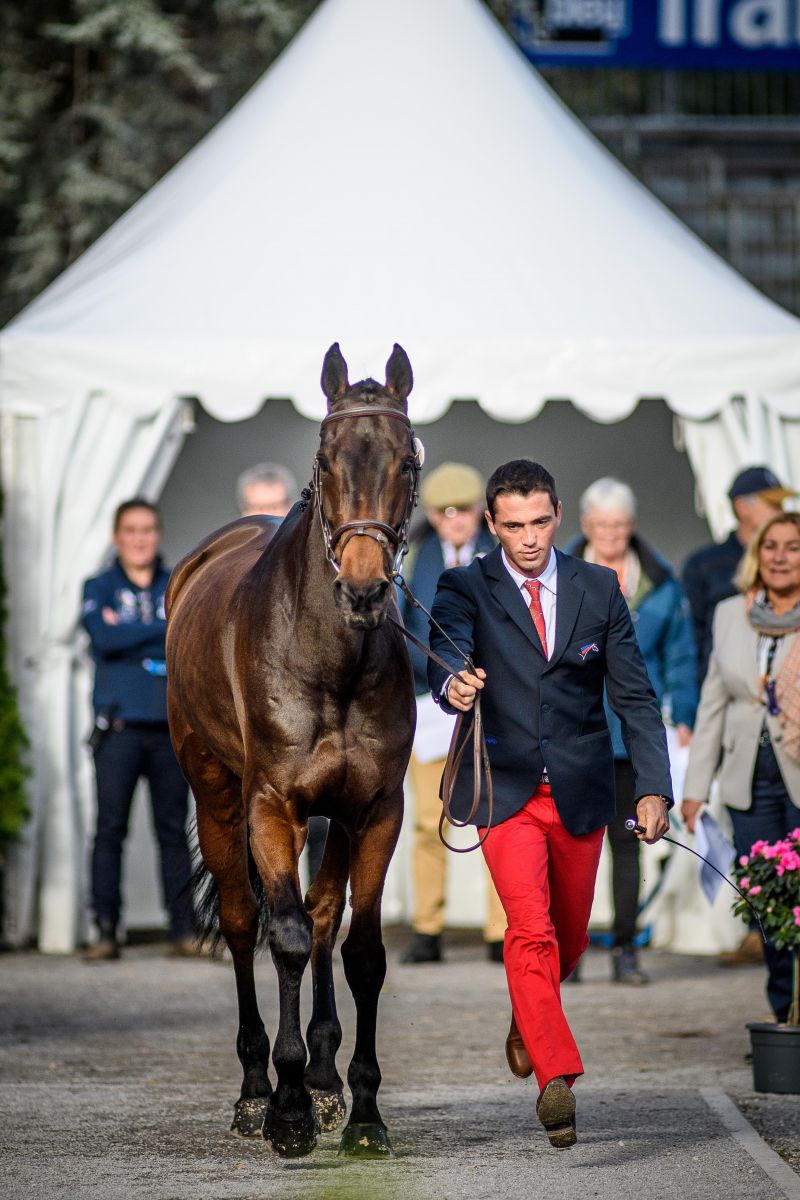
“This is our favourite part of the ERM, if you’ve gone clear and get to sit up here,” he laughed from the top spot of the podium. “It’s amazing – I still can’t believe it. I had such a good year last year that I really didn’t think I could ever do it again. We’re stoked! It’s a wonderful series to be a part of – and right now, we’re just going to enjoy the moment.”
And so the 2019 season winds to a close – and what a season it’s been. Six legs, five countries, and 85 of the world’s best horses and riders from 15 nations, all battling it out for £350,000 and podium glory. This is eventing, reinvented – and we can’t wait for 2020.

Friday Video from SmartPak: Eventing Down Under with Amanda Ross

The European eventing season is in its final month – though what a month it is, with the Event Rider Masters finale at Lignieres, the Nations Cup finale at Boekelo, the Young Horse World Championships at Le Lion, and the CCI5* at Pau – while those of you above the Mason-Dixon line will likely be thinking about hanging up your skull cap for the winter, too. But has that ever stopped EN from finding an event – and a heaping helping of eventers – to obsess over? No. No, it most certainly has not.

This week, the FEI are helping us to quell our end-of-season anxieties, as they wing us straight to the Land Down Under to meet Amanda Ross, who rode at the 2000 Olympics but somehow, infuriatingly, still looks younger than all of us. That’s probably because she was one of the earliest adopters of rider fitness regimes – but also, we suspect, because of her irrepressible joie de vivre. We first met her at Blenheim CCI4*-L last season, at which she and Koko Popping Candy finished tenth, and now she’s on the Tokyo trail. Get to know her – and get excited about a deeper dive into Australian eventing this winter – in her day-in-the-life vlog. Bonzer!

Friday Video from SmartPak: What’s That Teddy?

By this point, most of you will have encountered one of the most omnipresent faces on the global eventing circuit – the diminutive, wide-eyed face of Wilberry Wonder Pony (and his ever-expanding herd of Berry brethren, of course). But if you haven’t, you might have found yourself wondering why on earth some of the best riders in the world leave the start box with a stuffed animal attached to their number bib.

This season, the Event Rider Masters series has been a committed patron of the Willberry Wonder Pony charity, which helps to support vital research into the osteosarcoma that its remarkable founder, 17-year-old Hannah Francis, suffered through and ultimately passed away from. While pouring its resources into this research, Willberry also helps to grant wishes for equestrian enthusiasts suffering from serious illnesses.

The best bit? Eventers around the world have enthusiastically jumped on board in their support of the charity, which has snowballed in its reach since Hannah’s passing. Check out the ERM’s video, explaining their involvement with the charity this year and some of the riders who never leave the startbox without their own Berry pony on board. With the 2019 ERM series finale just a week away, we’ll be on Berry-watch — will you?