Sally Spickard is a Korean adoptee living in San Diego, California. Sally joined the Eventing Nation team in 2013 and has subsequently written for Noelle Floyd, Heels Down Mag, and other publications both in and out of the equestrian world. Sally is an eventing fan through and through and enjoys telling the stories of riders who are not well-represented within equestrian media.
Welcome to Throwback Thursday! Each Thursday, we will be bringing you some vintage eventing photos and posts. Do you want to show us your first horse or a photo of your early riding days? Email [email protected].
We know you are dying to know who we picked for our mystery rider this week. So, without further ado, the rider pictured below is…
… Dom Schramm! Dom is one of the most entertaining personalities in the sport, and these throwback photos definitely show that he got started early. Thank you for participating in this week’s mystery rider challenge!
When he’s not working on his dressage skillz, he’s busy coordinating ugly sweaters with Boyd.
Welcome to Throwback Thursday! Each Thursday, we will be bringing you some vintage eventing photos and posts. Do you want to show us your first horse or a photo of your early riding days? Email [email protected].
We’re back with another edition of Guess the Rider this week. We are loving this week’s submission, and we are anxious to see what guesses you come up with. Can you guess the upper level rider pictured here? Post in the comments below and check back later for the reveal. Happy guessing!
Peter Atkins and Henry Jota Hampton at Rolex 2013. Photo by Jenni Autry.
It’s been awhile since we last caught up with fan favorite Peter Atkins. After taking home 10th-place honors at Rolex last year, Henry Jota Hampton enjoyed a quiet fall, spending most of his time finessing his dressage with James Koford. With the World Equestrian Games rapidly approaching, Peter’s attention has now turned to working on the selection process for the Australian team.
“The Australians are not considering Rolex a selection event (for WEG),” Peter said. “They want the Australians to compete head to head, so they have recommended either Badminton or Luhmuhlen for 2014.” In 2012, Peter suffered a broken leg before flying over to the UK to contest Badminton, and Peter hopes that such bad luck will not befall him with this impending trip overseas. “Hopefully a horse won’t fall over and break my leg this time,” he joked.
Peter alluded to the fact that during his time competing in Australia, he found that there were no Open divisions to compete in. This meant that if a rider acquired an Advanced horse or had a horse coming out of the off-season, there were no other options other than to run Advanced the first time out. He remarked that he prefers the structure of the divisions in the U.S., which allow him to choose a level based on the horse’s fitness and current ability rather than having to come out guns blazing at the top level immediately. Peter plans to run Henny at Rocking Horse at Intermediate and Advanced before tackling Red Hills.
What about Henny’s opinions on coming off of a break? “He does really well with breaks. His dressage is really coming along, and he is jumping great. At the moment, I’m really happy with where he’s at,” Peter said. “He’s pretty consistent. I did run him Advanced first last year at Rocking Horse, and he was a little wild on cross country because he was excited to be back. So this year I decided to run an Intermediate beforehand.” As the new season progresses, Peter’s plan is to prepare to head overseas to have another crack at Badminton per the Australian selectors’ advice.
While based in Florida for the winter, Peter has a couple of young horses that he is working with, as well as a new Advanced horse. Lambrusco is an Oldenburg gelding that is coming off of a three-year break from competing. Peter ran him in the Preliminary division at the Ocala Horse Properties Horse Trials earlier this month, where he finished second in a strong field of 18. Lambrusco earned an impressive 27.4 to win the dressage that weekend, and Peter has high hopes for him going into 2014. “I still have to teach him my way of going, but I have pretty high hopes for him,” Peter said. “So far coming back from his break he is going very well.”
Peter also has undertaken the training on a promising new stallion, Clair de Lune. Owned by Rose Sullivan, the Holsteiner stallion was the West Coast Young Event Horse Champion in 2009 and most recently campaigned with Marilyn Little in 2012. Clair de Lune has produced many successful offspring, with many scoring between 85% and 89.98% in Future Event Horse competitions in 2013. Clair de Lune is preparing for a busy competition and breeding season in 2014. For the first time, both fresh/cooled semen and frozen semen will be available for interested parties. For more information on this exciting stallion, contact Peter.
While I’m sure that Peter and Henny’s U.S. fan base will be sorely disappointed that they will not be hearing that boisterous “Good boy Henny!” from Peter as the pair storms around Rolex, take solace in the fact that Peter plans to arm himself with his trusty helmet cam for his runs leading up to Badminton this year.
Always willing to expand his horizons, Peter has also had a bit of fun while spending some time in Florida. Check out this video that shows just one more use for event horses: mounted shooting! This is a horse in training with Peter, Tom Boy, who decided to take a crack at perhaps the loudest equine sport.
Michael Matz at the 1986 Show Jumping World Championships. Screenshot via YouTube.
Michael Matz has enjoyed a long and illustrious career that has spanned two equestrian disciplines. A Hall of Fame show jumper, Michael represented the U.S. on several occasions, including the silver medal winning Olympic team at the 1996 Atlanta Olympics. After retiring from his show jumping career, Michael ventured into the Thoroughbred racing world, where he has become one of the most sought after trainers on the scene.
After adding so many accolades to his career as a top level show jump rider, it’s difficult for Michael to pick his favorite moment.
Representing your country is always a big honor, and that is something that I always felt proud about. It’s always nice winning, but mostly when I was riding internationally and I felt that I was riding against not only good horses here in the U.S. but other people in Europe (and other countries), that was probably the most gratifying for me.
Michael certainly spent plenty of time traveling around the world for competitions. He represented the U.S. in the Pan American Games, three Olympics, and numerous World Championships and other top tier events worldwide. A particular standout event for Michael was the 1986 Show Jumping World Championships at Aachen. The team that year consisted of Michael Matz and Chef, Conrad Homfield and Abdullah, Katie Monahan (now Prudent) and Amadia, and Katherine Burdsall and The Natural.
“I think it worked out well that everyone got along and helped each other that year. I’ve been on teams where everyone mainly looks out for themselves, but this was a tour that I really looked forward to,” Michael said. “Katherine had perhaps the best horse of the group but was the greenest rider, so we worked together to ensure that our order of go worked for everyone so that (Katherine) could go in a spot where she felt a bit less pressure.”
Michael retired from show jumping and decided to venture into the racing world in 1998. “I’ve always enjoyed racehorses, and I had to find a way to make a living. I figured I could either teach people and give clinics or buy and sell horses, and I really wasn’t a very good seller, so that didn’t look like a very profitable option,” Michael said of his decision to start training racehorses. “I didn’t mind teaching, but just didn’t see myself teaching all the time.” Once Michael began training racehorses in earnest, he discovered that the worlds of show jumping and horse racing really weren’t too far apart.
Racehorses are the same as show horses in the fact that good horses make good riders and good trainers. I had a friend arrange to get better horses because in this world you just have to find a way to get better horses. It’s an ongoing situation where you keep looking for the best to improve your string and get good quality horses.
In 2005 and 2006, Michael trained the late Barbaro to an undefeated, albeit tragically short lived, career. Michael still speaks fondly of the bay colt who stole the public’s heart. “The biggest thing is that it was so sad to see what happened and we’ll never get to know what his true ability was,” Michael said. “When he won the Kentucky Derby so convincingly, that was a great feeling of accomplishment. You had so much confidence in this horse because he never lost; you just expected him to win.” After losing Barbaro, Michael went on to train Union Rags to a victory in the 2012 Belmont Stakes, notching two Classic wins under his training belt.
I’ve often wondered how Michael’s previous experience with a different equine sport has carried over into his race training. Michael remarked that his horses were well mannered after going through his program, and he hopes that the foundation that he puts on his horses helps them stay sound for longer careers. In talking with one of Michael’s part-time exercise riders, eventer Jennie Brannigan, I also found that Michael ensures his horses enjoy turnout, something that many racehorses do not see during their careers.
What if a horse is not showing the makings of a successful racehorse? Michael is a big advocate of helping find horses second careers if their racing career is cut short.
We’ve given quite a few horses to people to continue with either show jumping, fox hunting, pleasure (or other careers). We obviously try to find them nice homes if a horse gets hurt and needs six or eight months off if the owner says they aren’t interested in putting time into the horse. We try to find a good home for them to make another career.
One example of a horse who found a successful career after racing and even breeding is Kicken Kris, who won the 2004 Arlington National before being sold to Japan to stand at stud. Once his breeding career was over, he was brought back to the U.S. and is now retraining for a new career under the tutelage of eventer Jane Sleeper. A race trainer who is such a big advocate of ensuring his horses’ safety and well-being is a vital part to the racing industry, and Michael continues to support endeavors to find horses new homes if the horses are not successful on the track.
Michael returns to his show jumping roots every now and then. His three children are now competing in the show jumping ring, so he enjoys watching them when he can and will help out with coaching if they ask. “I’ve been more involved helping them this year because they asked me to, but I let them do their own thing as much as I can,” Michael said. “It’s been fun working with them and watching them ride.”
Michael has been a force to be reckoned with in both the show jumping and the racing world, and it’s enjoyable to follow his career knowing his horses are under the best possible care and are learning from one of the best. Many thanks to Michael for graciously spending some time letting EN get to know him better.
And as a bonus, here is footage of Michael and Chef competing at the 1986 Show Jumping World Championships at Aachen:
Marc Donovan and Hugh Lochore hard at work improving the cross country course. Photo via the Carolina International Facebook page.
In an effort to continue the improvement of the American eventing scene, the masterminds behind the Carolina International CIC3* are leaving nothing off the table when it comes to planning. Bringing in names such as Bobby Costello, Marc Donovan and Hugh Lochore, the panel in charge of the new premier CIC3* event on the spring calendar has done an excellent job of ensuring the Carolina Horse Park becomes a spring destination.
This year, the Carolina International will run CIC*-3* divisions, along with the horse trials divisions up to Advanced. Marc Donovan, who sits on the Organizing Committee for the event, did a lot of the legwork getting approval from the USEA and USEF to run the international divisions this year. This year’s dates of March 20-23 fall in between other premier events such as Red Hills and The Fork on the path to Rolex, giving competitors the chance to choose the event based on their spring schedule. “It’s an ideal time slot. So, with the prize money and quality of competition, we are hoping to have more entries than ever,” Marc said.
Riders have long expressed concern about the low amount of prize money given at many events. The Carolina International Organizing Committee has worked hard to ensure that the available prize money for this event is attractive to entrants. “We will have prize money to award for the Preliminary through Advanced divisions,” Jane Murray, who also sits on the Organizing Committee, said. “For the CIC divisions, there will be $25,000 in prize money for the CIC3* alone, as well as $10,000 for the CIC2* and $5,000 for the CIC*. There needs to be more prize money in the sport. We’re out there putting our stake in the ground.”
Hugh Lochore articulates his vision. Photo by Allie Conrad.
As far as improvements to the facility and courses are concerned, much progress has already been made to ensure the quality of the Carolina International is top tier. Hugh Lochore is the course designer for both the national and CIC divisions. “Improvements to footing, the galloping lanes and building new complexes are all things that are being addressed,” Marc said. “Eighteen to 20 new portable jumps are in the works, which we have people building as we speak. We’ve been doing everything we possibly can to up the level of quality.”
Another feature of the event this year will be a tribute to the members of the 1984 gold medal Olympic team called “Bring Back the Gold.” More information on this event can be found here as it becomes available. The level of commitment to this event on the part of the Organizing Committee is palpable, and it is with their hard work that U.S. eventing will soon have yet another top quality event to add to the spring season. Putting on an event of this size is a difficult task, one that requires plenty of land and a huge financial commitment.
“This has been a really big team effort,” Jane said. “A very strong, deeply experienced committee of people has been hard at work on this, which has taken the burden off of any one individual. We’ve got Bobby Costello (Chair), Marc Donovan, Nanki Doubleday, Will Faudree, Jane Murray, Doug Payne, Lizzie Snow and Lefredra Williams — a lot of depth, so that’s been a hallmark.”
The Carolina International will run from March 20-23 at the Carolina Horse Park. Registration for competitors opens on Feb. 4. For more information on the Carolina International, please visit the website or Facebook page.
One of our loyal readers, Jennifer Joyce, sent in her personal recap of an Ian Stark clinic, which she participated in over the weekend at Galway Downs. Thank you Jennifer for sending your recap and photos in, and thank you for reading.
All photos by Jennifer Joyce.
From Jennifer:
I had the privilege of riding with Ian Stark at Galway Downs this weekend. The first day was a private dressage lesson. He helped me get my horse to carry himself without a pulling match. Patience goes a long way on a young horse. He worked on my position and pace. I was allowing him to move through my hands too much, and my tendency was to rush him forward, onto his forehand. Ian had me keep my hands very still, relax my legs, and wait for Riley to relax and carry himself.
At times I felt like I was holding a 100 pounds in each rein. After 35 minutnes of holding my position, Riley lightened in the reins and carried himself easily. For the first time, I have a horse that is easy to ride, and I found his canter work and the corners of the ring to be my friends. Ian was confident that once he is made to carry himself every day and gains the correct strength, the extended work will come very easy for him.
The second day was show jumping. Ian really worked on getting riders to ride their horses more forward and freer to the jumps. The first exercise was a line of five bounce fences that encouraged the horses to use themselves more. He helped the riders come into the exercise with a more forward pace and better balance. After the horses were doing the bounces well, he made the line into a vertical in and oxer as the last element. V-poles were added to help keep the horses straight and jump bigger.
Each horse and rider combination improved as the exercises went larger. He is great at building confidence in the horses and riders. After the gymnastics, he worked on rideability in bending lines and through turns. Emphasis was on keeping the stride forward and consistent. Most important was to keep the horses coming forward without interfering by overusing the reins and remembering to keep your leg on to support them off the ground. Ian keeps it simple and fun! He is truly amazing.
I rode my 6-year-old Connemara stallion, Blue Rock Riley. He has done three Training horse trials and one Training Three-Day. After the the clinic, Riley feels like he’s ready for a move up to Preliminary this year. I learned how to keep a better pace and ride through my turns with more power, instead of getting quick and flat.
Another key element for me was to stay more up with my body over the jumps, which allowed my horse to jump rounder and have more power after landing. I am hoping Ian will come back to California soon and be available for more lessons. A huge thank you to Robert Kellerhouse for bringing him to Galway Downs and offering us the wonderful chance to ride with the Master.
Collegiate eventing is a growing sport among college athletes, offering an alternative to the traditional hunter/jumper, saddleseat and western options typically seen in athletic programs. We recently spoke with Lizzie Walters, who created the University of Alabama eventing team. Do you have a tip about a college team? Email [email protected].
Roll Tide!
Tuscaloosa, the home of the Alabama Crimson Tide, is not exactly a buzzing hub for eventing. Lizzie Walters, a junior at Alabama, kept tabs on the schools that were developing eventing teams and realized there could be other eventers at school with her who were looking to form a team. “I made a Facebook group with just two girls I knew who rode and asked them to spread the word just because I missed my eventing community,” Lizzie said. “The word spread much faster than I thought, and soon I had enough interest to start a club.”
Having found several like-minded individuals by September 2013, Lizzie set about organizing the club and applying for funding from the university’s Student Activity Council Funding Board for help with competition costs. The eventing team received official recognition as a club sport from the university in November 2013.
Lizzie Walters promotes UA Eventing at Chatt Hills
While the team hopes to focus more on competition as their membership grows, a big focal point for the team members right now is to create a supportive environment for eventers. “Our club is not solely based on competing,” Lizzie said. “My purpose for starting the club was just to get everyone back in the saddle. So many of us have had to stop riding since coming to school, and this club connects riders with horses and barns that need a hand.”
A few of the members on the team either do not own their own horse or were unable to bring their horses to school with them. To that end, the team works hard to assist riders who are looking for a lesson program, lease or a riderless horse while they are at school. “Right now we have more opportunities than we do riders, which is a really good thing,” Lizzie said.
She said that she gets almost daily emails and phone calls from people who are either looking to place a horse in the Alabama Eventing program or someone to help out with exercising horses. For team members who are without a horse, there are endless possibilities for being involved on the eventing scene.
Team member Whitfield Broughton gets some tips from Jim Graham.
The Alabama Eventing team has a strong roster of about 20 members currently, and more are always welcome. Experience levels range from members who have not competed to some actively competing at Preliminary or above. Because of this, there are plenty of opportunities for the team members to help each other out. “We’ve all kind of become each other’s trainers; it makes us work together a lot more,” Lizzie said.
The team is currently based out of several different barns in the area, but there is not a designated coach for the team at this time, although Bryan Tweed and Jim Graham have both helped out with clinics and lessons. Lizzie hopes that with additional sponsors and fundraising, the team will be able to bring in other clinicians in the future.
Most recently, the Alabama Eventing team received the good news that they had been awarded $2,000 in funding from the university that is allocated to use to send a team to the Intercollegiate Eventing League’s Spring 2014 College Challenge at Chattahoochee Hills Horse Trials.
Team member Meagan Majchszak and Caramba at the Hagyard Midsouth CCI*.
“I did a presentation (to the Student Activity Council Funding Board) on why our club should receive the funding and what we do,” Lizzie said. “I had to explain what eventing is and why it was important that we attend the spring challenge.” Within a short amount of time, the funding was approved, and now the team is hard at work preparing for its first formal competition.
Lizzie is very thankful for the support she has received from the collegiate eventing community as the Alabama Eventing team continues to grow. “Other schools have been so supportive and have really helped me get on the right track with getting this team started,” she said. For more information on the University of Alabama Eventing Team, visit its Facebook page.
Horse & Hound has commemorated the life of the Lionheart with a gallery of photos spanning his successful career with former rider William Fox-Pitt. While we are devastated that we will not get to witness the partnership between Lion and Allison Springer, this gallery reminds us how truly great this horse was.
I cannot begin to thank everyone enough for all their love and support through this terrible time. Naturally my team and I are completely heartbroken. We feel blessed to have had Lion in our lives and know that he will forever be with us in our hearts. I personally am completely blown away by the outpouring of support. Your letters, emails, texts and voicemails have helped to keep me strong in a time when simply putting one foot in front of the other has been a huge challenge. Thank you for being by my side. Your friendship means the world to me and is the greatest blessing of all.
Rest in peace, Lionheart.
To view the full Horse &Hound gallery, click here.
Boyd Martin and his Aiken crew. Photo from Boyd's blog.
Good morning! The weather is supposed to get unseasonably warm here in Kansas City this weekend, so it makes me slightly less envious of those who are migrating south. It seems that almost everyone is at least packed for or en route to Florida or Aiken. With the Eventing 25 sessions in Ocala and the High Performance Training sessions upcoming, it promises to be a productive winter. Poplar Place kicks off this weekend as well, which means we are that much closer to a full-fledged 2014 season. I don’t think I’m the only one who can’t wait. Are you settling in at your winter base? If so, we want to see your digs! Email [email protected] if you’d like to share your winter base with us.
EN reader Lisa Bauman of Austin Eventing sent us this video that exemplifies the many ways a GoPro, or other small camera, can be used. I am a huge fan of GoPro as they are lightweight, compact and, with the right case, virtually indestructible. Check out how many different angles are featured in this video. Thanks Lisa for sending this in!
Allison Springer and Arthur. Photo by Kate Samuels.
Chris Stafford of the USEA Podcast Channel has brought us another round of interviews this week. This week’s subject revolves around college education and balancing it with an eventing career. Allison Springer and Katy Groesbeck joined Chris to offer their input on how their college experience has evolved into a career as an eventing professional.
Both Allison and Katy earned four-year degrees from liberal arts colleges before beginning their respective eventing careers in earnest. Allison, though a successful Young Rider, went to college with a dream of competing at the Olympics but no plans to become a horse professional. After graduating, though, Allison did some soul-searching and found that she did not want to look back and say that she did not give her dreams her best shot.
So, as we all know, Allison ventured into the eventing scene full time and hasn’t looked back since. Allison does attribute much of her success to her education, though. “My education is the best thing sitting in my back pocket right now,” Allison told Chris. “It helps with talking to sponsors or syndicate members. It’s important to have intelligent conversations and engage people on a different level other than just the horses.”
Allison also gave some sound advice to other eventers who may be struggling with the decision to go to college or become a horse professional. “It’s important to try to also see the big picture in life,” Allison told Chris. “Make sure all the bases are covered. All of the time and thought and care that we put into our horses we don’t necessarily put into our personal lives. There is something to be said about stability. We are best at achieving our goals when our lives are as stress-free as possible.”
Katy Groesbeck and Oz the Tin Man. Photo by Jenni Autry.
Katy always knew she would attend college and even contemplated joining the Navy to be able to pay for her education. Both of her parents were horse professionals, and they were supportive of Katy’s endeavors at the University of California Los Angeles. Katy did not see herself becoming involved professionally with horses.
“I did not want to be a pro; I didn’t want to make my living because I’d seen how hard it was,” Katy said on the podcast. Katy did take her horse to school with her and worked both on campus and as a working student to make ends meet. Like Allison, after graduating, she realized that her dreams were worth following, and she decided to venture into the horse world as a professional. Katy echoed Allison’s sentiments that having a college education is still beneficial now.
If nothing else, both Allison and Katy feel that it’s important to have a backup plan in the event that riding becomes limited. As we know far too well, anything can happen, and virtually nothing goes according to plan when you deal with horses. My parents have always stressed the importance of a good education, and I tend to agree with them. As Allison stated, it’s a nice card to have in your pocket should your career plans change.
For much more from Allison and Katy, check out the full USEA Podcast with Chris Stafford here.
We are excited to announce a new series here on EN called "A Horse of a Different Color." We will be featuring horses and ponies that have been successful in the sport of eventing while representing a unique breed. Do you have a horse that you think would be a great feature subject? If so, email [email protected].
MMC Little Big Man, or Mopar. Photo by Dee McMaster.
Eventing ponies stole our hearts a long time ago, with Theodore O’Connor heading the superpony movement. Fortunately for us, another pony is making his way up the ranks and shows all of the makings to be a future superstar. Little Big Man is a tiny pony with a humongous heart who has been campaigned by Melissa McMaster. Melissa was kind enough to tell me more about this pocket rocket that everyone in the barn calls Mopar.
While Mopar’s USEF card lists him with a Quarter Horse sire and a Paint dam, Melissa questions his breeding. “He just screams Arab cross to me,” she said. Standing at just 14.2 hands, he exhibits much personality and movement similar to that of an Arab. Melissa’s mother, Dee, was actually the one who first laid eyes on Mopar. At the time, Mopar was more or less a backyard pony who competed in a few schooling jumper shows, and Dee was judging at a show where Mopar was competing.
Once she took in his huge jump and smart attitude, Dee knew she was looking at something special. After talking with Mopar’s owner at the time, the decision was made to take him cross-country schooling for the first time. “Within 10 minutes, he was jumping everything; it was all play to him,” Melissa recalled. “He would just look for the next big thing to jump.” Once Melissa realized that this pony’s calling might be eventing, a sale was drawn up and finalized.
All dressed up and ready to jump. Photo by Dee McMaster.
The primary challenge in training Mopar was the dressage work. “He really was very very reluctant to have any contact when we got him. If you touched his mouth, he would put his head into a very tight ball of energy frame,” Melissa said. “So we did a lot of walking. Lots of serpentines and trail riding and just throwing the reins away. That slowly progressed in the trot after about 60 days of just walking.”
After taking some lessons with Pierre St. Jacques, Melissa discovered that Mopar’s favorite movement to do was extend. “I have pictures of him doing an extended trot, and he looked like a well-trained, upper level dressage horse,” she said. “Pierre said that he had the power and balance to be a straight dressage horse if we wanted.”
Progressing Mopar’s eventing career was still the goal, so Melissa began competing but ran into some challenges due to her 5-foot-11 frame. “I usually ride horses that are 17 hands, so it was a big adjustment,” she said. Show jumping has proven to be a challenge for the pair, but Melissa takes the responsibility for this, as she realizes that the size difference plays a big role. Once she realized that Mopar would benefit from a rider of smaller stature, she began to look for possibilities.
Photo courtesy of Palmer Photo.
Christan Trainor is a U.S. rider based in Sydney, Australia, who produced legendary pony Theodore O’Connor before Karen O’Connor took over the reins. Initially, Melissa’s mother made contact with Christan to get some casual advice from someone experienced in training upper level ponies. Eventually, the decision was made to sell Mopar to Christan, who put together a syndicate for the purchase.
Mopar will be making his way to Australia later this spring. While Melissa is disappointed that she will not be the one to take Mopar to the top, she knows that he will be in the best possible hands with Christan. “To watch him is just awe inspiring,” Melissa said. “He truly does have a horse stride and can make the big distances. I really wanted to bring him up, but I know [Christan] will do a great job.”
Photo by Dee McMaster.
Mopar has already earned quite a reputation on the eventing scene. “He really is the horse that you stop to watch jump. He jumps so big and so high, he’s just incredible. He’s the horse that jumps the 6’ standard. At Ocala, everyone would stop to watch him go and ask questions about him,” Melissa said.
While I’m sure everyone will be sad to see Mopar go to Australia, we can rest assured that we haven’t heard the last from what looks to be an eventing superstar. Best of luck to Christan and Mopar as they begin their partnership this spring, and many thanks to Melissa for sharing her story with us.
To keep up with Little Big Man (Mopar)’s adventures, check out his Facebook page.
Jon Holling, Buck Davidson, and Jennie Brannigan checking out some new elements at Red Hills.
Happy Friday! As we gear up for the upcoming season, several eventers have gone to check out the brand new cross country course at Red Hills. Designed by Hugh Lochore and built by Tyson Rementer and Levi Rykewaert, the courses promise to be challenging and state of the art. I asked Jennie for her thoughts on the new course, and she said that “the new layout of the track is going to make for an even better atmosphere for an already action packed Red Hills HT.” We are excited to see how this year’s event goes off, and we don’t have too much longer to wait. Red Hills will take place March 6-9 in Tallahassee, Fl. To check out more of the new cross country course, click here.
Ready for Super Bowl Sunday? Budweiser has let loose a few details about their highly anticipated commercial for this year. Budweiser will be airing five spots this year. Expect a puppy and a follow up on the “Brotherhood” commercial from last year to make an appearance. [Budweiser Super Bowl Ad]
Are you planning to go to WEG this year? A new round of hospitality packages is now available for purchase. Expect more tickets to be released in March and April. [WEG Ticket Information]
John Nicholson, the executive director of the Kentucky Horse Park, has announced his retirement. Nicholson has served his position since 1997, the longest tenured executive director in the Park’s history. A replacement has yet to be named. [KHP Executive Director Retires]
Irish eventing has undergone some changes for the upcoming year. After listening to recent survey results, Eventing Ireland Classes are to be renamed. The new class names appear to be similar to those of British Eventing classes, perhaps to establish some similarities between the two to reduce confusion. Other changes and clarifications have also been listed. [Changes to Eventing Ireland]
In another development in the slaughter saga, another ban has passed in the House of Representatives. The bill would end funding to inspect slaughterhouse plans, which essentially bans horse slaughter in the US. The bill is expected to pass in the Senate next and would prevent inspection funding through September. [Ban on Horse Slaughter]
Top racehorse St. Nicholas Abbey lost his battle to colic earlier this week. The legendary horse notably won the Coronation Cup at Epsom for three consecutive years from 2011-13. After battling injuries and, most recently, colic, the decision was made to euthanize him. [St. Nicholas Abbey Euthanized]
Trading Aces is just one of the talented horses in Boyd Martin’s current string. This past weekend, Boyd took Trading Aces out to stretch his legs in the sandbox, performing CCI4* Test B at Full Gallop Farm’s dressage schooling show.
“I took Oscar on his first outing for the year on Sunday at the Full Gallop dressage schooling show. He did the 4-star test B, which is this year’s 4-star test. It was great to run him through this test off the farm. I was pretty happy with how he went; obviously we are a bit rusty at this point in the year but his changes are getting more and more confirmed. I believe he will be at a stage this year where he can put in some great scores on the flat.”
Welcome to Throwback Thursday! Each Thursday, we will be bringing you some vintage eventing photos and posts. Do you want to show us your first horse or a photo of your early riding days? Email [email protected].
Bobby Meyerhoff on his first POA. Photo submitted by Danica Meyerhoff.
We are loving the Throwback Thursday photos that you have been sending us, so we decided to post some reader submitted photos for this week’s post. Please keep the submissions coming, we love seeing everyone’s way back when photos!
Photo submitted by Kim Keppick.
Kim Keppick submitted her Throwback Thursday photo with this cool story: Eventing in Ireland in 1983. Came to USA in 1984 at age 19 to work for Karen Lende (now O’Connor) who was at Jimmy Wofford’s barn at the time.”
Photo submitted by Susan Gawley.
Susan Gawley sent in our next photo. “My first horse Tonto and I doing our dressage test at Aquilina Farms in Royalton, N.Y., circa 1983. He was a 15.2-hand Quarter Horse gelding I bought while working as a camp counselor at Forestel Farm during college. He was an off-the-track QH that had a background in barrel racing. Turned out to be an amazing little dressage horse who was 1987 AHSA Champion at First Level for my zone. Best first horse a girl could ever ask for. Had him 10 wonderful years. I groomed him so much that his coat gleamed like a wet seal!”
Photo submitted by Lori Stammer.
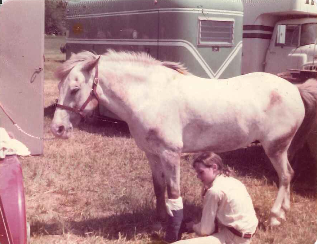
Finally, Lori Stammer sent in this dose of adorable. “This picture is of Nancy Grout (Fritz, back then). She is a USPC National Examiner now. In the picture, she is putting on shipping bandages after a Pony Club rally held at UNH. The pony is Cinnamon Sizzle. She was a member of Squamscott Pony Club.”
We here at EN have had no choice but to begin searching for Michael Pollard’s cloning technology, as the man seems to literally be in a million places at once. When he is not blazing around a CCI4* cross-country course, he fills the hours with curating Chatsworth Stud, putting in face time with many different committees and organizations within the USEA and beyond, and sweating to the oldies competing in CrossFit competitions, to just name a few. Michael was most recently sighted in Miami attending the United States Olympic Committee (USOC) Athletes’ Advisory Council meeting this past weekend.
The Athletes’ Advisory Council facilitates communication between the United States Olympic Committee and active athletes. The AAC consists of elected representatives from each Olympic sport, as well as Paralympic athletes. Each member serves a four-year term on the Council and attends meetings throughout the years between Games. Michael was elected from a list of potential council members last year, and his spot on the AAC also puts him on the USEF Eventing High Performance Board. He is honored to have the role as a Council member.
“After every meeting, I come away re-invigorated about the Olympic movement. It’s an incredible experience to be in the room with so many athletes. It’s really inspiring to hear other people’s stories.”
I asked Michael to elaborate a bit on how the AAC achieves its goal of keeping the lines of communication open between the USOC and the athletes. “Primarily what we try to do is understand what is happening with all USOC programs so that we can go back to our athletes and explain,” Michael said. There are also many valuable programs available through the USOC for eligible athletes Michael believes many members of the U.S. team don’t know about.
“At this meeting, I got a better understanding of Elite Athlete Health Insurance Program,” Michael said. “There is a lot that, as equestrian athletes, we don’t utilize as much — health insurance, for example. A lot basically goes unused, and even the ones who are using it don’t necessarily realize what possibilities there are. Now they have partner hospitals with some of the top hospitals in the world. Just being in the room and figuring out what other sports are doing and what the USOC has available has been helpful.”
Another instrumental part of attending the AAC meeting was the knowledge sharing that brought opinions and ideas from all of the Olympic sports into the same room. Michael touched on a few training methods that were utilized by other sports, such as sleeping at a higher altitude so that the body begins to more efficiently use oxygen. While this idea would be difficult to implement with equine athletes, there are many different concepts that Michael is anxious to mold into the equine training program.
“We get caught up in our own small little world, so it’s nice to get out and see what other opinions there are,” Michael said. “There are so many interesting training concepts that other sports have already figured out, and I’m always trying to figure out how to relate it back to horse physiology.” Additionally, Michael sees rider fitness as an integral part of the Olympic program.
“I would love to see more of a focus on rider fitness; this is somewhere where we could be leaders. Fitness tends to be an area where we are perceived to be least fit. Rider fitness would only take 45 minutes a day to be significantly more fit that many other athletes on the world stage. If you can take one thing and be significantly better, then that gives you an advantage.”
Michael continues to be a champion of physical fitness and the benefits that it brings to one’s riding. However, he did acknowledge there are challenges imposed by the fact that our team members are scattered throughout the country. “I don’t think David (O’Connor) and the High Performance board is opposed to a stronger fitness program, but no one has articulated a good plan. People live in a lot of different places,” Michael said. “Maybe a one-week workshop for team members can be used to get away from the horses for a week and really focus on their own individual fitness. Ninety days can make a massive difference in your own personal fitness.”
The importance of cultivating a true team environment is also something Michael took away from the AAC meeting. Last year when the USEA Annual Meeting and Convention was held in Colorado Springs, Colo., a few riders visited one of the USOC training facilities. Michael wants to make sure that the importance of representing the U.S. on the Olympic Team creates an overall confidence for team members.
“If you can get people together at a USOC facility leading up to the Games, you’d feel like you’re part of something a little bit bigger. Start to think of yourself as a ‘real’ athlete rather than just an equestrian, and if only from sports psychology standpoint would be a big benefit.”
As a member of the AAC, Michael is a representative for our athletes, both human and equine, to the USOC. To that end, he wishes to remind all potential Elite Athletes that he is always available for questions or concerns with the Games rapidly approaching. There are also other resources available for anyone who may have questions.
“John Ruger (USOC Ombudsman) is available to be an advocate for athletes who may have any questions or grievances concerning the USOC,” Michael said. “From questions about what signage is allowed at the Games to a grievance over unfair treatment in the selection process, he is someone who can offer advice as an athlete advocate.” Michael encourages anyone who wishes to know more to contact himself or Joanie Morris.
One night after Rolex last spring, Jennie Brannigan decided to venture out of her comfort zone and try something new. After some prodding from her friends, Jennie went to renowned race trainer and Hall of Fame show jumper Michael Matz’s barn to try her hand at exercise riding. “I happened to have a day off, and I only went to gallop once, but I ended up falling in love,” Jennie said. An established eventer at the top level of the sport, Jennie has picked up a new hobby working for Michael as an exercise rider.
Jim Wofford wrote a research article for Practical Horseman that dissects the galloping position that is used for cross country riding versus the position that jockeys use. I found this article interesting because there are similarities between the two positions, and finding ways to integrate elements from both can be useful in creating the most effective position for event riding.
“One important finding of the study is that each time horses take a galloping stride, there is a vertical displacement of their withers as well as the horizontal reach of their legs. This means that if riders stand straight-legged, each stride horses take must push the weight of the riders up, as well as carry the riders’ weight forward. In effect, a straight-legged rider is driving his weight straight down into his horse’s withers, while a rider who gallops with a bent knee “floats” over his horse.” — Jim Wofford in “The Science of Galloping“
I asked Jennie if she noticed any of the traits from her exercise riding position transferring into her cross-country position, or vice versa. “I will say that it is completely different because your stirrups are so short,” Jennie said. “The muscles used are different, but I’ve evented some pretty strong Thoroughbreds, and I think it would help me now going into handling a strong horse and learning how to handle and go with it. It is a certain skill that galloping helps.”
What about the overall benefits of exercise riding? Jennie is very grateful for the opportunity to work for such a wonderful trainer in Michael, and she thinks that just getting out of her normal comfort zone has been instrumental.
“David (O’Connor) is very keen on me doing it, and he said that it’s a very unique experience to go that fast, even though there’s no reason why I would ever go that fast eventing. Pulling yourself out of your comfort zone and opening your eyes, being open to meeting new people and trying new things and having a lot of respect for things that you don’t know anything about is important.”
As far as the differences between her event horses and the racehorses she has been around recently, Jennie said she has a whole new sense of respect for the racehorses. “I couldn’t have Cambalda trotting towards horses galloping the opposite direction without him being an orangutan, and therefore I have a lot of respect for OTTBs to be able to handle themselves in that sort of situation.”
I also asked Jennie for any advice or major takeaways for those who may be interested in exercise riding.
“I think the trainer you work for is important. I wouldn’t tell some kid to just go to any track and start riding horses. For me, having an interest outside of just eventing has been a big mental improvement. I was the fittest I’ve ever been from exercise riding. Michael has been out to watch me jump, and there are just so many connections to make when you mix the two worlds together.”
Many thanks to Jennie for taking the time to tell us about her experience as an exercise rider. We love to see eventers branching out to experience new areas of the horse world.
Leah and Of Course Carter at the Ocala Horse Properties Horse Trials. Photo via LLG Eventing's Facebook.
EN last caught up with Leah Lang-Gluscic and her superstar ride, AP Prime, on our EN’s Got Talent series last year. To recap, Leah took a leap of faith and quit her job in the finance industry three years ago to become a full-time professional eventer, and she hasn’t looked back. She now has a thriving business and is spending the winter months in Ocala this year. Leah had a stellar 2013 season with AP Prime and now has a few younger horses coming out to stretch their legs early this season. Leah was kind enough to update us on her whirlwind year last year and her plans for 2014.
Leah and AP Prime. Photo by David Mullinix Photography.
AP Prime, an OTTB Leah has produced herself, capped off a successful 2013 season with a top 20 placing in the CCI2* at Fair Hill. One of only 10 horses to run a double-clear cross country, Leah was extremely proud of how far AP had come. “At Fair Hill, he skipped around cross country like it was absolutely nothing because he is such a machine. He’s very naturally fit; he left the vet box after cross country before two other horses that had come in before him.” Leah said.
“Jon [Holling] was warming us up for show jumping the next day and warned me that I might have to ride a bit harder than I normally do, and he was absolutely wild,” Leah said. “I should have taken him for a gallop before show jumping!” Leah said that AP’s usual competition schedule allowed for about one run a month, and this year he will kick off with one run at Intermediate followed by a move up to Advanced at Red Hills, if all goes according to plan.
Leah has been working hard on dressage with Peter Gray during the off season in the hopes of helping AP through some tension that has held some scores off the table previously. As far as the move up to Advanced is concerned, Leah couldn’t be more excited. “I don’t think he will even notice that he’s moved up, to be honest,” Leah said. “But maybe he will just be a bit more rideable when it comes time to show jump.”
Leah and A Novel Romance (Pogo) at the Ocala Horse Properties HT. Photo via LLG Eventing’s Facebook page.
Leah has also been able to take on a few sales projects as the 2014 season kicks off. “They are all so nice and great quality that whenever a couple of them sell, I will probably keep what is left for myself,” Leah said A Novel Romance, “Pogo”, is one of Leah’s young horses who competed at the Ocala Horse Properties Horse Trials this past weekend. Pogo is a 5-year old Hanoverian/Thoroughbred gelding who began his season at Novice. “Pogo was uncharacteristically naughty during dressage at Ocala, but even at his worst, he still scored a 34.” Pogo will likely move up to Training this year after a few more runs at Novice. You can check out Pogo’s performance on cross country in the video below.
Of Course Carter is another one of Leah’s sales horses that came out to play this weekend. Carter is a 6-year old Thoroughbred gelding who shares AP Indy bloodlines with AP Prime. “He is a slightly better mover than AP and is very scopey,” Leah said. “He went double clear on cross country and will probably be ready for Training after one more run at Novice.” Carter finished up third in the Open Novice at Ocala this weekend, and you can check out his dressage test by clicking here.
Like many of her peers, Leah had nothing but good things to say about the first competition of the new season at Ocala. Even with a torrential downpour on Saturday night, the event went off without a hitch. Leah was impressed with the caliber of the Jay Hambly cross-country course as well. “It was a really good track. A lot of early season Novice courses are slightly bigger Beginner Novice courses, but this one had a half coffin and a baby sunken road. For two horses looking to move up, it was a really good run for both of them,” Leah said.
One of the reasons why Leah has been able to cultivate such a successful environment in Ocala is her “working student extraordinaire” Patrick Zinck. Patrick is a one-syar rider who came to Leah from Tudor Oaks Farm in Barrington, Ill. “He has totally changed my business and what I am able to do,” Leah said. “Normally, I go to a horse trial and do everything on my own and am exhausted by end of the day. I go with him and hardly feel like I went to a horse trial. Everything is so productive. This weekend, I was able to go to the show and come home and ride the rest of the horses before the end of the day. So it’s been a real treat.”
After going pro three years ago, it looks like Leah is well on her way to accomplishing her goals. With established competition horses like AP Prime and plenty of young horses in her arsenal, Leah has all of the makings of a force to be reckoned with in the coming seasons. Best of luck to Leah and LLG Eventing as the 2014 season gets into full swing.
The 2013 USEF Pegasus Awards were held at the annual meeting in in Louisville, Ky. this weekend, and many top equestrians were honored. Among the top winners of the weeekend were Beezie Madden and her 14-year old Dutch Warmblood, Simon. Beezie and Simon have had a whirlwind of a partnership, which was begun in 2011, notably helping the US secure the win at the $75,000 Furusiyya FEI Nations Cup in March. To that end, Beezie was named USEF Equestrian of the Year for 2013, her third time receiving the award. Simon was awarded USEF International Horse of the Year.
The other USEF Award recipients are:
Jimmy A. Williams Lifetime Achievement Trophy – Keith Bartz
2013 Junior Equestrian of the Year – Lillie Keenan
2013 National Horse of the Year – Brunello
For more highlights, including replays of the awards ceremony, visit the USEF Network.
We recently reported that Boyd Martin had acquired Shamwari 4 from Sweden thanks to the assistance of the Shamwari Syndicate. After a grueling trip, Boyd’s latest addition has arrived safe and sound at the Martin’s Aiken base, Bridle Creek Farm. We are excited to see how this new partnership develops as the 2014 season kicks off. To stay abreast of further updates from the Martins, check out their blog.
With the weather getting up to a balmy 40 degrees yesterday, I am hopeful that a reprieve from the cold temperatures is approaching. For most of you, I’m sure that means plenty of barn time is in store. How do your horses handle a break in the cold temperatures? They usually seem as relieved as I do when the sun pokes out and the thermometer climbs into the positive reading again. Perhaps it’s just because they are thankful to shed at least one of the blanket layers that we impose during this time of year. The good news is that the 2014 season is officially showing signs of life as the Ocala Horse Properties Winter Horse Trials kick off today. I am not sure that I have ever been more thankful to see live scores as I am now.
Courtney Due of the JustJump3Day blog recently posted her own list of signs that you may suffer from the eventing bug. Courtney graciously agreed to let us reprint her post here on EN, so we want to know what you would add to the list. To follow Courtney’s blog adventures, click here.
10 Signs You Might Be an Eventer
1. Someone mentions jumping their horse over a coffin, and this doesn’t sound strange at all to you.
2. The most expensive pair of pants you own are breeches.
3. You don’t blink at spending $300 on a winter turnout blanket for your horse, but you think $100 is a fortune to spend on your own winter coat.
4. When you see stacks of railroad timber on the side of the road, you wonder if anyone would notice if you hauled it away. You could build an awesome XC jump with all that!
5. You think golf courses are a terrible waste of perfect terrain.
6. You wear breeches, tall boots, and rock helmet hair without shame in public places.
7. When you mention going to Florida for the winter, your friends know you’re not talking about spending time on the beach.
Our favorite filmmakers are back with a new episode of Evention. I don’t know about you, but I’ve become rather addicted to this series. Keep it up, Dom and Jimmie! We here at EN greatly appreciate the work you have put into Evention. My personal favorite part of this edition of Evention has to do with car cleanliness standards of regular people versus horse people. I’m sure you can guess the rest. Enjoy!