


Articles Written 2,016
Article Views 5,518,973

Tilly Berendt

Achievements

Become an Eventing Nation Blogger

About Tilly Berendt

Latest Articles Written

Belton, Day Two: Taylor is Untouchable; Comeback King Returns to Main Stage

Despite valiant efforts, no one could usurp Monkeying Around’s decisive lead in Belton’s Grantham Cup CCI4*-S today. Piloted by world number 12 Izzy Taylor, he put a 26.2 on the board yesterday morning and, although he’s one of the most inexperienced horses in the field, continues to hold top spot going into the final day of competition. Though this is his first appearance at the four-star level, he showed a maturity which belied his years.

“I was delighted with him; he’s only eight,” says Izzy. “He’s very capable, but it’s a lot in there, and it’s a level up in what he’s got to do. He’s one I’ve had from the beginning, and it’s lovely when they’re yours from the very beginning. It makes a big difference.”

For Izzy, the process of taking a horse through a high-pressure competition like this is much the same, whether she’s sitting on an experienced horse or, in the case of Monkeying Around, a youngster: at the end of the day, it’s about taking one step at a time and adapting to what the horse needs at every juncture.

“He’s got to showjump tomorrow, and we’ll see how he goes and jumps,” she says firmly. “Then — well, he’s a very exciting horse for the future, and today, or tomorrow, or whenever isn’t the be-all and end-all. His future is still the most important thing; he’s still learning, but equally, I’m very driven, and I know him and he knows me. If I’m going around and he suddenly says, ‘I’m not okay with it’, then we go from there.”

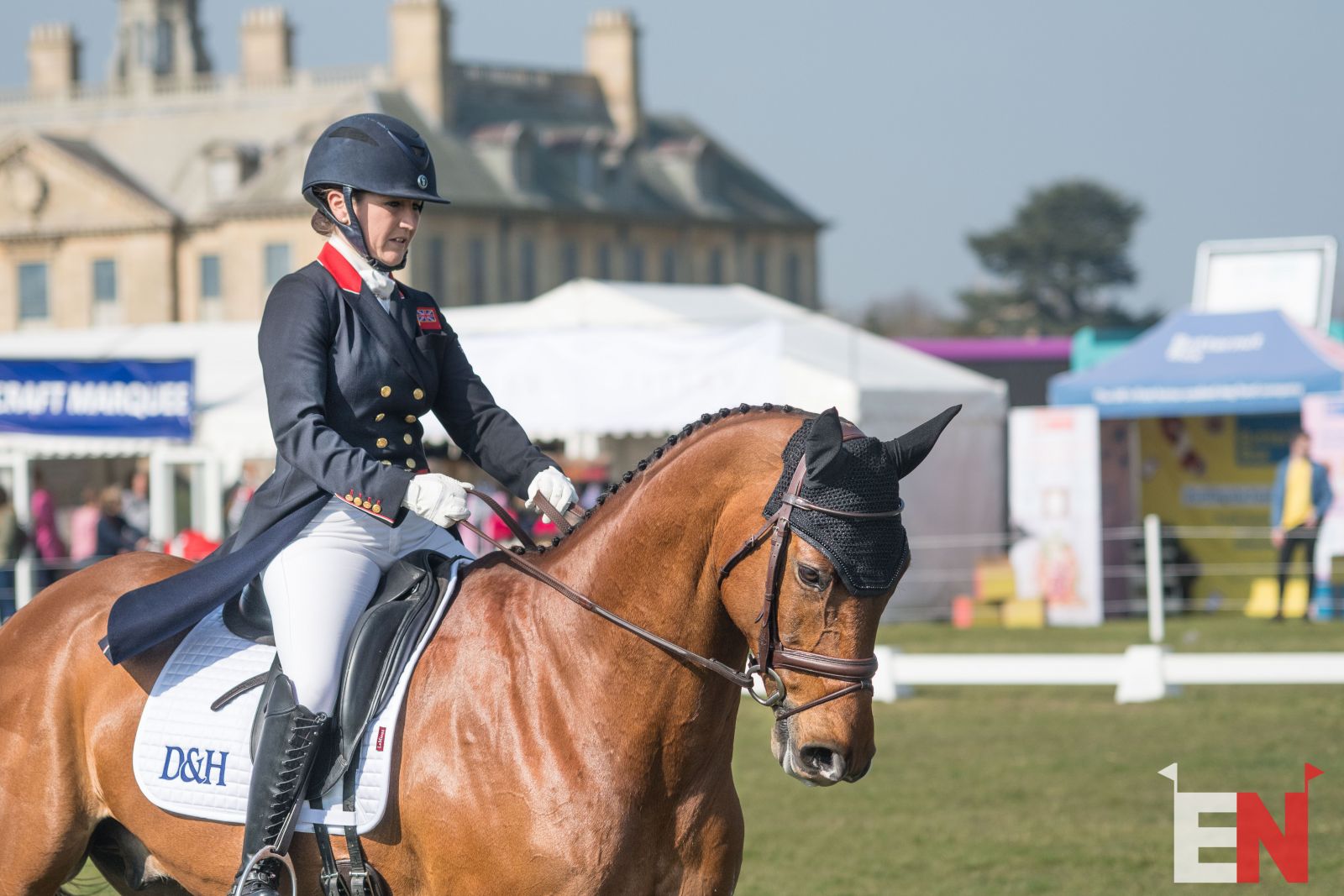
Izzy Taylor and Springpower. Photo by Tilly Berendt.

But #BusyIzzy wasn’t sitting on her laurels today – she also brought forward the Badminton-bound Springpower (Power Blade xx x April Imperator), who duly showed that he’s lacking in neither spring nor, as it happens, power. Some cheeky moments pushed them down to a 34.7, which sees them hold 32nd in this incredibly competitive class. But lest you discount her now, remember that Izzy is one of the fastest and most reliable cross-country jockeys on the scene, and this certainly won’t be a competition that ends in the first phase.

“He’s quite naughty and can be cheeky,” says Izzy. “It’s the first outing here – the sun’s out, the warm-up’s manic, and you go in there … it’s irritating, but he’s a very good horse, and hopefully going to Badminton, so very exciting.”

Pippa Funnell and MGH Grafton Street get their Badminton prep underway. Photo by Tilly Berendt.

Pippa Funnell stepped into second place overnight with Billy Walk On, one of her Badminton entries and a product of her Billy Stud sport horse operation. He scored a 27.6, rocketing him up the leaderboard and placing him well ahead of his ordinarily competitive stable mate MGH Grafton Street, who scored 33.9 for provisional 27th place.

Harry Meade and Away Cruising follow up their Burghley success with a strong start at Belton. Photo by Tilly Berendt.

Harry Meade’s Away Cruising delivered a CCI4*-S personal best of 27.9 to hold third place going into the final session of dressage tomorrow morning. He’s been a reliable circa-30 scorer at this level for a while now, although his career-best performance at Burghley last year saw him score a 29.5 in this phase. Last year, he produced a 30.5 in this class – with his major spring run at Badminton looming, this impressive spike could bode well for his early-season campaign.

Mr Bass impresses for 6th place provisionally. Photo by Tilly Berendt.

Laura Collett held second place yesterday after a fantastic test with London 52, and although he slipped a couple of spots into 4th, he was joined in the top ten by stablemate Mr Bass today. Mr Bass, or Chuck, put a 29.9 on the board and sits sixth after having shown much of his typical class today. Between Laura’s two star boys sits Australia’s Bill Levett, riding his former five-star campaigner Shannondale Titan. The Event Rider Masters specialist scored a 29.6, leaving him in fifth place overnight.

Oliver Townend and Kentucky winner Cooley Master Class. Photo by Tilly Berendt.

William Fox-Pitt and Little Fire managed to stay in seventh place after their afternoon test yesterday, while Piggy French and early runner-up Quarrycrest Echo share overnight eighth with Gemma Tattersall and Pamero 4, as well as Oliver Townend and his Kentucky winner (and entrant) Cooley Master Class. Though the latter lost marks for unsolicited lead changes in both counter canters, the quality of the rest of his test allowed him to cling onto a top-ten provisional placing on 30.4. Oliver brings forward his Burghley winner Ballaghmor Class tomorrow, who dazzled us all with a record-equalling 20.8 at Badminton last year – though Oliver is prone to an eleventh-hour withdrawal at this competition, so his looming test shouldn’t cause too much alarm amongst the ranks.

Jenny Caras and Fernhill Fortitude fly the flag for the USA. Photo by Tilly Berendt.

Our sole US representative – and currently the only US rider accepted at Badminton – is Jenny Caras, and she and Fernhill Fortitude strode down the centreline today for their UK season debut. Some tension marred their overall score, and the pair move ahead to the showjumping and cross country with a dressage score of 40.1, which sees them sit in 75th place overnight.

Pregnancy isn’t slowing Ros Canter down: she and Allstar B gave an educational and entertaining demonstration in the main arena. Photo by Tilly Berendt.

Baby on Board

Spectators were treated to a surprise main arena appearance from World Champion Ros Canter and her WEG mount, Allstar B. Ros, who announced her first pregnancy shortly after her Tryon successes, might be sidelined this spring – but she’s not letting it slow her down. She’s been keeping busy fine-tuning her horses’ flatwork at home, and today, she demonstrated how she schools and warms up her top horses.

“I might do most of this in canter – it’s a little bit more comfortable,” she laughed, gesturing to her burgeoning bump. Ros, who’s due in early summer, then demonstrated a series of breezy flying changes and canter pirouettes because, you know, she’s rather good.

We’ve got a while to wait yet, but here’s something slightly frightening to mull over: we’ve seen an awful lot of riders come back better than ever after their maternity leave. If Ros gets any better, what hope do the rest of us have?!

Flanked by his teammates, Jonty Evans makes a return to his happy hunting ground at Belton. Photo by Tilly Berendt.

The Return of the King

Today’s competition was punctuated by a warm welcome back to reigning Grantham Cup champions Jonty Evans and Cooley Rorkes Drift. Their victory in Belton’s feature class last spring felt a fitting and poignant one – it came, after all, on the back of a gruelling fundraising effort to secure the horse, which birthed a nearly-7,000 strong collective, referred to as ‘Art’s Amazing Family’. Then, of course, the partnership’s story took another turn: Jonty fell from Art in Tattersall’s CCI4*-L and spent the next seven weeks in a coma. Since then, he’s defied every single odd that’s been stacked against him – first, he woke up, despite doctors warning his family that he might not. Then, he walked. Soon, he ran. Before too long, he was back aboard his beloved horse, and today, they made their first public appearance together, riding back into Belton’s main arena flanked by former teammates Padraig McCarthy and Austin O’Connor.

Jonty Evans and Cooley Rorkes Drift at Belton. Photo by Tilly Berendt.

After parading around the main arena, Jonty and Art gave the crowd a show, popping a fence before stopping to thank Jonty’s many supporters throughout his ordeal. Those mentioned included Art’s part-owners Jane and Fred Moss, long-time owners Helen and Nick Caton, head girl Jane Felton, handyman and friend Michael Knight, and his family, including mum Maggie, stepfather Arthur, sister Rebecca, and children Mia and Charlie.

Jonty and Art treated their fans to a show, demonstrating their enviable flatwork and popping a fence, too. Photo by Tilly Berendt.

I’m quite confident I speak for all of our noble eventing nation denizens when I say we’re glad to see Jonty back – we look forward to welcoming him into the spotlight for many, many years to come.

Tomorrow brings us an even more ludicrously jam-packed day: we’ll be powering through one last tiny dressage section in the morning, which includes Kitty King and Vendredi Biats and Burghley winners Oliver Townend and Ballaghmor Class, and then we’ll go straight from showjumping into the weekend’s cross-country finale. Stay tuned for an absolutely colossal report and photo gallery tomorrow!

It’s a who’s-who of eventing in the Grantham Cup CCI4*-S – here’s your top ten as we head into tomorrow’s final short session of dressage.

Belton: Website, Ride Times, Live Scores, Live Stream, EN’s Coverage, EN’s Twitter, EN’s Instagram

Belton, Day One: No Monkeying Around for Young Horses in World-Class Field

The Belton entry list is a sight to behold – every year, in every iteration, and in every class, it’s chock full of top-class horses and riders, preparing for a busy spring of taking over the world. This year is no different and, in fact, there’s a case for calling it the best Belton yet: unhindered by a bad spring, as they were last year, the finest specimens of the eventing world are out in force. Our focus this weekend is the feature class, the CCI4*-S Grantham Cup. A hefty chunk of the Badminton entry list has come forth to battle it out – most of the rest can be found in the event’s OI sections – and there’s a pretty incredible selection of the country’s finest young horses on display, too.

The first half of the field took to the dressage arena today, and it was the young horses who were to steal the show in a closely-fought contest. Leading the way going into day two is Izzy Taylor‘s 2017 six-year-old world champion Monkeying Around, who put a 26.2 on the board first thing this morning. Now eight, he comes forward for just his ninth international competition, and his first four-star. In his eight starts so far, he’s finished in the top ten five times and has begun to establish himself as a force to be reckoned with in the first phase. It should come as no surprise, really – the Hanoverian’s breeding is pure dressage, with Brietling W on his sire’s side and Donnerhall on his dam’s. He can jump, too, although we saw him finish the season with a 20 at the seven-year-old World Championships – so Izzy may not choose to run him to time here, despite his competitive position.

Laura Collett’s London 52 hits the mark in his first international test of 2019. Photo by Tilly Berendt.

Laura Collett‘s 2018 Blenheim eight- and nine-year-old CCI4*-S winner London 52 started his season much as he finished it — the consistently flash first-phase performer laid down one of the tests of the day to post a 28.8 in the Grantham Cup CCI4*-S, putting him in provisional second place. Owned by Karen Bartlett, Keith Scott, and the rider, ‘Dan’ was certainly one of last season’s most exciting prodigal talents, particularly when you consider that he only started eventing in the latter half of 2016. Prior to that, he was a showjumper – and though Laura initially bought him as a sales prospect, his ineffable talent and almost freakish adaptability to his new role quickly won him a permanent stable in her yard.

Last season, we saw enormous potential backed up by correct training — this season, we’re seeing that potential come good. Graced with elegant paces, Dan is now exhibiting a greater level of confidence in his way of going, and a more refined and secure acceptance of the contact, and it was this that allowed him to rocket up the leaderboard despite finding himself up against much more experienced horses.

London 52 spent a winter working on perfecting his dressage – and his blue steel. Photo by Tilly Berendt.

“I’m so pleased with him. He’s still really green at this level, and to go into an atmosphere like that so early in the season is a lot,” says Laura. “He went in at the beginning and sort of froze a bit, but as soon as we started he came back to me. One of the things we’ve been working on is getting a bit braver in the canter work, and I thought in the second canter, that really paid off. We missed the change in the first canter, but in his way of going and everything he does, he’s just a lot more mature now.”

Little Fire is, well, a little fiery – but an otherwise correct and pleasing test puts him into third place overnight with William Fox-Pitt in the irons. Photo by Tilly Berendt.

William Fox-Pitt led the charge for the five-star squad among the field, closing out today’s competition with a 30.1 for provisional third place with Little Fire. Some interpretive dance moves in the changes proved expensive, but Little Fire is yet another horse who begins this season looking a jot more mature and confident overall. The pair finished their season at Pau last year, which looked set to be an impressive debut at five-star for Jennifer Dowling’s ten-year-old, but a surprise rider fall at the tail end of the course ended their weekend early. Now, they’re looking ahead to the horse’s first Badminton.

From Tryon to Belton: Quarrycrest Echo points his toes for a competitive first day in the CCI4*-S. Photo by Tilly Berendt.

She was part of the gold medal-winning team at Tryon last year, and with entries at both Kentucky and Badminton, Piggy French is looking to finally add a five-star victory to her resume. That determination certainly showed through today, and she finishes the day in provisional fourth aboard WEG mount Quarrycrest Echo (30.4), and tenth with stalwart partner Vanir Kamira (33.1).

Quarrycrest Echo, or Red, lost some marks when he broke in the first medium trot, but the rest of his performance was polished and professional – Piggy, for her part, thought it rivalled some of his best work. The twelve-year-old gelding, owned by Jayne McGivern, will head to Kentucky next month, while Trevor Dickens’ Vanir Kamira, known as Tilly, will make her return to Badminton.

Five-star stalwart Vanir Kamira rounds out the top ten. Photo by Tilly Berendt.

Just outside the top ten, one of the most exciting performances of the day was delivered by JL Dublin, the talented up-and-comer in Nicola Wilson‘s string. Just eight-years-old, he comes to his first four-star after finishing fifth in last year’s seven-year-old World Championship. His 33.2 today was enough to put him in eleventh, so while he won’t be in the upper echelons after this phase, he’s reaffirmed his place on our radar as a serious horse for the future.

Nicola Wilson’s level debutante JL Dublin offered a taster of what’s to come – and it was very tasty indeed. Photo by Tilly Berendt.

“I’m just so proud of him,” says a delighted Nicola of James Lambert and Deirdre Johnston’s Diarado gelding. “He was with me the whole way through, and we know that the dressage arena for the Grantham Cup is really electric – they’re all on their own here, and there’s a lot going on. For such a young and inexperienced horse he stayed so focused, and he really did the best test he could have done at this stage in his career. I’m just so pleased with him, so proud of him, and so excited for what’s to come.”

It’s a jolly good start in a hot field, but tomorrow we’ll really see the leaderboard sizzle. Ireland’s Padraig McCarthy and his WEG silver medallist Mr Chunky, Kitty King and Ceylor L A N, Pippa Funnell and MGH Grafton Street, Tom McEwen and Toledo de Kerser, and Laura Collett‘s stable star Mr Bass head up an enormous batch of top-level heavy hitters taking to the main stage, promising a siege of the top spots. We’re also very excited to see sole US representative Jenny Caras, who partners Fernhill Fortitude in the first of their Badminton prep runs on these shores. The fun won’t stop there, either – Belton’s organisers have snuck a few bonus tests into Sunday morning’s schedule. The last of those? A certain Ballaghmor Class who, with rider Oliver Townend, served up a piping hot 20.8 dressage at Badminton last year. There’s nothing we like better than an eleventh-hour gauntlet throw.

The top ten at the end of the first day of dressage in Belton’s CCI4*-S.

Belton: Website, Ride Times, Live Scores, Live Stream, EN’s Coverage, EN’s Twitter, EN’s Instagram

How to Watch the 2019 Belton Live Stream

Jonty Evans and Cooley Rorkes Drift: winners of Belton’s Grantham Cup CCI4*-S in 2018. Photo by Tilly Berendt.

It’s that time of year again, folks — the British eventing season is hitting its stride this weekend with its first major international of the year, which means that we’ll be bringing you piping hot coverage at a speed and intensity that’ll rival Classic Moet sprinting around a two-star.

Belton International always boasts one of the hottest entry lists of the year, and 2019’s iteration is no different. Most of the Badminton field is in situ across the event’s jam-packed feature CCI4*-S, a drool-worthy Open Intermediate field, and a remarkably impressive CCI3*-S. There’s also Novice, Intermediate and Advanced classes running across the three days. In short, it’s probably the easiest way to see the very best horses in the UK (and beyond) in one place. Plus, there’s a gin den.

Photo courtesy of Belton International Horse Trials.

If you can’t be at Belton but want to keep up to date with how your Badminton favourites are doing, the kind folks at BEDE Events will be live-streaming every day’s cross-country action. Here’s the timetable. (Note: as BEDE haven’t confirmed which classes will be live-streamed, we’re working on the broad assumption that all of them will be, although only the cross country phase of each. We’ll be sure to update you if this changes.)

Friday, 29 March:

Novice: 9.30am BST/5.30am EST – 1.35pm BST/9.35am EST

Intermediate: 2.00pm BST/10.00am EST – 5.40pm BST/1.40pm EST

Saturday, 30 March:

CCI3*-S: 9.00am BST/5.00am EST – 12.45pm BST/8.45am EST

Intermediate: 1.00pm BST/9.00am EST – 5.10pm BST/4.10pm EST

Sunday, 31 March:

CCI3*-S: 8.44am BST/3.44am EST – 10.22am BST/5.22am EST

CCI4*-S: 12.06pm BST/7.06am EST – 4.10pm BST/11.10pm EST

Live-streaming will be available through the BEDE website and Facebook page. I’ll be on the ground (with Chinch in tow) to bring you full reports, hot tips (and probably gin recommendations) from Belton’s smoking hot competition. Stay tuned!

Belton: Website, Ride Times, Live Scores, Live Stream, EN’s Coverage, EN’s Twitter, EN’s Instagram

British Eventing CEO Steps Down

Great Britain’s team gold at the 2018 World Equestrian Games heads up an enviable list of successes the country has had on the world stage in David Holmes’ tenure. Photo by Leslie Threlkeld.

British Eventing’s CEO David Holmes announced his resignation today after four years in the role.

The news comes just months after October’s Extraordinary General Meeting, at which a vote of no confidence in both Holmes and chairman Paul Hodgson was put to attendees. Though a marginal majority voted to keep both men instated, concern was expressed at the primary causes of the vote of no confidence — that is, an ongoing and over-budget IT project, which saw the new British Eventing website launch only semi-successfully last month, and accumulated expenses of around ÂŁ11,000, related to the new showcase event at Osborne House on the Isle of Wight. Concerns have since arisen regarding the future of the fixtures list, with the popular Brightling Park International one of the first major victims.

The new British Eventing season began on the second of March, and Holmes has made appearances at several of its fixtures, ostensibly to allow members a chance to voice their concerns and ask questions about the running of the organisation. However, many members feel that these appearances haven’t been sufficiently well-advertised.

British Eventing released a statement this afternoon, which reads:

“The Board of British Eventing thank David for his hard work and dedication, and wish him all the best for the future.”

Holmes, who intends to move to Italy later this year, and will continue in his post until the end of this month, says, “I have very much enjoyed my time working as CEO of British Eventing. I would like to say a huge thank you to everyone with whom I have worked over the last four years — the team of staff in the office and regionally, volunteers, organisers, officials, owners and sponsors; a key part of what has motivated me to drive forward great change in our sport is working with such a committed, hardworking and inspiring group of people.”

British Eventing has not yet confirmed a replacement for Holmes, though an update on the BE website by board chairman Fiona O’Hara confirmed that arrangements are in place to facilitate the transition. She also addressed some of the concerns that led to last autumn’s vote of no confidence.

“2019 has seen the much-anticipated website launch and with each week this is becoming increasingly stable as fixes and updates are made. I would also like particularly to thank the team in the office, who have continued to demonstrate their huge commitment and been unfailingly helpful to members who have contacted them.

“Looking ahead, we will continue to invest in IT and we will shortly announce the results of the fixtures review for 2020. I know there will be some disappointment, however this review was driven by the international and championship calendar and was also needed to ensure we have a geographically balanced and financially viable fixture list that will ensure the long term future of the sport.

“At HQ we will be simplifying some of the committee and team structures with the aim of improving efficiency and we are also strengthening our relationship with the BEOA [British Event Owners’ Association], EHOA [Event Horse Owners’ Association] and ERA [Event Riders Association] through the appointment of Non Exec Directors to work with them directly.”

Friday Video from SmartPak: Back to the Track

In between some soggy early-season events, Britain’s horsey set were thoroughly preoccupied with one thing last week: the Cheltenham Festival. National Hunt racing’s crown jewel, the Festival brings together the UK and Ireland’s finest runners, while punters bring forward their most ludicrous head-to-toe tweed outfits, and then madness ensues. It’s a smashing good time for everyone.

But where there’s racing, there are ex-racehorses, and as proud and unabashed OTTB fans, we’ve got to give a nod to the Thoroughbreds tackling second careers with aplomb. To our delight, Cheltenham – and the hard-working organisation Retraining of Racehorses –  felt the same way. Meet Master Minded, a former Festival winner who made a long-awaited return to his happy hunting ground at this year’s festival. We love him already, and we’re pretty sure you will too.

#BadmintonAt70: Ride the 1969 Cross Country Course

Gird your loins, chaps: the countdown is ON to the Mitsubishi Motors Badminton Horse Trials, and we, for one, couldn’t be more excited — not least because this year is a special one. 2019’s competition is the 70th anniversary of the inaugural Badminton, and since its first running in 1949 the sport, the venue, and the characters within this epic story have changed and evolved significantly. To celebrate 70 years of brilliant Badminton, we’re going to be bringing you an extra-special inside look at the event and its rich and exciting history, every week from now until the competition begins on May 1. Consider the archives your own personal Gringotts, and EN your loyal goblin sherpas. 

This week, as we pour our time and attentions to your bumper Badminton form guide, we’re filling in the gap with help from our pals at the event — you’re in for a real treat!

If you’re anything like us, you absolutely live on the Cross Country App when the season starts. Forget wheeling your course — this GPS-powered mini marvel allows you to work out minute markers as you walk, leaving you free to plot the best possible line, take pithy notes, and snap photos of your fences and your routes. It’s great for spectators, too, allowing you the chance to do a deep dive into the courses at internationals the world over.

We’re all for the innovative use of technology, so when our friends at the Mitsubishi Motors Badminton Horse Trials told us they were launching a course ‘preview’ that would take its users 50 years back in time, we started to get excited. When the end result dropped, we absolutely weren’t disappointed.

Richard Walker and Pasha tackle the steeplechase course. Photo courtesy of Badminton Horse Trials.

Badminton is celebrating two special anniversaries this year: one is its 70th birthday, which we’re sure we haven’t let you forget quite yet. The other is the 50th anniversary of the youngest-ever winner, Richard Walker, who was just 18 years (and 247 days) old when he triumphed with his 15.1-hand Anglo-Arab, Pasha. Remarkable Richard has seen the course change and evolve enormously throughout the last 50 years and now, he’s helping to bring those changes to life for us all via an archival, interactive course map on the Cross Country App.

The Vicarage Vee: a real pants-wetter even (or perhaps especially?) in 1969.


Want to give it a go? You can download the 1969 Badminton course directly to the app, but we recommend clicking through to the Badminton website and enjoying the experience full-screen. You’ll get to ride along through all four phases — roads and tracks, steeplechase, more roads and tracks, and finally, that beefy cross country course — with incredible archival photographs, footage, and endlessly fascinating audio clips explaining the whys, wherefores, and changes to this iconic course. No stone has been left unturned: you’ll see competitors running alongside their horses on roads and tracks, as explained by competitor and president of the Ground Jury Judy Bradwell, and you’ll head into the Formula One-esque 10-minute box with inspector Bill Bush. Then, you’ll head out on course with ’69 winner Richard Walker and learn which bits of the course really made his knees knock.

The evolution of “no thanks”.

With insights into the development of safety technology, the rise of technicality, and the evolution of the Vicarage Vee, this is your afternoon sorted. Even better? If you’re a UK resident, you can enter the 1969 trivia competition to bag yourself a Badminton polo top from sponsor Joules.

Happy app-ing!

#BadmintonAt70: Six Women Who Wowed the World

Gird your loins, chaps: the countdown is ON to the Mitsubishi Motors Badminton Horse Trials, and we, for one, couldn’t be more excited — not least because this year is a special one. 2019’s competition is the 70th anniversary of the inaugural Badminton, and since its first running in 1949 the sport, the venue, and the characters within this epic story have changed and evolved significantly. To celebrate 70 years of brilliant Badminton, we’re going to be bringing you an extra-special inside look at the event and its rich and exciting history, every week from now until the competition begins on May 1. Consider the archives your own personal Gringotts, and EN your loyal goblin sherpas. 

This week, it’s a #girlpower special – fire up the BeyoncĂ© playlist and get comfortable…

We all know – and, perhaps, take for granted – that the equestrian sports are that rare, progressive microcosm in which gender neutrality is a given and women compete on equal terms – and with equal success – as men. For this to be true of one of the toughest sports in the world, which requires such high levels of physical strength and fortitude, as well as relentless focus and unflappability, is doubly remarkable.

Badminton made its auspicious debut in 1949, and in doing so, it created the atmosphere of equality – until that point, eventing had existed solely as a military sport, which meant that civilians and women weren’t allowed to partake. Although the competition was introduced as a training ground for future team hopefuls, the organisers opted to open the entry to anyone. In doing so, they levelled the playing field and left a legacy that continues to this day. In 2018, women won 50% of the world’s five-stars – take THAT, mainstream sport.

Jonelle Price hefts the Badminton trophy, 64 years after the first female winner did the same. Photo by Tilly Berendt.

Though we consider it a given that women are as capable as men, it’s important to remember that other sports – and indeed, many paths of life – aren’t nearly as progressive. Today, we’re looking back at those fearsome ladies who paved the way and proved that Badminton’s decision was the right one – the firestarters, the record-makers, the record-breakers, and of course, the mares.

 6: DOING THE DOUBLE

Anneli Drummond-Hay is widely considered one of the female trailblazers of eventing, and rightly so: she’s perhaps best known for winning the first ever Burghley in 1961 with Merely-a-Monarch, but the pair won Badminton too, taking the victory the following spring in 1962. They didn’t just edge the win, either – they led from pillar to post and finished 42 points clear of second-placed Frank Weldon and Young Pretender.

Anneli was following in the eventing footsteps of older sister Jane, who was second at Badminton in 1951. She had borrowed the ride on her sister’s horse Freya in 1955, standing in for her on the team at the Europeans so that her sister could get married, and from then on out, she was hooked. In 1960, she was third, and best of the Brits, at Badminton aboard Perhaps, a horse she’d bought from the slaughterhouse for £15.

Anneli Drummond-Hay and Merely-a-Monarch – perhaps the world’s first truly remarkable event horse. Photo courtesy of Badminton Horse Trials.

After Perhaps was bought by the Swiss team, Anneli went on the hunt for a youngster. She bought an advert in Horse & Hound, and although she was offered plenty of duds for sale, one response made her look twice. She was mailed a photograph of a two-year-old – a lovely stamp of a horse, she thought, but a year or two younger than she wanted. She forgot all about the horse, but a year later, the owners contacted her to ask if she could post the photograph back to them as they were still trying to sell the horse. This time, she decided to go and have a look herself.

“I fell in love with him immediately,” she recalled. Merely-a-Monarch was Ÿ Thoroughbred and a quarter Fell pony and just as classy as he’d been the year prior. Anneli borrowed the ÂŁ300 purchase price and got to work with the talented, tricky youngster.

By the time he was five, Monarch had won a horse trials at Tweseldown and had also been victorious at the Horse of the Year Show, winning the Foxhunter (1.20m) class, the show hunter division, and the combined training championship. He was just six years old when he won Burghley – and he was the only horse in the entire competition not to fall across the country.

As part of her preparation for Badminton, Anneli sent Monarch to Ivor Herbert’s gallops for fitness prep. Because Ivor only allowed jockeys to use his track, Anneli had to sign the ride over for the day, and Monarch was sent out to gallop with Flame Gun, one of the most successful two-mile chasers of the time. Monarch outstripped the full Thoroughbred easily.

After taking the Badminton title, Anneli was so worried about her beloved – and now extraordinarily valuable – horse getting hurt that she opted to switch to pure showjumping. Women still weren’t allowed to ride on the eventing team at the Olympics, but had been let into the showjumping squad, and this was another enormous influence on Anneli’s decision.

Although the pair had a great many successes together on the world stage – they were on five Nations’ Cup teams, came second at the 1970 World Championships, and won Grands Prix at Madrid, Toronto and Geneva – Anneli also suffered from attacks by the press.

“I will always remember how fickle the press could be,” she said to Debbie Sly. “When I was third at Badminton on Perhaps there were a lot of very complimentary press cuttings saying I deserved a far better horse than the one I was on. But when I hit a few problems showjumping with Monarch there were more press cuttings declaring that this talented horse deserved a far better rider!” When Anneli was forced to sell a share in her horse to keep afloat financially, the shareholders, influenced by the negative press, insisted that the horse move to another rider. The matter was settled in court, and Colonel Tom Greenhalgh helped to resecure the share.

Anneli retired Monarch from competition when he was sixteen and left him in the capable hands of his former groom, Merlin Meakin, who gave him a decade of fun out hunting. Anneli had moved to South Africa with her husband, but on a visit back to England, she received a call saying that Monarch had fallen whilst being shod and couldn’t get back up.

“I was able to say goodbye before having him put down. I was always grateful that he ‘waited’ until I was home so that I could do that,” she reflected.

The Drummond-Hay legacy continues to dominate to this day – Jane’s granddaughter, and Anneli’s great-niece, is British eventing supremo Izzy Taylor.

5: THE GALLOPING NURSE

Jane Holderness-Roddam (then Bullen) took the Badminton title twice: her first win was in 1968 aboard Our Nobby, and her second came ten years later in 1978 with Warrior. With the latter, she also won Burghley in 1976, while the former was her mount for the ’68 Olympics in Mexico City, where Great Britain took team gold.

Of course, multiple wins are almost commonplace these days, but Jane’s first victory was notable for a couple of reasons. First was her horse. Although Our Nobby has been written into the history books as being 15hh, which would tie him with Our Solo as the smallest-ever winner of the event. In actual fact, he may well have been smaller: Jane admitted after the fact that it was always a struggle to get him to measure up to the required minimum height of 15hh, and he had won several showing classes for ponies up to the height of 14.2hh prior to his major win. He was issued a life certificate for the Pony Club, which confirms this smaller height – whether he grew that final two inches, or whether he was standing on tip-toes for measurement is a historical uncertainty that only Jane would know the answer to.

Jane Holderness-Roddam and Our Nobby.

The full Thoroughbred gelding (Bewildered x Lady Sicily, by Happy Landing) had been sold to the Bullen family for £120 as a potential family pony – he was an athletic type, but simply hadn’t grown enough to be considered an adults’ mount. This was partly due to his premature birth – his owners were out of the country when he appeared, quite unexpectedly, and he very nearly perished in the harsh winter weather before a local blacksmith spotted him in the field and took him to the RSPCA. Though he tried his hand at racing as a four-year-old, he wasn’t considered a competitive prospect. He was passed along via a Welsh shepherd, contracted Canadian Pox, and ended up in his permanent home with the Bullens when he was a five-year-old, once again weakened and in a sorry state.

However, once he settled into his new surroundings and enjoyed some of the Bullens’ hospitality – and good feed – he revealed his true colours. Nappy and tricky, he couldn’t be sold on. Jane’s older siblings Mike and Jennie rode him initially, and once some of the buttons had been installed, he was passed along to young Jane for use in Pony Club competitions. Though he was never a reliable first-phase performer, he was tough and quick across the country, and he and Jane tended to claw their way up the rankings by amassing the maximum possible bonus points for speed in the cross-country phases.

“He was as tough as old boots and speed was nothing to him; he was terribly fast and a fantastic jumper,” said Jane.

Jane earned the nickname ‘the galloping nurse’ because, at the time of her first Badminton win, she was working full time as a nurse in London. In fact, the 20-year-old worked seven night shifts back to back leading straight into Badminton. Despite lack of sleep and the rigours of her stressful job, she achieved the maximum possible bonuses on Saturday and delivered the pivotal clear round on Sunday. It was exactly what she needed to win what was deemed in a year with the biggest field yet – 55 entries – and what was, at the time, the biggest and toughest cross-country challenge yet. Though eventing hadn’t yet reached the peak of professionalism that it has now, it was still unusual for a Badminton competitor to juggle eventing alongside a full-time job – indeed, the only person to win with such credentials since was Captain Mark Phillips, who won while serving as an army officer.

After Badminton, Jane went on to become the first women ever to win an Olympic gold medal for equestrianism. Since then, she’s been a hugely influential figure in the industry: she’s an FEI technical delegate and judge, has been the president of British Eventing, the vice-president of the British Horse Society, and a trustee of both the Brooke and World Horse Welfare Charities. She also served as a lady-in-waiting to Princess Anne and was honoured with a CBE by the Queen of England.

4: TRAMELLA TRUMPS THE BOYS

At just 15hh, the diminutive Tramella was one of the smallest horses to compete at Badminton. But that’s not what made the Welsh pony x Thoroughbred mare so remarkable.

In 1954, Diana Mason and Tramella, by Tramail, finished third at Badminton. The winner that year was Margaret Hough (see #3) – the first ever woman to win the event. Later that year, both women would contest the European Championships, giving them the shared honour of being the first women to ever ride on a three-day-eventing squad.

But Diana didn’t always expect greatness from her little mare. She came across Tramella – known as ‘Mell’ – as a four-year-old, and found her exceptionally naughty and nappy. Still, she climbed aboard for a trial ride, which required Mell’s then-owner to lead the recalcitrant youngster down to the far end of the field with Diana aboard. Once they reached it, the owner unclipped Mell and girl and horse galloped at full-speed back to the gate. That was as much as Mell was willing to do.

Tramella shows off her party trick.

For whatever reason, Diana’s father saw something in the horse that he liked, and Diana, who was offered a suitably 1950s amount of say in the matter, had a new horse in Mell. (The joke was to be entirely on him – Mr Mason decided that his daughter ought to study something sensible and ladylike once she left school, and sent her away on a sewing and cookery course. She was allowed to join in with an equine course, too, which was run by John Shedden – the very first winner of Badminton. At his base, she was allowed to ride Golden Willow and Kingpin, his two Badminton mounts, and had her head filled with stories about the remarkable competition nestled in the Cotswolds.)

Along the way, though, Mell was getting no easier to deal with. Her nappiness worsened after she managed to jump out of her field and onto the road. There, she slipped and gave herself some minor superficial injuries – and this just furthered her conviction that staying put on the yard was the safest way to live.

“I used to just sit it out; there was no point in hitting her, because then she just reared higher and higher,” remembered Diana. “After about an hour and a half she would obviously be bored of that game, and would set off for her ride and never even look back!”

Tramella’s famous over-fences rage face. Photo by l’Annee Hippique.

Once Diana started to figure the mare out, the pair had lots of success in the show ring. Pretty Mell, with her four white socks, even made it to the Horse of the Year Show, where she performed beautifully in all her classes – but it was her win in the combined training that made the biggest impact on her plucky young rider. Perhaps she, too, could make it to Badminton.

The following year Mell was a five-year-old and deemed ready to head out eventing. She won her second competition, finishing ahead of two horses that had been shortlisted for the ’52 Olympics. In ’53, as a seven-year-old, she made her first trip to Badminton. There, Diana discovered that her little mare’s mercurial nature didn’t exactly lend itself to dressage in an atmosphere – she refused to work in the furthest third of the arena by the grandstand. They finished 19th that year.

The next year, Diana went back to Badminton with a plan of action. They warmed up for a whopping five hours before the first phase. This time, she and Tramella found themselves in second place after the dressage, and went on to finish third in the competition. Later that year, they’d make their history-making team debut at the Europeans, contributing to the team’s gold medal and finishing seventh individually despite a tumble on the flat on cross-country. They were duly selected for the Europeans again the following year, where they led after the dressage – but Tramella slipped on landing from one of the imposing cross-country fences and both horse and rider fell. For Tramella, this first ever fall had an enormously detrimental effect – she completely lost her confidence across the country. Diana decided to listen to her plucky mare and swapped her over to pure dressage. After teaching her flying changes with the aid of a training manual, the pair were competing prolifically at the Grand Prix level. At that time, Tramella was one of only a handful of horses at the level in Great Britain.

Diana Mason and Tramella at their first European Championships. Photo by l’Annee Hippique.

The pair would compete internationally multiple times in their second career, but it wasn’t until Diana had retired the mare to try to get her into foal – unsuccessfully – that she set her remarkable record. At 17, the mare was called up to represent her country at the Europeans once again, this time on the dressage team. The team took gold, and Tramella and Diana remain the only pair to win gold medals in two disciplines.

All this aside, our favourite thing about Tramella is that she had a special trick – she’d been taught to ‘curtsy’ for a lump of sugar. At Badminton, she would pull out that trick for anyone who walked past her stable – including the Queen of England, who was thoroughly charmed by the little mare’s impeccable etiquette.

3: LEADING THE WAY FOR WOMEN

1954 was a banner year for the girlpower contingent – it was at this iteration of Badminton, its sixth running, that the first female winner was crowned. Even better, she did it riding a mare.

Margaret Hough was bitten by the eventing bug in 1951 when she took third place at Gisbourne with her future Badminton winner Bambi V (Long Walk x Dark Secret). Though it was only the mare’s second competition, she was talent-spotted by team hopeful Reg Hindley and Tony Collings, who asked Margaret if they might borrow the mare for the squad to use. Though this sort of horse-swapping was commonplace in those days, Margaret wasn’t initially convinced. Eventually, she came round to the idea, thinking that even if she could never ride at the Olympics, perhaps her horse could make something of herself in Helsinki. The one condition she named was that she would get to accompany her mare as her groom.

Margaret Hough and Bambi V take Badminton. Photo from the Badminton Horse Trials archives.

In the end, Bambi did go to the Helsinki Games, but she was the reserve and wasn’t called up. The following year, 1953, saw her stay with the team, and she was piloted by Bertie Hill in the Open European Championships at Badminton. They finished seventeenth individually and contributed to the British team’s gold medal.

With a newly-minted Badminton horse on her hands, Margaret thought it was high time she had a go at this elite competition herself.

“I was determined to do my best, though I never really thought that would be good enough to win,” she recalled. Her best was certainly good enough to put the pair into the lead after dressage, though, and they set out on Saturday’s speed and endurance phases feeling full of running – so much so that Bambi, who was renowned for jumping with her ears flat back against her head like some sort of rage-fuelled Ferrari – tried to jump one of the waters in one go.

Interestingly, though the duo went on to win, they did so with a black mark against them on the cross-country – they had a stop at the Luckington Lane crossing. Their win was thus marred by some controversy – there were many who felt that second-placed Frank Weldon and Kilbarry had been mistimed in the steeplechase and not given the correct bonuses, and still more who felt that his two rails down on the final day shouldn’t have been more heavily penalised than Margaret’s stop across the country. A lengthy – and rather familiar – debate followed about which of the phases should carry the most influence on the competition as a whole. That debate would rage on for another 23 years before the penalties for a knocked rail were reduced from 10 to 5.

Despite the bickering, Margaret’s abilities were duly noted by the powers that be, and she and third-placed Diana Mason and Tramella were named to the British team at the Basle European Championships later that year. In a sport that had remained a game for the boys at the squad level, this was enormous: Margaret and Diana were the first women to represent any country in a team three-day event. Afterwards, Horse&Hound ran a poem to commemorate the achievements of its global girls – please stand by for our impassioned petition to bring dodgy rhyme schemes back to the pages of this hallowed publication:

Now who’d have thought such modest charm

            was hiding nerves so strong and calm

            not ONLY found in She Who Rides!

            And who’d have thought an English Miss

            could stimulate the stolid Swiss –

            (I mean could stimulate to cheers)

            and bring the Germans near to tears.

            So who’d have thought that we’d have TWO

            who this, and doubtless more, could do.

            But that we had, there was no doubt, and,

            being British, blushed about.

            But now who dares the sombre thought

            that at this three-day equine sport

            the aids required to set the pace

            are nerves, curves, and a pretty face!

Thanks for the clarification re: the Swiss, chaps – was rather concerning otherwise.

Margaret died at the beginning of 2018 at the age of 86 after suffering a chest infection. This was the final battle in a lifetime of respiratory issues – in fact, it was due to chronic bronchitis as a child that Margaret began riding on the recommendation of the family doctor.

2: EVENTING’S FIRST PROFESSIONAL

Despite her incredible legacy, the late Sheila Willcox wasn’t born into a remotely horsey family. Instead, she once described her household as being “entirely suburban, based on business and academic careers and given to rugger, tennis, and bridge-playing.” Nonetheless, she was inexplicably bitten by the horsey bug, and spent her formative years saving up her pocket money so she could afford pony rides along the beach on holidays. Her parents eventually defected, and she was allowed to join the Pony Club. This, of course, swiftly became the primary focus of her life – so much so that her unwitting father bought her an unbroken pony in order to persuade her to head back to school without a fuss. Sheila was only ten years old at the time but nevertheless, she set about the great new challenge of training the two-year-old ‘Folly’.

Sheila Willcox, from her book “The Event Horse.”

Not long after, Sheila discovered the joys of competing – and moreover, the joys of victory. After being awarded her first rosette at a local fair, she vowed to be the very best at riding, saying: “to wear a number, to be called by name into the ring and walk, trot, and canter around with the other ponies – this was halcyon bliss
at the same time I determined that no matter which branch of equestrianism I should eventually take up, I should strive to emulate the leaders.”

A successful junior career riding show hacks followed, after Sheila’s parents deemed showjumping rather too unladylike to be proper. But Sheila wanted more of a challenge and, at the age of seventeen, she came across the sport of eventing. Like many profoundly bonkers teenage girls thereafter, she was instantly committed, and set about on the hunt for a horse that she might be able to turn into an eventing star.

Eventually she found that horse in the form of High and Mighty, or ‘Chips’, a seven-year-old dun by a Thoroughbred stallion and out of a Highland pony/Arab-cross mare. Though neither horse nor girl had any real formal training, Sheila undertook the job with aplomb, consulting a well-worn copy of Dressage by Henry Wynmalen for guidance. They won on their first attempt at eventing, in a Novice (Prelim) class at the now-defunct Hovingham Hall Horse Trials, and the British Horse Society got in touch to suggest that, down the line, Sheila might consider lending the horse to the British team for use at the Olympics.

And here we get to the crux of what really makes Sheila’s legacy so remarkable: she paved the way for women when the sport, though still refreshingly genderless in most spheres, only catered to men for Olympic berths. Impossibly glamorous and relentlessly fierce, Sheila refused to bow down to the whims of the BHS, and she rode as though she had a point to prove – perhaps because she did. As one of eventing’s suffragettes, she made it clear that the ‘lady riders’ could play with the big boys – and she did so by setting a remarkable Badminton record that no one has yet beaten.

In 1955, she began training with Colonel Edy Goldmann, who was one of the first British trainers to promote a German-style focus on dressage. Paired with Sheila’s single-minded competitiveness, the result was formidable, and after a good showing at Harewood Horse Trials, Sheila and Chips were offered a place on the British team at that year’s Turin International. Sheila was the only female rider in the competition
and she won it.

In 1956, after just a year and a half of eventing, she and Chips headed to Badminton. They were placed second after the dressage, and accumulated the maximum number of bonus points in the speed and endurance phases, but even their clear showjumping on the final day couldn’t push them ahead of the legendary Frank Weldon and Kilbarry. They retained that second place all the way through until the bitter end – and overnight, British selector Ted Marsh had bought the horse on behalf of the team. As consolation, Marsh promised that if Chips returned from that year’s Stockholm Olympics in one piece, Sheila would be allowed to take him to Badminton the next year.

As it turned out, Chips didn’t even make it to Stockholm – instead, he went lame whilst in training at Windsor. But Sheila attended the Games herself – not as a competitor, which wasn’t allowed, but as a member of the media, commenting on the action for l’AnnĂ©e Hippique. The British team took gold, but Sheila felt she’d been hard done by: “Harking back to the controversy over allowing women competitors in the three-day event, and without wanting to appear a militant feminist, I still think the element of danger is in ratio to intelligent riding, and that should an unlucky accident happen to a woman instead of a man, she will show equal fortitude and endurance, as well as possibly less sustained shock due to the relief of feminine tears. No one would be surprised to see me passing the finishing post crying bitterly and feeling much better for it, but it would cause something of a furore if [Laurence] Rook or [Frank] Weldon came home dripping tears over Sissi or Kilbarry!”

Sheila Willcox at Badminton. Photo by Badminton Horse Trials.

After the Games, Sheila was able to buy her ‘lame’ horse back from the team. He promptly came sound again, and they won their ’57 Badminton prep run. Then it was time to head to the main event, made doubly special by the fact that Sheila’s 21st birthday fell on cross-country day. Fortunately for her festive spirit, she and Chips found themselves in the lead after dressage and, with a fast clear under their belts, still at the top of the pack by the time her party began at a nearby hotel. The crowning glory of the party was her colossal birthday cake – it was made to look like an elaborate cross-country course, with 21 fences artfully constructed along the top. Around them was a castle, some streams, and some carefully constructed terrain – and, of course, a tiny replica of Sheila and Chips popping over the final fence.

By all accounts, the party was a roaring success. At 3am, Sheila had to forcibly remove the revellers so she could get some sleep – but in true eventing fashion, she was able to get the job done the next day. The Badminton title was hers.

The next year, the remarkable pair took the crown again. This time, they would do it by the widest margin ever seen to date or since – they led the dressage by 22 points and ultimately won an astonishing 47 points clear of the next competitor. That autumn, Sheila and Chips headed to the European Championships in Copenhagen, and won both team and individual gold – this made Sheila the first woman ever to win the Europeans. Afterwards, Sheila gave High and Mighty to Ted Marsh to ‘retire’ into the Heythrop hunting field, but nevertheless, she was able to continue her quest to be the very best. The seven-year-old Airs and Graces had only been eventing for six months by the time he headed to Badminton in ’59, but he won it easily, giving Sheila the last of her unrivalled three consecutive wins. In 1964, she took a fourth title, winning ‘Little Badminton’ – a separate class run over the same course but for horses with minimal winnings – with Glenamoy.

Sheila Willcox and Chips. Photo from the Badminton Horse Trials archives.

In 1971, Sheila suffered a catastrophic fall at Tidworth Horse Trials, and was left partially paralysed. Determined not to give up riding, she swapped her focus to pure dressage and went on to compete successfully at the Grand Prix level. But she was also an enormously influential figure to the next generation of event riders: one of her rare and notable students was Mary King, who worked her way up to being Sheila’s head girl.

As it turned out, the ferocity of spirit and determination that made Sheila such a formidable competitor made her a notoriously tough employer and trainer, too.

In her 2009 autobiography, Mary King reflected: “my days would begin at 5.30am and, before I even got on a horse, I realised that the stable management was extraordinarily thorough. Mucking out was a very strict procedure; the floor had to be ‘clean enough to eat from’ and you had to move the straw back completely
no more than one pile of poo was allowed in a stable at any one time. Windows were Windolened inside and out once a week and there mustn’t be a cobweb in sight. Sheila Willcox was a perfectionist who left no stone unturned.”

In lessons, too, Sheila demanded the highest standards from her staff: “Sheila would say, ‘don’t you dare fall off!’ and the fact that I was much more scared of her than I was of a rearing and bucking horse made me stick on. It was very educational.” But, says Mary, “my two and a half years there turned out to be fantastic training and the broad base on which I have built my career.”

1: QUEEN GREEN AND THE SIX VICTORIES

“My heart does something at Badminton that it doesn’t do anywhere else.”

There couldn’t really be anyone else in the top spot but Lucinda Green, the undisputed queen of Badminton. She won the event an astonishing six times on six different horses – a record that remains unbeaten. Let’s take a closer look


1973

Lucinda was just nineteen when she took her first title in 1973 riding Be Fair, her Pony Club eventer who had taken her to team gold at the ’71 Junior European Championships. Be Fair was out of a mare called Happy Reunion, but he wasn’t planned progeny – in fact, he was borne out of an illicit liaison between the supposedly barren Happy and her field companion. The guilty colt in question would go on to contest Badminton himself – he was Fair and Square, ridden by Sheila Willcox.

Lucinda – then Prior-Palmer – had her first ride around Badminton with Be Fair in ’72. She later recalled in an interview with Debbie Sly, “I walked the course with Mark Phillips, who just kept saying ‘You want to kick here
I should keep kicking here
’ It didn’t seem to matter what type of fence we were looking at, the advice seemed to remain the same: just keep kicking! By the time we got to the end of our course-walk I had a streaming nosebleed from the stress of it all.”

Despite the nosebleed – and a runout at the walls as a result of her slippery leather gloves – Lucinda finished fifth. The following year she and Be Fair would return, and this time, they’d produce a nearly foot-perfect round – just one minor reroute due to an erroneous lack of martingale marred their cross-country, but they escaped penalty and took the title.

In an interview with Country Life, Lucinda said: “It was ridiculous: I was 19, it was my second attempt and the horse, Be Fair, had been my 15th-birthday present. Winning Badminton happens to other people, doesn’t it, but, as I drove home, in my little converted ice-cream van, with Be Fair’s ears just inches behind my own and my dog, Oliver Plum, beside me, I heard on the six o’clock news: ‘Today, Badminton Horse Trials was won by
’”

1976

In 1976, Lucinda took her second Badminton title, but her victory was arguably superseded by the tragic death of her mount, Wideawake. The 16hh gelding (Hereward the Wake x Serenade) had been a tricky character, and Lucinda had poured all her energy into building a partnership with him.

She recounted to Debbie Sly, “Wakey really did not like me very much when our partnership began; he once even squashed me against the partition of the lorry with great purpose to the extent that I had to shout for help, and he seemed to take great delight in being as annoying and unhelpful as possible. He would back you into the corner of the stable and leave you there, he would wait until the mucking out bin was full and then tip it all over the clean floor, and when you tried to put his boots on he would wave his leg around until it connected with your knee or your toe. He was an extraordinary horse; sensitive without being highly strung. Once he galloped loose up the drive; a van was coming down the road and the two collided, sending Wakey flying over the bonnet and onto the other side of the road. He escaped with a few scrapes and bruises but his fear of traffic – the only fear he knew – remained with him always.”

In winning Badminton, it seemed as though all the hard work had come good – as Lucinda put it, “I had finally learnt to ride him as he needed to be ridden.” That required doing as little as possible – Wakey didn’t like to feel even the slightest nudge of his rider’s legs, but instead wanted to be left alone to work things out for himself. As the pair waited to begin their lap of honour, Lucinda leant down to hug her mount’s neck. While she did so, the rest of the top-placed horses and riders duly filed out of the arena in order to allow Lucinda to begin the victory gallop alone, as was customary. Just as the final horses were leaving the arena, Wideawake reared up without warning, staggered a few paces, and fell to the floor. He was pronounced dead shortly thereafter, and the cause was never ascertained.

1977

The following year, Lucinda was back with a bang riding George, the 16.2hh grandson of 1948 Grand National winner Sheila’s Cottage. Though he looked the perfect stamp of an event horse, his competition record was so peppered with falls that Lucinda nearly turned down the ride. But her father had reached the terminal stages of his cancer diagnosis, and life in the Prior-Palmer household was a pretty morose affair, so her parents encouraged her to take the horse on as a welcome distraction. He arrived just a matter of weeks before Badminton and promptly went lame.

Lucinda managed to get him back on the straight and narrow with just enough time to run at a one-day event as practice. To her own great surprise, they won it – and Lucinda began to wonder if she should aspire to more than just survival at their big outing.

She changed her mind swiftly upon starting the second phase. Although George had performed well in the dressage to sit fourth, he set against her hand in the steeplechase and ploughed through most of the fences. But while Lucinda was losing faith, her support team wasn’t – her father even insisted on leading the horse around in the ten-minute box.

“It was their optimism and belief that finally shook me out of my own depths of despondency,” Lucinda recalled.

Lucinda Prior-Palmer and George, right, enjoy their win. Photo courtesy of Badminton Horse Trials.

George responded in kind. As they set out onto cross country proper, he came into his own, jumping around faultlessly to finish within the optimum time and go into the lead. That Sunday was St George’s Day and, as though in recognition of the fact, he jumped yet another foot-perfect clear to secure a third victory for his rider. That autumn, he contested the Open European Championships at Burghley, winning both team and individual gold, and was retired to the hunt field shortly thereafter. Lucinda’s father passed away in the months following her Badminton victory.

1979

Lucinda’s fourth victory came aboard another horse she considered an unlikely champion. Killaire wasn’t naturally fast, and he tended to be a long and low type of horse. But he had managed to finish second at Burghley in 1976, third at Badminton and Ledyard in 1977 and, as Lucinda had been pipped at the post and ‘only’ finished second at Badminton ’78 with Village Gossip, it was felt that it was high time for another triumphant effort. In ’79, Killaire offered just that, digging exceptionally deep to make up the seconds across the country and just beating Sue Hatherley and Monocle, a defeat that Sue never quite got over.

Killaire and Lucinda Prior-Palmer. Photo by Kit Houghton/Mitsubishi Motors Badminton Horse Trials.

Lucinda, for her part, went on to write a book called Four Square, which chronicled her four wins and four remarkable horses. Quite understandably, she assumed she’d put a cap on her winning by now, and described her ’79 victory as “drawing the fourth and final side, and thereby closing an unbelievable square.” Joke’s on YOU, Lucinda.

1983

“He had an incredible jump, but did everything with his head in the air – he was so ewe-necked that when he galloped along his ears were in your mouth,” said Lucinda of her ’83 victor, Regal Realm, who I’m sure many of us know best as ‘the horse with the really good stats in Equestriad 2001’.

It was fitting, really, that Lucinda should triumph again in this of all years – after all, it was director and designer Frank Weldon’s 70th birthday, and he had created a track that would truly test the mettle of the most experienced and savvy cross country riders. Despite a proliferation of alternative routes for less experienced competitors, who wouldn’t mind adding on a fair chunk of time in exchange for surviving their round, only nineteen pairs recorded clears. Weldon was stumped, and Lucinda laughed her way to the top of the podium once again. After an illustrious career as a team stalwart and medal-winner, he was sent home to Australia to enjoy a sunny retirement, and died at the age of 21.

1984

Lucinda’s final victory came in 1984 aboard the great grey Beagle Bay, the part-bred Welsh pony with whom she’d won Burghley in 1981. Beagle Bay’s great weakness was his intermittent unsoundness, and Lucinda had been disappointed several times at three-days when she’d found herself forced to withdraw on Sunday morning. He also had a bit of pony brain about him, which meant that he could occasionally stop or duck out of a fence purely, it seemed, for the laugh. His “fat pony tummy”, as Lucinda called it, “must have housed a huge pair of lungs as he had tremendous stamina.”

Though Lucinda harboured some hope that she might notch up one more win – “seven is my lucky number,” she laughed – she never quite managed it. Now, she remains a familiar face on the circuit as a trainer, media mainstay, mother of five-star rider Lissa, and as a competitor herself. Long may the Queen of Badminton reign on!


Friday Video from SmartPak: Party Mode Activated

Our Friday video this week comes to us courtesy of British eventer Harriet Upton, who represented Team GB at the 2014 Junior European Championships. Then, we saw her partner with 2012 Olympics veteran Carraigh Dubh, the great grey gelding she bought for a whopping 90p. Never the most straightforward horse, Danny obviously taught Harriet a thing or two about getting the very best from a horse with, um, an opinion or two! Now, Harriet’s burgeoning string (which includes two horses owned by none other than Her Majesty, the Queen of England!) is headed up by the talented Kilkenny Lady, who might just be the dictionary entry for ‘chestnut mare.’

Check out this fab compilation that Harriet put together, showing some of her mega mare’s best dance moves. Harriet and Rosie will be stepping up to four-star this year after a successful season at Advanced last year — these two are definitely a pair to keep an eye on (and not just for the above!) Turns out the upper levels ARE one big party … who’d have guessed?! (Also, check out that smile — it never budges. New life motto? #BeMoreHarriet!)

#BadmintonAt70: The Realm of the (Ex) Racehorse

Gird your loins, chaps: the countdown is ON to the Mitsubishi Motors Badminton Horse Trials, and we, for one, couldn’t be more excited — not least because this year is a special one. 2019’s competition is the 70th anniversary of the inaugural Badminton, and since its first running in 1949 the sport, the venue, and the characters within this epic story have changed and evolved significantly. To celebrate 70 years of brilliant Badminton, we’re going to be bringing you an extra-special inside look at the event and its rich and exciting history, every week from now until the competition begins on May 1. Consider the archives your own personal Gringotts, and EN your loyal goblin sherpas. 

This week, we’re delving into the rich history of the ex-racehorse at Badminton. Thoroughbred fans — this one’s for you!

There’s an age-old debate where the Thoroughbred’s role in eventing is concerned. Those in favour argue that a blood horse is a faster horse, a fitter horse, and a horse with more stamina. These qualities in tandem allow a horse to be more comfortable thinking and reacting at high-speed, with – in theory, at least – less chance of a catastrophic tumble when a quick change of plan is required. Those against point out that the sport has changed in favour of a horse bred to be as competitive on the flat and over the poles as it is across the country.

Whichever side of the argument you fall on, Badminton has seen a number of enormously successful ex-racehorses cross the finish flags — in total, nine horses with connections to racing have won the event. Seven of those were ex-racehorses, one would go on to race after its eventing career, and another enjoyed moonlighting as a racehorse between its top-level eventing runs.

The Thoroughbred was certainly the dominant force of early-era eventing. This can partly be attributed to the increased emphasis on cross-country – of course, we’re talking about old-school long-format eventing, with its multi-part cross-country phase.

The course map of the 1949 Badminton cross-country — all 847 phases of it. Image courtesy of Badminton Horse Trials.

The very first running of Badminton was largely experimental, but even then, horses and riders had to cover some 22km – that is, 14 miles – on cross-country day. This must have seemed almost merciful after the 1948 Olympics’ 22-mile cross-country, but compared to 2018’s 6750m – or 4.2 miles – it was a Herculean effort.

  • PHASE A (three miles, 22.5 minutes at 220mpm): First, Badminton competitors had to complete a roads and tracks phase, which took them at a gentle pace across to the village of Didmarton, where the steeplechase course was held. Roads and tracks was a game of forward planning – you didn’t want to waste any time, but nor did you want to waste any energy. Those riders who could strike a balance and use this jump-less phase to warm up and install some level of rideability would find themselves much better prepared to kick on at speed over

  • PHASE B (two miles, 9-12 fences, 5.5 minutes at 600mpm): The forthcoming steeplechase fences. Once completed, there was

  • PHASE C (five miles, 38 minutes at 220mpm): a second roads and tracks section – ostensibly just the hack back to cross-country, which began by the stables. Once again, tactics came into play: there was no ten-minute box to allow horses to recover before they set out to tackle

  • PHASE D (three miles, 21 fences, 11 minutes at 450mpm): the cross-country. If riders wanted their horses to recover, they needed to complete the latter roads and tracks phase more quickly – a tricky catch-22 for anyone not sitting on a horse with a high blood percentage. Once the cross-country was navigated, there was just
  • PHASE E (1161m, 3.5 minutes at 330 mpm): a long canter stretch designed to help wind the horse back down and initiate the recovery period.

Of course, a high percentage of blood is no guarantor of fast recovery, but it’s a pretty safe bet that a pure Thoroughbred will benefit from increased stamina over a cross-bred horse. In the early days of eventing, many of the riders were off-the-track, too – plenty of National Hunt and point-to-point jockeys tackled the first few iterations of the event, looking for a new challenge for themselves and their game, gutsy horses. The pairing of high-class horses who were bred to run and jump with jockeys, who were capable of not only bringing a horse to peak fitness but riding them to conserve energy too, was a formidable one. It’s worth noting, too, that the early rules of eventing favoured aggressive speed – riders could earn bonus points for quick times in the cross-country phases, effectively allowing them to mitigate the effects of a poor dressage performance. The faster you rode, the more points you could knock off – and penalties for going too fast wouldn’t be introduced for some time.

Together, these factors created a sport in which speed and toughness was king. Before the idea of breeding and producing event horses ever occurred to anyone, the classic, hardy Thoroughbred had established its dominance.

In the 1940s and ‘50s, Thoroughbreds were bred with one purpose in mind – to race. That meant that any Thoroughbred doing another job was almost certainly a byproduct – it was either being made useful following a career on the track, or it was a dud that had flunked out of training. Perhaps unsurprisingly, the very first winner of Badminton was inextricably linked with the racing industry.

THE STARS AND STRIPES AT BADMINTON

Golden Willow (Cloth of Gold x Pussy Willow) wasn’t a byproduct, per se – in fact, he was one of the rare few horses that was an eventer first and a racehorse second. Bred in the US in 1943, he was brought to the UK in 1948. The striking bay five-year-old easily won four hunter trials that autumn, showing an impressive length of stride and a remarkable toughness across the country. That toughness, however, was paired with a tricky streak – Shedden described the horse as being both lovable and terrifying all at once. In fact, the horse was so prone to fits of excitability that Shedden, frightened of falling and losing the animal, tied a length of twine from his belt to the saddle. That way, he hoped, he might stand half a chance of keeping a hold on the horse if he were to take a tumble.

Golden Willow takes the first Badminton. In a twist on what we now consider the norm, Golden Willow wasn’t so much an ex-racehorse as a racehorse-to-be.

Despite his quirks, the five-year-old Golden Willow found himself third after dressage. (Admittedly, this was, perhaps, due to his competition – many of the horses entered hadn’t ever been in an arena before, and spent most of their tests trying to figure out how to exit it at speed.) On cross-country day, he went so astonishingly fast that he leapt the Irish Bank in one, and finished the day having knocked 63 points off his first-phase mark. He was so far ahead of the pack that even a knocked rail – worth ten penalties in those days – saw him win with 26.5 points to spare.

Eleanor Home Kidston took home £150 (£5207 after inflation) for her horse’s win, and enjoyed another piece of the pie the following year, when her talented tearaway finished fifth. Now only a six-year-old, it looked as though Golden Willow was to become the sport of eventing’s very first legend – but instead, he became the sport’s first financial casualty. Dismayed with what she felt was insufficient prize money, Kidston was persuaded to send the horse into racing. Shedden, who was one of the country’s most accomplished horsemen, knew that Golden Willow’s tempestuous, busy mind wouldn’t be able to cope with the rigours of race training, and his habit of running away even in a strong gag bit would be dangerous, at best, on the track. But he was overruled, and his talented young mount was sent away. Shortly thereafter, Golden Willow bolted in training, galloping for fourteen straight miles and pulling up only when his tendons broke down. After a year and a half of rehabilitation, he was sent back into training and it happened again. This time, the horse’s career was over.

Apropos of nothing, a fun fact:
1952’s winner wasn’t an ex-racehorse – in fact, Emily Little was bought as a five-year-old with only the intention of competitive glory. But her rider, Colonel Mark Darley, came from illustrious Thoroughbred stock himself – his family was responsible for the introduction of the Arabian horse into English breeding. The Darley Arabian, of course, was one of the three founding sires of the English Thoroughbred. Not a shabby legacy.

THE FIRST EX-RACEHORSE

If Golden Willow was arguably a racehorse-to-be, then 1953’s victor was the first true off-the-track Thoroughbred to take the Badminton title. Starlight XV (Trappeur II x Dawn), ridden by Major Laurence Rook, was another striking stamp of a Thoroughbred. Like his American forebear, he had a difficult streak. While galloping and jumping came naturally to the horse, who had been intended for steeplechasing, he found dressage difficult at best, and garnered a reputation for being explosive in this phase. (Incidentally, his trainer on the track was Gerald Balding, who was Britain’s last 10-goal polo player before turning to racing –his granddaughter, television presenter Clare Balding, presents the television coverage of Badminton these days. Synchronicity, my friends.)

Laurence Rook and Starlight XV.

Poor Starlight had a questionable run of luck – at the Helsinki Olympics the year prior, he’d stumbled into a hidden piece of guttering on course, turning himself over and dazing Rook. Once the two were reunited, they still managed to notch up a bonus of sixty marks, but missed a turning flag in phase E, the run-in. They were eliminated, and the British team lost its grasp on the gold medal.

In 1953, Badminton a bit of a double feature – the competition wasn’t just a major event in its own right, it was also the home of the very first FEI Open European Championships. After the previous year’s blunder, and because of his horse’s unreliability in the first phase, Rook was dropped from the home team at the last minute. He was still allowed to ride as an individual, though, and he did so, confident that he could win by some margin. He did, and his replacements on the British team – Major Frank Weldon and the ex-racehorse Kilbarry – finished second.

Weldon, whose first love was racing, had bought Kilbarry with the intention of aiming for the Gunner’s Gold Cup, and the pair won their first point-to-point together in preparation. Unfortunately, a bout of equine flu meant that Kilbarry had to undergo a tie-back surgery at the end of 1952, effectively ending his racing career. Weldon had ridden at Badminton once already on another mount, and so he was quick to reroute the horse’s career trajectory. Rightly so: the horse would never finish outside of the top three in an international event.

Frank Weldon and Kilbarry in 1955.

Not insignificantly, the 1953 running of the event was considered a particularly tough one – the weather was unseasonably warm, and any fitness issues made themselves readily apparent part of the way through the course. Only 26 of the 40 starters made it through to Sunday’s showjumping phase, and thereafter, it was decided that there ought to be some sort of qualification process to compete at Badminton. It was, arguably, a year destined for the Thoroughbred horse.

In 1955 and 1956, Kilbarry and Weldon finally won Badminton, having finished second the two previous years. Once again, 1955’s running was a special Badminton: not only was it again hosting the European Championships, but bizarrely, it had moved to Windsor Great Park – the Queen’s back garden – for the year. Second-placed in this event was another racing combination – Bertie Hill had been persuaded to give the sport a go, and his ÂŁ90 ‘dud’ Countryman ended up being syndicated by the Queen and winning the gold medal at the 1956 Olympics. Later on, he would be bought and piloted by the 11th Duke of Beaufort – the owner of Badminton estate – who would finish second with the horse in 1959.

David Somerset, the Duke of Beaufort, and Countryman knock a rail to narrowly miss the win at Badminton 1959. Photo courtesy of Badminton Horse Trials.

THE OVER-ACHIEVER

In 1961, a horse with the absolutely remarkable moniker of Salad Days would take the Badminton win. Piloted by Australia’s Laurie Morgan, he occupies a unique place on this list: he wasn’t quite an ex-racehorse, nor was he a racehorse-to-be – instead, he was a top-notch eventing horse who raced for fun in between his competitions. He was part of the 1960 gold medal-winning Australian Olympic team, and much of his preparation for the following year’s Badminton was done over hunter chase courses. Unsurprisingly, the pair were remarkably quick and clean across the country – and they needed to be. The day before the dressage, Morgan discovered that he’d learned the wrong dressage, and they went off-course in their test three times. Only their blazing speed on Saturday saved them from a frustrating loss.

Embed from Getty Images

It would be another ten years before a racehorse (past, present, or future!) would grace the top of the leaderboard. When the next one did, though, he made up for it by doing the double. Captain Mark Phillips enjoyed wins in 1971 and 1972 with Great Ovation, a horse he had very nearly given up on, admitting that he didn’t think the horse would make the grade. But instead of selling, he decided to give the horse, by Three Cheers, a season of hunting from his army barracks at Catterick. The following spring, the ‘never naturally brave’ gelding, with a penchant for hesitance in front of a fence, took his first title.

1971 was also the first year that the modern optimum time system was used – previously, points could be made up with bonuses for going fast across the country. Now, however, an optimum time was set for each of the five speed and endurance phases. Phases A and C, the roads and tracks, would garner one penalty per second over the time, while a second was worth 0.8 penalties on steeplechase and, as today, 0.4 on cross country.

Embed from Getty Images

Great Ovation’s 1972 victory is memorable for a slightly different reason – it’s the tightest winning margin ever recorded. Phillips and Great Ovation led the dressage, seven marks ahead of second-placed Richard Meade. But disaster struck as he set off for the steeplechase – he forgot to start his stopwatch, and racked up an expensive 8.8 time penalties in Phase B, and 38.8 further time penalties across the country. As they headed into the final day, Meade and his horse, Laurieston, led by 0.6 penalties. When Phillips jumped a foot-perfect clear, the pressure was on Meade to deliver.

And he did: he kept his notoriously fiery horse under perfect control to leave the course intact. As he rode away from the final fence, he was delighted to realise he’d won Badminton – but the faces of the crowd ahead of him told him that something wasn’t quite right. As it turned out, he’d finished 1.25 seconds over the optimum time. He lost Badminton by a sixth of a penalty.

(For what it’s worth, Meade and Laurieston won the individual Olympic gold later that year, so he probably wasn’t basking in his misery for long.)

A COLOSSAL MARGIN

After Great Ovation’s second Badminton win, keen ex-racehorse fans were in for a bit of a wait. Some 34 years later, Australia’s Andrew Hoy would win aboard Moonfleet, but in the meantime, an unraced Thoroughbred would leave a lasting impression.

Embed from Getty Images

In 1999, Badminton was celebrating a major milestone – it was the 50th birthday of the greatest event in the world, and anyone with even a passing interest in horses had piled into the Gloucestershire estate to join the party. Ian Stark, colloquially known as Scottie, had been the first-ever person to take first and second place at the event eleven years prior, but this year, he was back with an exciting up-and-comer. The New Zealand Thoroughbred Jaybee was only eight years old, but Scottie hoped he might be one of his future stars.

Embed from Getty Images

He certainly would – but what Scottie hadn’t quite expected was how soon that moment would come. Under the watchful eyes of the Queen of England, the youngest horse in the field triumphed, winning despite his inexperience in monsoon conditions that saw some of the world’s best riders walk home disappointed. Even Chris Bartle, himself a winner of the Badminton, retired at the third fence.

That year, the US cut a formidable figure in the form of Kerry Millikin and her ’96 Olympics mount Out and About, who finished third. ‘Outie’, like Jaybee, was something of a child prodigy — he was only eight when he won his bronze medal in Atlanta, nine when he finished seventh at the Open European Championships at Burghley in 1997, and eleven when he ran so well at Badminton.

Out and About and Kerry Millikin. Photo by Phelps Photo.

Out of Incardine and by the stallion L’Amour Rullah, Outie cemented his place as one of the greatest off-the-track American-bred Thoroughbreds in eventing history, and was posthumously honoured with a place in the USEA Hall of Fame last year. In a touching induction speech, Jimmy Wofford said: “About 25 years ago, a much younger Kerry Millikin came jogging by me on a loopy Thoroughbred, having just been run away with around the Preliminary horse trials course at Fair Hill. In somewhat of a disheveled state, Kerry said, ‘Jimmy, what should I do with him?’ And I said, ‘For heaven’s sake, upgrade him!’

Andrew Hoy’s Moonfleet, victorious at Badminton in 2006 after leading from pillar to post, was a remarkable example of an ex-racehorse. Originally known as Empty Wagon, he was sold for 50,000 guineas at the Tattersalls Ireland Derby Sale in ’95, but only lightly raced as a point-to-pointer.

Embed from Getty Images

In his eventing career, he would win Badminton, finish second at Burghley in the same year, and then go on to win the latter. At 47, Hoy was then one of the oldest riders to have won Badminton and, perhaps more notably, it was the year in which the long format of eventing was dropped. The Irish-bred Moonfleet, by Strong Gale, would be the first horse ever to win a short-format Badminton, completing a remarkable week for owner Susan Magnier, who also had a victory in the 2,000 Guineas at Newmarket that weekend.

Embed from Getty Images

THE LAST TRIUMPHANT

In 2013, we saw our most recent ex-racehorse take top honours at Badminton. That was Clifton Promise, ridden by New Zealand’s Jock Paget, and I know I say this a lot, but he won in a truly remarkable year. For the first – and, I’d wager, the last – time, two riders came to Badminton in pursuit of the Rolex Grand Slam.

William Fox-Pitt found himself in contention when, after winning Burghley in 2011 and Kentucky in 2012, he was unable to contest Badminton due to its cancellation. Instead, it was decided that his bid could roll over to Badminton 2013 – but that meant that, should another rider win Burghey 2012 and Kentucky 2013, there’d be a face-off. Of course there was, and of course that rider ended up being Fox-Pitt’s oldest rival Andrew Nicholson, and it was all ludicrously exciting, until a Kiwi bricklayer who’d only started riding at the age of 18 came along and trounced them all.

Jock Paget and Clifton Promise take Badminton. Photo courtesy of Badminton Horse Trials.

Clifton Promise (Engagement x Darn Style) was registered as Bachelor Boy, but he was such a failure as a racehorse that he never even made it to the track. Instead, Clifton Eventers bought him at the sales for $3000, and many years down the line, he would help Paget become the second person ever to win on their Badminton debut.

THE NEW GUARD

Despite the loss of the long format and, as a result, less of a need for the sort of endless stamina that eventing’s earliest heroes demonstrated, Thoroughbred blood remains vital to the modern-day event horse. While the 7/8 Thoroughbred remains a popular choice, and lighter-boned warmbloods produce the first and final phase goods, the full Thoroughbred – and the ex-racehorse – remain a mainstay of the top levels, if in small numbers.

Arctic Soul and Gemma Tattersall speed around the 2018 Badminton course. Photo by Nico Morgan Media.

Arguably the most successful ex-racehorse currently competing at five-star is Gemma Tattersall’s Arctic Soul (Luso x Dream Cocktail, by Roi Danzig). A consummate warhorse, ‘Spike’ ran his first event at six; prior to that, he’d plugged away at a lacklustre National Hunt career in Ireland that saw him contest just four races, never finishing higher than eleventh for trainer Colm Murphy.

But as is so often the case, his form on the track has been no indicator of his success in his second career, and the sixteen-year-old has finished in the top ten at Badminton three times, finishing on his dressage score for third in 2016. Widely regarded as one of the best five-star cross-country horses in the game, he’s a favourite to take this year’s title.

In 2016, Badminton recognised the importance of the ex-racehorse to the sport by introducing the Retraining of Racehorses award for the highest-placed off-the-track Thoroughbred. Arctic Soul has taken the prize each year since its inception.

Lynn Symansky and Donner at Badminton. Photo by Nico Morgan Media.

Recent years have seen ex-racehorses make up the number across the board at key internationals: Lynn Symansky‘s Donner (Gorky Park x Smart Jane, by Smarten), who ran on the flat as Smart Gorky, is a notable fan favourite. He finished 22nd at Badminton in 2017 and has amassed a number of impressive results at the top level. His racing career, too, was short-lived: he retired at the age of three, having won just $2,870 in six runs.

Britain’s Ben Way has enjoyed several years at the five-star level with Irish-bred Galley Light (Turtle Island x Coola Cross, by Be My Native) — their best result was 12th at Badminton in 2016, but they also won the prize for best first-timers, named after Laurence Rook, in 2015. Jesse Campbell‘s Kaapachino (Kaapstad x Right Tune ) won Jesse his first international event outside of New Zealand, putting him on the map as a formidable addition to the global Kiwi contingent. In 2016, they made their Badminton debut, finishing 33rd.

Libby Head and Sir Rockstar at Badminton. Photo by Shannon Brinkman.

If ever there was a compelling case for the toughness of the Thoroughbred horse, surely it would be Sir Rockstar (Rockamundo x How Unusual, by Great Sun): Libby Head‘s remarkable gelding finished 31st at Badminton in 2016 at the age of eighteen, following a racing career that spanned 16 runs. He didn’t begin his reeducation until he was ten, when 16-year-old Libby — who had only been riding for two years — found him malnourished in a field and decided to buy him. At 15.1hh, he was one of the smallest horses in the Badminton field, and although he struggled to produce a competitive test, his cattiness across the country allowed the pair to climb 42 places.

And that, folks, is just classic Thoroughbred coolness.

Author’s note: A previous version of this post missed out on one very special ex-racehorse who represented the USA at Badminton. Out and About, ridden by Kerry Millikin, has now been included – thanks to Kerry for reaching out! 

Friday Video from SmartPak: An Accidental Pas-de-Deux

As eventers, we’re used to adopting a certain kind of mindset where the first phase of competition is concerned: that is, most us just want to get it over and done with so we can get to the fun bits. All too often, our horses seem to agree with us.

Britain’s Imogen Murray encountered something else entirely while competing at Oasby Horse Trials today: a horse that would rather be between the boards than out on course, thank you very much. The Lesser-Spotted Dressage Enthusiast is a rare breed — it’s estimated that there are probably less than a hundred breeding mares left in captivity, and all of them are too busy flicking their toes to produce any progeny, so hopes aren’t high for its longevity. But as Imogen rode through her Intermediate test with Roheryn Ruby, she was able to enjoy (?) a not-so-fleeting glimpse of one of the last remaining LSDEs in the wild. A nobler sight has surely never been seen, and the female mating call of “LOOOOOOSE HOOOOORSE” is music to any horse-spotter’s ears.

Quite remarkably, Imogen and the eleven-year-old Ruby managed to stay in the zone and on the pace, producing an impressive test for a score of 26.1. Imogen, with her impressive five-star results aboard top horse Ivar Gooden, has already cemented her title as One to Watch, but we’d like to join the Ruby fan club now too, please. Check out the video at your own peril — there’s officially no excuse to ever lose focus in a dressage test again once you’ve seen it.

Friday Video from SmartPak: Surviving the Golden Button Steeplechase

“Bad news for the down-dumbing, time-serving, health-and-safety nicks, for the country that brought you cheese-rolling, the Cresta run, and walking slowly towards the enemy has come up with another semi-suicidal sport, and it has the innocent-sounding name of the Golden Button.”

Spanning three miles of Ledbury hunt country, and covering 22 colossal fences, the Golden Button Challenge isn’t for the faint-hearted — in fact, it’s earned the reputation of being Britain’s toughest hunt ride. This year’s iteration took place on the 23rd of February, and 62 brave — and perhaps slightly bonkers — starters came forward to give it the old college try. After a little bit of rough and tumble (and just one minor injury, to a rider), 33 of them would cross the finish line.

The Golden Button is a steeplechase in the most classic sense: there’s no racetrack, just open country crisscrossed with sprawling ditch-and-hedge combinations and looming gateways. Riders know where they need to start and where they need to finish, and what happens in between is up to them. It’s fast, it’s furious, and it draws in some of the UK and Ireland’s finest under-the-radar cross-country riders.

I caught up with Jemima Taylor to find out more about the madness that ensued between starter’s orders and the final flags. Jammy lost her Golden Button v-card in fine style last week – she not only completed, but finished 25th, riding her own Kitkat. 20-year-old Jammy is, perhaps, the perfect model of a Golden Button entrant — that is, she can ride enviably well, and she’s completely and utterly nuts. In 2016, she decided she wanted to find a creative way to raise money for two worthy charities, the Kent and Sussex Air Ambulance and the James Wentworth Stanley Memorial Fund, which raises awareness of mental health issues and works towards suicide prevention. The idea she landed on? Ten days of bareback hunting. We’re not talking about a couple of hours of meandering along at the back of the field, either — Jammy stayed out for up to seven hours each time, jumping the biggest fences each day had to offer aboard her feisty little mare. She raised £10,000 for the charities.

“I hadn’t had an adrenaline kick like that since doing the bareback hunting, and I thought, ‘well, how mad is it? I might as well give it a go!'” says Jammy of her decision to enter the Golden Button. To do so on the tricky mare she’d produced from a five-year-old, she thought, would be even more special.

“Kitkat had been sent over from Holland, and it’s safe to say we bought a mentally deranged mare! It’s taken about six seasons of hunting for her to finally calm down.”

Jammy had attempted to event Kitkat, to no avail: “One weekend you could get a great dressage and a double clear, and then the next weekend, she’d buck round the dressage test or refuse to go into the showjumping warm-up, so we decided it was getting too expensive. We ended our eventing career on a cricket score because she napped halfway around the showjumping course and then refused at the easiest cross-country fence. But once she’s on the hunting field or doing a scurry, then she’s at her prime and will jump anything you put in front of her.”

This isn’t to say that the Thoroughbred cross has become anyone’s ride.

View this post on Instagram

Clearly she'd rather still be on holiday 🐎

A post shared by jammy_taylor (@jammy_taylor) on

“God forbid you try to take her out hacking alone,” says Jammy wryly. “She’ll throw a temper tantrum like no other. But for me, she’s the horse of a lifetime and is the most fearless thing. She’s only 15.2hh, but she has scope to burn and she’s out-jumped a lot of horses that are at least a hand bigger. Although, if you ask someone else to jump a crosspole on her, she won’t have any of it.”

And so the gutsy combination headed to big hedge country, ready to test their mettle. I need a stiff drink just thinking about it, but then, I suspect I’m not a prime candidate for the Golden Button.

“Surprisingly, I wasn’t that nervous — once I was on and we were walking around the paddock, I just got tunnel vision and only wanted to get round clear and in one piece,” explains Jammy. “When you’re actually on the course, it really is every man for himself. I honestly couldn’t stop smiling the whole way round — once I’d got through the finish line I forgot everything that had just happened!”

So what’s next for Jammy and Kitkat? Well, they haven’t got any more seriously mad adventures lined up — not yet, anyway — but they’re planning to fit in some nice, sedate sort of activities together. Like team-chasing. And hunt scurries. We’ll wait at the bar.

#BadmintonAt70: The Birth of Badminton

Gird your loins, chaps: the countdown is ON to the Mitsubishi Motors Badminton Horse Trials, and we, for one, couldn’t be more excited — not least because this year is a special one. 2019’s competition is the 70th anniversary of the inaugural Badminton, and since its first running in 1949 the sport, the venue, and the characters within this epic story have changed and evolved significantly. To celebrate 70 years of brilliant Badminton, we’re going to be bringing you an extra-special inside look at the event and its rich and exciting history, every week from now until the competition begins on May 1. Consider the archives your own personal Gringotts, and EN your loyal turquoise goblin sherpas. 

This week, we’re looking back at where it all began — the inspiration for, and organisation of, the very first Badminton…

Sixth at the very first running of Badminton, Captain Tony Collings and Remus would return a year later to take the title. Photo courtesy of Badminton Horse Trials.

The Birth of Eventing

Despite Great Britain’s reputation as the mecca of three-day-eventing, the country was actually a bit of a slow burner when it came to adopting the sport. In fact, it’s the French who can boast of the earliest iteration of it; their military competition, the Championnat du Cheval d’Armes, featured challenges resembling modern eventing as early as 1902. But it wasn’t until the king of Sweden’s Master of the Horse, Count Clarence von Rosen, got ahold of it in 1912 that the first true event was staged at the Stockholm Olympics, because why spend a few years ironing out the details of a sport when you could just chuck it into the most prestigious championships in the world and figure it out as you go along?

Open only to active military men on military horses, the ‘Militaire’ began with a 33-mile endurance ride, followed by a three-mile cross country course. The second day was a rest day, followed by steeplechase on day three, while day four was devoted to the showjumping test. Only on the fifth day did horse and rider enter the dressage arena — there, they would perform a 10-minute long test to a panel of seven judges, ostensibly to demonstrate their ability to perform in important military displays such as the changing of the guard, or in the parades that were often used to celebrate the country’s monarchy.

The test, called ‘Prize Riding,’ bore little resemblance to modern-day dressage: many riders rode one-handed, showing off movements such as ‘fast walk’ (bring this one back, please), Spanish walk, and gallop. Bafflingly, the test included five show jumps of roughly 1.10m (3’7), and one instance of Don’t-Try-This-At-Home: horse and rider had to jump an overturned barrel while someone rolled it towards them. Yeah, we don’t know either.

Sweden’s Axel Nordlander survives all 862 phases to take the individual eventing title at the 1912 Olympics. Many horses and riders would contest more than one discipline. Show-offs. Photo via Public Domain/IOC.

By the time the Antwerp Games rolled around in 1920, the decision had been made to scrap dressage altogether, proving that eventers are made of the same fundamental stuff, no matter which decade you find us in. But by 1924, some sadist decided it probably ought to be slotted back in.

The organisers of the 1912 Games had had a pretty appealing reason to pop dressage in at the end of the competition: “With respect to the order in which the various tests should be executed, it was thought best to place the prize riding last, as the clearest obedience-test could thereby be obtained. A well-trained horse that has been severely taxed should, even after taking part in the previous tests, be able to do itself justice in the final one too.” Paris, clearly laughing in the face of danger, reintroduced everyone’s least favourite phase at the beginning of the competition, and modern-day eventing was born, sort of.

Eventing Comes to England

Despite fielding a team at every Games, Great Britain had only managed to medal once in the equestrian disciplines, when they clinched a team bronze for eventing at the 1936 Berlin Games. But this wasn’t, perhaps, something to write home about — the fourth-placed Czechoslovakian team finished on an incredible score of 18,952 after one of their riders got lost on cross country, and then misplaced his horse, and took three hours to find his errant nag and his way home, after all. There was a lot to be done, but outside of the military barracks, no one in the UK knew, or cared, about eventing. Berlin’s Games — known as the Nazi Games —  would be the last Olympics for two cycles: both the 1940 and the 1944 Games were scheduled and ultimately abandoned because of World War Two. In 1948, though, the Olympics were back — and this time, they were heading to London.

Embed from Getty Images

The three-day eventing competition was held at Tweseldown Racecourse, part of the Aldershot military complex and, to this day, one of the most popular one-day event venues in Britain. The host nation, with its rich equestrian history, expected itself to do very well in these disciplines, despite a shortage of equine talent — and far too little training time — after the ravages of the Second World War.

They categorically did not. Riding horses they’d only begun to school that spring, the British eventing team had just one finisher — Major Borwick made it to the end of the competition, while Brigadier Lyndon Bolton hit the deck twice and Major Stewart’s horse went lame before it could even begin the cross country. The competition was a wash-out for the Brits, but it did have one enormously important legacy: it introduced eventing to a hungry audience who had grown up on the hunting field and saw success in this exciting new triathlon-of-sorts as a birthright.

“It came as a rude awakening to find that we were not very good,” mused The Horseman’s Year some 11 years later, pointing out that “there is nothing which so gets under the skin of an Englishman as to be told he does not know how to ride.”

One Englishman and Olympic committee member in particular thought something ought to be done — and his conviction set the wheels in motion to create the heart of the sport in his home country.

A Star is Born

His Grace the 10th Duke of Beaufort, Henry Hugh Arthur Fitzroy Somerset, or ‘Master’ to his nearest and dearest, was a man of enormously high esteem. His sprawling Gloucestershire estate was home to one of the country’s most famous packs of hounds, and when he wasn’t carrying out his duties as Master of the hunt, the Duke could be found serving as Master of the Horse to the royal family, a position he would hold for a record-breaking 42 years, serving under three sovereigns. He took equestrian sport incredibly seriously; in 1933 he headed up a committee that would establish the London International Horse Show at Olympia, which remains one of the country’s most beloved horsey establishments, and he was vice president of the FEI and the BHS, too.

As such, he was one of the first people to see Great Britain’s immense potential for success in this exciting new discipline, and together with his close friend and British Horse Society council member Colonel Trevor Horn, he began to research the logistics and formalities of building an international-standard three-day eventing venue on his own Badminton estate. With the right infrastructure and a home competition at which to practise, he was sure that the British team could bring home a medal at the next Games. Somehow, he suspected, there was even a way to get past Britain’s deep suspicion of ‘dressage’, this ostentatiously continental pastime of silly circus tricks that seemed so thoroughly at odds with the fast and furious galloping and jumping the rest of the sport was based around.

He wasted no time. The BHS granted its approval and the Duke assembled an organising committee of military men, with Horn stepping into the daunting role of director. Horn’s legacy is, perhaps, one of the most overlooked — after all, he had just that one Olympic event to use as a reference point, and the FEI was yet to draft a set of rules for the sport, so he was working with the most raw of materials: a sprawling acreage, an end date, and a set of ideals. But that was all he’d need to create the blueprint for British eventing, and the rules he made up as he worked built the framework for the sport as we know it.

Photo courtesy of Badminton Horse Trials.

‘The Most Important Horse Event in Great Britain’

Britain in 1949 was an altogether different beast. Just a handful of years out of the devastation of World War Two, it was a nation rebuilding itself — and reexamining itself, too. The class system that had defined British society and culture for so long was unravelling; two long wars had shaken the country’s foundations and life was suddenly becoming much less Downton Abbey for all concerned. But it wasn’t quite there yet. Although it’s commonplace now to be able to walk into just about any stately country home you so choose, thanks to the ministrations of the National Trust and the need for the remaining ‘landed gentry’ to cover upkeep costs, back then access to these upper echelons of society was restricted to a privileged few, even in this new dawn. In fact, it was in 1949 that the first of the country’s many manor houses was opened to the public — that was Longleat House, an Elizabethan prodigy house set in sumptuous Capability Brown-designed gardens. Its acreage would later become home to the UK’s foremost safari park.

Come one, come all: despite dressage’s limited popularity in Britain, and some arguably poor examples of the discipline, spectators still flocked to watch the first phase in its old location on the north side of Badminton House. Photo courtesy of Badminton Horse Trials.

When the public realised they’d get the chance to make merry on the very same grounds frequented by the who’s-who of British society, they jumped at the chance. The crowds at the very first ‘Badminton Three Days’ Event: The Most Important Horse Event in Great Britain’ were considerably larger than its organisers expected at roughly 6,000 people, and once inside, they were given free rein. The dreaded dressage and showjumping took place in front of the house in those days, were only the horse inspections take place now, and rather than piling into grandstands, spectators and judges alike stood atop their cars or sat on straw bales to watch. The cross-country course wasn’t roped, and instead, people were expected to keep their wits about them and get out of the way of an oncoming horse — tricky, perhaps, when riders were allowed to take whichever line they so choose from one fence to the next.

Judges oversee the final showjumping phase:

Embed from Getty Images

Making a Go of It

Forty-seven horse and rider combinations put in entries for this intriguing new competition on the spring calendar, among them military men, hunters, racing types, Thoroughbreds, cobs, and, though they weren’t yet allowed to compete at the Olympics, women. Of the twenty-two eventual starters, a quarter were female. The highest-placed of the 1949 #girlpower contingent was Vivien Machin-Goodall, who would go on to be the first female three-day event winner.

The shopping was almost as good then as it is now. Almost. Photo courtesy of Badminton Horse Trials.

Even adjusted for inflation, entering the first iteration of the Badminton Horse Trials was as cheap as chips. The entry fee was just ÂŁ2 per horse (roughly ÂŁ69 in today’s money — a tenner less than an entry into Tweseldown’s BE80(T) or Beginner Novice class would cost you now), while the winner was promised a princely sum of ÂŁ150 (ÂŁ5190), a pittance compared to today’s first prize of ÂŁ100,000.

But then again, the first Badminton was a gamble, with almost all of its first competitors admitting that they didn’t necessarily take it seriously — it was, in the words of David Somerset, who would go on to become the legendary 11th Duke of Beaufort, “just a sort of hunter trial” in that first year. But with its exciting and almost totally unprecedented sporting action, its friendly, laid-back feel — there was space to picnic at the Lake in those days, and you might find yourself eating your sarnies next to the royal family — and its promise of future Olympic glories, it would very quickly become a competition to be taken very seriously indeed.

Embed from Getty Images

For all its risks, the very first Badminton proved a hit with competitors and spectators alike, totting up a grand total of ÂŁ20 (ÂŁ694.25 today) in profit. Before too long, smaller events began to pop up around the country. Just as Badminton had been devised as a way to train for the ’52 Helsinki Olympics, these events were intended as a way for riders to train for Badminton, creating a funnel system that would eventually become a set of distinct levels. Badminton — the topmost echelon of eventing — led the way, and the rest of the sport was built down from there. Now, Britain holds the most one-day and three-day events prior to Badminton of any country in the world.


Friday Video from SmartPak: Binging on British Eventing

At least five times in the past few days I’ve uttered the words “…when we’re out eventing next week”, promptly stopped in the middle of my train of thought, and gazed off into the middle distance like one of those memes of sad dogs waiting for their husbands to return from the war.

Yes, that.

You see, it’s not that I’m sad that eventing season is starting — no, definitely not that at all. Slightly unprepared? Perhaps. Maybe a little bit too fat after a winter of eating away the cold? Um, guilty. But mostly, I’m just shocked — SHOCKED — that the new season has finally deigned to appear, without so much as a weather warning to mar the way.

Obviously, this means cramming in as much last-minute prep as possible: setting up some tricky bending lines, jumping every ditch we come across, and, of course, binging as many useful training videos as possible. That’s why I was delighted to stumble upon and rewatch The Arena Show, which was produced by The Gaitpost last winter. In their early-2018 eventing special, they covered all the important stuff: training tips with Caroline Moore, turnout advice from supergroom Alex Van Tuyll, and a visit to Badgerstown, the base of Kiwi extraordinaire Mark Todd. Consider my eventing season excitement levels boosted to the max.


Friday Video from SmartPak: What’s Love Got To Do With It?

Ahh, Valentine’s Day – that most contentious of ‘holidays’. Once again, it’s come and gone, leaving pink and red devastation and more than a little bit of romantic ennui in its wake. (But hey, also discount chocolates, so there’s that.) Is it just me, or does it feel like Valentine’s Day makes sort of makes you feel, well, bad (not to mention broke) even if you’re coupled up? Like, whether you acknowledge it or not, you’ve probably not done the right thing, and also, did you get engaged? DID YOU? If you didn’t, you didn’t do enough, and if you did, someone is quietly judging you for doing it on the most obvious day of the year. Snore.

My take this year has been the same as any other year, romantically attached or otherwise: I bought a box of choccies, played truffle roulette, lost and got the coffee one, and then sacked the whole sorry endeavour off and went to snuggle my horse. And you know what? That’s MORE than good enough for me. So to celebrate the joyous passing of this arguably pointless day, here’s some gratuitous videos of horses in love. The best bit? Hallmark hasn’t seen a penny out of them.

Heart eyes. Heart eyes everywhere.

Locked (Down) and Loaded: Equine Influenza Outbreak Hits UK

Photo by Leslie Wylie.

More than 150 racing stables have been placed on lockdown after a bout of equine influenza hit a yard in Cheshire, in the north-west of England. Three horses tested positive for the virus at Donald McCain‘s base on Wednesday, 6th February; because several of their stablemates had contested races at Ayr, Ludlow, and Wolverhampton racecourses earlier in the week, the British Horseracing Authority (BHA) opted to cancel all race meetings on Thursday 7th in order to contain the spread. Since then, three further horses at McCain’s yard have tested positive, as have horses in Somerset and Suffolk. Each of the cases has been confirmed as Florida clade 1 virus, an uncommon strain last seen in the UK in 2009. FC1 is most commonly found in North America, and the source of the outbreak, which began in isolated cases at the tail end of 2018, is unknown.

The initial one-day cancellation of race meetings was extended to Wednesday the 13th at the earliest as racing yards have gone into pseudo-quarantine to monitor their equine residents and test for the virus. This represents the biggest shutdown to the sport since 2001’s foot-and-mouth outbreak.

Since Wednesday, approximately 2,000 nasal swab samples have been sent to the Animal Health Trust for testing. The results of these tests will begin to come through on Monday the 11th, giving the BHA a better idea of the scope of the outbreak and how best to tackle it.

So what does this mean for eventing, with the start of the season just three weeks away? Currently, not much. With a handful of exceptions, schooling facilities and training shows remain open, following the advice put forth by the British Equestrian Federation (BEF). Many of these venues have released statements of their own, requiring horses to have been vaccinated within the last six months, and confirming that passport spot-checks will be carried out on-site.

Equine influenza, while not normally fatal, is a highly contagious airborne virus, which affects the upper respiratory tract and can be harmful to the very young, old, or infirm, and particularly foals, in whom it can lead to pneumonia. While racehorses and competition horses are vaccinated annually, the flu virus is antigenic, meaning that it mutates constantly, which can effectively safeguard it against the vaccine. Although vigilant vaccination has been proven to minimise the risk of influenza – or diminish the symptoms in an affected horse – the vaccine’s efficacy has also been impacted by the large number of unvaccinated horses in Great Britain: only 40% of British horses are up-to-date with their flu jab. A study by the AHT has found that if just 70% of Britain’s horses were vaccinated, every horse would be safe from a flu outbreak.

The BEF have advised horse owners and yard managers to exercise vigilance against the flu outbreak. This starts with making sure your horse is adequately protected: if its flu vaccination is more than six months old, you should consider scheduling a booster jab, which will contain the latest strain of the virus. It’s recommended – and in some cases, required – to give your horse a seven-day clearing period after a jab before heading out to a competition, although British Eventing permits you to compete the next day. You should also be on the lookout for symptoms of the flu, and if your horse or another in the same yard begins to show any, isolate the horse, contact your vet immediately and cease all movement of horses in and out of the yard.

Symptoms of equine influenza include:

  • A high temperature – typically over 38.5˚C/101.3˚F
  • A sudden cough
  • Nasal discharge
  • Loss of appetite
  • Enlarged glands, typically underneath the jaw
  • Swollen, sore, or weepy eyes
  • Lethargy
  • Swelling in the lower legs

Clinical signs of the flu normally appear within one to three days after exposure to the virus, and usually last a week or so. Any longer indicates a more serious secondary bacterial infection. Generally, the virus is transmitted by airborne droplets, released when an infected horse coughs. In many ways, equine influenza is much like human flu – but it can travel much further, and an infected horse needs to be isolated at a distance of at least 100m/328ft from other horses. The virus itself can’t be treated with antibiotics; instead, rest, appropriate feed, adequate hydration, and a clean environment are necessary to help the horse recover. It’s absolutely necessary to involve your vet if you think your horse might have the flu, though – they’ll be able to diagnose any secondary infections or complications and advise appropriate action as needed.

If you travel between yards – for example, if you’re a freelance groom or trainer – it’s sensible to adopt some basic biosecurity practices. Use the yard’s own equipment rather than bringing your own from job to job, change your outer layer of clothing between yards, and use disinfectants to ensure your hands and boots are free of contaminants.

The BHA’s efficient and comprehensive lockdown means that it’s unlikely we’ll see a true influenza crisis, but stay vigilant, make sure your horse is up-to-date on vaccinations, and if in doubt, raincheck on any outings scheduled for the next few days.

The Animal Health Trust offers free nasopharyngeal swab and blood tests as part of its equine influenza surveillance board, sponsored by the Horserace Betting Levy Board. To make use of the scheme, contact your vet – they’ll need to be registered with the scheme, which they can do online at equiflunet.org.uk. For up-to-the-minute updates on further outbreaks, follow @equiflunet on Twitter. 

#FlashbackFriday Video from SmartPak: Three Cheers for Chipmunk

In one of the biggest pieces of eventing news so far this year, it was revealed earlier this week that Chipmunk FRH, the prodigal talent at the forefront of Julia Krajewski‘s string, had been sold to fellow German team member Michael Jung. Like many high-profile horse transfers, this inspired a variety of visceral emotions — how exciting to see what the Maestro might do with some an impressive horse; how desperately sad to see Julia, herself an excellent competitor and the producer of the horse, lose one of her best friends.

But this is one of the tricky parts of the sport. It’s an unrealistic idealisation to imagine a world in which eventers might one day own their own horses; it’s not a sport with high profit margins, as we all know, and the support of owners is crucial to a team’s success. Unfortunately, the downside is that sometimes, for a number of reasons, owners may find themselves unable to continue in their role, and much-loved horses must change hands.

Find yourself someone who looks at you the way Julia Krajewski looks at Chipmunk FRH. Photo by Tilly Berendt.

Instead of cursing the system, I’m taking a few minutes today to look at the positives instead — and those positives aren’t hard to find in the case of Julia and Chipmunk. It’s hard to pinpoint the highest points of their impressive career together, but I’ve settled on two: THAT dressage test at the World Equestrian Games, which earned them a jaw-dropping score of 19.9, and their brilliant cross country round at Aachen, which Julia names as her standout competition.

The take-away? You’re allowed to be sad for Julia, while also feeling a twinge of excitement over what might happen when the world’s most decorated event rider takes the reins on his first-ever made horse. But we mustn’t, down the line, forget the years of hard work, partnership, and sheer love for the horse that went into creating the formidable athlete that the ineffably goofy Chipmunk most certainly is. The credit — and a share of the glory — will always go to Julia.

Go Chipmunk, and go eventing.

Friday Video from SmartPak: The Most Important Job in Australia

Kangaroos decide to have their own race

Are ‘Roo’ serious? A mob of Kangaroos deciding to have their own race at Hanging Rock is about the most Aussie thing we saw all day. 🇩đŸ‡ș

Posted by Racing.com on Saturday, January 26, 2019

Hello from Ocala, where I’m determinedly chasing the sunshine (having abandoned my poor horse to England’s sudden barrage of snow). It’s a funny old place, this — gloriously, unapologetically horsey, but also inexplicably covered in billboards for vasectomies and warring lawyers (who have presumably not had vasectomies, and are, instead, fuelled by testosterone and gas station tacos). Anyway, spending my days basking in the sunshine and trying to dodge the insect-infested Spanish moss has inspired me to try to find a new career, one that takes me somewhere warm and keeps me there, please, for the love of god.

Enter ‘roo-shooing.’ As you’ll see in the above video, where Northern Hemisphere eventing has loose dogs, errant spouses, and spectators in absurdly clean purple breeches, Australia’s equestrian pursuits are stymied by a different sort of pest. Bloody ROOS, my friends. But, being a resourceful bunch, they’ve figured out a solution to the problem, and it’s not actually got anything to do with swarms of astonishingly poisonous snakes nor, um, drop bears. Instead, they send heroic small children and ponies out to do battle against the armies of roos, and it sounds HILARIOUS.

Miri and Tex Lang are the wee sproglets of an eventing dad (obviously) and Hanging Rock and Kyneton racecourse’s chief roo-shooers, after an infestation of the animals led to the unfortunate cancellation of the course’s Australia Day meeting. They also might be my new heroes.

“FOILED AGAIN.”

“The last time I was doing it, like a few minutes ago, I cracked the whip and it scared most of them away, but two of them were left, and I just didn’t bother,” says Tex of his roo-shooing technique. I mean, same, buddy. Honestly, if you watch one thing today, make it this video. I LOVE this kid.

Anyway, if you need me, I’ll be stocking up on some curiously enormous American snacks ahead of my long trip to the ‘roos. #rooshooingsunnyfl

#FlashbackFriday Video from SmartPak: The Heyday of Hickstead

Forgive me for what might seem like a digression from your regularly-scheduled eventing chat, but I couldn’t resist the innumerable charms of this remarkably British video showcasing the heyday of showjumping.

The Hickstead Derby is arguably the most iconic showjumping course in the world, and in the 1960s, it was in its infancy, gaining in immense popularity after Hickstead owner Douglas Bunn sought to create his own version of the course he’d so admired in Hamburg. Mixing the best elements of top-level showjumping and cross-country prowess, it’s fast, it’s furious, and no matter which decade you watch it in, it’s always brilliant fun. These days, horses are chosen and developed as Derby specialists, but back in the ‘golden era’ of the sport, horses would tackle the Derby alongside running the gamut of showjumping classes. Follow along as Bunn chooses his next superstar and prepares him for the competition, and then spend the rest of the weekend speaking the Queen’s English, darling. Pip pip, cheerio!

Friday Video from SmartPak: Can’t Catch This

7 ways to catch a horse… plus a bonus, how it all started…

And here it is, all 7 ways to catch a horse, to better help you choose a method that may work for you (we'd be surprised đŸ€”) … plus a bonus one, how it all started.

Posted by Brookby Heights International on Thursday, January 17, 2019

Just in case your horse is the lone sadomasochist who delights in whizzing away from you across the field (presumably to spend an extra hour or two clenching his bumcheeks against misplaced gusts of wind), the fabulous folks of Brookby Heights International in New Zealand have treated us to this very educational video. (You may remember the Brookby crew — and remarkably bombproof denizens Pumba and Kevin — from their brilliant sales ads, which quite rightly earned owner Karen Teague the unofficial title of Sales Ad Queen.) Can’t catch the quick-heeled little bugger? There’s every chance you just haven’t stumbled upon the right method yet. Don’t worry: there’s seven to choose from.

(An EN disclaimer: maybe leave this one to the pros, eh?)

The Healing Power of Art: Jonty Evans Back on Board Top Horse

There’s no cure for the Monday blues, right? Wrong-o, friends — there most certainly is, and it comes in the form of jolly good news. Today, that news — and that bit of sunshine on a dreary Monday — comes to us from Jonty Evans, whose rehabilitation after a traumatic brain injury sustained at Tattersalls on June 3, 2018 is one we’ve all been following closely.

The boy’s done good: Jonty Evans and Cooley Rorkes Drift at Badminton. Photo by Nico Morgan Media.

After spending six weeks in a coma in Dublin’s Beaumont Hospital and undertaking a lengthy period of rehabilitation, most recently under the careful guidance of the Injured Jockeys’ Fund‘s Oaksey House centre, Jonty has defied perhaps all the odds. Beginning with stints on Hartpury College’s mechanical horse, the popular rider — arguably The People’s Eventer — has since progressed onto the real thing. Today, he shared one of his most poignant pieces of news yet — he’s back on board Cooley Rorkes Drift, or ‘Art’, the horse he crowdfunded in excess of ÂŁ500,000 to secure, and from whom he fell at Tattersalls.

The best view in the world? Photo courtesy of Jonty Evans.

“It’s not possible to put into words what it’s like to be on him again,” says Jonty. “It feels like I was meant to be there, and I’m so grateful for the support I’ve had.”

Art, who is jointly owned by Jonty, Jane and Fred Moss, and Elisabeth Murdoch, was kept in work in the initial stages of Jonty’s rehabilitation by fellow venter Andrew Downes. More recently, he moved back to Jonty’s Gloucestershire base and has been ridden by head girl Jane Felton.

Jonty’s continued rehabilitation has been made possible in large part as a result of the support of the David Foster Injured Riders’ Fund and the IJF‘s Oaksey House. If you’d like to contribute to either of these fantastic organisations’ efforts, visit their websites for more information. 

#FlashbackFriday Video from SmartPak: The Oddest of Olympics

I know I’m not the only person who’s prone to falling down a seriously nerdy online rabbit hole. It usually happens when I’m researching a topic in earnest, and I stumble upon an article that conveniently links back to a million-and-one other articles. Before I know it, I’ve gone from writing a magazine feature about the importance of faecal egg counts to reading all about how Tom Cruise has a tooth that perfectly bisects his face. Wondering how I got from one to the next? Yeah, me too, pal. Me too.

Anyway, I was in the middle of one of these internet deep-dives the other day when I fell down an even more interesting — and relevant — well of information. I know what you’re thinking — more interesting than Tom Cruise or anything containing the word ‘faecal’? But somehow, despite the odds, it was more interesting than both of those things.

The subject matter of my (wholly incidental) choosing was the 1936 Berlin Olympics, colloquially referred to as the ‘Nazi Games’. They were most memorable, perhaps, for Jesse Owens’ historic athletics victories, which disproved the legitimacy of Adolf Hitler’s idea of Aryan genetic supremacy, and also helped to break new ground for people of colour in the US, where segregation and overt racism was still running rampant. And believe me — there are hundreds of articles and thinkpieces that are just begging to be written about what Owens accomplished. But I was on a deep dive, and there was no stopping for contemplation.

That is, until I discovered my new favourite piece of useless Olympics trivia.

I mean, we’ve all had our whoopsies, right? But one has to wonder who was responsible for stringing the cross-country course, frankly.

It might not seem particularly surprising that the German riders claimed every single gold medal across the three equestrian disciplines that year — after all, they’ve long been one of the strongest countries in the world where horse sports are concerned. But of course, that Olympics was a bit different to the rest, not least because the cross-country course harboured a few traps. There were holes in the water jumps, unseen dips in the middle of combinations, and all sorts of other tricks that turned rider after rider over — but rather curiously, not a single German rider had a problem through any of these dubious questions. Almost, some speculated, as though they’d been given an advance warning — or a secret schooling session.

It wasn’t all bad news — the equestrian competitions in 1936 clocked up some impressive and enthusiastic audiences.


Oh, and this happened to one of the French competitors:

The aforementioned could, perhaps, be attributed to a curious change of rules: teetotal Hitler banned the athletes from drinking any alcohol, but the Italian, French, Belgian and Dutch teams protested so vociferously that he had to lift the ban for them, and athletes from these four nations were served alcohol with every. Single. Meal.

There was also further speculation, when one of Japan’s early equestrian heroes took an uncharacteristic fall mid-course. How much of it was strategic? The truth is, perhaps, lost to history.


Check out this brilliant footage from the eventing at the ’36 Games — it was rough and ready, certainly, and sure, some of the riding leaves much to be desired, but each and every competitor was a military man on a military horse, and it’s remarkable to see how much of that training and skill has held up over the years. Fortunately, an enormous amount has changed since then, too — we’ve made huge advances in the sport’s safety, courses are designed and built with much stricter regulations, and the sporting world is, well, generally a bit nicer and less politicised of a place to hang out.

Strike Smartly Passes Away after Colic Complications

Tom McEwen and Strike Smartly lead going into the final phase of the Blair CCI3*. Photo by Tilly Berendt.

Britain’s Tom McEwen today announced the sad passing of 12-year-old Strike Smartly, his 2017 Chatsworth CCI4*-S (CIC3*) and Camphire CCI4*-L (CCI3*) winner.

Known as Paddy, the Irish Sport Horse (Ghareeb x Ramble Way, by Diamond Lad) was bred by Patrick Fenton and campaigned as a four-year-old by Australia’s Paul Tapner, who piloted Paddy’s full brother Kilronan at CCI5*-L (CCI4*). He was then ridden by fellow British rider Daisy Berkeley, who produced him to the CCI4*-S (CIC3*) level. Paddy would jump clear at Blenheim’s prestigious eight- and nine-year-old class for 16th place in 2016, and that winter, he would make the move to Tom McEwen‘s yard.

In 2017, Paddy would record his two international wins and finish his year by jumping clear around Boekelo’s formidable cross-country course, and in 2018, he would make the big step up to CCI5*-L at Badminton. There, he made a hugely exciting impression, posting a 25.9 with three 10s in the first phase and delivering a steady clear that hinted at his enormous potential for the future. That autumn, the striking 16.3hh gelding lead Blair Castle’s CCI4*-L until the final phase, where a solitary rail moved him into a creditable second place.

Strike Smartly in action. Photo: Tom McEwen Eventing.

In an emotional Facebook statement, McEwen’s team announced today that the rising star had succumbed to complications due to colic.

“It was a pre-existing condition that caused complications over the weekend,” explains the statement. “We are sure that he would have had a huge future in this amazing sport of eventing. He will leave a deep hole in Team McEwen. However, he will be even more acutely missed by his owner Penny Barker, who rode him regularly and followed his successes with a passion. He was one in a million, who would give his heart to everything he did, asking for nothing in return except his food!”

Tom McEwen and Strike Smartly. Photo by Tilly Berendt.

“Tom feels privileged to have been allowed to ride such an amazing horse, and the team were honoured to have looked after Paddy who was the most genuine, kind and honest person we think we will ever have or meet. We are all heart broken.”

All of us at EN send our deepest condolences to Team McEwen and all those who knew, loved, or admired Paddy.

Friday Video from World Equestrian Brands: A Poignant Plea to Drivers

If you’re based in the States, you may be lucky enough to avoid riding on the roads entirely. But if you’re a UK-based rider, it’s likely that roadwork is unavoidable, as privately-owned parcels of land tend to be much smaller and access to bridlepaths is dwindling constantly. Those who ride out regularly know all too well how risky it can be: despite high-visibility clothing, frequent warning signs, and a number of campaigns, many motorists continue to drive too fast, too close, and too recklessly around horses. The results? Often frightening, and occasionally tragic.

Manchester-based student Holly Woollock was fed up of seeing the grim statistics playing out, and so she decided to take action. She created this tearjerker of a video as part of her coursework, showing the heartbreaking reality that far too many riders have had to face. A fair warning: it’ll make you have a bit of a cry — but it might also persuade your non-horsey friends to slow down when driving through the countryside. And that, frankly, is a big win for riders everywhere.