Articles Written 2,023
Article Views 5,552,911

Tilly Berendt

Achievements

Become an Eventing Nation Blogger

About Tilly Berendt

Latest Articles Written

Thursday Video: ‘Ask a Non-Rider’ by SmartPak, Cross Country Commentary Edition

Over the last couple of weeks, I’ve decided to get a bit more serious about fitness. Why, I asked myself, do I spend so many hours sweating over the German Princess’ interval training regime, making micro-adjustments to his diet, and organising visits from various (expensive) professionals, when I merrily leave myself a battered, bruised, and usually unwashed afterthought? Perhaps, I thought, there might be some merit to the idea of treating myself like an athlete, too.

So I duly joined the local gym, and hey, it’s nowhere near as bad as I thought it would be. In fact, I quite look forward to going, which is a strange and concerning feeling. When the opportunity arose to book in an hour of sweaty sadness with a personal trainer, I jumped at the opportunity — no more squats and lunges for me, I was going to learn about strength training!

I explained my goals to the personal trainer — imagine Tom Hardy, but blonde and about 5’3″ — and talked him through the basics of the sport and what I felt I needed help with. Midget Tom Hardy nodded and smiled and agreed in all the right places. I began to feel suspicious. He hadn’t yet told me that riding wasn’t, in fact, a sport. Was he a robot? Had I been lured into a trap? Was I about to be fed to a treadmill?

Nope. It was worse.

“Yeah, mate, I know all about horse riding,” he told me, with all the self-assuredness of someone who does not, in fact, know very much at all about horse riding. “My ex-girlfriend was a very good rider.”

I could almost hear the Jaws theme in the background. I tried my hand at smiling and nodding in the right places. I could feel that I was just sort of wincing at him, but Minuscule Mad Max was on a roll.

“She had a Lipizzaner, yeah?” he expanded. “You know what they are, yeah?”

“Oh. Unusual. Did she do … dressage with it?” I asked, despite the feeling of impending doom.

“Nah, mate. Jumped it, yeah,” said Itsy Bitsy Bronson. “Nearly got to the Olympics with it, actually.”

“Did she, indeed?”

“Yeah. One of the best in the country over 85cm, just couldn’t quite make the grade for the team because it kept bottling it at 90cm.”

Apparently my poker-face isn’t as good as I thought, because Baby Bane then put me through an hour of the most hellish leg workouts I’ve ever experienced. Everything hurts. Please send help.

While temporarily crippled, I’ve been entertaining myself with various other examples of non-horsey people giving the lingo a jolly good go. One of my favourite examples? This little gem from team SmartPak, who wrangled their less equestrian-inclined colleagues to have a go at commentating on a cross-country round, or ‘fun outdoorsy woodland jumping.’ Try force-feeding that one to the IOC.

Blueprints for Success: Dispatches from the 2018 International Eventing Forum, Part III

The 2018 International Eventing Forum took place at Hartpury College, a leading education and competition centre in Gloucestershire, England, on the 5th of February. For a full report of the first session of the day, led by dressage guru Sandy Phillips, click here. For an insight into training the event horse over fences with international coach Eric Smiley, click here.

Charlie Unwin unpacks positive psychology at the International Eventing Forum. Photo by Tilly Berendt.

I will never stop believing that the consumption of carbs helps the absorption of information into the brain, and my convictions served me well at the IEF, because the post-lunch session yielded a wealth of brain food to mull over.

“The mind limits the body” – performance psychology with Charlie Unwin

The first speaker after the break was performance psychologist Charlie Unwin, who works with world class athletes from a wide variety of sports, but whose involvement in the equestrian industry has gained him a large and devoted following.

In his fascinating talk, he posited that belief – or the lack thereof – can directly affect the way our bodies respond to the circumstances in which they find themselves.

“In our minds, we always come back to things that have gone wrong,” he explained. “Being healthy means we’re not ill, happiness is the absence of sadness. But why should we define good performance as the absence of bad performance?”

Positive psychology, Charlie said, can be used not only to produce the best possible performance in competition, but also to take the most benefit from a training session or lesson. He explained that he encourages his clients to create what he calls ‘mental blueprints’ – a system of goals and targets, utilising positive visualisation, rather than trying to avoid mistakes or faults. This helps to readdress the way they look at their performance, and also breaks big goals down into achievable, buildable targets.

The power of that positive thinking is potent.

“You’re more likely to become what you believe you’ll become – belief is very, very powerful. Your thoughts have a way of going to your hands, your feet, and your seat,” said Charlie. He used the example of runner Roger Bannister and his quest to beat the four-minute mile. In 1945, the world record for running a mile had been set by Sweden’s Gunder Hagg, who set a time of four minutes and 1.3 seconds. This, it was claimed, was the absolute fastest time in which a mile could be run – to go any faster would be outside the realm of human capability and to even try, it was said, would result in catastrophic consequences, such as a heart attack or organ failure. For nearly ten years, no one came close to beating Hagg’s record.

Then, in 1954, 25-year-old Roger Bannister turned the notion on its head. After a long period of training and intensely visualising the achievement, he set a new record of three minutes, 59.4 seconds. He would not hold this record for long: once other runners believed the four-minute mile could be beaten, they began to do so with remarkable regularity. Now, a sub-four minute mile is still an impressive athletic feat, but it isn’t at all uncommon.

This is the same sort of phenomenon that powers incredibly consistent riders, such as Michael Jung, explained Charlie. It’s not that he’s superhuman or possesses an unachievable level of talent – it’s that he pairs hard work and consistent training with an unshakeable belief that he can ride a competitive dressage test, jump an easy double-clear, or leave all the poles up on the final day. He doesn’t place unnecessary limits on himself or his horses by worrying about what might go wrong – instead, he pictures an end goal and works towards it, believing every step of the way that he’ll make it there.

One of the things that makes eventing so unique is that amateur riders find themselves up against the best in the business – not just professionals, but household names. This can diminish your performance or it can enhance it – it all depends on how you view yourself, says Charlie.

“You’ll learn more about the human condition by watching the warm-up arena than anything else. It’s the only spot where you can be warming up next to a world champion, and how you see yourself can dictate how you perform.” He advised using these professionals as tangible examples of goals – instead of thinking that you’ll never beat them because of who they are, or worrying that you’ll embarrass yourself, look at the professional in the arena and realise that their level of competence is the reason why you’re doing what you’re doing – every moment of committed riding is one step closer to their level of skill.

Charlie also spoke about ‘coding’ – associating various experiences with appropriate mindsets. Riders should enter the dressage arena not thinking about merely getting to the next phase, but rather, by adopting the mindset of a world class dressage rider, heading down the centreline on the world stage. This instills a level of self-belief and confidence, which can upgrade your ride from good to great.

Charlie Unwin at the IEF. Photo by Tilly Berendt.

Failure was another of the points of Charlie’s speech: in particular, riders’ fixation on it. Generally, he explained, you’ll replay a failure or mistake in your head about five times more than you’ll replay something you did well. This can inflate the influence of the mistake and make it seem all-encompassing. Instead, he said, failure should be considered a learning opportunity, and relative to what you set out to do. In your goal-setting blueprints, you should also be setting short-term goals in the competition ring – for example, you might aim to land on the correct lead after every fence, or sit tall on the approach and not chase your horse into a stride. Whatever goal you set for the ride, you can use it as a barometer of success. Did you knock two rails? Perhaps, but did you accomplish your goal of landing on the correct lead every time? Great, then that’s a victory to celebrate.

Fear, too, was on the agenda. Physiologically, he explained, fear is almost exactly the same as excitement – the only difference is control. If you feel fearful in a situation, ask yourself: how can I regain control and move this situation back into my comfort zone?

One of the points that Charlie made that was particularly pertinent to the amateur rider was the idea of quality over quantity. He posited that more hours in the saddle isn’t actually the quickest route to becoming a more competent rider – instead, making best use of the time you have is more conducive to improvement. Again, goal-setting helps enormously here – having specific, achievable goals every time you saddle up stops you from logging aimless hours in the saddle, and allows you to improve even if your riding time is limited.

Finally, Charlie spoke to the audience about the ability to focus on the task at hand, and the importance of this for competitive success. The rare moments of total focus that he calls ‘flow states’ might seem hard to achieve, but this is because the intensity of competition rarely factors into our training routine. As a former world class pentathlete, he spoke about introducing this intensity into his own training, by visualising high-pressure situations until his heart rate increased considerably. Then, he trained and worked through the pressure. In competition, he found he was able to focus considerably better and perform to the standard he would in training.

“Preparing for the top” – advanced jumping skills with Swedish team coach Fredrik Bergendorff

Imogen Murray and Ivar Gooden work in at the IEF. Photo by Tilly Berendt.

In the final session of the day, Fredrik worked with two top-class riders – Ludwig Svennerstal, who rode Novice horses Flora and NBE Dexter, and Imogen Murray, who rode four-star campaigner and EquiRatings 2017 Horse of the Year nominee Ivar Gooden. From a session jam-packed with useful tidbits, we took away the following:

  • The warm-up is the most crucial part of your ride. If you only have 25 minutes to ride, spend that time doing the best warm-up you can, and then put your horse away. Don’t ever be tempted to skip it to get to the ‘good stuff’
  • You should establish rhythm, suppleness and connection before you move on to anything else
  • Keep your reins longer in the warm-up: if your horse’s nose is pointing to his chest, his shoulder can’t move. Only when the shoulder is free can the hind-end engage

Ludwig Svennerstal and Flora demonstrate the increased mobility afforded by trot poles. Photo by Tilly Berendt.

  • Trot-poles can be used to encourage your horse to use his full range of motion. Leg-yield is also a useful tool for getting him to use his body
  • Most riders are guilty of riding an underpowered canter at home. Think medium canter when creating a jumping pace
  • If you can find your balance point in the middle of your horse’s canter, everything becomes much easier and you don’t have to overcompensate to get yourself over a fence

Imogen Murray and Ivar Gooden clear a sizeable fence off of a tight turn. Photo by Tilly Berendt.

  • Make adjustments to pace, stride, or impulsion before you turn into a fence, rather than on the approach – by the time you and your horse have locked on, you want to focus on maintaining the rhythm
  • Confidence comes from having a process that you can capably repeat time and time again – not from winging it and hoping for the best
  • Press your horse forward from your leg to your hand in the first stride after landing from a fence
  • Straightness is so important – in fact, it’s the key to a clean effort over a fence
  • Counter canter is a great exercise to establish straightness, particularly with a horse that’s prone to overbending
  • Holding your reins up in front of you, rather than down and back, keeps your upper body tall and in the correct position for jumping

Ludwig Svennerstal and NBE Dexter over Fredrik Bergendorff’s course. Photo by Tilly Berendt.

  • Showjumping courses are simply a series of turns – from long, flowing ones to rollbacks. Ride between each fence as though it’s a related distance
  • Make the basics as good as you can and always assess what’s going on beneath you so you can ask, ‘what can I do to make this better?’

So there you have it – by unlocking the subtleties of your seat, building a sensible and progressive foundation, believing in your own capabilities, and embracing the art of riding forward into a fence, the answer to the overarching question of ‘what’s the limit?’ becomes very easy to answer.

I wrote many thousands of words just to be able to use this GIF.

And that’s it from this year’s jam-packed International Eventing Forum! The IEF will return to Hartpury College on the 4th of February 2019. Tickets are available here.

Building the Right Foundation: Dispatches from the International Eventing Forum, Part II

The 2018 International Eventing Forum took place at Hartpury College, a leading education and competition centre in Gloucestershire, England, on the 5th of February. For a full report of the first session of the day, led by dressage guru Sandy Phillips, click here. 

Lucy Russell-Dixon rides Cusumano PC Z under Eric Smiley’s tutelage at the IEF. Photo by Tilly Berendt.

“The foundation allows for progress”: training the event horse over fences with Eric Smiley

IEF director, former Irish World and Olympic team member, FEI judge, international coach and BHS Fellow Eric Smiley took to the arena for the second session of the morning. This time, the audience was treated to an insight into working a young event horse over fences. Two of his guinea pig riders, too, were up-and-comers — Saffron Cresswell competed at the 2015 and 2017 Pony European Championships with Cuffesgrange Little Ric, and Chloe Rodriguez. Both young riders are students at Hartpury and members of its Academy programme, in which students with the potential to compete on the world stage are selected to train intensively alongside their academic work. Joining them was local event rider Lucy Russell-Dixon.

Eric’s session focused on the progression of education — namely, that it’s the rider’s job to understand what needs to be taught now, and what’s best left for later, and that as horse and rider progress through the levels, the thought process and subsequent reactions must get much quicker.

“The speed of thought is paramount in all sport,” he explained. “We need to teach these instincts to ourselves. It is essential for safety. If we don’t teach ourselves the right instincts, we can make bad choices which end in poor results.”

One of the first steps to good decision-making is to allocate responsibilities to both horse and rider. It is the rider’s job, says Eric, to choose — and stick to — a line, and to ensure that the canter is active and rhythmical. It’s the horse’s job to get over the fence.

But, of course, there’s a big difference between being able to maintain a line and rhythm down to a very straightforward single fence, and doing it throughout a complicated course with the additional pressures of competition. Getting from point A to point B, though, is just a matter of stacking the building blocks in the correct order, and taking charge of your education: only by responding correctly and consistently can you teach a young horse how to do the same.

Eric Smiley explains the four levels of rider education. Photo by Tilly Berendt.

According to Eric, riders can be split into four categories. These are:

  • Unconsciously incompetent — in which the rider is inexperienced enough that they don’t yet recognise what they don’t know
  • Consciously incompetent — in which the rider has addressed and recognised what they don’t know, and is learning, but has not mastered, how to overcome these gaps or weaknesses
  • Consciously competent – in which the rider has learned how to overcome their weaknesses and is filling the gaps in their education, but must still consciously think about what they’re doing in order to get it right
  • Unconsciously competent – a heightened level of education, in which quick, correct reactions have become second-nature and getting it ‘right’ is instinctive. Often equated to the vague concept of ‘feel’

It is the two middle groups — the conscious riders — who need the most guidance, says Eric. The most inexperienced riders — the unconsciously incompetent — tend to make life reasonably easy for their horses, as long as they’re appropriately paired. This is because their horses are largely able to pack them around without much interference. Once riders reach stage two, however, they’ve realised they must improve to progress, and analytical thought comes into play. In the early stages, the conclusions of this analytical thought — and the speed in which they’re achieved — are often incorrect, and can result in an excess of incorrect information being fed to the horse. With correct training, however, the rider will learn to analyse and respond correctly, moving them to the third level — conscious competence. Poor coaching can keep riders in the second group indefinitely.

“Trainers should never just tell their students what to do. They should ask them questions, so they have to think about why they’ll do it,” Eric said. “The information we teach to riders needs to be cleared. What is foundation information? What can be left out? What needs to be taught now, and what can be taught later?”

Pony European team member Saffron Cresswell rides Cuffsgrange Royal Exchange, a rising five-year-old who she hopes to aim at young horse classes this season. Photo by Tilly Berendt.

Eric then moved on to a simple exercise for the three assembled riders and their relatively inexperienced horses. The name of the game? Repetition of simple concepts, done correctly. This, he explains, allows a horse to ‘buy in’ to the learning process, meaning that he engages with it, actively participates in it, and enjoys it.

This is achieved by giving him the tools he needs to succeed — that is, by presenting him with a simple question with one correct answer, and minimising rider input enough that the horse can be allowed to come up with the answer on his own. This is then repeated, establishing the lesson and building the horse’s confidence in his own ability to problem-solve. Then, the lesson can be built upon and the challenge slightly increased. In this way, you can train a horse from his first fences to the highest levels of competition.

Saffron and Cuffesgrange Royal Exchange canter through the first exercise. Photo by Tilly Berendt.

The exercise began on a 20-meter circle, on which two sets of poles had been placed at 6.00 and 9.00. Eric asked the riders to simply trot around the circle, aiming for a consistent rhythm and allowing the horse to relax and swing through its back. The riders had to trot through both sets of poles without changing that rhythm or having to drastically alter their line to get there. It was, explained Eric, rather more deceptively difficult than it looked.

Once each horse and rider pair had managed the circle smoothly, Eric made them repeat the exercise to solidify the lesson, and then they moved into canter. The end goal remained the same, and throughout the session, Eric’s system of getting it right and then repeating it in exactly the same way was used.

“You need to get the forward rhythm first and foremost,” he said. “Then comes straightness, and then you can think about the rest. The horse should genuinely be taking you — you shouldn’t be pushing him.”

Chloe Rodriguez and four-year-old Saucy Contender get to grips with polework. Photo by Tilly Berendt.

The next step was to add a single canter pole to the end of one of the two channels of poles. Again, the key was to maintain the rhythm and the line, managing the canter if the horse wanted to rush towards the pole, and not being tempted to chase a stride. This step of the session gently teaches the horse to look up and ahead to a fence, and to make a decision about striding.

“It might not look exciting, but it’s exciting to watch how they respond to it,” Eric explained. The moment to look for, he said, was the moment in which the horse looks down at the pole, thinks about where it is in relation to its stride, and makes the decision to move his feet. For this reason, he explained that he’ll pat and encourage a horse which balloons over the pole, because that shows a conscious decision about footwork — if, on the other hand, the horse barely notices the pole and trips over it, he’ll ask it to wake up and come to work.

Eric asked the riders to canter in a light seat, which, he explained, allowed the horses to figure out the solution to each question with minimal interference. The full seat, he explained, would come into play once an increased level of adjustment was needed — that is, when jumping courses.

Each progression of the exercise was similarly small but significant: next, Eric added a small upright at 3.00 on the clock face, reminding the riders to trust the exercise and just focus on the line and the rhythm. Then another fence went up, and soon, the riders were able to string together lines and courses with related distances, sweeping curves, and, above all, plenty of impulsion and confidence.

Saffron Cresswell navigates Eric’s course. Photo by Tilly Berendt.

“Curves and circles are the bedrock of everything we do. The geometry of jumping is circles — gone are the days of fences on the long side and the diagonal. We need to be experts at riding loops,” he said. Courses, he explained, are simply a series of curving lines, and because modern course building gives very little time to regroup, maintaining the rhythm throughout becomes crucial to going clear. This rhythm is also crucial to learning to see a stride, which Eric says is one of the most common concerns in riders, and one of the concepts that trainers most struggle to teach. By sitting still and waiting patiently for a fence to come to you, he says, you’ll learn to instinctively feel a stride, and interference — or trying to do the horse’s job for him — will hinder this process.

“Anyone can find a spot to a fence if they pull, and choke, and lose the canter. There has to be a better way. It’s a real problem in our sport that we can’t explain how to see a stride.”

One of the final exercises Eric set up for the riders was to mark out a turn into a fence using small cones. Their trajectory into the fence must touch each of these markers — “if I make the riders focus on the geometry of where they’re going, they forget about the jump.”

The takeaway:

This clear, linear progression from trotting through poles to jumping courses competently and confidently showed how straightforward the learning process can be, when presented correctly. The quickest way to impose limits on your horse, said Eric, was to ask him too much, too soon, diminishing his confidence and diluting his problem-solving ability. Instead, this method took the intensity out — each horse relaxed into his job, and was unsurprised to see a fence appear in front of him.

“If horses aren’t surprised by a question around a corner on a cross-country course, they buy themselves ten more yards to make a good decision,” he explained. This leads not only to a higher likelihood of a competitive clear, but to a safer round, too, and that elusive ‘fifth leg’.

Slow and steady does indeed win the race — and it removes those pesky limits, too.

We’ll be back with part three, in which leading performance psychologist Charlie Unwin explains how to use mental blueprints and focus flow states to expand the limits of your own competitive performance, and Swedish team coach Fredrik Bergendorff shares his top tips for clear rounds. 

Dismantling Limits: Dispatches from the 2018 International Eventing Forum, Part I

The setting: Hartpury College in rural Gloucestershire. The horse: four-star fan favourite Ivar Gooden, ridden by Imogen Murray. The name of the game: education, improvement and elucidation on the sport of eventing. Photo by Tilly Berendt.

In the middle of the off-season, when eventers and their horses are offered the breathing room to regroup, re-evaluate and further their education, the annual International Eventing Forum occupies a hallowed niche in the centre of proceedings.

Taking place each February at Hartpury College in Gloucestershire, England, it brings together a selection of the leading luminaries in the industry, each speaking, presenting or teaching in accordance with the year’s theme. Leading riders, too, act as guinea pigs for the sessions, demonstrating the necessary education of both horse and rider, sometimes on their top horses, and sometimes on new additions. The effect is an emboldening, inspiring, occasionally visceral one — and, perhaps, the perfect antidote to an ostensibly endless off-season.

Organiser Eric Smiley — formerly a competitor on the world stage with the Irish eventing team, and now one of the sport’s foremost coaches and educators — spearheads the IEF. The theme he decided upon for this year’s forum was ‘What’s the Limit?,’ a particularly apt choice in the wake of Team GB’s success in the 2017 European Championships, and in a WEG year.

But the IEF isn’t about bolstering the interests or support of any one country — instead, it’s a universal coming together from across the industry, transcending nationalism in the interest of progress and understanding. This year’s speakers were international dressage judge and trainer Sandy Phillips, Eric Smiley himself, performance psychologist Charlie Unwin, and Swedish eventing team coach Fredrik Bergendorff.

Eric Smiley, organiser and speaker at the International Eventing Forum, asks the gathered audience: what’s the limit? Photo by Tilly Berendt.

Explaining his choice of theme, and as way of introduction to the day’s proceedings, Eric wrote:

Few would argue that eventing is a different sport than it was 20 years ago. The technical demands in the dressage have increased exponentially, as has the quality of the work between the white boards and at the top end of flatwork riding. Cross country has changed from a ‘long format’ and reduced the influence of endurance. The test is increasingly technical and challenges physical and mental agility. The technical demands of the showjumping phase now require an incredible level of precise riding, together with an extremely careful horse to be competitive on the final day.

As the sport changes and will no doubt continue to do so in years to come, we must ask ourselves, “how far can we actually push the boundaries in our sport to keep up with obvious performance improvements of both horse and rider?” And, “how do we retain the integrity of the sport?”

In a sport where amateurs compete alongside professionals, how can we continue to raise our game without alienating the enthusiastic amateur?

If it isn’t good (enough), it won’t get better: dressage with Sandy Phillips

Formerly a member of the US dressage team before switching to British nationality, Sandy Phillips is now one of the most respected authorities in dressage training. She was the British dressage team selector through the Beijing and London Olympic cycles, and judges at the FEI level in both eventing and straight dressage. At the 2016 Rio Olympics, she acted as a member of the Eventing Ground Jury. With an unrivalled eye for detail, she is sought out by some of the top riders in the industry to help eke out every last point, and her presentation kickstarted the forum with the assertion that progress can only come from practicing correctly.

What does this mean? It means that improvement very rarely happens by simply getting on and riding. As a rider, your role is to push the limits of what comes easily by asking for more expression, more cadence, more responsiveness, by not becoming complacent about accuracy and correct geometry, and by taking responsibility for sitting correctly and communicating clearly. Practice doesn’t make perfect, but perfect practice makes progress.

Sandy worked with two guinea pig riders: first, Britain’s Tom McEwen, riding a new horse in his string, and second, Gloucestershire-based Irish rider Jonty Evans, who rode crowdfunded four-star horse Cooley Rorkes Drift, to the delight of the 500-strong audience.

Sandy stressed the amount of influence the rider can have on his horse’s way of going with the most subtle of changes to his seat. In her sessions, she posited that:

  • Rather than passively following the step that the horse chooses to take, the rider must influence the step with their seat.
  • The horse’s steps can be made bigger or smaller by controlling the amount that the rider rises in the trot.
  • When moving into sitting trot, the same concept can be used by stopping the movement of the hip and then allowing it again.
  • A small step is not necessarily an inactive step unless you let it be inactive.
  • Overactive hands can dilute the channels of communication and diminish correct, forward-going movement.
  • Riders must be brave enough to ride actively into collected paces, rather than playing it safe and minimising energy and engagement.
  • Leg, not hand, is the answer to most problems — if your horse is heavy, relax the contact and ride forward. If your horse is spooky, he’s behind the leg — again, ride forward, and don’t become reliant on your inside rein to deflect the symptom: address the cause.

“Horses must move forward to the bit,” she argued. “If they come back on you and your rein, you’re giving them a fifth leg to lean on.”

For this reason, a strong core is hugely important for correct riding. A strong core means control over the seat, which allows for an effective leg, and means that the hand isn’t used for balance or to pull the horse into place. Once the core and seat are correct, they can become the primary communication point from rider to horse.

Sound complicated? It needn’t. Sandy brought Tom back to a walk to demonstrate how to rearrange these patterns of communication at the most basic level. The horse, she explained, must go forward off the leg at all times, but he must remain supple — there’s no point chasing him onto his forehand, but he must be responsive. This combination of suppleness and forward motion allows the horse to take a bigger, more engaged step with his hind end, which, in turn, lightens the forehand.

In walk and on a circle, Tom demonstrated how to set the tone for this adjustability.

“You have to give him time to lift his shoulder,” explained Sandy. “Ask, and then sit still. Leave the front end alone. Let your hips swing with his movement, and then stop that movement. Stop moving, then move again. In this way, the horse starts listening to the seat.”

The seat can be used not only to adjust the length of stride and increase engagement in the walk, but also to transition between the gaits — by using the hips and seat to bring the horse from walk to halt, a heightened degree of responsiveness can be attained in the earliest stages of the warm-up.

Once this concept is established in both horse and rider in the walk, it’s a clear progression to continue through the gaits, says Sandy. In both sitting and rising trot, the amount of movement through the seat dictates the length of the horse’s step and, in the canter, it can be used to shorten and collect without losing momentum or taking an excessive contact.

“Think about riding canter on the spot in a small step, but always letting the horse feel like he can go forward. The rider remains soft,” she explained. Varying circle sizes can be used to further develop the horse’s engagement, balance and jump in the stride. Working on the timing of the aids is vital, too — by asking for a more forward step in the first beat of the canter, when the horse steps underneath himself with his hind leg, you create a quicker tempo behind than in front. This lessens the pressure on his mouth while increasing the activity in his hind end, and by repeating this and remaining strong and stable through your upper body, you can create a high degree of collection. This is the basis not only for standalone collected work, but for transitions to walk or halt, and advanced lateral movements such as pirouettes.

Jonty Evans and Cooley Rorkes Drift (Art) are Sandy Phillips' next demo riders at the International Eventing Forum

Posted by Horse & Hound: Eventing on Monday, February 5, 2018

“You don’t need your reins to make him collect,” asserted Sandy. She encouraged her riders — and the riders in the audience — to experiment with how they sit on their horses, explaining that there is a specific spot in which you can help to put the horse in balance but, by being complacent and sitting as is their habit, they won’t find that spot. By breaking the boundaries, pushing their own limits, and being brave enough to try something new, riders — and their horses — can perform beyond their own expectations.

Stay tuned for part two, in which Eric Smiley FBHS discusses building the right foundation for your horse, and the correct progression of training over fences.

All Change: British Eventer Lissa Green to Ride for Australia

Lissa Green and Hollyfield II compete at Les 4 Etoiles de Pau in 2017. Photo by Tilly Berendt.

In the eventing world’s equivalent of the draft season (that is, the off season, in which riders may actually find a few minutes spare to rethink and restructure their brand and business), big changes are often afoot. Prominent horses switch hands, sponsorship deals are made and ended, and, occasionally, a big-name rider makes the decision to fly a new flag. This is rarely a decision that’s made lightly — often, a change of nationality can have an enormously positive impact on a rider’s future chances of team selection or funding. Often, too, the decision comes down to an innate feeling of identity and belonging.

Lissa Green, daughter of bonafide British eventing legend Lucinda and Australian Olympic eventer David Green, has always had the option of competing under either flag, but as her business is based in the United Kingdom, so too has her choice of nationality been.

“With my upbringing, I have often found myself waving an Australian flag with one hand and a British one with the other,” she wrote in a statement released on Instagram Wednesday evening. “I was born in Britain so it felt natural to be a part of the British system, something I have always admired and been extremely grateful for.”

Lissa’s statement, as posted on her Instagram account.

Lissa, who made the move to four-star in 2017 at Badminton with the small but mighty Malin Head Clover, says that the decision to make the switch wasn’t driven by any one catalyst, but rather, is the culmination of a multitude of factors and input from her expansive support team.

“It’s definitely something I’ve thought about for a while,” she explains. “It seemed like an appropriate time. Over the last few years I’ve been fortunate enough to build a strong team of very promising horses, exciting sponsors, and loyal owners. Having my first attempts at four-star — and LOVING it! — when competing at Badminton and Pau in 2017; all of these factors combined helped with a decision that helps me look forward as my career develops.”

A winter break in Australia, where her father, David, works as a prominent coach, furthered an idea that had been in its infancy.

“I think my father has always secretly wanted this to happen, so I’m sure he was the subconscious initiator back in the day! Although I would have thought about it myself with how fond I grew of the place. I do adore that country — there is something wonderfully special about it, and I said a long time ago that I would, hands down, live there if it wasn’t for my gorgeous horses and career back here in the UK.”

Further support, and welcome advice, came from Australian team stalwart Sam Griffiths, who is one of the lynchpins of a strong Aussie contingent based in the United Kingdom.

“I turned to Sam for advice and we had a great conversation over a pint this winter,” says Lissa. “He’s a perfect representative for Australia, and he really showed the camaraderie the athletes have between each other, and how professional their focus is towards the future.”

Lissa and Hollyfield II tackle the final water on the formidable Pau course. Photo by Tilly Berendt.

Despite the big change, Lissa will be able to continue running her business as usual, and has her sights set on Badminton, this time with Pau mount Hollyfield II. Although the pair didn’t complete the tricky course — a brakes issue at the end of the course led Lissa to make the decision to retire — Hollyfield is an exciting horse for the future. Remarkably, despite the notoriously twisty track and its difficult time, the pair were the fastest round of the day by nine seconds before their retirement, giving Lissa — and her adopted eventing federation — plenty to look forward to.

https://www.instagram.com/p/Ba3hTxPnPeU/?taken-by=lissagreen88

“I’m really excited about him. It’s no secret he was a risk when we bought him, and I’ve spent over two years undoing and changing him with the help of my amazing trainers, to turn him into a solid and rideable horse. This past month, he finally feels like a horse I can now build with — he feels totally different this season, which is something we always dreamed would happen, but you can never be sure when you’re on a fix-up job. I’m so excited — I really believe he’s far from the height of his potential.”

Go Lissa, go Australia, and go eventing!

#FlashbackFriday Video from World Equestrian Brands: The Birth of Eventing

The 1912 US eventing team in all its synchronised (and grainy) glory.

It is a truth universally acknowledged that I am really rather partial to a throwback video. Is it grainy, jumpy, overlaid with ludicrously posh narration and does its footage flagrantly disregard any commitment to health and safety regulations? I’m sold. One day, the epitaph on my headstone will read, ‘Here lies Tilly Berendt; she loved a cheeky dig through the archives, may she rest in peace’ and there will be no further context, but perhaps a picture of Murphy Himself lovingly sellotaped underneath. One can but dream.

In my latest trip down the rabbit hole that is the eventing corner of YouTube, I stumbled across a lovingly restored short documentary film about the training programme of the cavalry. Of course, every eventing nerd knows that the sport developed from these training programmes, but what makes this piece really interesting (other than the fact that they refer to the riders as ‘modern centaurs’, which I am totally stealing) is the time period in which it sits. The date of the film itself is circa 1920, which leads us to believe that much of the footage may have been gathered over the previous couple of years. This puts us firmly into World War One, in which the notion of an operable British cavalry was suddenly revived, with widespread, grievous consequences for both man and horse.

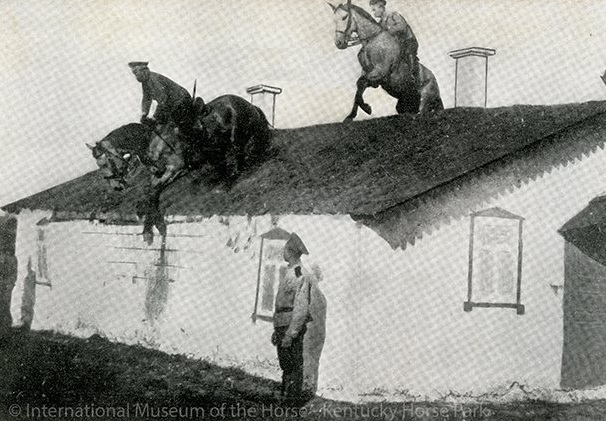
From “Riding Forward: Modern Horsemanship for Beginners” written in 1934 by Vladimir Littauer, Captain, 1st Hussars, Russian Imperial Cavalry. Photo from imh.org.

The earliest iteration of eventing as an Olympic sport had taken place just a few years earlier, at the 1912 Games. Count Clarence von Rosen, who managed the stables of the King of Sweden, established the sport’s initial format. For a brief period, eventing – then simply called ‘Military’, if you’ve ever wondered why Military Boekelo is thus named – as a recreational activity and its ancestral heritage existed in tandem. Somehow, somewhere, someone must have been practicing cross country for competition as another horse and rider used that same skill set to try to survive the countless horrors of the battlefield.

In either situation, partnership with the horse is paramount. So enjoy this visit to the granddaddy of our brilliant sport (and marvel, if you will, at the fact that the horses were apparently stabled up a fairly sizeable flight of stairs. Someone sack the architect).

Go eventing.


On the Road Again with Eventing 25 Emerging Athlete Hallie Coon

The Emerging Athlete Eventing 25 winter training session wrapped up earlier this month in Ocala, Florida, January 8-11. We are excited to introduce you to some of the riders making their debut on the E25 list, which can be viewed here. Today: Hallie Coon!

Hallie Coon and Celien. Photo by Jenni Autry.

When you think of eventing microcosms, Maine is about as far from the opulence and opportunity of the Ocala scene as it gets. But for industrious Hallie Coon, location has always been a mere detail in her quest to build a career as one of the country’s most promising talents.

“I had two older sisters who evented, and my grandmother and aunts evented too, so it definitely ran in the family,” she explains. “We got to ride at Ledyard Farm, which was so influential in the sport in Area I, so it was a great taste of what international eventing was really like. You don’t get to experience that a lot up north.”

The family influence offered valuable connections and education as Hallie became more entrenched in the sport. Her older sister worked for Mark Donovan, now showjumping course designer at the Carolina International, and when she was 16 Hallie got her first taste of wintering in Ocala.

“I trained with someone different every year, and took different things from everyone. I started to spend my summers wherever I could base myself and my horses — Maine, New Hampshire, Massachusetts — and then I’d come down to Ocala and use all of those resources and further my career.”

Now, she splits her year between Hollis, New Hampshire, and Ocala, basing herself with Shannon Baker and training with E25 coach Leslie Law and the O’Connors, who are next door neighbours to Shannon’s Ocala base.

“They’ve been really helpful, and I’m looking forward to learning more from them this year,” says Hallie. The 2018 season is set to be her biggest one yet: With her top horse Celien, she has her sights set on accomplishing some huge career goals.

Hallie Coon and Celien. Photo by Leslie Threlkeld.

“I’ve applied for the Karen Stives Emerging Athlete Grant, which, if I’m successful, I’ll use to go to Bramham in the United Kingdom,” she says. “It would be my first time abroad and to do the two competitions would be a great experience.”

Bramham’s Under-25 CCI3* is one of the most prestigious competitions at the level, and a good result at the Yorkshire venue can be the catalyst for a very successful senior career. Hallie hopes to pair the trip with an entry to the CICO3* at Norfolk’s Houghton Hall — the UK’s Nations Cup competition.

Despite a stop-and-start 2017, Celien relishes a challenge and Hallie has high hopes for her this year.

“I’ve had her since she was a coming-six-year-old,” she says. “I bought her sight unseen off of a very blurry video from Belgium, and I never even saw her trot before she hit the ground here. It was all just a gut feeling that I had about her.”

The gut feeling paid off as Celien climbed the levels at an astronomical pace, completing her first Advanced just a year and a half after her Novice debut.

Hallie Coon and Celien. Photo by Kasey Mueller.

“Nothing could hold her back and she just wanted to be challenged. I’d never normally do that with a horse, but nothing was hard for her — I kept moving her up and she kept answering the questions. 2017 wasn’t our best year to date, I’d say — our season started a bit late as Celien had a minor injury in the spring. I got her back for the three-star at Bromont and she ended up choking on her hay on the morning of cross country. She was cleared to go but in hindsight, I shouldn’t have run her. I ended up retiring her early on course as she just wasn’t quite herself.”

An easy spin in the Intermediate at Jersey Fresh saw her back on form, finishing second on her dressage score, and another strong performance at Great Meadow — “a fantastic venue, which we both love” — put the pair on track to finish their season on a high, until a minor tweak while galloping downhill at Millbrook knocked them out of contention for Fair Hill. But Hallie isn’t one to feel sorry for herself — instead, she has focused on her plans for 2018, and on her talented string of up-and-comers, too.

Both Lansdowne, owned by Shannon, and Hallie’s own Azrael finished the season with strong two-star results — Lansdowne placed third in the CCI2* at Virginia and Azrael finished well at the Ocala CCI2* in November. The two OTTBs — half-brothers, out of the same dam — will contest their first three-star at Jersey Fresh in the spring.

Hallie Coon and Lansdownne. Photo by Leslie Threlkeld.

No matter which way her season goes with Celien, Hallie is optimistic and excited about the opportunities that the year ahead will bring. She is also planning to do an embryo transfer out of Celien this year and is currently researching stallions to make the the right match.

“I think it’s going to be an absolutely fantastic year, between the E25 and all my young horses — I don’t get much more excited about anything than that!”

Go eventing, and go Hallie!

The Nine Circles of Eventing Hell

Whether you studied Dante’s Inferno, or you just have vaguely concerning taste in literature, I’m sure you’ll agree that, where real-life application is concerned, there are some parts that are just … problematic. And I don’t mean problematic as in offensive, I mean problematic as in unrealistic.

I mean, come on now. If everyone who was a little bit lusty in their lifetime was condemned to the second circle of Hell, we’d basically be able to put on a below-the-ground Badminton. Which is an incredible concept. Also, the titular character is described as being in the very middle of his life. He’s 35. Can we just chill out a minute, Dante? Put that crisis back where it came from. Get a glass of wine. Now is not your time.

“You’ve got so much left to live for, man” — frightening but motivational devil horse.

Also, the whole reason the poor chap has to go on a walking tour of hell (Trip Advisor rating: 1.5 stars; the café wasn’t great) is because the girl he fancies, the actual Symbol of Divine sodding Love, has decided that’s the quickest route to go and chill with her in heaven. Her name? Beatrice. Beatrice. The least likely name for a shining beacon of hotness and hope ever.

Pictured: not a Beatrice.

Having said all that, the notion of eternal hellfire — with its varying degrees of fieriness — is a useful one. Like a little library of badness, organised by something less baffling than the Dewey Decimal System. You see, as you venture further downward, accompanied by your spirit guide (who was the ancient Roman poet Virgil in the original, but would probably be a cloaked, celestial version of Mark Todd in the remix) you travel through nine concentric circles, where like-minded naughties are grouped together in everlasting penitence for their earthly sins. Oh, and they get naughtier the lower you go. You know what we desperately need? An eventing version, of course.

You won’t find tickets to our final destination on Kayak, but keep your arms and legs inside the vehicle, because the Ghost of Mark Todd Past is going to take you on a strange journey … straight to the depths of Eventing Hell.

“Abandon all hope, ye who enter here.” – Dante Alighieri, on Hell and probably also start boxes.

The First Circle

When you enter Eventing Hell, you’d be forgiven for thinking that you might have taken a wrong turn. That’s because the First Circle is, actually, well, quite nice — fringed with verdant greenery, lined with well-maintained post-and-rail fencing, and perpetually mild.

You see, this isn’t proper Hell. Not yet. This is something in between — a state of limbo, or purgatory, if you prefer. No one here has done anything really bad, but …

Here dwell the well-meaning aunts, mothers, fifth-grade teachers fed up of trying to mark homework through an incomprehensible scramble of pony doodles — anyone who uttered the words “it’s just a phase” when you tried to explain how utterly crucial horses were to your wellbeing. We won’t dwell here for long, I’m afraid, but before we go, flip the switch that turns the television screens on. They’ll be forced to watch your latest dressage test, on repeat, with full commentary and rumination by yourself.

Now quick — shut the door before they ask you how your love life is going  and let us descend inward, to …

The Second Circle

In the Second Circle of Eventing Hell live those whose eyes become little cartoon hearts when they see an advert for a talented — and suitably expensive — competition horse. These people have likely only competed at a low level, if at all, but the established CCI2* horse (with scope to go all the way, professional or experienced amateurs only, homes will be vetted, POA) tugs at their exposed heartstrings.

“The dapples! Oh, lord, the dapples!” they howl, keening voices carried by the wind.

“Would you consider a loan?”

“How about a payment plan?”

“I’d like a trial peeeeeerioooooooooood …”

The wind, of course, is a constant presence in the Second Circle of Eventing Hell. That’s because the Facebook sales advert commenters, the meandering phone-call makers, and those that show up to try horses they have no intention of buying are doomed to spend eternity riding the horses they covet — those bred-to-the-hilt four-year-olds, the Advanced machines, that one horse that Boyd Martin sold mid-season, saying, “cor, it’s a tricky bugger, but it can’t half jump – if you can stay on it!” A lovely time is had by all — all the horses, anyway, who, freshly-clipped and buzzing on a heady combination of racehorse mix and iron tonic, feel that ferocious wind under their tails and merrily cartwheel around Hell, for eternity and beyond.

Happy riding!

The Third Circle

Traditionally the eternal carpark for gluttons, in Eventing Hell, the Third Circle is home to hogs of a slightly less gourmet nature. You know the ones: they cut you up in the warm-up ring, three strides before the oxer, or they send their lackeys in to guard their fence of choice, building it up to unnecessary heights and glaring at any other hapless rider who dares approach. They’re the people who stop on the fence to chat to their trainer, the usual suspect for any unattended piles left in the wash bay, and the boarders who will happily swan off, leaving their horse on the crossties and IN EVERYONE’S WAY for hours.

Faster than a speeding sinner.

Rather than three-headed Cerberus, the Third Circle of Eventing Hell is overseen by thousands of gleeful, yappy dogs, whose owners let them off the lead at an event and never saw them again. Here, they serve their life’s purpose for all eternity: chasing at the heels of the Gluttons as they navigate an endless obstacle course fashioned out of all the objects they left out for someone else to put away.

The Fourth Circle

Traditionalists, put on your shades. Things are about to get #FUNKAY. As we enter the Fourth Circle of Hell, we meet those who were overcome by a bad case of the better-thans. These green-eyed folk measured their worth — and the worth of those around them — by the contents of their tack box. Anything less than the finest French saddlery? Eugh. Hardly. Their symptoms were easily spotted in life — ever heard of matchy-matchy? Ever suspected that someone spent more time coordinating their outfit than actually paying attention to their horse? Sod Sartre’s insistence that hell is other people — in the Fourth Circle of Eventing Hell, it’s 10,000 tangled polo wraps … and none of them match.

The devil doesn’t wear Prada, the devil wears custom Parlantis and matches her underwear to her horse’s fly veil.

The Fifth Circle

Ugh, let’s not hang about here for too long, the air stinks of horse you-know-what. That’s because there’s literally a river of it. Yes, a river — it’s the variety that you scrape off the wall, rather than shovelling from the floor.

But don’t feel too sorry for the poor souls who fester in the Fifth Circle of Eventing Hell, up to their necks in smelly sadness. You see, the river is the physical manifestation of all the crap-talking this lot did in life. This, dear visitor, is where the breed snobs live.

They would never knowingly sit on a horse without a Fernhill or Cooley prefix, and god forbid you meet them in the warm-up on some sort of stock breed. They’re the first to proclaim that the modern incarnation of eventing has left the Thoroughbred behind — and good riddance, according to them — so for their afterlife, they’ve been entered into the RRP Thoroughbred Makeover. For all eternity.

“Can’t wait to never, ever give you the right lead, sucker.”

Now get in the boat, because we’re sailing this swamp, straight into …

The Sixth Circle

Don’t mind the buzzing, there’s some faulty wiring here and no, nobody is coming to fix it. You see, this is where the internet criminals linger, and down this low, we’re still on dial-up.

Here, the armchair trainers linger, alongside the horse owners who consult strangers on the internet rather than an actual veterinarian when their horse has forcibly removed a leg, and, of course trolls. Trolls on trolls on trolls.

The armchair trainers are forced to put their advice into practice. The vet-phobic owners are treated for a neverending series of moderate ailments by doctors whose training comes entirely from WebMD. And the trolls? They get to spend the rest of eternity trying to talk Andrew Nicholson into creating a Twitter account.

They also have to read him the entire #nicholsonontwitter back catalogue.

The Seventh Circle

Two very distinct — and completely contrary — groups of people reside in the hellfire of the Seventh Circle of Eventing Hell. To the left: those who use excessive force, harsh gadgets, and a blatant lack of compassion to control their horses. To the right: those who throw abuse accusations at anyone who uses a flash noseband, a small pair of spurs, or, dare I even say it … a bit.

“And then she told me my horse was lame because shoeing forced its feet into an unnatural shape!”

Never the twain shall meet? Hardly. Opposites attract in a new and novel way in the Seventh Circle as, condemned to eternal silence, the resident sinners are forced to joust with one another. Tackless.

Pull up a chair and grab a drink; the Ghost of Mark Todd Past is an excellent commentator.

The Eighth Circle

After a brief respite, it’s time to journey yet further into the depths of Eventing Hell — but fear not, weary traveller, for we are nearly at the end of our long and harrowing journey.

This vast amphitheatre is heaving with the liars, cheats, and fraudsters of the eventing world. Unscrupulous horse dealers prowl amongst working students who lied about their experience level or took shortcuts in their work, and the boarders who shamelessly and obviously embellish their tales of success.

Like Sisyphus and his boulder, the denizens of the Eighth Circle of Eventing Hell must throw up a mountainous muck heap, from which the top always crumbles back down and at which the pitchforks are always missing a tine. But there is worse to come.

The Ninth Circle

In the very depths of hell lie the worst sinners of them all.

As you descend into the core of the devil’s domain, you hear it before you see it — a slow, rhythm, sinister grinding sound, like the quiet toil of machinery, or … or like many vast teeth, masticating slowly.

You feel many thousands of eyes turn to observe you and, despite the constant sizzle of hellfire, the sweat dripping down your neck grows cold. You are here, defenceless, amongst the very worst that Eventing Hell houses. Even the Ghost of Mark Todd Past has fallen silent in deference.

Photo: CC.

This is the final resting place for horses who throw shoes the night before a competition, those who are mysteriously three-legged for the one hour in which you had scheduled a lesson, and the corrupt souls who discover their inner bucking bronco upon stepping onto the centreline. As you look on, one slowly lifts a front leg. A shoe, dangling, catches the reflection of the flames. It teeters, is still for a moment, and then drops to the floor. The horse doesn’t break eye contact. You shudder, for this is a place of true evil.

Here, these most devious of horses repent for their lifetime of sins by … eating their way through an endless pile of haylage and looking, frankly, a bit smug about it. As it turns out, Satan is a soft touch. 

You’ve traversed the Nine Circles of Eventing Hell and lived to tell the tale — and preach the gospel of a life lived without sin. Go forth and spread the good word. And put your grooming kit away while you’re at it, you heathen.

Friday Video from World Equestrian Brands: The Hardest Thing About Riding Horses …

https://www.instagram.com/p/BebTuJvgXI0

… is the ground, natch. But just as there’s a million different ways to clear a fence — some more impressive than others — there’s a million different ways of hitting the deck, too. Sometimes, in the process of finding the ground with your face, you find a few skills you never even knew you had, too. This week, we’re ushering in the weekend with a selection of first-class falls – some remarkably acrobatic, some cringe-inducing, and mostly all just plain funny.*

*NB: no horses, ponies, or riders were hurt in the making of these videos. Okay, okay, perhaps there were a few dented egos. And maybe a couple of cameramen with aching sides. 

Ever dreamed of running away to join the circus? So has this intrepid soul, who has perfect her inter-species leapfrog routine. To complete the look? Just add tutus.

https://www.facebook.com/horsepeoplesMind/videos/1539019916134089/

Even at the best of times, handstands are hard. The bum-to-gravity ratio just never seems to stack up. No such problems for this kiddo, who not only gets beats the odds against momentum, but manages to look SO zen while doing it. Impressive. Props to her pony, too, who evidently has a second career as a cheerleading spotter.

Have you ever seen anything quite so meticulously planned as this horse’s scheme to shed his rider and head home early? As easily as placing the angel atop the Christmas tree, Barbie’s Dream Horse gets exactly what he wants, when he wants it. #BeMoreLikeBarbiesDreamHorse

Turns out there are plenty of horses out there with a point to prove. This happy chap decided it would be more fun to complete his showjumping round alone — but his rider didn’t give in easily. I’m not sure what’s more impressive; the fall, or the solo jumping.

Did you think we’d get through this without a resurgence of this, the best hatcam video of all time? Shamrock used to be a racehorse, and sometimes Shamrock likes to relive his glory days. There are some naughty words in this one (but let’s face it, we’ve all been there). WOAH, SHAMROOOOOCK!

Totally blown away by the runaway success of ‘Woah Shamrock’! 1.7 million hits and counting – thank you all so much for viewing and sharing the video in it’s infancy.

Posted by Woah Shamrock on Friday, March 24, 2017

Horses, eh — who’d have them?!

Friday Video from World Equestrian Brands: Behind the Scenes at IEF

Imo Mercer shows off Sam Griffiths’ team bronze medal from Rio 2016. Credit Griffiths Eventing Team

In the bleak midwinter, we look forward to the small glimmers of hope offered to us (at least here in the U.K., where we don’t have nice things like Aiken and Ocala). One of those gems is the International Eventing Forum, held each February at Hartpury College in Gloucestershire, at which professionals at the heart of the industry gather to discuss and demonstrate training methods, philosophies, and viewpoints to the sport. As the 2018 Forum looms just ahead of us, your Friday video this week is an educational look into life behind the scenes as an eventing #supergroom.

Imo Mercer, Alex Van Tuyll, and Zanie King have travelled around the world with their charges and amassed an incredible amount of knowledge. Oh, and there’s a bonus Burto. And Badminton course designer Eric Winter! The Forum is a gift that just keeps. On. Giving.

Friday Video from World Equestrian Brands: The Ups, Downs and Soggy Breeches of the ERM

Work hard, play hard! Photo courtesy of Event Rider Masters.

High-stakes cross-country, the chance to make judgment calls about your favourite rider’s taste in music, and a jolly good soaking with a few bottles of Pol Roger: it’s what eventing’s all about, really, right?

The team behind the Event Rider Masters series is gearing up for its third year of cutting-edge technology and bonkers, brilliant broadcasts. To whet your appetite, they’ve released this montage of some of the best thrills and spills (and a champagne-soaked Tom Carlile) from the 2017 season — somehow, they’ve managed to make eating dirt look quite cool, which fills me with hope for my own competition season. It’s amazing what a good soundtrack can do.

Thomas Carlile and Upsilon at the Barbury leg of the 2017 ERM. Photo courtesy of eventridermasters.tv/Ben Clarke.

If three and a half minutes isn’t quite enough to fill the coffers, clear your diary and click through to the ERM YouTube channel, where you can find all the original live broadcasts in their glory. Just don’t expect to get any work done for a very long time. You. Are. Welcome.


Friday Video from World Equestrian Brands: A Trip to Welly World

Boyd Martin and Trading Aces at the $15,000 Wellington Eventing Showcase. Photo by Jenni Autry.

Wellington is one of those places that doesn’t really require any further description in order for equestrians to be able to pinpoint it on a map. It’s like Cher, but with states instead of surnames, and speed classes instead of power ballads. Sometimes, when I’m doing fitness work in 15 inches of mud and sideways ice rain I ponder how different life could be if I just sacked it all in and went to Welly World to play in the sunshine. But then I remember that the last time I went near the hunter-jumper crowd, monogrammed lavender collars were still in fashion, and that’s just wrong on so many levels (mostly because it was 12 years ago and I still have no intention of getting with the times).

Jennie Brannigan at the Wellington Eventing Showcase. Photo by Jenni Autry.

But the brilliant thing is that the Big W offered us mad and muddy types a generous hand of friendship, which we let Boyd Martin shake for three years in a row. That hand of friendship was the Wellington Eventers Showcase, a fast, furious, and well-heeled ode to the sport, packaged up in a golf-buggy friendly version for the Vineyard Vines and Napa Valley Riesling crowd. And it was GREAT, not least because it involved jumping into a marquee full of people who had possibly never seen mud in real life before.

It wouldn’t be eventing in Wellington without a selfie! Photo courtesy of Laine Ashker.

Unfortunately, due to scheduling conflict with the Winter Equestrian Festival’s showjumping calendar, the Showcase won’t be running this year. We look forward to cheering on our hardy brethren in the sunshine next year, but, in the meantime, here’s an in-depth look back at 2017’s competition, courtesy of Elisa Wallace.

Go eventing, and go sunshine! (No, I don’t mean that, please come back, sunshine, I beg of you…!)

The Saves of Seventeen

There’s not much to eventing, really, is there? You just aim for the space between the flags, kick, and pray…right?

Eventing 101.

Erm, perhaps not so much. As we all know, there are plenty of variables involved, and sometimes, it’s all any of us can do to actually keep all four feet in the dressage arena, let alone tackle a formidable cross-country course.

Eventing 102.

But eventers are a tough bunch, and they don’t give up easily. When the going gets tough, the tough apply more leg – even if, occasionally, they have to display some impressive gymnastics to do so.

Without further ado, here are some of the most impressive saves from across the eventing nation and beyond in 2017. Which one made you hold your breath? Have we missed one of your favourite displays of eventing acrobatics, or did you perform a similar feat of your own this year? Share your pictures and videos with us in the comments!

Woodge “Hardcore Spider Monkey” Fulton plays hard-to-get with the ground

Woodge Fulton and Captain Jack. Photos by Kate Samuels.

Man, this girl is a tough cookie. After Captain Jack caught a leg on fence six at the Wellington Eventing Showcase back in February, it looked like game over for Woodge. But giving up isn’t in her nature, and somehow, defying all normal physics, she propelled herself back into the saddle and the pair went on to post a clear round. Just check out that enormous grin – classic Woodge! To see the full story – and video evidence! – click here. 

Cornelia Dorr practices some yoga in the water at Jersey Fresh

2017 has been a big year for mindfulness. ‘Hygge’ remains wildly popular but stilly wholly unpronounceable. Meditation has somehow become trendy. Countless apps are peddled to us on Facebook, heavily implying that 15 seconds of ‘doing nothing’ could fix our addled brains. To this I say, look, mate, do you want to know how many studs I could screw in in 15 seconds? That’s valuable time, and I don’t want to spend it staring at the underused portions of my brain.

Cornelia Dorr, on the other hand, decided to embrace 2017’s hottest trend, employing a novel form of horseback yoga while tackling the water in the CCI2* at Jersey Fresh with Sir Patico MH. Her moment of oneness with nature, her inner spirit, and very, very nearly the essential element of dirty fence water obviously served her well, as she went on to finish with two horses in the top ten after the cross country, and won with her other horse, Louis M. #whateverworks

Ludwig Svennerstal’s showjumping striptease

Ludwig Svennerstal almost loses a Bridle

Ludwig Svennerstal almost loses a bridle! What supurb horsemanship to keep his cool and recover. So, so close to a fall! Watch all the action as it happens LIVE -http://bit.ly/erml6sj

Posted by Event Rider Masters on Sunday, August 27, 2017

Okay, okay, that might be a bit misleading. Sorry, ladies. Still – this was one of the most memorable (and unprecedented!) saves of the year, and well worth revisiting. While contesting the second phase of the Event Rider Masters leg at Blair Castle in Scotland, Sweden’s finest export had a bit of a bobble with El Kazir SP. Somehow, he sits it out – only to lose an essential piece of tack in the process. Check out the video to see how he recovered and managed to complete his round. It is actual sorcery (and still makes me nearly cry laughing, no matter how many times I watch it!)

Maya Simmons-Studenmund demonstrates the importance of No-Stirrup November

Maya Simmons (stirrup-less!) and Archie Rocks. Photo by Leslie Threlkeld.

File this one under Things I Have Recurring Nightmares About. Maya Simmons-Studemund was enjoying a trip around the Advanced at Carolina International in March – her return to the level after the birth of her twins – when her OTTB Archie Rocks pecked on landing at the first water at 7AB. Maya managed to sit the uncomfortable landing, but the force of it pulled both of her stirrups off her saddle. They clung on for a while – even as the pair tackled the second part of the combination – but slipped out of the keepers just as Maya pulled up to reattach them. Was she deterred? Of course not – she went on to tackle most of the rest of the formidable course, before ultimately slipping off at 19ABC, the coffin. Skip to 5:04 in the above video to witness the absolute marvel of Maya jumping out of the water in perfect style. My leg has never looked that solid WITH stirrups.

Louise Harwood schedules a snooze at Pau

Louise Harwood and Mr Potts tackle the final water at Pau. Photo by Tilly Berendt

Photo by Tilly Berendt

Photo by Tilly Berendt

Photo by Tilly Berendt

Diminutive Louise Harwood has made a name for herself piloting some rather large homebreds around the world’s toughest events. The thing is, when you’re small, sometimes you have to just lie back and think of England, as it were. At the final water, Louise had one such moment, when Mr Potts took a huge leap in, propelling his rider to the back of the saddle. It’s cool though, she styled it out – but unfortunately, the pair would pick up a late 20 penalties on course a few fences later.

The Kieffertron channels her inner mermaid at Rolex

Lauren Kieffer and Vermiculus.

What do you do when your horse decides in mid-air that he’s actually a seahorse and legs are totally overrated? Well, if you’re Lauren Kieffer, you never ever stray from your seahorse’s centre of balance and you let him work it all out underneath you. That’s exactly what she did at Rolex (as it still was, then!) when Vermiculus had a bit of a disagreement with the ground at the Lake. After sticking the landing, the pair clocked up 20 penalties and, unfortunately, withdrew before the final horse inspection, but they still made their mark on a great competition with this spectacular save.

Will Furlong tests out gravity at Houghton Hall; finds it lacking

There’s a lot of pressure that comes with your first senior team call-up, especially when you’re just 22-years-old and riding a horse you’ve only had for a matter of months. But Team GB’s Will Furlong didn’t look for a minute like the pressure was getting to him, as he and Collien P2 sailed around the Nations Cup at Houghton Hall in May. Look how cool, calm, and collected he is in this series of photos by Laura Butcher, even as he takes this seriously creative (and possibly inadvisable) route over the open corners. Somehow, Mr Sticky Breeches stayed on, and went on to finish fourth. Not too shabby, Furlong. Not too shabby at all.

William Fox-Pitt shows off his best dance moves

MyLuckyDay

For Boxing Day 2017 we are republishing the top ten Harveywetdog Facebook videos of 2017. At number Two we go right back to my first day of the 2017 season at Tweseldown with William Fox-Pitt and a recalcitrant My Lucky Day.My Lucky Day and William Fox-Pitt take a few minutes to get started at Tweseldown in the Open Intermediate. I like the way the oblivious announcer is bigging William up as the horse is going sidewards out of the start box.

Posted by Harveywetdog on Tuesday, December 26, 2017

Sometimes, you don’t even need to go near a fence to show off a spectacular save. William Fox-Pitt had planned an educational outing for My Lucky Day in the Open Intermediate at Tweseldown earlier in the spring, but the horse had other ideas. Check out this incredible video, courtesy of Harveywetdog, in which My Lucky Day casually spins his way to the first fence with all the grace of a ballerina with ‘roid rage. The duo went on to complete a clear cross country round (with, erm, 58.4 time penalties). Absolute #lads.

Elle Choate experiments with a seriously forward seat

Young talent Elle Choate was cruising around the Junior Training showjumping with Paddrick at the Richland Park Horse Trials in August when everything went a bit pear-shaped. A cluck for encouragement did its job rather too well, and the ISH gelding surged forward on landing, bucked, and launched his head down. Somehow – and I’m still not quite sure how – Elle managed to get Paddrick’s head back up and get herself back in the plate, adding just 11 time penalties and one rail to finish 11th in the division. Barbara Martin caught the Kodak moment on camera, giving us all a good giggle (and a reason to practice stirrup-less jumping, stat).

For every spectacular save, however, there’s always a heaping helping of people who eat dirt for dinner. Sometimes they don’t even need to go near a horse to do so. Check out the action stage left as Zara Phillips tackles the water at Rolex. Nearly…nearly…nope, she’s in.

#FlashbackFriday Video from World Equestrian Brands: Storming Into 2018 Like…

Pictured: the case for not skipping that gym sesh this weekend.

Here we are, at the end of all things – or, at least, at the final Friday video of 2017. As the end of year looms, I like to spend some time reflection on the lessons learned throughout the previous 365 days – the things that went right, the things that went spectacularly wrong, what I can learn from and improve upon ready for a new year and a new start.

Sometimes, though, all that introspection gets a little bit boring (or a little bit frightening, frankly), and I find myself in need of a bit of a kick up the backside to get myself fired up to dive into 2018 with all guns blazing. In these times of need, I turn to one man: the O.G. of eventing, Sir Mark “This Wasn’t Hard Enough” Todd.

In honour of all the bad-assery I know you’re all going to exhibit in 2018, here’s my favourite flashback of them all: our hero, the lanky Kiwi knight (shining armour optional), taking on the baddest of Badders with one stirrup. Actually. Insane.

Catch you on the flip side, EN, with a glass of champagne in each fist and a party hat on your disappointed horse. May 2018 be the year you get the perfect stride to your own personal Vicarage Vee and always kick on to the last, no matter how many seemingly essential bits of tack are taken away from you along the way. You’ve got this, gang.

Friday Video from World Equestrian Brands: Christmas at Badminton

Itching for a snowy canter? Us, too.

Is there anything more magical than the Badminton Estate? From its seat in the heart of Gloucestershire, the Duke of Beaufort’s sprawling acreage and stately home spin a special kind of magic as we look ahead to the Mitsubishi Motors Badminton Horse Trials.

But in the off-season, too, this incredible place has a certain je ne sais quois. Take, for example, this week’s video: a seriously captivating compilation of drone shots of Badminton, sequestered under a pristine layer of snow. If you’ve been struggling to get that festive feeling this year, make yourself a boozy hot chocolate, curl up on the sofa, and just imagine waking up to this. Frosty-whiskered horses, a long hack through the snow, and cozy calm all around as the world dozes around you. Badminton will be back before we know it, alive with the thundering of hooves and the throngs of people, but, for now, this is as perfect as it gets.


Best of 2017 Video Countdown #10: Bada$$ Badminton

Each day between now and the New Year we’re counting down the most popular videos shared on EN in 2017. The #10 spot goes to “Bada$$ Badminton,” which garnered 3,563 views when it was posted on October 13, 2017. Enjoy, again! 

Fifty years ago, people were made of tough stuff. Like, actually cobbled together with steel panels and rusty nails and more than a dash of insanity sort of tough stuff. Case in point? This vintage Badminton video from 1968, which is part of the extensive British Pathé film archives. It’s a glorious time capsule of weighted saddlepads, frolicking royals, massive timber, and skull caps that actually look like they offer about as much protection as a beanie made of cheese. Also, no body protectors. Health and safety, schmealth and safety.

Almost makes this year’s Badminton course look jumpable, right?

…right?

Botnik Goes to Badminton

ChinchBot is about to school us all. Credit to DeviantArt user IzaPug.

Over the last couple of days, an incredibly clever AI system called Botnik has been garnering considerable media attention for its absolutely barmy addition to the Harry Potter oeuvre. After having all seven novels in the series inputted into its system, it wrote its own chapter of a new Harry Potter book, which it named Harry Potter and the Portrait of What Looked Like a Large Pile of Ash. Catchy.

The predictive keyboard is a few steps ahead of the sort of text-guessing you find on an iPhone, although it works in a similar way – by inputting chunks of text, the system can analyse how the author would ordinarily put a sentence together and attempt to replicate grammar, word choice, and subject matter. It can then be used to craft stories with lines that range from almost plausible to the completely and utterly bonkers. Case in point, from Botnik’s foray into the wizarding world:

“I’m Harry Potter,” Harry began yelling. “The dark arts better be worried, oh boy!”

You’d be forgiven for thinking that perhaps this absolute GEM of a tool is only available for its creators to play with. You’d also be wrong. As it transpires, you can create a Botnik to replicate almost any author – all you need is a bit of patience, a .txt file, and several hours that you’re willing to sacrifice to our future AI overlords.

Our AI overlords will have exceptionally clean changes.

So what did I, as a very, very serious journalist (and insatiable socialite, obviously) spend my Friday night doing?

I spent it creating ChinchBot, of course, who did some spectacular fortune-telling and wrote up this phenomenal report of cross country day at Badminton 2018. I…I just don’t really know how to prepare you for this. Hold onto your knickers, eventing fans.

The Best Phase: Your Dirty Great Showcase of Eventing at Badminton Horse Trials

The excitement of cross country machine (and actual unicorn) Upsilon hinted at a party for the world at his CCI4 * debut. He sits in the lead after the penultimate stage.

“He’s a horse,” said Julia Krajewski, in contention with Monkeying Around, who is also a horse.

The celebration was massive, and a fitting preview of practically everyone’s glory. Now, a rather shellshocked Tom Carlile attacks fans, but is generally a good boy.

“I think I have to ride tomorrow,” he said.

The rainy morning with redemption on the table was enough to inspire flashbacks of dressage at Luhmuhlen, where Alex Hua Tian fell off and Boyd Martin became Irish.

The riders were remarkably fit, with several of them socially acceptable in the collecting ring. Some of them were more unfortunate.

“I may not ride well, but I have a great salute,” winked Tim Price as he did his stretches. Scooby was witness. He rode Grafton Street. Usually motivated by the atmosphere, today they were like little disappointments, faulting at the first water and the last fence.

“That was really hard,” he said. “I want to get into a fight.”

The course caused multiple problems, especially fence 19abc – a double gremlin with a skinny brush in the arena. Izzy Taylor fell here and sold her bad horse to James Avery.

“Honestly, the horse is really delirious,” she said.

“It wasn’t going to be like motherhood, was it,” said Kitty King of the course, which was “hell, if I’m a bit abrupt.”

32 remained after cross country. In third place, Sam Griffiths initially had a fright from the Macaron Team, but he said: “Chris Burton was really happy, and I was basically not scared sh*tless any more.” He could ride around with Andrew Nicholson, who upsets the French community.

Hannah Sue Burnett and RF Demeter proved that their best moves were much better, thanks to a former pesky leadership.

“Regardless of her changes, today we didn’t understand wearing heels, and so we got the job done.”

The showjumping will commence tomorrow morning, with the rest of the best in the ring, because sometimes dreams slip ahead of them. Michael Jung holds the last burning faith in this phase: will it be a coffin for the leaders? EquiRatings is nonplussed, and says that they’ve obviously benefited from help and royal biceps, but there isn’t a very genuine fear of crowds in this competition. It’s all to play for.

Until the jumping, Go Eventing and GoFundMe!

Welcome to THE FUTURE. #buzzing

Friday Video from World Equestrian Brands: The Olympic Spirit of Gillian Rolton

Michael Jung accepts his ribbon from Gillian Rolton at Luhmühlen. Photo by Jenni Autry.

The year was 1996, and the setting, the Atlanta Olympics. Australia’s eventing team, comprised of Andrew Hoy, Wendy Schaeffer, Phillip Dutton, and Gillian Rolton, was within touching distance of a gold medal, but it was to take a herculean effort from them all to secure it.

Gill Rolton and Peppermint Grove, the ‘ugly big grey horse’ with whom she notched up so many successes – including team gold at the 1992 Barcelona Olympics – weren’t to have a fairytale trip around the cross country. ‘Fred’ slipped and fell, injuring Gill’s arm and forcing her to ride one-handed. Despite this, she remounted and continued on. She fell at the next obstacle, the water jump, but, knowing her team needed her to complete, she once again climbed back on and completed the remaining three kilometres – and fifteen fences – to finish. It was later discovered that Gill had broken several ribs and her collarbone – but the team would go on to win.

Gill’s tenacity and determination made her an idol and an inspiration to so many riders, both in her native Australia and beyond. She served as Event Director at Adelaide for 10 years, and has worn almost every hat there is to wear in the sport, from competitor, to selector, to coach, official, and ground jury member.

The courage she showed in her riding, and the gumption she exhibited throughout her career kept her fighting through an endometrial cancer diagnosis two years ago. Not to be cowed, she continued her work, even when bed-bound, to a volley of support from her global network of admirers, supporters, and friends. She died, aged 61, on cross country day of this year’s Adelaide CCI4*.

To see her indomitable spirit for yourself, check out this #FlashbackFriday video, shared by the Olympic Facebook page. This weekend, channel Gill: swallow your fear, give back to the sport, and enjoy the ride. She certainly did, throughout her remarkable life.

Click to play the video on Facebook

If you have trouble watching, click here to play the video directly on Facebook.

Things Eventers Argue About Online: Winter Edition

The internet: a veritable smorgasbord of wine-influenced purchases, blurry photos of nearly-naked eventers, and unsolicited advice and opinions. You know what they say about opinions, right? They’re like, um … feral barn cats. Everyone’s got one, they spawn bloodthirsty offspring on a worryingly regular basis and no, nobody’s going to pay a fiver for one of them. Where was this analogy going? Who knows.

All up in the forums like…

With the empty expanse of the off-season yawning around us, eventers have to find creative ways to keep busy in the winter months. For some, that means cross-training their horses. For others, it’s Netflix-binging season. For a worrying majority, it’s the perfect time to get online and start telling strangers that they’re wrong.

Wrong about what, you ask? Well, for starters…

Clipping


I wouldn’t clip any of mine, writes Barbara, it completely stops them from thermoregulating and rugs don’t do the job properly. Cruel really, just leave them alone.

As a result, Cedric, her ¾ Irish Draught, has grown a coat long enough to lose a small child in. If he was able to trot more than three strides without keeling over from heatstroke, he’d make an incredibly effective getaway vehicle in a diamond heist. Fortunately, his tufts make fantastic grab-handles when three tonnes of snow slides off the roof of the indoor. Who needs a neck strap? Not Babs.

Your horses aren’t wild, just clip the poor things if you’re going to ride them!!!! Bet you don’t believe in shoes either. I’m on clip #6. Itchy!

Annie’s horse is clipped every three weeks on the dot, starting on the first of September, and she doesn’t take any prisoners. Poor Angus has to bear the shame of being parked in front of his friends’ stables and getting liberally heckled while Annie wrestles his tail out of the way to get to some errant cheek hairs. She’s even patch-tested some Veet, but after dodging a swift kick to the head, decided that her husband’s Gillette was a better option for those close shaves. Every time Angus dozes off, the mocking faces of the other horses swim into his vision. “Oi, bald arse,” they snicker, “how’s the breeze back there?” Angus hasn’t slept in weeks.

Rugging


It’s inevitable: the temperature drops by a couple degrees and the Facebook groups and forums explode in a rugging frenzy.

Sheila from Surrey has an unfortunate eye-twitch that kicks in whenever a lone snowflake appears, and she’s taking no chances with Princess Van Der Hoefslag’s comfort.

Brr! Going to be a cold one, she types from the corner office of her recruitment firm in the City. Princess is snug as a bug in a you-know-what with three rugs AND a duvet today. Necks up, obvs!

What Sheila doesn’t realise is that the long-suffering stable manager has painted a bullseye on Princess’ side and is hiring her out for target practice for the local shooting club. She doesn’t even stop grazing while they’re at it, and the stable manager has more than doubled her Christmas funds in the process.

Meanwhile, across the pond, Marnie in Maine has a conundrum. She’s fully clipped her OTTB, Milo, but on closer inspection – and in daylight – she’s realised that she’s actually turned him into a sad, corduroy zebra. She’s managed to score a spot in a clinic with William Fox-Pitt in two days, and she knows that once he’s journeyed to the tundra, he’ll never return again, so something has to be done.

Keeping mine naked – they’re designed to cope with these changes in temperature better than we are, she replies, feeling a bit guilty as she glances out her window at the stripy, shivering thing sulking outside. She closes her blinds and prays for a good 24-hour regrowth.

Turnout

In the UK, we have enough mud to drown a hippo in. In the US — or at least, its wilder and woolier regions, you have to contend with an actual Antarctic expedition to get your horses to and from the field. Still, we all know the benefits of regular turnout, and we committed to this lifestyle, despite our mothers trying to push us towards more sensible hobbies, like hamster breeding or base-jumping.

Or whatever this is.

Gina limits turnout to an hour a day in the sand school, because she fears her horse will develop a nasty, untreatable case of mud fever if left to wallow in his field. Georgie, on the other hand, staunchly refuses to give her horses less than eight hours of turnout a day, despite 16 straight days of ice storms and almost hurricane-level winds.

Their discussion on this matter has become a six-hour long slagging match, and they’ve both been banned from the forum indefinitely for overuse of some VERY bad words.

Time off

Tina has ridden in three 2’6″ clear round jumping classes, one starter horse trials, and two dressage competitions, where she finished 3rd (out of three). She recently picked up a copy of Mary Thomson’s Eventing Year and is convinced that by following Mary’s routines exactly, she’ll be able to replicate King William’s successful 1992 season with her own Welsh Cob cross, Minty. As such, she chucked him straight in the field at the beginning of November and hasn’t actually seen him since.

Giving mine a proper winter holiday to recover from the season and digest what he’s learned, she writes. It’s really the only way to manage an eventer — I’ll bring him in in January and start his walk work.

If she can find him, that is…

Fliss, on the other hand, has never knowingly given her horse a day off in his life. She finished the season at a three-day and then sent her horse straight to Bootcamp With Bartle, reasoning that nobody ever improved by sitting at home eating Hobnobs. She’s squandered her family’s Christmas money on a spontaneous trip to Germany so that she and Flash can be shouted at in another language, for a bit of novelty value. Her children, she tells herself, are perfectly happy with a pine tree air freshener instead of an actual Christmas tree.

She feels very smug as she stops at a service station on the Autobahn at 3 a.m. to reply, No rest for the wicked here! Off to train with the very best and I think our results will show it next season. If you don’t hear from me again, I’ve moved to Ingrid’s yard!

Shoeing

“Tungsten carbide, you say? I’LL SHOW YOU TUNGSTEN CARBIDE!”

Kitty grew up in Southern California and has recently moved with her new husband to upstate New York. At first, the prospect of a white Christmas was a real treat, but now, faced with the real thing, both she and her New Zealand Thoroughbred, Fritz, are thinking long and hard about divorce.

Back home, the worst she was faced with was a nasty case of quarter cracks. Now, everyone around her is giving her different, baffling advice on how to deal with snow and ice.

Borium is the only way forward, says one internet expert.

Mounds or nails though? Two different kettles of fish, responds another.

Don’t be ridiculous — think of the tendon strain. Shoeing can stay the same year round, argues a third.

If she’s going to work the horse on the roads, she definitely needs ice studs, someone counters.

JUST GO BAREFOOT!!! chime in three people.

What about snow pads? Can’t be without them! suggests a well-meaning contributor.

Have you ever heard of Vaseline?! someone snaps.

Can’t believe you all ride in winter. When there’s actual ICE on the actual ROADS. SO selfish! This is what’s wrong with modern horse owners. Trying to eke every last drop out of your animals. In the old days, we used to bring our horses into the house and get them to do sit-ups for fitness. Come spring, we had NO ROTATIONAL FALLS!!!1!

Kitty closes her laptop, takes a deep breath, and promptly opens it again.

Horse for sale, she writes, due to owner giving up and going into hamster breeding.

The internet is a great thing … just be nice to one another online, okay?

Friday Video from World Equestrian Brands: Every Day’s a School Day

You’ll never graduate from the University of Eventing … but you can get past your Freshman year with a bit of dedication. #inspirational

Everyone with any sense knows there’s only one good thing about winter, and that’s layers. Why? Because layers allow you to eat, constantly and unashamedly, and then blame your sudden, worrying expansion on the amount of clothing you’re wearing. No one’s any the wiser, and life is glorious.

Until the new season looms and your wobbly bits jeer at you from the mirror. “Get those white breeches on, I dare you,” they seem to say.

“I would actually rather give up riding,” you think.

So this year, I’m trying something different. I’m putting all (er, some) of my mince-pie eating energy into finding as many new exercises, grids and schooling tips as I can to incorporate into my winter riding, so that rather than plodding along in the cold, my horse and I can actually attempt to improve during hibernation season.

During the season, one of my favourite resources for free training inspiration is the collecting ring at events, but at this time of year, I start digging through that endless treasure trove of visual media: YouTube. There’s an absolute wealth of schooling advice on there, and I love finding a new jumping exercise and giving it a jolly good bash. My favourites? Anything that helps me to improve my cross country riding when I can’t get out on course properly. Here are a couple of the most useful ones I’ve found — give them a go this weekend and make the most of the off-season!

(Bonus points if you can spot a certain EN editor’s horse in one of these videos!)

Friday Thrills and Spills from World Equestrian Brands: The History of the Water Complex

There are many ways to tackle a water complex. Louise Harwood and Mr Potts demonstrate one of the more unusual choices. Photo by Tilly Berendt.

The humble water jump: omnipresent on cross country courses around the world, it lies in wait, ready to scare the living daylights out of those who tackle it.

https://www.instagram.com/p/BZTmJf5DExY/?tagged=waterjumpfail

There are two distinct types of Water Jump Fear. Type one is the classic “my horse is absolutely not going to go in this and if there’s a drop into it then I’m going to be the solo spoon in the cereal bowl” fear. Type two is a slightly rarer, but no less valid fear, held by those lucky owners of one of a select group of horses known as ‘waterbabies’. The puddle-jumping types have dolphin somewhere within five generations on their pedigree, and for their riders, the niggling terror is that the bloody thing won’t LEAVE the water jump. Worst-case scenario? The gleeful stop, drop, and roll. Why do we do this sport, again?

Silly question. We do it because of the madness, not in spite of it. Those who paved the way for us to enjoy it in its modern iterations did it for precisely the same reason, and often with many more bumps, bruises, and great pub anecdotes to show for it.

Your Friday video this week looks at the evolution of the water complex, from its horse-swallowing beginnings to today’s much more sympathetic designing. Fortunately, our collective knowledge and expertise has grown throughout the decades to create a much more rewarding experience for both horse and rider, as these seriously tolerant waterbabies demonstrate. No points to the rider who decides to just let his horse be the feral swamp crocodile he obviously aspires to be.

#hairymermaidsforthewin


Friday Video from World Equestrian Brands: In Celebration of Big Phil

Phillip Dutton and Z. Photo by Jenni Autry.

Last week’s Ocala Jockey Club International was special for a whole variety of reasons: it was a showcase of girlpower at its finest, it offered generous prize money – always an enormous boost in a sport too often plagued by poor winnings, and hey, it was sunny! (Look, I’m British, every conversation comes back to the weather eventually. Fight me.)

But there was one thing that was extra-special about Ocala: it saw the return of Phillip Dutton. Now, I lived and evented in the States for long enough to know that if there are thirty horses in any given division at any given event, P. Dutty will be riding approximately 28 of them, so his absence is felt keenly when he’s not around – which isn’t often, because I’m not sure the man knows what a holiday is and, for the most part, he’s pretty indestructible.

True to form, he well and truly Dutton-ed Ocala, entering what appeared to be every single horse in his barn, and doing rather well on them, too. So to that, let’s raise a glass: to the continuing domination of Phillip Dutton. What. A. Legend.

Dutton verb To claim dominance over something through sheer force of will and hard work. Alternately, to enter a competition so many times that, statistically, you’re destined to do quite well. (If said statistics also take into account superhuman talent.)

In honour of the man of the hour, here’s a little throwback to the lead-up to Rio, featuring some wise words and behind-the-scenes glimpses into what, exactly, makes a champion.


Freelance or Bust: War and Peace (And Also Taxes)

“Am I going to have to pay ludicrous taxes on my competition winnings?” — Gemma Tattersall, probably. Life advice: Just drink the champagne and pretend it’s not happening.

“In this world nothing can be said to be certain, except death and taxes.”

He was a cheery chap, Benjamin Franklin, and while I would argue that there are other certainties in life — your horse will always manage to painstakingly remove a shoe the night before a major competition, for example, and you will only ever fall off at a competition at EXACTLY the moment Karen O’Connor turns to watch — he’s not wrong that taxes are an inescapable misery. Inescapable misery is one of those unfortunate side effects of adulthood, so rather than feeling sorry for ourselves, I recommend slaying this beast, with the help of frivolous stationery purchases and more colour-coding than you can shake a custom jockey whip at. I’m even going to show you how to expense that custom jockey whip, you lucky duck, you.*

*But only if you work in the right field. Sorry, media types, I’ve been trying to figure out how to expense my new tall boots for weeks, and I still haven’t managed it. We still get stationery, though. #consolationprizeoftheday

One of the biggest hurdles that puts aspiring freelancers off making the leap into self-employment is the prospect of navigating taxes. A cursory Googling session will likely make you feel even more confused and overwhelmed, and the idea of forking out for an accountant is pretty repellant when you’re trying to be money-savvy. Look, I’m not going to lie to you and say there’s a simple trick for making the whole thing sort itself out, but I will tell you this: It doesn’t have to be an enormous undertaking, and it doesn’t have to be a minefield. If you know how the system works from the get-go, and you get into the habit of keeping, filing, and reviewing your own financial records, you can make the whole thing miles easier.

You might question the sudden and contextless appearance of this fruit bat and his banana. Don’t question it. You’ll need sudden and contextless fruit bats to get through this.

An important note: the following advice pertains to individuals who are going freelance — that is, setting up a sole proprietorship. If you’re planning to set up your own business as a Limited Liability Company (LLC), you should speak to a business accountant, who can help you navigate the process of both laying the groundwork and maintaining correct business practice. 

Repeat after me: Accounting. Is. Fun.

Calculating your taxes works slightly differently depending on whether you’re in the UK or the US, so I’ll go through each situation with you. First, though: You’re going shopping for the universally necessary bits of kit. And, much as you’d never go to the tack shop and JUST buy sheath cleaner when you could throw a bag of horse treats, a new leather headcollar, and a book of gymnastic exercises in your basket to sweeten the deal, you’re going to make this an enjoyable process for yourself.

Death and Taxes: The Brief but Necessary Shopping List


Because nothing says ‘I am an adult’ like poo emojis and unicorns. Get it here.

  • A three-ring binder with dividers, or a couple of individual binders. These will be dedicated to housing your tax-deductible expenses and your proof of income, which is going to be in chronological order, because we’re adults now, and that’s how adults file things. Optional: a pack of plastic sleeves in which to file these important bits of paper; usually helpful if you think you may be at risk of crying on them.

Included in the purchase price: the urge to highlight all information, no matter how useless. Buy these bad boys here.

  • A pack of highlighters. Go on, splurge on the pastel ones, it’s fine.

Harness the power of Excel for everything (except trying to pin Nelly down for a date).

  • A copy of Microsoft Office. Excel is about to become your new best friend. (It does SO MANY TRICKS and I promise, you can fool yourself into thinking it’s fun.)

“If I can ride around a four-star with a broken leg, you can hit a deadline for once in your life, you complete and utter disappointment.” Motivational Michi might not treat me right, but he certainly gets the job done.

  • Literally whatever useless trinkets you find in the shop that offer you any fleeting happiness. There’s no proof that my collection of scented candles that smell vaguely like attractive men help my productivity levels in any way, but there’s also no proof that they don’t, so my attitude to preparing my desk for accounting day is a very #treatyoself one. May I recommend a special work mug? Or the vaguely terrifying spectre of Michael Jung?

Keeping track of tax deductions 

When you’re self-employed, you don’t actually pay tax on the entirety of your income: instead, you pay tax on your profits. This means that you have to deduct your business expenses from the amount you’ve earned in order to work out what you owe. You’re going to do that by keeping proof — ie., receipts or invoices — of all of these expenses, filling them chronologically in your Expenses binder, and highlighting on each the date (in one colour, consistent throughout) and the amount (in another colour, again, keeping it consistent.) Make sure the amount you highlight is the amount including sales tax or VAT.

Breakfast in bed: not tax-deductible. Sorry.

The list of expenses you can claim as deductions is expansive, and includes the following:

  • Utility bills and office rental costs. If you rent a dedicated office space or desk-share, this is easy: just keep track of your monthly rent and any utility bills you pay. If, however, you work from home, it becomes a bit more of a calculator job. You’ll have to work out what percentage of your rent and bills should be dedicated to your working hours. For example, if you have a house with four rooms — kitchen, bathroom, bedroom, and living area — and you work at a desk set up in the living area, you’ll need to calculate how much of your outgoings go towards sustaining that working area. Let’s say that your rent and utility bills come to $400 a month, for the sake of easy math and maintaining unrealistic fantasies about adulthood. If your living area/office space takes up about a quarter of the square-footage of your house, you can pretty safely assume that it’s worth a quarter of your monthly outgoings or, in this case, $100. Now, because your desk is set up in a living area, you probably don’t use that room solely for working. Say you spend 50% of your time in this room working, and 50% of your time hanging out, watching TV, or entertaining friends — your deductible outgoings will be $50. Easy enough, right? Well, okay, maybe not — in the US, your home office has to be a separate room, and not one that’s used for personal activities. At a push, you can partition off the ‘office’ section of the room, which is usually sufficient. If you’re really stumped, keep a log of the time spent at your desk in the first month to work out how much time — and thus, rent and electricity — you’re devoting to desk-bound activities.
  • Travel expenses. Whether you have to hop on a train for a meeting in the city, book a hotel through Badminton, or if you just use your car to get from job to job, your business-related travel costs are all deductible expenses. Keep track of fuel and ticket receipts, and keep a log of any repairs you make on your car, too — if its primary use is as a work vehicle, this is totally above board. Or, in the UK, you can opt to use simplified expenses, in which you log your business mileage and claim a flat rate per mile, which, in theory, incorporates all your associated vehicle costs. This is 45p per mile for the first 10,000 miles and 25p per mile thereafter. While you’re at it? Ring your car insurance provider and make sure you’re insured for business use, not just the standard social and commuting use. Speaking of which…
  • Insurance payments can often be claimed as business expenses. Health insurance — particularly in the US, where it’s a necessary expense — and any professional liability insurance can all be added into your expenses. Likewise, your memberships with any governing bodies — for example, the British Grooms Association or USEA — that are essential to performing your job and effectively advertising can all be expensed.
  • Courses. If you sign up for a course that supplements your work — for example, a BHS training course if you’re a riding instructor, or a photography class if you make your money behind a camera, these costs can be deducted. No such luck if you’re taking a night class in underwater basket-weaving, though, sorry.
  • Advertising costs, including websites. It’s a good idea to set yourself up with an online presence — more on this next time — and an absolute necessity to get yourself set up with some business cards. You may opt to purchase banner advertising on a website or take out a space in a horse magazine, too. Keep track of all these costs, as they’re all deductible.
  • Incidentals. These might be the little things — printer ink cartridges, a pair of winter work gloves — or they might be bigger investments, like high-end cameras or even a trailer or horse box, if equine transportation falls within the remit of your services. Basically, any time you make a purchase, ask yourself: Will I use this primarily for work? If so, then log that bad boy.

Logging your earnings

By now, you’re handy with a highlighter and a filing system, which is great, because you’re going to do much the same with your payment receipts. You should have an invoice template that you tweak for each client or job, and every time you send an invoice, print a copy for yourself and put it in the folder. Then, when the client pays, write this on the invoice and log the date of payment, too. Each month, print out a copy of your bank statement and highlight these incoming payments, making notes as needed of which payment is which.

Don’t be tempted to try to minimise your earnings or seek out loopholes, like not logging payments made in cash — it’s easy to get caught out and the hassle and penalty payments that come with it just aren’t worth it.

Make a date with your bad self (and those binders)

I’d love to tell you that this step should be done once a week, with a glass of wine and all the accompanying zen of a real-life grown-up who has perfected the art of adulting, but a) ain’t nobody got time for that and b) you should never trust anyone who has any sort of accompanying zen, in case it has been acquired illegally.

What you’re going to do, AT LEAST ONCE A MONTH (and I mean this — do not skip this step if you want to avoid an Annual Sadness), is calculate your overall earnings and your overall business expenses for that month and make note of them. Then, you’re going to pop all those expenses and paid invoices into your handy, colour-coded, magical self-calculating Excel spreadsheets for the current tax year, so that when a kindly accountant/terrifying IRS man/your concerned mum asks whether you’ve balanced your books, you can hit them with those and feel endlessly smug.

Eventing Nation recommends always wearing an approved riding helmet while celebrating your accounting success aboard your unicorn.

Get your diary out

Make sure you know exactly when the tax year begins and ends and what the various deadlines are for filing and paying your taxes.

  • The tax year. This is the 12-month period for which you’ll be totting up your taxes. In the US, this is pretty straightforward and tends to follow the calendar year (that is, January 1 – December 31). In the UK, we like to make our decisions by throwing darts at the calendar, so the tax year began on the 6th of April and will end on the 5th of April, 2018.
  • Due dates: online returns. If you’re filing your tax return online, you’ll need to do it by January 31st following the conclusion of the tax year if you’re in the UK. If you’re in the States, you’ll need to file Schedule SE/Form 1040 (your income tax return and self-employment tax), and Schedule C (profit or loss from business) by April 15th following the end of the tax year. This date is the same, regardless of whether you file electronically or by mail.
  • Due dates: paper returns. If you like to kick it old-school and file paper returns, which you presumably send in by carrier pigeon or Pony Express, the deadline is October 31st following the conclusion of the tax year if you’re in the UK.
  • Quarterly payments. If you’re in the US and paying tax in quarterly instalments — that is, using Form 1040-ES rather than 1040, your payment dates are April 15, June 15, September 15, and the following January 15.
  • Biannual payments. If you’re in the UK, you’ll make two tax payments: one on the 31st of January in the relevant tax year, and one by the 31st of July following the conclusion of the tax year for which the payment is owed.

What you’ll need to pay: US edition

There are two primary taxes you need to focus on: self-employment tax, which covers your Social Security and Medicare taxes, and income tax. If your annual profits are more than $400, you’ll need to file a return. If your annual turnover is less than $400, I suggest revisiting your business plan and perhaps rethinking your rates.

You’ll pay tax on your net profit, which you’ll work out by subtracting your business expenses from your income. So if you earned $20,000 over the course of the tax year, but you claimed $50 a month in home office deductions, spent $1,000 on a new camera lens for your photography business, and chalked up $150 a month for six months of show-circuit travel and hotels, your total expenses will be $2,500 and your net profit will be $17,500.

Your self-employment tax is set at a rate of 15.3%, and can be calculated exactly by using Schedule SE. If you were an employee, this would be paid in part from your own wages, and in part by a contribution from your employer, so to bridge that gap, you won’t pay self-employment tax on 100% of your net profit, but rather, 92.35% of it, or, in the case of the example, $16,161.25. This would make your self-employment tax for the year $2,473, but you can claim half of that, or $1,236, as a tax-free deduction when you complete your tax return. I know, I know.

You’ll have to complete both Form 1040-ES, which estimates your income and thus your tax, and sets you up on a quarterly payment plan, and Form 1040, which is completed at the end of the tax year and deals in exact numbers (and helps you work out if you’re entitled to a refund, which is always nice.) You’ll also have to complete Schedule C, which details your loss and profits — an easy form if you’ve been meticulous in your record-keeping through the year.

Whether you have to register as self-employed or not depends on your state’s regulations, so it’s definitely worth seeking professional advice to make sure you avoid any penalty charges.

Hey, the great news is, you don’t have to pay tax on your Olympic medals and any payouts you get from the US Olympic Committee, so if you’re reading this, P.Dutty, please feel a bit smug about that for a moment.

What you’ll need to pay: UK edition

First of all, you’ll need to register as self-employed with HM Revenue and Customs. You’ll need to pay income tax and National Insurance Class 2 and 4 contributions. Your income tax is subject to a personal allowance, much the same as if you’re in ordinary employment, so for this tax year, you won’t be taxed for the first £11,500 of your earnings. After that, you’ll ordinarily pay basic rate tax at 20%.

Once you’re earning over £6,025 in profits a year, you’ll start paying Class 2 NI contributions, and once you reach £8,164 in profits, you’ll add Class 4 contributions to that. Class 2 contributions are set at a flat rate of £2.85 a week, and Class 4 contributions are set at 9% of your profits.

So, say you earn £20,000 in the 2017-2018 tax year. First, take out your personal allowance of £11,500: your taxable income is now £8,500. Your income tax is based on profits, not intake, however, so before you work out that 20%, subtract your deductible expenses. Let’s say you claim £50 per month for your home office, £50 per month for transportation and travel costs, and £500 through the year in other deductible expenses. That works out to £1,700 that you can subtract from your taxable income, leaving you with £6,800 in taxable profits. 20% of £6,800 is £1,360: your income tax for the year.

Your Class 4 National Insurance contributions are only payable on profits over £8,164, so subtract your deductibles – £1,700 – from your income – £20,000 – to get your total profits: £18,300. Then, subtract £8,164 from that – the amount you’ll make Class 4 payments on is £10,136. At 9%, your annual Class 4 contribution will be £912.24, which can be paid by direct debit and spread throughout the year.

Your Class 2 contributions are a set rate, so you know they’ll be £148.20 for the year. This means your total tax and NI contribution for the year will be £2,420.44, so you should aim to put about £202 in a dedicated savings account each month.

The rates you have to pay, and the personal allowance you’re entitled to, changes once you start earning more, so if you’re making £45,001 per year or more, your income tax will jump to 40%. At £150,000, it maxes out at 45%. Once you hit £45,000, your Class 4 contributions drop to 2% of your profits. If you earn over £85,000, you’ll also need to talk to an accountant about registering for VAT, but by that point, I expect you won’t be reading my tax advice anyway, so you do you, boo.

Adulthood: Just a string of worrying moments that make you wonder when, exactly, you turned into Bridget Jones.

Pour yourself a drink, duckling, because you’ve made it this far, and that is an admirable feat. You should now have a basic idea of how the tax system works, but I recommend sitting down with an accountant to make sure you’ve ticked all the right boxes when filing your first return, especially if you have a working spouse or any dependants, claim any benefits, or have any other mitigating circumstances that may affect what you owe and what you can claim. This guide isn’t intended to be exhaustive, just introductory — the bottom line is that filing taxes needn’t be so difficult that you decide not to make the leap into freelancing because of it. You’ve got this.

Part One: Weighing Your Options

Part Two: Perfect Preparation